


Noticia
On Wednesday, March 4, the Cajasiete Big Data, Open Data and Blockchain Chair of the University of La Laguna held a webinar to present the winning ideas of the Cabildo de Tenerife Open Data Contest: Reuse Ideas. An event to highlight the potential of public information when it is put at the service of citizens. The recording of the presentation is available here.
In this post we will review what each of the winning projects consists of – which are still pending ideas for development in apps – and what challenges they would answer.
Cultiva+ Tenerife: precision agriculture for the Tenerife countryside
The first prize-winning project was born from a very specific need that every farmer on the island knows well: to make the right decisions at the right time. Which crop is most profitable this season? What are the weather conditions forecast for the coming weeks? Is there a fair or event in the sector that should not be missed?
Cultiva+ Tenerife is an application designed specifically for the agricultural sector that integrates open data from the Cabildo to answer these questions in a simple and intuitive way.
Specifically, it is aimed at both workers already established in the sector and new farmers. In the first case, the app would facilitate daily work through irrigation recommendations and other issues that improve production; while for new farmers the application would help to select the best plot to start an agricultural activity according to soil type, weather conditions, etc.
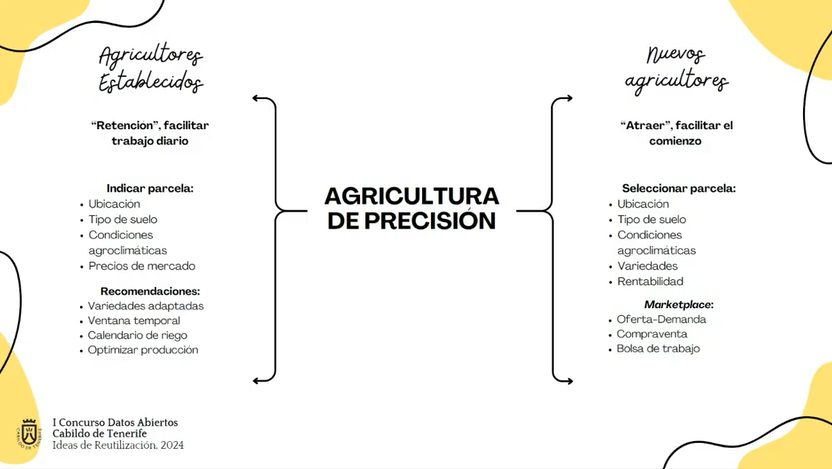
Figure 1. Possible uses of the Cultiva+ Tenerife application according to the type of user. Source: presentation by Cultiva+Tenerife in the Webinar "From data to innovation: Reuse ideas awarded in the I Open Data Contest of the Cabildo de Tenerife, Universidad de la Laguna".
The application would intuitively and clearly collect information such as:
- Price information: the farmer can consult the evolution of market prices of different products, which allows him to plan what to grow based on the expected profitability.
- Weather conditions: the app crosses weather data with the specific needs of each type of crop, helping to anticipate irrigation, protection or harvests.
-
Agenda of activities of interest: agricultural fairs, technical conferences, calls for grants... All relevant information for the sector, centralized in one place.
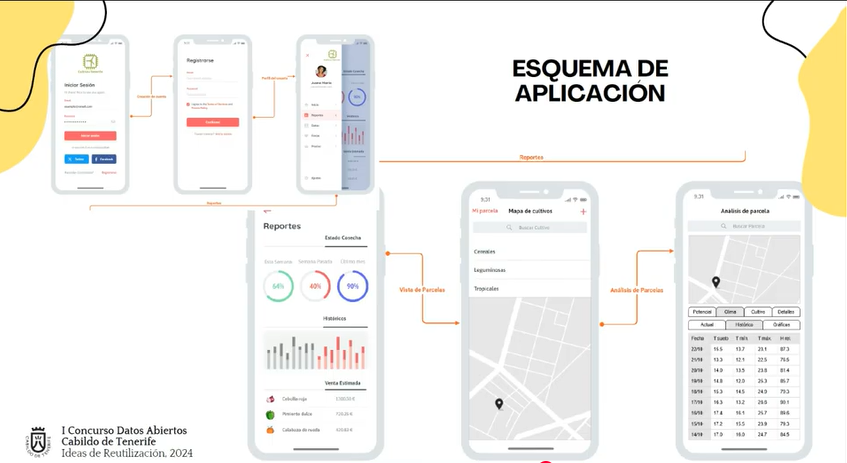
Figure 2. Visual structure of the Cultiva+Tenerife application. Source: presentation by Cultiva+Tenerife in the Webinar "From data to innovation: Reuse ideas awarded in the I Open Data Contest of the Cabildo de Tenerife, Universidad de la Laguna".
Something that was highlighted as valuable about this project in the webinar is its focus on a group that has historically had less access to digital tools: farmers in Tenerife. The proposal does not seek to complicate their day-to-day life with unnecessary technology, but to simplify decisions that today are often made by eye or with incomplete information. Precision agriculture is no longer just a matter for large farms: with open data and a good application, it can be within the reach of any local producer.
Analysis of trends and models on tourism in Tenerife: when the data reveal a crisis
The second winning project addresses one of the most complex and urgent issues in the reality of Tenerife: the relationship between tourism, housing and the labour market. An equation with multiple variables that directly affects the quality of life of residents and that, until now, was difficult to analyse rigorously without access to reliable data.
The starting point of the project is revealing: in June 2024, 35% of the new employment contracts signed in Tenerife corresponded to the hospitality sector. A figure that perfectly illustrates the structural dependence of the island's economy on tourism, but which also opens up uncomfortable questions: to what extent is tourism growth transforming the housing market? Are you displacing habitual residents from certain areas? How will tourist arrivals evolve in the coming years?
This project proposes to answer these questions through an analysis and prediction model built with data science tools. Its developer proposes to use data such as the number of tourists staying in Tenerife according to category and area of establishment, available in datos.tenerife.es, to build models with Python and NumPy that allow identifying trends and projecting future scenarios.
The objectives of the project are ambitious but concrete:
- Analyse the relationship between tourist demand and accommodation supply, identifying which areas of the island suffer the greatest pressure and at what times of the year.
- To develop a predictive model capable of estimating the future arrival of tourists and their impact on the tourist housing sector.
- Contribute to mitigating the housing crisis by providing data and analysis that allow us to understand how tourism is affecting the availability of housing for residents.
- To support business and urban planning, offering companies, investors and administrations an analysis tool that facilitates strategic decision-making.
In short, it is a matter of putting the intelligence of data at the service of one of the most current debates that Tenerife has on the table.
The university as a bridge between data and society
The choice of the Cajasiete Big Data, Open Data and Blockchain Chair of the University of La Laguna as a space to give visibility to the winners is in itself a message: the University has a key role in the construction of the open data ecosystem in Tenerife.
This chair has been working for years on the border between academic research and the practical application of technologies such as big data analysis, blockchain or the reuse of public information. Their involvement in this competition and in the dissemination of its results reinforces the idea that open data is also a valuable resource for training, research and local economic development.
The success of this first call has confirmed that there was a real demand for this type of initiative. So much so that the Cabildo has already launched the II Open Data Contest: APP Development, which gives continuity to the process by taking ideas to the next level: the development of functional applications.
If in the first edition ideas and conceptual proposals were awarded, in this second edition the challenge is to build real solutions, with code, user interface and proven functionalities. The economic endowment is 6,000 euros divided into three prizes.
Projects such as Cultiva+ Tenerife or the Analysis of the impact of tourism on housing show that there are ideas with the potential to become useful and sustainable tools. This second phase is the opportunity to materialize them.
