


Blog
The Open Government Guide for Public Employees is a manual to guide the staff of public administrations at all levels (local, regional and state) on the concept and conditions necessary to achieve an "inclusive open government in a digital environment". Specifically, the document seeks for the administration to assume open government as a cross-cutting element of society, fostering its connection with the Sustainable Development Goals.
It is a comprehensive, practical and well-structured guide that facilitates the understanding and implementation of the principles of open government, providing examples and best practices that foster the development of the necessary skills to facilitate the long-term sustainability of open government.
What is open government?
The guide adopts the most widely accepted definition of open government, based on three axes:
- Transparency and access to information (vision axis): Refers to open access to public information to facilitate greater accountability.
- Citizen participation (voice axis): It offers the possibility for citizens to be heard and intervene to improve decision-making and co-creation processes in public policies.
- Collaboration (value axis): Focuses on cooperation within the administration or externally, with citizens or civil society organizations, through innovation to generate greater co-production in the design and implementation of public services.
This manual defines these axes and breaks them down into their most relevant elements for better understanding and application. According to the guide, the basic elements of open administration are:
- An integrity that cuts across all public action.
- Data are "the raw material of governments and public administrations" and, for this reason, must be made available to "any actor", respecting the limits established by law. The use of information and communication technologies (digital) is conceived as a "space for the expansion of public action", without neglecting the digital divide.
- The citizenry is placed at the center of open administration, because it is not only the object of public action, but also "must enjoy a leading role in all the dynamics of transparency, participation and collaboration".
- Sustainability of government initiatives.
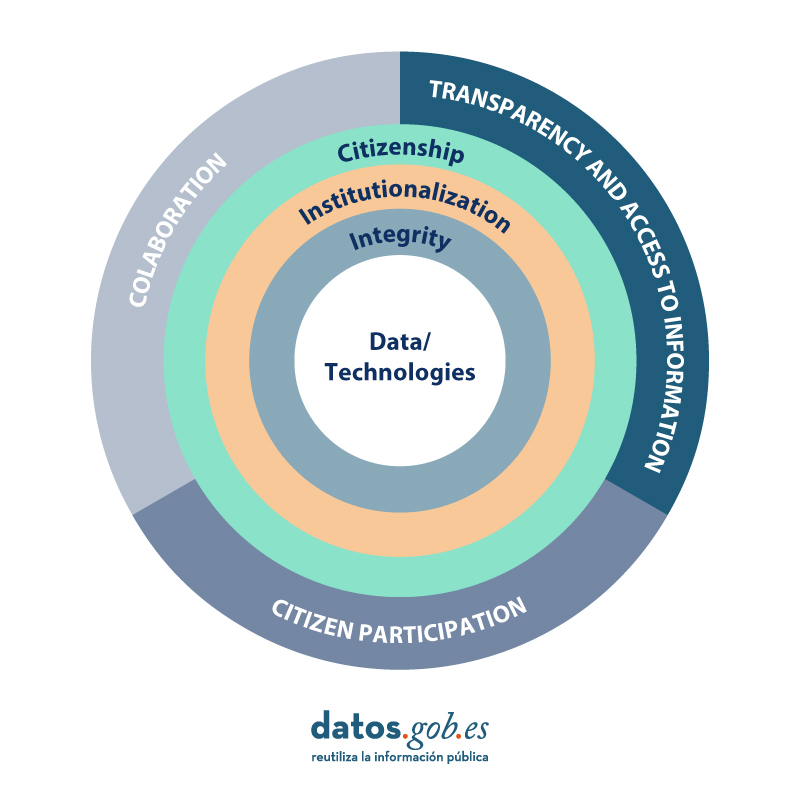
Adapted from a visual of the Open Government Guide for Public Employees. Source: https://funcionpublica.hacienda.gob.es/Secretaria-de-Estado-de-Funcion-Publica/Actualidad/ultimas-noticias/Noticias/2023/04/2023_04_11.html
Benefits of Open Government
With all this, a number of benefits are achieved:
-
Increased institutional quality and legitimacy
-
Increased trust in institutions
-
More targeted policies to serve citizens
- More equitable access to policy formulation
How can I use the guide?
The guide is very useful because, in order to explain some concepts, it poses challenges so that civil servants themselves can reflect on them and even put them into practice. The authors also propose cases that provide an overview of open government in the world and its evolution, both in terms of the concepts related to it and the laws, regulations, relevant plans and areas of application (including Law 19/2023 on transparency, the Digital Spain 2025 agenda, the Digital Rights Charter and the General Data Protection Regulation, known as RGPD). As an example, the cases he mentions include the Elkar-EKIN Social Inclusion Plan of the Provincial Council of Gipuzkoa and Frena La Curva, an initiative launched by members of the Directorate General of Citizen Participation and the LAAAB of the Government of Aragon during COVID-19.
The guide also includes a self-diagnostic test on accountability, fostering collaboration, bibliographical references and proposals for improvement.
In addition, it offers diagrams and summaries to explain and schematize each concept, as well as specific guidelines to put them into practice. For example, it includes the question "Where are the limits on access to public information? To answer this question, the guide cites the cases in which access can be given to information that refers to a person's ideology, beliefs, religious or union affiliation (p. 26). With adaptation to specific contexts, the manual could very well serve as a basis for organizing training workshops for civil servants because of the number of relevant issues it addresses and its organization.
The authors are right to also include warnings and constructive criticisms of the situation of open government in institutions. Although they do not point out directly, they talk about:
- Black boxes: they are criticized for being closed systems. It is stated that black boxes should be opened and made transparent and that "the representation of sectors traditionally excluded from public decisions should be increased".
- Administrative language: This is a challenge for real transparency, since, according to a study mentioned in the guide, out of 760 official texts, 78% of them were not clear. Among the most difficult to understand are applications for scholarships, grants and subsidies, and employment-related procedures.
- The existence of a lack of transparency in some municipalities, according to another study mentioned in the guide. The global open government index, elaborated by the World Justice Project, places Spain in 24th place, behind countries such as Estonia (14th), Chile (18th), Costa Rica (19th) or Uruguay (21st) and ahead of Italy (28th), Greece (36th) or Romania (51st), among 102 countries. Open Knowledge Foundation has stopped updating its Global Open Data Index, specifically on open data.
In short, public administration is conceived as a step towards an open state, with the incorporation of the values of openness in all branches of government, including the legislative and judicial branches, in addition to government.
Additional issues to consider
For those who want to follow the path to open government, there are a number of issues to consider:
-
The guide can be adapted to different spheres and scales of public. But public administration is not homogeneous, nor do the people in it have the same responsibilities, motivations, knowledge or attitudes to open government. A review of citizen use of open data in the Basque administration concluded that one obstacle to transparency is the lack of acceptance or collaboration in some sectors of the administration itself. A step forward, therefore, could be to conduct internal campaigns to disseminate the advantages for the administration of integrating citizen perspectives and to generate those spaces to integrate their contributions.
- Although the black box model is disappearing from the public administration, which is subject to great scrutiny, it has returned in the form of closed and opaque algorithmic systems applied to public administration. There are many studies in the scientific literature -for example, this one- that warn that erroneous opaque box systems may be operating in public administration without anyone noticing until harmful results are generated. This is an issue that needs to be reviewed.
- In order to adapt it to specific contexts, it should be possible to define more concretely what participation, collaboration and co-creation are. As the guide indicates, they imply not only transparency, but also the implementation of collaborative or innovative initiatives. But it is also necessary to ask a series of additional questions: what is a collaborative or innovation initiative, what methodologies exist, how is it organized and how is its success measured?
- The guide highlights the need to include citizens in open government. When talking about inclusion and participation, organized civil society and academia are mentioned above all, for example, in the Open Government Forum. But there is room for improvement to encourage individual participation and collaboration, especially for people with little access to technology. The guide mentions gender, territorial, age and disability digital divides, but does not explore them. However, when access to many public services, aid and assistance has been platformized (especially after the COVID-19 pandemic), such digital divides affect many people, especially the elderly, low-income and women. Since a generalist guide cannot address all relevant issues in detail, this would merit a separate guide.
Public institutions are increasingly turning to algorithmic decision-making for effective, fast and inclusive decision making. Therefore, it is also increasingly relevant to train the administration itself in open government in a digitized, digitized and platformized environment. This guide is a great first step for those who want to approach the subject.
Content prepared by Miren Gutiérrez, PhD and researcher at the University of Deusto, expert in data activism, data justice, data literacy and gender disinformation. The contents and views reflected in this publication are the sole responsibility of the author.

Noticia
When launching an open data initiative, it is necessary that everyone involved in its development is aware of the benefits of open data, and that they are clear about the processes and workflows needed to achieve the goals. This is the only way to achieve an initiative with up-to-date data that meets the necessary quality parameters.
This idea was clear to the Alba Smart Initiative, which is why they have created various materials that not only serve to provide knowledge to all those involved, but also to motivate and raise awareness among heads of service and councillors about the need (and obligation) to publish as much information as possible for the use of citizens.
What is Alba Smart?
The Alba Smart project is jointly developed by the city councils of Almendralejo and Badajoz with the aim of advancing in their development as smart cities. Among the areas covered are the control of tourist mobility flows, the creation of an innovation hub, the installation of wifi access points in public buildings, the implementation of social wifi and the management of car parks and fleets.
Within the framework of this project, a platform has been developed to unify the information of devices and systems, thus facilitating the management of public services in a more efficient way. Alba Smart also incorporates a balanced scorecard, as well as an open data portal for each city council (Almendralejo's and Badajoz's are available here).
The Alba Smart initiative has the collaboration of Red.es through the National Plan for Smart Cities.
Activities to promote open data
Within the context of Alba Smart, there is an Open Data working group of the Badajoz City Council, which has launched several activities focused on the dissemination of open data in the framework of a local entity.
One of the first actions they have carried out is the creation of an internal WIKI in which they have been documenting all the materials that have been useful to them. This WIKI facilitates the sharing of internal content, so that all users have at their disposal materials of interest to answer questions such as: what is open data, what roles, tasks and processes are involved, why is it necessary to adopt this type of policies, etc.
In addition, on the public part of the Badajoz website, both Transparency and Open Data have shared a series of documents included in this WIKI that may also be of interest to other local initiatives:
Contents related to Transparency
The website includes a summary section with content on TRANSPARENCY. Among other issues, it includes a list of ITA2017 indicators and their assignment to each City Council Service.
This section also includes the regulatory framework that applies to the territory, as well as external references.
Content related to open data
It also includes a summary section on OPEN DATA, which includes the regulations to be applied and links of interest, in addition to:
- The list of 40 datasets recommended by the FEMP in 2019. This document includes a series of datasets that should be published by all local authorities in Spain in order to standardise the publication of open data and facilitate its management. The list generated by Alba Smart includes information on the local council service responsible for opening each dataset.
- A summary of the implementation plan followed by the council, which includes the workflow to be followed, emphasising the need for it to be carried out continuously: identifying new sources of information, reviewing internal processes, etc.
- A series of training videos, produced in-house, to assist colleagues in the preparation and publication of data. They include tutorials on how to organise data, how to catalogue data, and the review and approval process, among others.
- A (sample) manual on how to upload a file to their open data platform, which is developed with CKAN. It is a practical document, with screenshots, showing the whole process step by step.
- The list of vocabularies they use as a reference, which allow to systematically organise, categorise and tag information.
Among its next steps is the presentation of the datasets in the map viewer of the municipality. Data from the portal is already being fed into the corporate GIS to facilitate this function in the future.
All these actions are intended to ensure the sustainability of the portal, facilitating its continuous updating by a team with clear working procedures.
Noticia
The COTEC Foundation has recently published a Guide for the opening and sharing of data in the business environment, with recommendations and good practices to boost data reuse in the private sector. The objective is twofold: on the one hand, to raise awareness of the opportunities of data opening and sharing within the companies, and on the other, to accompany organizations in this process.
The guide is organized around 5 steps to follow when launching a data sharing / opening initiative:
- Experimentation and awareness, where the potential of company data is identified.
- Definition of a strong strategy that includes the objectives and decisions to be taken at the organizational level among other aspects.
- Technical preparation, where aspects related to data management and technological infrastructure are addressed.
- Implementation of data life cycle, which is subdivided into the following phases: collect, prepare, share or publish and maintain.
- Initiative monitoring, where the level of success is analysed and actions for continuous improvement are proposed.

The guide also analyses other relevant aspects to consider, such as relationship and financing models, the legal framework and the roles or skills necessary to launch such an initiative. The document ends with an glossary of terms and acronyms.
To illustrate the numerous benefits that data opening can bring to private companies, the guide includes numerous examples of companies that have launched initiatives to share their data with third parties or have found a new business niche based on data. These examples show the potential offered by these processes, both for companies that provide data and for reusers.
The Cotec Open Data Working Group was launched in September 2018 and has been coordinated by Cristina Oyón and Amaia Martínez from the Department of Strategic Initiatives of SPRI, the Basque Agency for Business Development. The Economic Development Agency of La Rioja (ADER), Alliance 4 Universities, Banco Santander, Bankia, BBVA, Clarke Modet, the Ministry of Employment, Business and Commerce of the Junta de Andalucía, Ecoemblajes España (Ecoembes), EDP Spain, Vodafone Foundation, F. Iniciativas, Indra, the Valencian Institute for Business Competitiveness (IVACE), Orange, Primafrío, Suez Advanced Solutions Spain, Tecnalia and Telefónica are part of this group.
Noticia
On Friday July 7, the Federation of Municipalities and Provinces of Spain (FEMP) presented the "Strategic Guide to Open Data - Minimum Data Sets to be published" which condenses actions, guidelines and recommendations for municipalities and local authorities to publish their data in a useful and effective fashion for its use and reuse by citizens, organizations, companies or other administrations.
The document was prepared by the Open Data Group of the Network of Local Entities for Transparency and Citizen Participation of the Federation, made up of technical managers from various municipalities and other entities, and offers a work itinerary for the opening of data and its reuse by local administrations.
Specifically, this Guide details the model map of an open data portal (basic components, conditions of use or terms of reuse), the legal framework for the reuse of public sector information, data recommendations), as well as the technological plan (tools, platforms and formats), along with measurement systems (indicators for measuring open data initiatives, indexes, popularity and utility of data, etc.).
It also incorporates a Training and Dissemination Plan that includes training for technical personnel who work with data, training for citizens, and also establishes basic skills and training for citizens.
The work team that developed this document decided to define concepts and to differentiate between transparency and open data, between channel and tool and between data and information. In the section intended to show the typical map of an open data portal, it details the basic components that a portal must have and a series of recommendations are added. It also establishes the set of minimum data to be published by each municipality. Specifically, it details a series of essential components that a portal must have (catalogue, search engine, filtering, conditions of use, API services, etc.), as well as a series of recommended components (SPARQL service). This classification of mandatory / basic and recommended was made according to the results of a survey conducted by a group of re-users and managers of open data portals in Spain.
The Guide - available on paper and in digital version - defines a technology plan to be able to integrate the technology within a strategy of opening data, and it ranges from the tools needed for data cleaning, extraction and transformation and visualizers, to platforms, reusable formats, standards, data interoperability and security.
Although this Open Data Guide is specifically aimed at municipalities, it can also become a useful consultation and user manual for other public administrations, institutions, agencies, companies, citizens, entrepreneurs, university students and all other stakeholders who need information about data and its reuse.
In sum it is a document which aims to familiarize citizens and society with the world of Open Data and offers a set of tools to develop open data projects in an easy, simple way.
Noticia
In order to help the different agents of the national open data community, Iniciativa Aporta elaborates and publishes regularly handbooks and methodological guidelines that address different aspects of the openness and re-use of public sector information. In addition, it periodically reviews and updates the information of such materials to suit the latest industry trends while the content is redesigned to make it more attractive to users.
Thus, it has recently released the new version of the Methodological Guide for Sectoral Open Data Plans, a document created in collaboration with the international expert on open data, Carlos Iglesias, showing how to articulate a open data project around the needs of a specific sector or theme.
This latest version is enriched with visual elements -graphics, illustrations, diagrams, among others - that facilitate the use and dissemination of content. In addition, new references have been included to enable the reader to delve into the most important aspects for the preliminary study and construction of a conceptual model on which a sectoral open data initiative is based. Finally, the content has been reorganized to improve the reading and understanding of the guide for the user to take full advantage of the information and data provided.
These actions are included in the lines of action of Iniciativa Aporta, designed to provide support to the stakeholders of the open data ecosystem in Spain, and help them create new business models based on the re-use of open data which collaborate in the socio-economic growth.