Every day the need of information increases in urban areas. The cities are becoming sophisticated ecosystems that, using the technological advances, are able to respond to the demands which arise in sectors so diverse as transport, health, education, waste management or infraestructures. In this context, open data can help us understand and interact in a more sustainable and effective way with cities. The openness and re-use of local public information lets us know in real time the bus schedules, localize the nearest retail business or identify the best neighborhood to buy a house. The development of Smart Cities cannot be understood nowadays without open data.
On the occasion of the last International Open Data Conference, Madrid was the setting of different events that, along the week, analyzed the impact of open data in the cities. Within the program of activities previous to IODC, the Open Data Summit gathered the open data community in the Madrid’s exhibition centre Media-lab Prado in order to find solutions to the challenges of the Smart Cities related to open data policies, urbanism, environment and competitivity.
The Conference itself dedicated several sessions exclusively to this area such as the panel A global marketplace for city data or the meeting about the OjoalData100 initiative to harmonize datasets in Smart Cities. Concurrently, IODC organized two tables in the first day to show success cases around the world which prove the perfect couple formed by open data and smart cities. A large group of national and international experts showed the attendees projects aimed at promoting Smart Cities through open data.
Sergio Fdez Balaguer from Empresa Municipal de Transportes of Madrid was in charge of starting the first session, moderated by Jean-Noé Landry, executive director of Open Northe- Canadian Open Government Partnership Civil Society Network. With approximately 1.5 million passengers per day and more than 85 million kilometres driven per year, this public entity has its own open data portal since 2011; platform that, nowadays, has 800 developers registered and receives each month 35 million hits with data requests. Thanks to the change of mind and the commitment to information openness of EMT, till 40 official apps have been created by third parties. The expert also talked about the project Mobility Labs Madrid, an open and interoperable platform where users can publish and re-use data, promoting the information sharing between the citizens and the local body.
The British initiative MediaMill, presented by Andy Dickinson, also showed the potential of open data in the cities. Despite of UK is one of the open data leaders in the world, only 4% of the 18.000 datasets from the national catalogue belong to local governments. The goal of MediaMill project is promoting the development of open source and open data platforms in two specific regions in England: Leeds and York. This program identifies ways that local data can be transformed into media stories and visualizations that help citizens understand the environment in which they live, improving their quality of live and active participation.
The second international practice case comes from Asia. The success case, Jakarta Smart City shown by Sinitra A. Punti proved how that platform uses the Information Technologies to empower the citizen, who re-uses and produces urban data, track the government activities and improve the public services in the city.
Lastly, Daniel Sarasa, responsible for Smart City division at Zaragoza City Council, explained to those present the role played by the Aragon’s capital in the international project CITYKeys, whose aim is creating a methodology to assess and compare the Smart Cities policies in Europe. Sarasa took this opportunity to highlight the importance of maximising the local community talent to develop the Smart Cities through the citizen collaboration and the organization of events -such as hackathons- that gather the different stakeholders looking for innovative solutions based on open data.
All the examples shown in this session at IODC were just a small sampling of the potential offered by the binomial: open data and Smart Cities. Thanks to open data, it is possible to establish mechanisms of transparency and citizen participation, improving the interoperability between the public administrations and the society, and, increasing, as a result, the access to public sector information and the intelligence in the cities.
CartoCrítica is an independent civil initiative, a non-profit organization that works for transparency and free access to public information in Mexico, applying geospatial technology, re-using national open data and cartographic analysis to defend the national territory, the human rights and the environment.
Thus, the platform offers different maps and visualizations segmented into seven categories - environment, water, hydrocarbons, mining, indigenous peoples and health- where users can know the current situation in these areas and, through the data that the initiative collects and treats, understand what is happening in their country.
So, thanks to CartoCrítica in collaboration with the Mexican Alliance Against Fracking, the citizens were informed that nearly a thousand oil wells use the fracking process to extract oil or natural gas in Mexico. In this way, the entity alerted that those perforations were made without any consultation or consent of the affected communities, as it is stipulated in Article 120 of the Mexican Law of Hydrocarbons that obliges those entities to inform the affected population about such projects.
Other examples of the benefits of the openness and re-use of open data are the recent visualizations of Cartocrítica on the water concession to the mining industry in the country; a sector where it is very difficult to find public, accessible and detailed information. In order to know the impact of mining activities in the Mexican environment and its water consumption, a comprehensive information search was performed to create maps and data tables to show the project conclusions.
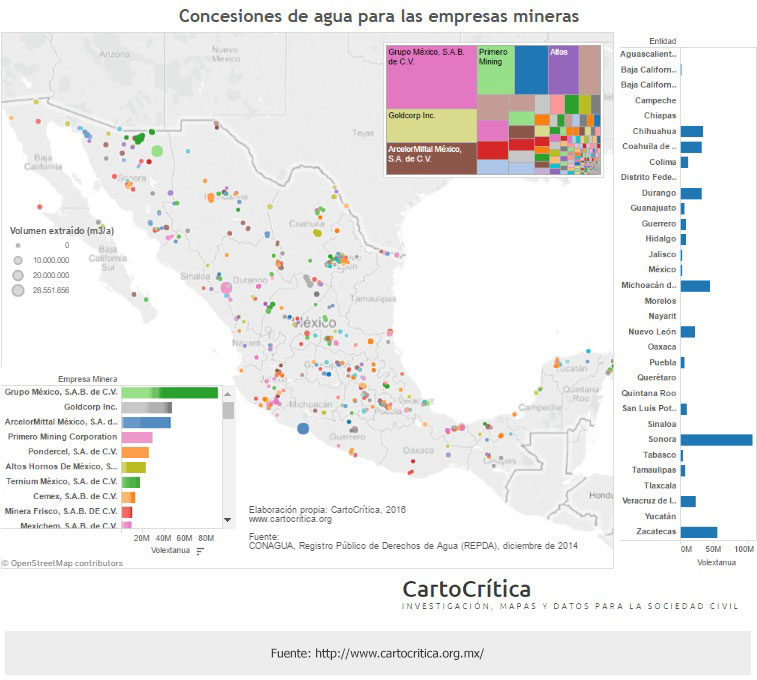
So, thanks to the work of the entity, we know that mining industry in Mexico has been granted the same volume of water that twelve million people would need in a year; in a country where there are still 13.8 million people with no access to water in their homes.
Thanks to initiatives like Cartocrítica which makes available public sector information that is hidden and transform it into knowledge, citizens can be better informed and participate in the processes that affect their context. Therefore, the further collaboration with both public and private entities is needed to promote the openness of data that remain inaccessible. Only in this way projects as Cartocrítica can reuse them for the common good, revealing and focussing on those bad practices and abuses that occur in the different socio-economic sectors