


Publication date
11/12/2025
Update date
15/09/2026


Sector
Transport
Name
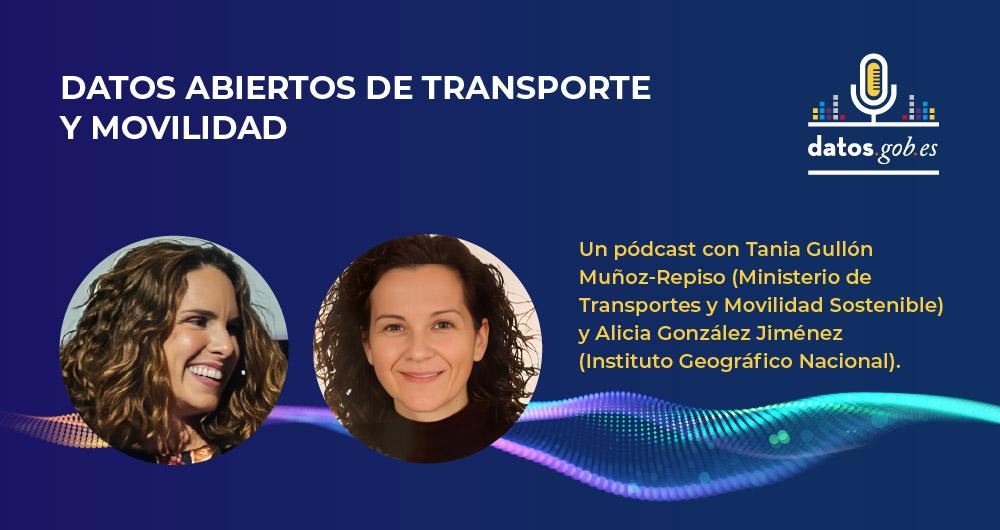
Tania Gullón Muñoz-Repiso, Ministerio de Transportes y Movilidad Sostenible, y Alicia González Jiménez, Instituto Geográfico Nacional.
Description
In this podcast we talk about transport and mobility data, a topic that is very present in our day-to-day lives. Every time we consult an application to find out how long a bus will take, we are taking advantage of open data linked to transport. In the same way, when an administration carries out urban planning or optimises traffic flows, it makes use of mobility data.
To delve into the challenges and opportunities behind the opening of this type of data by Spanish public administrations, we have two exceptional guests:
- Tania Gullón Muñoz-Repiso, director of the Division of Transport Studies and Technology of the Ministry of Transport and Sustainable Mobility.
- Alicia González Jiménez, deputy director in the General Subdirectorate of Cartography and Observation of the Territory of the National Geographic Institute.
Listen to the full podcast (only available in Spanish)
Summary / Transcript of the interview
1. Both the IGN and the Ministry generate a large amount of data related to transport. Of all of them, can you tell us which data and services are made available to the public as open data?
Alicia González: On the part of the National Geographic Institute, I would say that everything: everything we produce is available to users, because since the end of 2015 the dissemination policy adopted by the General Directorate of the National Geographic Institute, through the Autonomous Organism National Center for Geographic Information (CNIG), which is where all products and services are distributed, is an open data policy, so that everything is distributed under the CC BY 4.0 license, which protects free and open use. You simply have to make an attribution, a mention of the origin of the data. So we are talking, in general, not only about transport, but about all kinds of data, about more than 100 products that represent more than two and a half million files that users are increasingly demanding. In fact, in 2024 we have had up to 20 million files downloaded, so it is in high demand. And specifically in terms of transmission networks, the fundamental set of data is the Geographic Reference Information of Transport Networks (IGR-RT). It is a multimodal geospatial dataset that is composed of five transport networks that are continuous throughout the national territory and also interconnected. Specifically, it contemplates:
1. The road network that is made up of the entire road network, regardless of its owner and that runs throughout the territory. There are more than 300 thousand kilometers of road that are also connected to all the street maps, to the urban road network of all population centers. That is, we have a road graph that backbones the entire territory, in addition to having connected the roads that are later distributed and disseminated in the National Topographic Map.
2. The second most important network is the rail transport network. It includes all the data of rail transport and also of metro, tram and other types of modes by rail.
3 and 4. In the maritime and air field, the networks are already limited to infrastructures, so that they contain all the ports on the Spanish coast and all the infrastructures of aerodromes, airports, heliports in the air part.
5. And finally, the last network, which is much more modest, is residual data: cable transport.
Everything is interconnected through intermodal relationships. It is a set of data that is generated from official sources. We cannot incorporate just any data, it must always be official data and it is generated within the framework of cooperation of the National Cartographic System.
As a dataset that complies with the INSPIRE Directive both in its definition and in the way it is disseminated through standard web services, it has also been classified as a high-value dataset in the mobility category, in accordance with the High-Value Data Enforcement Regulation. It is a fairly important and normalized set.
How can it be located and accessed? Precisely, as it is standard, it is catalogued in the IDE (Spatial Data Infrastructure) catalogue, thanks to the standard description of its metadata. It can also be located through the official INSPIRE (Information Publication Services) data and services catalog or is accessible through portals as relevant as the open data portal.
Once we have located it, how can the user access it? How can they see the data? There are several ways. The easiest: check your visualizer. All the data is displayed there and there are certain query tools to facilitate its use. And then, of course, through the CNIG download centre. There we publish all the data from all the networks and it is in great demand. And then the last way is to consult the standard web services that we generate, visualization services and downloads of different technologies. In other words, it is a set of data that is available to users for reuse.
Tania Gullón: In the Ministry we also share a lot of open data. I would like, in order not to take too long, to comment in particular on four large sets of data:
1. The first would be the OTLE, the Observatory of Transport and Logistics in Spain, which is an initiative of the Ministry of Transport, whose main objective is to provide a global and comprehensive vision of the situation of transport and logistics in Spain. It is organized into seven blocks: mobility, socio-economy, infrastructure, security, sustainability, metropolitan transport and logistics. These are not georeferenced data, but statistical data. The Observatory makes data, graphs, maps, indicators available to the public and, not only that, but also offers annual reports, monographs, conferences, etc. And also of the observatories that we have cross-border, which are done collaboratively with Portugal and France.
2. The second set of data I want to mention is the NAP, the National Multimodal Transport Access Point, which is an official digital platform managed by the Ministry of Transport, but which is developed collaboratively between the different administrations. Its objective is to centralise and publish all the digitised information on the passenger transport offer in the national territory of all modes of transport. What do we have here? All schedules, services, routes, stops of all transport services, road transport, urban, intercity, rural, discretionary buses on demand. There are 116 datasets. The one of rail transport, the schedules of all those trains, their stops, etc. Also of maritime transport and air transport. And this data is constantly updated in real time. To date, we only have static data in GTFS (General Transit Feed Specification) format, which can also be reused and in a standard format that is useful for the further development of mobility applications by reusers. And while this NAP initially focused on static data, such as those routes, schedules, and stops, progress is being made toward incorporating dynamic data as well. In fact, in December we also have an obligation under European regulations that oblige us to have this data in real time to, in the end, improve all that transport planning and the user experience.
3. The third dataset is Hermes. It is the geographic information system of the general interest transport network. What is its objective? To offer a comprehensive vision, in this case georeferenced. Here I want to refer to what my colleague Alicia has commented, so that you can see how we are all collaborating with each other. We are not inventing anything, but everything is projected on those axes of the roads, for example, RT, the geographical reference information of the transport network. And what is done is to add all these technical parameters, as an added value to have a complete, comprehensive, multimodal information system for roads, railways, ports, airports, railway terminals and also waterways. It is a GIS (Geographic Information System), which allows all this analysis, not only downloading, consulting, with those open web services that we put at the service of citizens, but also in an open data catalog made with CKAN, which I will comment on later. Well, in the end there are more than 300 parameters that can be consulted. What are we talking about? For each section of road, the average traffic intensity, the average speed, the capacity of the infrastructures, planned actions are also known -not only the network in service, but also the planned network, the actions that the Ministry plans to carry out-, the ownership of the road, the lengths, speeds, accidents... well, many parameters, modes of access, co-financed projects, alternative fuels issues, the trans-European transport network, etc. That's the third of the datasets.
4. The fourth set is perhaps the largest because it is 16 GB per day. This is the project we call Big Data Mobility. This project is a pioneering initiative that uses Big Data and artificial intelligence technologies to analyze in depth the mobility patterns in the country is mainly based on the analysis of the anonymized mobile phone records of the population to obtain detailed information on all the movements of people not individualized, but aggregated at the census district level. Since 2020, a daily mobility study has been carried out and all this data is given openly. That is mobility by hours, by origin / destination that allows us to monitor and evaluate the demand for transport to plan improvements in those infrastructures and services. In addition, as data is given in open space, it can be used for any purpose, for tourism purposes, for research...
2. How is this data generated and collected? What challenges do you have to face in this process and how do you solve them?
Alicia González: Specifically, in the field of products that are technologically generated in geographic information system environments and geospatial databases, in the end these are projects in which the fundamental basis is the capture of data and the integration of existing reference sources. When we see that the headline has a piece of information, that is the one that must be integrated. In summary, in the main technical works, the following could be identified:
- On the one hand, capture, that is, when we want to store a geographical object we have to digitize it, draw it. Where? On an appropriate metric basis such as the aerial orthophotographs of the National Plan of Aerial Orthophotography (PNOA), which is also another dataset that is available and open. Well, when we have, for example, to draw or digitize a road, we trace it on that aerial image that PNOA provides us.
- Once we have captured that geometric component, we have to provide it with an attribution and not just any data will do, they have to be official sources. So, we have to locate who is the owner of that infrastructure or who is the provider of the official data to detect what the attributes are, the characterization that we want to give to that information, which in principle was only geometric. To do this, we have to carry out a series of source validation processes, detect that it does not have incidents and processes that we call integration, which are quite complex to guarantee that the result meets what we want.
- And finally, a fundamental phase in all these projects is the assurance of geometric and semantic quality. In other words, a series of quality controls must be developed and executed to validate the product, the final result of that integration and confirm that it meets the requirements indicated in the product specification.
In terms of challenges, a fundamental challenge is data governance, that is, the result that is generated is fed from certain sources, but in the end the result is created. Then you have to define the role of each provider that may later later be a user. Another challenge in this whole process is locating data providers. Sometimes the person responsible for that infrastructure or the object that we want to store in the database does not publish the information in a standardized way or it is difficult to locate because it is not in a catalog. Sometimes it is difficult to locate the official source you need to complete the geographical information. And looking a little at the user, I would highlight that another challenge is to identify, to have the agility to identify in a flexible and fast way the use cases that are changing with users, who are demanding us, because in the end it is about continuing to be relevant to society. Finally, and because the Geographic Institute is a scientific and technical environment and this part affects us a lot, another challenge is digital transformation, that is, we are working on technological projects, so we also have to have a lot of capacity to manage change and adapt to new technologies.
Tania Gullón: Regarding how data is generated and collected and the challenges we face, for example, the NAP, the National Access Point for Multimodal Transport, is a collaborative generation, that is, here the data comes from the autonomous communities themselves, from the consortia and from the transport companies. The challenge is that there are many autonomous communities that are not yet digitized, there are many companies... The digitalisation of the sector is going slowly – it is going, but it is going slowly. In the end there is incomplete data, duplicate data. Governance is not yet well defined. It happens to us that, imagine, the company ALSA raises all its buses, but it has buses in all the autonomous communities. And if at the same time the autonomous community uploads its data, that data is duplicated. It's as simple as that. It is true that we are just starting and that governance is not yet well defined, so that there is no excess data. Before they were missing and now there are almost too many.
In Hermes, the geographic information system, what is done, as I said, is to project it on the information of the transport networks, which is the official one that Alicia mentioned, and data from the different managers and administrators of infrastructures are integrated, such as Adif, Puertos del Estado, AENA, the General Directorate of Roads, ENAIRE, etc. What is the main challenge - if you had to stand out, because we can talk about this for an hour? It has cost us a lot, we have been working on this project for seven years and it has cost a lot because, first, people did not believe it. They didn't think it was going to work and they didn't collaborate. In the end, all this is knocking on the door of Adif, of AENA and changing that awareness in which data cannot be in a drawer, but must all be put at the service of the common good. And I think that's what has cost us a little more. In addition, there is the issue of governance, which Alicia has already commented on. You go to ask for a piece of information and in the organization itself they do not know who is the owner of that data, because perhaps the traffic data is handled by different departments. And who owns it? All this is very important.
We have to say that Hermes has been the great promoter of the Data offices, of the Adif Data office. In the end they have realized that what they needed was to put their house in order, as well as in everyone's house and in the Ministry as well, that Data offices are needed.
In the Big Data project, how is the data generated? In this case it is completely different. It is a pioneering project, more of new technologies, in which data is generated from anonymized mobile phone records. So, by reconstructing all that large amount of Big Data data, of the records that are in each antenna in Spain, with artificial intelligence and with a series of algorithms, these matrices are reconstructed and made. Then, those data from that sample – in the end we have a sample of 30% of the population, of more than 13 million mobile lines – is extrapolated with open data from the INE. And then, what do we do as well? It is calibrated with external sources, that is, with sources of certain reference, such as AENA ticketing, flights, Renfe data, etc. We calibrate this model to be able to generate these matrices with quality. The challenges: that it is very experimental. To give you an idea, we are the only country that has all this data. So we have been opening a gap and learning along the way. The difficulty is, again, the data. That data to calibrate, it is difficult for us to find it and to be given it with a certain periodicity and so on, because this goes in real time and we permanently need that flow of data. Also the adaptation to the user, as Alicia has said. We must adapt to what society and the reusers of this Big Data are demanding. And we must also keep pace, as Alicia said, with technology, which is not the same as the telephony data that exists now as it was two years ago. And the great challenge of quality control. But well, here I think I'm going to leave Alicia, who is the super expert, to explain to us what mechanisms exist to ensure that the data are reliable and updated and comparable. And then I will give you my vision, if you like.
Alicia González: How can reliability, updating and comparison be guaranteed? I don't know if reliability can be guaranteed, but I think there may be a couple of indicators that are especially relevant. One is the degree to which a set of data conforms to the regulations that concern it. In the field of geographic information, the way of working is always standardized, that is, there is a family of ISO 19100 on Geographic Information/Geomatics or the INSPIRE Directive itself, which greatly conditions the way of working and publishing data. And also, looking at the public administration, I think that the official seal should also be a guarantee of reliability. In other words, when we process data we must do so in a homogeneous and unbiased way, while perhaps, perhaps, a private company may be conditioned by them. I believe that these two parameters are important, that they can indicate reliability.
In terms of the degree of updating and comparison of the data, I believe that the user deduces this information from the metadata. The metadata at the end is the cover letter for the datasets. So, if a dataset is correctly and truthfully metadatad, and if it is also made according to standard profiles – the same in the GEO field, since we are talking about the INPIRE or GeoDCAT-AP profile – if different datasets are defined in their metadata according to these standardized profiles, it is much easier to see if they are comparable and the user can determine and decide if it finally satisfies their update and comparability with another dataset.
Tania Gullón: Totally Alicia. And if you allow me to add, we, for example, in Big Data have always been very committed to measuring quality – more so when they are new technologies that, at first, people did not trust the results that come out of all this. Always trying to measure this quality - which, in this case, is very difficult because they are large data sets - from the beginning we started designing processes that take time. The daily quality control process of the data takes seven hours, but it is true that at the beginning we had to detect if an antenna had fallen, if something had happened... Then we do a control with statistical parameters and other internal consistency and what we detect here are the anomalies. What we are seeing is that 90% of the anomalies that come out are real mobility anomalies. In other words, there are no errors in the data, but they are anomalies: there has been a demonstration or there has been a football match. These are issues that distort mobility. Or there's been a storm or a rain or anything like that. And it is important not only to control that quality and see if there are anomalies, but we also believe that it is very important to publish those quality criteria: how we are measuring quality and above all the results. Not only do we give the data on a daily basis, but we also give this metadata, which Alicia says, of quality, of what the sample was like that day, of those values that have been obtained from anomalies. This also occurs in the open: not only the data, but the metadata. And then we also publish the anomalies and the reason for those errors. When errors are found we say "okay, there has been an anomaly because in the town - I don't know what to imagine, it is all of Spain - del Casar was the festival of the Casar cake". And that's it, the anomaly has been found and it is published.
And how do you measure another quality parameter: thematic accuracy? In this case, comparing with sources of true reference. We know that evolution with respect to itself is already very controlled with that internal logical consistency, but we also have to compare it with what happens in the real world. I talked about it before with Alicia, we said "the data is reliable, but what is the reality of mobility? Who knows her?" In the end we have some clues, such as in the tickets of how many have boarded the buses. If we have that data, we have a clue, but of the people who walk and the people who take their cars and so on, what is the reality? It is very difficult to have a point of comparison, but we do compare it with all the data from AENA, Renfe, bus concessions and all these controls are passed to determine how far we deviate from that reality that we can know.
3. All this data serves as a basis for developing applications and solutions, but it is also essential when it comes to making decisions and accelerating the implementation of the central axes, for example, the Safe, Sustainable and Connected Mobility Strategy or the Sustainable Mobility Bill. How is this data used to make these real decisions?
Tania Gullón: If you will allow me, I would first like to introduce this strategy and the Law on data for those who do not know it. One of the axes, axis 5 of the Ministry's Safe, Sustainable and Connected Mobility Strategy 2030 is "Smart Mobility". And it is precisely focused on this and its main objective is to promote digitalisation, innovation and the use of advanced technologies to improve efficiency, sustainability and user experience in Spain's transport system. And precisely one of the measures of this axis is the "facilitation of Mobility as a Service, Open Data and New Technologies". In other words, this is where all these projects that we are commenting on are framed. In fact, one submeasure is to promote the publication of open mobility data, another is to carry out analysis of mobility flows and another of the measures, the last, is the creation of an integrated mobility data space. I would like to emphasize - and here I am already in line with this Bill that we hope we will soon see approved - that the Law, in Article 89, regulates the National Access Point, which we also see how it is included in this legislative instrument. And then the Law establishes a key digital instrument for the National Sustainable Mobility System: look at the importance given to the data that in a mobility law it is written that this integrated mobility data space is a key digital instrument. This data space is a reliable data sharing ecosystem, materialized as the digital infrastructure managed by the Ministry of Transport and in coordination with SEDIA (the Secretary of State for Digitalization and Artificial Intelligence), whose objective is to centralize and structure the information on mobility generated by public administrations, transport operators, infrastructure managers, etc. and guarantee that open access to all this data for all administrations under regulatory conditions.
Alicia González: In this case, I want to say that any objective decision-making, of course, has to be made based on data that, as we said before, has to be reliable, up-to-date and comparable. In this sense, it should be noted that the IGN, the fundamental support it offers to the Ministry for the deployment of the Safe, Sustainable and Connected Mobility Strategy, is the provision of service data and complex analysis of geospatial information. Many of them, of course, about the set of data that we have been talking about transport networks.
In this sense, we would like to mention as an example the accessibility maps with which we contribute to axis 1 of the "Mobility for all" strategy, in which, through the Rural Mobility Table, the IGN was asked if we could generate maps that represented the cost in time and distance that it costs any citizen. Living in any population centre, access to the nearest transport infrastructure, starting with the road network. In other words, how much it costs a user in terms of effort, time and distance, to access the nearest motorway or dual carriageway from their home and then, by extension, to any road in the basic network. We did that analysis - so I said that this network is the backbone of the entire territory, it is continuous - and we finally published those results via the web. They are also open data, any user can consult them and, in addition, we also offer them not only numerically, but also represented in different types of maps. In the end, this geolocated visibility of the result provides fundamental value and facilitates, of course, strategic decision-making in terms of infrastructure planning.
Another example to highlight that is possible thanks to the availability of open data is the calculation of monitoring indicators of the Sustainable Development Goals of the 2030 Agenda. Currently, in collaboration with the National Institute of Statistics, we are working on the calculation of several of them, including one directly associated with Transport, which seeks to monitor goal 11, which is to make cities more inclusive, safe, resilient and sustainable.
4. Speaking of this data-based decision-making, there is also cooperation at the level of data generation and reuse between different public administrations. Can you tell us about any examples of a project?
Tania Gullón: I also answer that to data-based decision-making, which I have previously beaten around the bush with the issue of the Law. It can also be said that all this Big Data data, Hermes and everything we have discussed is favouring this shift of the Ministry and organisations towards data-based organisations, which means that decisions are based on that analysis of objective data. When you ask like that for an example, I have so many that I wouldn't know what to tell you. In the case of Big Data data, it has been used for infrastructure planning for a few years now. Before, it was done with surveys and it was sized because how many lanes do I put on a road? Or something very basic, how often do we need on a train? Well, if you don't have data on what the demand is going to be, you can't plan it. This is done with Big Data data, not only by the Ministry but, as it is open, it is used by all administrations, all city councils and all infrastructure managers. Knowing the mobility needs of the population allows us to adapt our infrastructures and our services to these real needs. For example, commuter services in Galicia are now being studied. Or imagine the burying of the A-5. They are also used for emergencies, which we have not commented on, but they are also key. We always realize that when there is an emergency, suddenly everyone thinks "data, where is data, where is the open data?", because they have been fundamental. I can tell you, in the case of the Dana, which is perhaps the most recent, several commuter train lines were seriously affected, the tracks were destroyed, and 99% of the vehicles of the people who lived in Paiporta, in Torrent, in the entire affected area, were disabled. And 1% was because he was not in the Dana area at the time. So mobility had to be restored as soon as possible, because thanks to this open data in a week there were buses doing alternative transport services that had been planned with Big Data data. In other words, look at the impact on the population.
Speaking of emergencies, this project was born precisely because of an emergency, because of COVID. In other words, the study, this Big Data, was born in 2020 because the Presidency of the Government was in charge of monitoring this mobility on a daily basis and giving it openly. And here I link with that collaboration between administrations, organizations, companies, universities. Because look, these mobility data fed the epidemiological models. Here we work with the Carlos III Institute, with the Barcelona Supercomputing Center, with these institutes and research centers that were beginning to size hospital beds for the second wave. When we were still in the first wave, we didn't even know what a wave was and they were already telling us "be careful, because there is going to be a second wave, and with this mobility data and so on we will be able to measure how many beds are going to be needed, according to the epidemiological model". Look at the important reuse. We know that this data, for example, from Big Data is being used by thousands of companies, administrations, research centers, researchers around the world. In addition, we receive inquiries from Germany, from all countries, because in Spain we are a bit of a pioneer in this matter of giving all the data openly. We are there creating a school and not only for transportation, but for tourism issues as well, for example.
Alicia González: In the field of geographic information, at the level of cooperation, we have a specific instrument that is the National Cartographic System, which directly promotes coordination in the actions of the different administrations in terms of geographic information. We do not know how to work in any other way than by cooperating. And a clear example is the same set we have been talking about: the set of geographic reference information on transport networks is the result of this cooperation. That is to say, at the national level it is promoted and promoted by the Geographic Institute, but in its updating, regional cartographic agencies with different ranges of collaboration also participate in its production. The maximum is even reached for co-production of data from certain subsets in certain areas. In addition, one of the characteristics of this product is that it is generated from official data from other sources. In other words, there is already collaboration there no matter what. There is cooperation because there is an integration of data, because in the end it has to be filled in with the official data. And to begin with, perhaps it is data provided by INE, the Cadastre, the cartographic agencies themselves, the local street maps... But, once the result has been formed, as I mentioned before, the result has an added value that is of interest to the original supplier itself. For example, this dataset is reused internally, at home, in the IGN: any product or service that requires transport information is fed into this dataset. There is an internal reuse there, but also in the field of public administrations, at all levels. In the state sector, for example, in the Cadastre, once the result has been generated, it is of interest to them for studies to analyse the delimitation of the public domain associated with infrastructures, for example. Or the Ministry itself, as Tania commented before. Hermes was generated from RT data processing, from transport network data. The Directorate-General for Roads uses transport networks in its internal management to make a traffic map, its catalogue management, etc. And in the autonomous communities themselves, the result generated is also useful to them in cartographic agencies or even at the local level. Then there is a continuous cyclical reuse, as it should be, in the end everything is public money and it has to be reused as much as possible. And in the private sphere, it is also reused and value-added services are generated from this data that are provided in multiple use cases. Not to go on too long, simply that: we participate by providing data on which value-added services are generated.
5. And finally, you can briefly recap some ideas that highlight the impact on daily life and the commercial potential of this data for reusers.
Alicia González: Very briefly, I think that the fundamental impact on everyday life is that the distribution of open data has made it possible to democratize access to data for everyone, for companies, but also for citizens; and, above all, I think it has been fundamental in the academic field, where surely, currently, it is easier to develop certain investigations that in other times were more complex. And another impact on daily life is the institutional transparency that this implies. And as for the commercial potential of reusers, I reiterate the previous idea: the availability of data drives innovation and the increase of value-added solutions. In this sense, looking at one of the conclusions of the report that was carried out in 2024 by ASEDIE; the Association of Infomedia Companies, on the impact that the geospatial data published by the CNIG had on the private sector, there were a couple of quite important conclusions. One of them said that every time a new set of data is released, reusers are incentivized to generate value-added solutions and, in addition, it allows them to focus their efforts on this development of innovation and not so much on data capture. And it was also clear from that report that since the adoption of the open data policy that I mentioned at the beginning, which was adopted in 2015 by the IGN, 75% of the companies surveyed responded that they had been able to significantly expand the catalogue of products and services based on this open data. Then, I believe that the impact is ultimately enriching for society as a whole.
Tania Gullón: I subscribe to all of Alicia's words, I totally agree. And also, that small transport operators and municipalities with fewer resources have at their disposal all this open and free quality data and access to digital tools that allow them to compete on equal terms. In the case of companies or municipalities, imagine being able to plan their transport and be more efficient. Not only does it save them money, but they win in the end in the service to the citizen. And of course, the fact that in the public sector decisions are made based on data and this ecosystem of data sharing is encouraged, favouring the development of mobility applications, for example, has a direct impact on people's daily lives. Or also the issue of transport aid: the study of the impact of transport subsidies with accessibility data and so on. You study who are the most vulnerable and in the end, what do you do? Well, that policies are increasingly fairer and this obviously impacts the citizen. That decisions about how to invest everyone's money, our taxes, how to invest it in infrastructure or aid or services, should be based on objective data and not on intuitions, but on real data. This is the most important thing.
Interview clips
1. What data does the Ministry of Transport and Sustainable Mobility make publicly available?
2. What data does the National Geographic Institute (IGN) make publicly available?
Excelente presentación de estas dos mujeres, que evidencian un conocimiento técnico de elevada magnitud. Muy interesante porque supone un repaso a datos de alto valor para desarrolladores , y cómo es mi caso, técnicos en análisis de movilidad. Lo he escuchado con sumo interés y he archivado el texto porque presentan herramientas que son de mi interés. Lamentablemente en mi ciudad, Bilbao, todos los datos de movilidad permanecen secuestrados por la corporación municipal, ya que llevan más de tres meses enviando los gtfs y los formatos NeTex Y Siri vacíos a los repositorios. Además el punto de acceso de datos abiertos está caído, por lo menos desde hace tres meses