


Noticia
Companies and public administrations in our country continue to advance on their path towards digitalization, with the opportunities that this entails: process optimization, improved user experience, and innovation in the products and services offered. This is reflected in several of the reports published during 2021, starting with the DESI index, prepared within the framework of the European Commission.
DESI Index
The DESI (Digital Economy and Society Index) tracks the progress made by EU Member States in digital competitiveness. For the latest edition, published at the end of 2021, there has been a change in methodology in order to align with the Recovery and Resilience Plan and the objectives set out in the EU Digital Decade Digital Compass. In this way, 4 indicators have been changed to measure: human capital, broadband connectivity, integration of digital technologies by businesses and digital public services.
It should also be noted that the data in the report correspond mainly to the first half of 2020, so the effect of the pandemic is only partially reflected. Its consequences will become clearer in the next edition.
In this context, Spain is positioned in 9th position, improving two positions compared to the previous year.
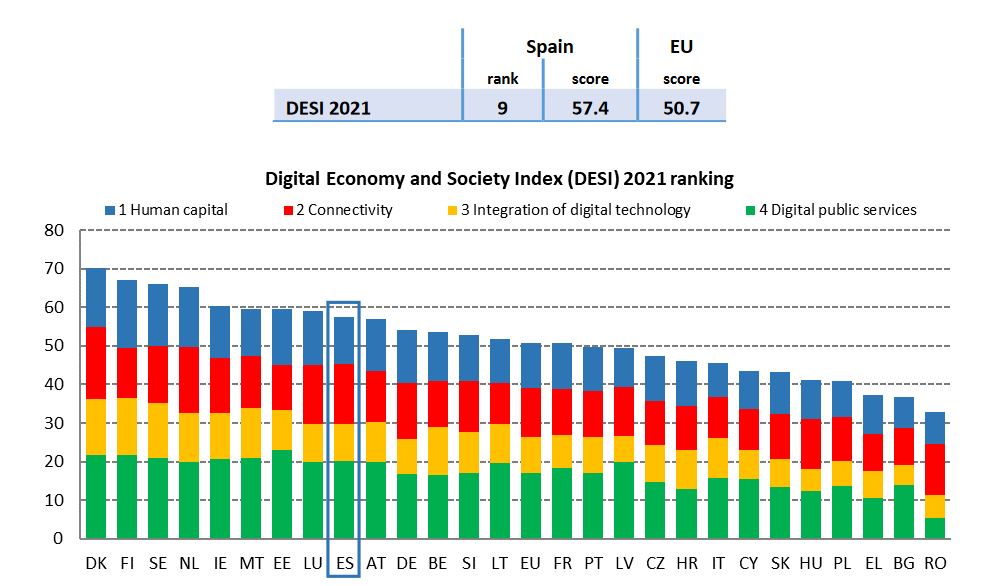
Spain remains ahead of the European average in the 4 categories analysed, standing out especially in the dimensions of digital public services and connectivity.
- Digital public services. The category where our country scores best, especially in the subsection of open data, with a score (94%) 16 percentage points above the EU average. The report also highlights that 67% of Internet users actively participate in e-government services. Thanks to the Public Administration Digitalization Plan, it is expected that at least 50% of digital public services will be accessible via mobile by the end of 2025. This seeks greater personalization of services and improved effectiveness, efficiency and transparency in the public sector.
- Connectivity. Spain stands out in very high-capacity networks. The differences between rural and urban areas are being increasingly reduced, although they still exist. 99.9% of populated areas have 4G coverage, but 5G still only reaches a minority. To reverse the situation, the Plan for Connectivity and Digital Infrastructures and the Strategy to Boost 5G Technology is underway, a roadmap whose goal is for the entire population to have a connection greater than 100 Mbps by 2025.
- Human capital. The report highlights that 57% of the Spanish population has at least basic digital skills. To increase this figure to reach the European target of 80% by 2030, the Spanish government has included the promotion of the population's digital skills as one of the main lines of action of the Digital Spain 2025 strategy. In this regard, the National Digital Skills Plan has been launched with seven lines of action ranging from the digital training of citizens and the reduction of the digital divide to the promotion of ICT specialists, a field where there is still ample room for improvement. The report also highlights the launch of the Educa en Digital Program, which establishes measures to promote greater digitalization of the Spanish education system.
- Integration of digital technology. 62% of Spanish SMEs have at least a basic level of digital intensity and 24% have embraced e-commerce, but few companies are taking advantage of technologies such as artificial intelligence, big data or cloud services. The response to improve this situation is the SME Digitalization Plan 2021-2025, which has five main lines of action: basic digitalization for SMEs; support for digital change management; promotion of disruptive innovation and digital entrepreneurship; support for sectoral digitalization (with a focus on industry, tourism and commerce); and coordination and efficiency.

Other reports related to digital transformation in Spain
In addition to the DESI index, some reports have also been published in our country during the last 12 months that refer to the current state of implementation of digital tools in different areas.
One example is "Sociedad Digital en España 2020-2021" (Digital Society in Spain 2020-2021), by the Telefónica Foundation. The report analyses the effects of the current healthcare situation on the technological habits of Spanish companies and citizens, globally and by autonomous communities. The COVID has driven the transformation, boosting teleworking and forcing many companies and public administrations to adopt digital tools both for their internal processes and for the relationship and provision of services to citizens. In this situation, the report highlights 3 key aspects:
- The importance of connectivity and the quality of the Spanish network, which faced a massive increase in traffic of almost 50%.
- The acceleration of the digitalization of individuals and companies, with the increase in the number of users connected to the network and consuming online services. It is estimated that digitalization could increase Spain's GDP by between 1.5 and 2.5 points each year until 2025 and improve the productivity of SMEs by between 15 and 25%.
- The need to put people at the centre of digital transformation. The pandemic has also widened the gap between those who have already embraced digital transformation and those who have not yet started. To alleviate this situation, it is proposed to rely on public-private partnership initiatives.
Last year also saw an update of the report The Digitalization of the Economy (originally published in 2017), by the Economic and Social Council of Spain. The debate on the impact of digitalization on productivity and employment has been joined by other new challenges related to the risk of technological hegemony of certain countries and companies, the deployment of 5G, the ethical limits to artificial intelligence or data ownership, among others.
Given that this is a situation in continuous evolution, the reports on the subject are constantly being updated. In the coming months, for example, we will be able to discover the conclusions of the new edition of "The Digital Economy in Spain", by the COTEC Foundation, currently under development.
What cannot be denied is that our country is advancing on its path towards digital opportunities. A path in which it is essential to continue promoting access to quality data and related capabilities to extract its full value.

Noticia
We have been talking about the digital transformation for years, but perhaps it has been in the last few months when we have had to stay at home and resort to teleworking or e-commerce, that we have noticed the need for it the most. Many companies have had to transform quickly, adapting their internal processes, their relationship with customers and even their business models to new needs.
However, the digital transformation is nothing new, and before the health crisis there were already many organizations with a long way to go. This is reflected in the Digital Economy and Society Index (DESI), which each year measures the performance and evolution of the EU Member States in terms of digital competitiveness.
DESI INDEX
The DESI Index performs its analysis based on 5 indicators: Digital Public Services, Connectivity, Human Capital, Integration of Digital Technology and Use of Internet Services.
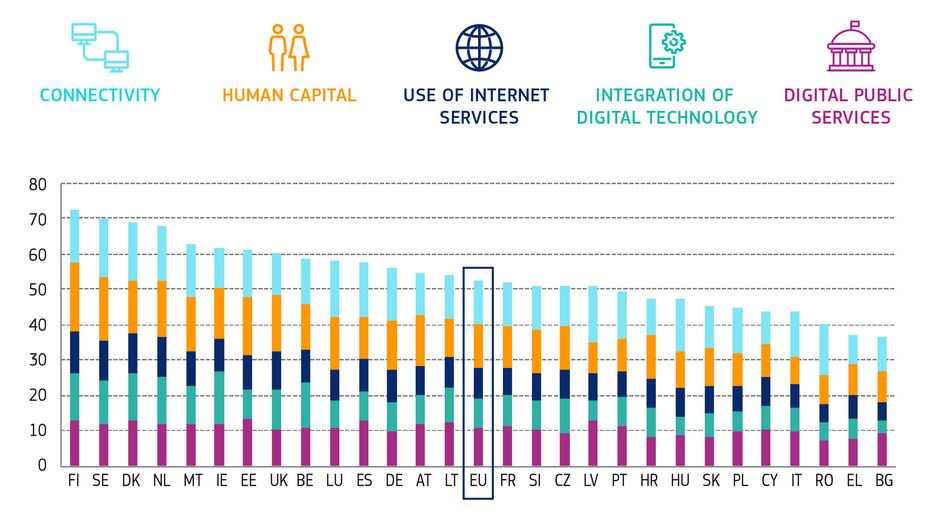
In this index, Spain is above the European Union average, occupying the eleventh position, with unequal scores in the various markers:
- The score where our country stands out the most is Digital Public Services, where it is in second place in Europe, improving its position with respect to last year, thanks to the application of a default digital strategy throughout its central administration. One of the indicators driving Spain's position in this dimension is open data, where we are in second place in terms of maturity in Europe. We are also above average in the availability and use of e-government services.
- Spain also performs well in the area of connectivity (5th place), driven by the good implementation of high-speed networks: 80% of households have fiber optic coverage, well above the EU average (34%).
- In contrast, Spain is below the EU average in the human capital indicator (16th place), with 43% of people between 16 and 74 years of age still lacking digital skills. It does improve on last year's percentage of ICT graduates and specialists in total employment. The report highlights the government's efforts to improve this situation, with actions such as the Strategic Plan for Vocational Training in the Education System 2019-2022, which seeks to create forty new degrees in different ICT fields.
- With regard to the integration of digital technology, Spain ranks 13th, in line with the EU average. Spanish companies take advantage of the opportunities offered by digital technologies and are above Europe in the use of electronic information exchange systems (43% compared to 34%), although slightly below in access to macrodata analysis (11% compared to 12) and the use of the cloud (16% compared to 18%). With regard to emerging technologies, the report highlights that Spain has developed a significant number of coordination measures, especially in the field of cyber security.
- Finally, the use of Internet services has increased since the previous year, and the country has obtained results above the EU average. However, it is worth mentioning that it is still used more for leisure activities (consuming multimedia content), than for day-to-day business, such as banking or e-commerce.
The study was carried out before the pandemic, so the results do not include the actions carried out in recent months, such as the publication of the Digital Agenda 2025, which includes the promotion of a Data Economy. The measures to be developed include the implementation of an Artificial Intelligence Strategy, the development of a Data Office with a Chief Data Officer at the head and the creation of an Artificial Intelligence Advisory Council, among others.
OTHER REPORTS ON DIGITAL TRANSFORMATION IN SPAIN
In addition to the DESI index, in recent months two reports of particular importance when it comes to digitalization have been published in our country: the "Digital Society in Spain Report 2019" and the "COTEC 2020" report.
Digital Society in Spain 2019 Report
This report, published by the Telefónica Foundation, includes data and indicators that describe the state of Spanish society in relation to the media, uses and digital services. Specifically, it focuses on the deployment of telecommunications infrastructure, the level of implementation of the most advanced technologies and the state of the art of Spanish digital life.
The conclusions of the report are very much in line with the DESI index, which it takes as a reference. It highlights that 9 out of 10 inhabitants are Internet users, and that the gender gap in cyberspace has been completely eliminated, although an age gap still exists. The report also highlights that our country has a very good connection, with ultra-fast network coverage in three out of every four homes.
The study indicates that the main technological currents that are shaping the digital transition in Spain revolve around artificial intelligence, industry 4.0 and cyber security, with the first one standing out above all: while in 2013 only one out of every fifty emerging companies focused its activity on artificial intelligence, now one out of every twelve do so.
The report ends with an analysis of the degree of digital development presented by the Autonomous Communities, describing the current situation and the challenges facing each region.
You can read the full report at this link.
COTEC 2020 Report
The COTEC report, on the other hand, focuses on a fundamental aspect to boost the digital transformation: the R&D+I. The report shows us the innovation map in Spain, through the analysis of the main indicators and national, regional and international strategies.
The report analyzes data from 2018 and shows that R&D has gained weight in the productive structure for the second consecutive year, driven mainly by private investment. However, we are still far from countries like France, Italy or Germany.
The autonomous communities maintain heterogeneous levels of effort. The five most advanced regions are the Basque Country, Madrid, Navarre, Catalonia and Castile and Leon).
The report also focuses on education, where it highlights that Spain has a higher rate than the European average in STEM graduates, but with a much wider gender gap than in most surrounding countries. It should be noted that our country has a low proportion of people with an average educational level, since we have a high rate of population that leaves school at an early age, and a high percentage of young people who graduate from university.
You can read the full report at this link.
After taking a look at these reports, we can conclude that both the public and private sectors are making an effort to promote the digital transformation of Spain in order to make the digital transformation and innovation a driver of economic and social development in our country. There are still areas for improvement, but there is no denying the interest in tackling the challenges ahead.