


Noticia
The Open Data initiative of the Government of Aragon was created by an agreement in 2012 with the aim of creating economic value in the ICT Sector through the reuse of public information, the increase of transparency and the promotion of innovation. All this, in order to boost the development of information society and data interoperability in the Administration. Thanks to this agreement, open data is incorporated into the strategies of the Government of Aragon, who is committed to the effective opening of public data that they hold, understanding as public all data not subject to restrictions of privacy, security or property.
In this context, in 2013, the open data web portal of the Government of Aragon was launched. Since then, Aragón Open Data underwent an exponential growth, driven by the unit responsible for its management, the current General Directorate of Electronic Administration and Information Society, and, of course, by the different data providers: public units, mostly from the Autonomous government. These providers offer their information under open data philosophy from a single access point.
Since the creation of the portal, more services have been developed, such as Aragopedia, Budget or Open Analytics Data. All of them are related to open data reuse and disposition through services that facilitate its use and interpretation. In this line, Aragón Open Data offers diverse applications and training materials, as well as APIs and services that add value to data. Due to these projects, the initiative was selected as the only Spanish experience in the Open Data Leader's Network, held in London in 2016.
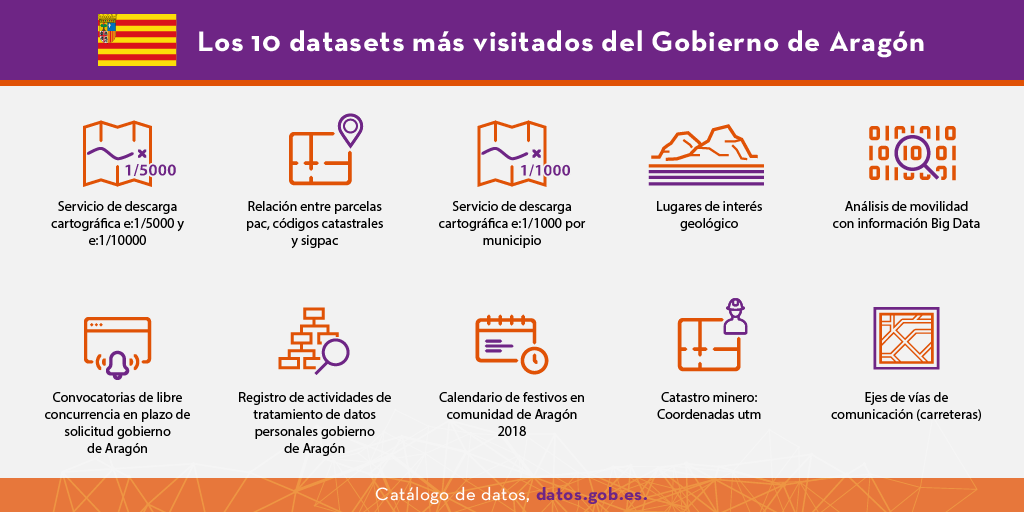
The most downloaded resources of the portal include: Cartographic download service e: 1/1000 by municipality, Government of Aragon Contracts, list of municipalities of Aragon or annual holiday calendars of the Autonomous Community and its provinces.
In this wide and diverse framework, in 2016, Aragón Open Data also began a work of identification and integration of the diversity of data generated by the Government of Aragon, in order to facilitate its disposition and opening. The first step was to create an ontology, the Interoperable Information Structure of Aragón EI2A, with the collaboration of the units that possess, create and manage data, participating different areas of the Government of Aragon such as agriculture, finance, culture, geographic information or environment, among others.
The Interoperable Information Structure of Aragón (EI2A) homogenizes structures, vocabularies and characteristics within the framework of Aragón Open Data to mostly resolve the problem of data diversity and heterogeneity in the Administration. A heterogeneity that is a real reflection of the reality and competences of the Administration, but which hinders its opening and reuse.
The EI2A describes the conceptual and logical data model generated by the Government of Aragon, representing entities, properties and relationships. The structure is intended to support data interoperability through its standardization. The Interoperable Information Structure of Aragon aims to relate the content and elements of the different data sets so that data can be standardized and exploited jointly in the Government of Aragon, by combining, simplifying and homogenizing them, regardless of the origin, purpose, model, entities and relationships.
It is in 2017 and 2018 when the EI2A becomes a reality due to Aragón Open Data Pool project. Aragón Open Data Pool is a pilot and innovative project that demonstrates the importance of centralizing and publish data to drive its use and exploitation. Open Data Pool is available since December 2018, based on EI2A.
As a result: more than 140 sources of well-differentiated organisms and purposes, which were previously open in Aragon Open Data (API GA_OD_Core), have been standardized according to the EI2A to be exploited together and offered in a simple way, from a single point of access and with the same query criteria.
This project data are aligned with the semantic web standards for its exploitation, consultation and use (SPARQL endpoint), which is its real potential. This makes data consulting and use possible, regardless of their characteristics and vocabularies. It even allows federating data from portals of different administrations such as Aragón Open Data (under EI2A) and Open Data Euskadi (under ELI).
Another noteworthy aspect is that it is oriented to a non-technical user, by allowing a intuitive and simple navigation using data relationships, putting interoperability into practice through the relation of diverse data using a normal navigation web.
This project has helped to better understand the reality of data incorporated into Aragón Open Data Pool under the EI2A, and confirm the need of data normalization in the production-point, to latter, open and offer them in Aragón Open Data, facilitating their use and reuse, both inside and outside the Administration. But we need a change, sought by data interoperability and reuse guidelines, to open a unique data access point in the Government of Aragon, which today corresponds to a regulatory project. Among its axes of action, this project aim to better identify data, improve its quality at source, and internally support the process from the creation of the data by the different production units, until its publication in Aragón Open Data. In this way, they seek to continue growing, improving and orienting theirselves so that any interested party, institutions, developers or infomediary company can use the information, data and services available for any of their interests, thus contributing to the development of the information society.

Noticia
With the establishment of the internal market in the European Union, member state administrations need to effectively exchange information beyond their borders in order to be able to comply with public services. Nevertheless, such exchange has posed a challenge since, sometimes, electronically transferring data from one nation to another is not easy. Each national system follows different parameters according to the internal needs of the country that make cross-border administrative procedures into long and costly processes.
However, electronic collaboration among European administrations can speed up and economise such public procedures. In this context, the ISA program of the European Commission started in 2010, which, with an initial budget of 160 million euros, created a joint framework to develop international and interoperable electronic public services for the benefit of citizens and businesses in the EU. This program is based on the interoperability of these services, which not only reduces costs and administrative burdens, but it also contributes to the smooth functioning of the European internal market.
The evolution towards ISA²
ISA² is running from 1 January 2016 until 31 December 2020, replacing the previous ISA programme, supporting both cross-border and intersectoral interaction, as shown in the following video:
With a budget of 131 million euros, distributed over the 5-year duration of the programme, ISA² has a new program designed to achieve the following goals:
- ensure that interoperability activities are well coordinated at EU level;
- develop and operate solutions for the public administrations on the basis of businesses’ and citizens’ needs;
- put in place the necessary instruments to boost interoperability at EU and national level, such as: a revised European Interoperability Framework (EIF); a revised European Interoperability Strategy (EIS); an European Interoperability Reference Architecture (EIRA); and the European Interoperability Cartography (EIC).
This collaborative work within ISA2 resulted in the publication of the version 2.0 of the Core Vocabularies, a set of technical implementation guidelines for the DCAT-AP and the RDF dissemination vocabulary for the EU Budget Vocabulary for representing EU budget data, aimed at increasing government transparency.
Although the program is managed by a specific unit of the European Commission, the DG for Informatics, all member states are actively involved through the ISA² Committee and the ISA² coordination group, which is responsible for ensuring consistency among the program actions.
Achievements regarding semantic interoperability
ISA² is implemented through five work programs, one per year during the period 2016-2020. The member states participating in the 2017 program had to present their proposals last year, providing a solution that is assessed and selected by the ISA² Committee. Once the list of proposed actions is approved, in March 2017, the European Commission will define a work program and allocate a budget for the implementation of the program.
To date, more than 40 actions have been carried out, with special attention to the excellent results obtained by the SEMIC initiative, an action plan to improve semantic interoperability among the different European e-government systems. Within this plan, the ISA² program has developed, along with a group of experts belonging to different institutions of the EU, a set of new data specifications including:
- the DCAT-AP for statistical datasets (StatDCAT), an extension of the DCAT Application Profile to enhance interoperability between descriptions of statistical datasets and open data portals;
- the Core Public Organisation Vocabulary (CPOV), a data model to describe public organisations in the European Union, based on W3C's Organisation Ontology;
- the Core Criterion and Core Evidence Vocabulary (CCCEV), a data model that simplifies the exchange of information between organisations, businesses and citizens in public procurement processes, allowing them to provide the evidence required: CCEV.
In addition, SEMIC continued to provide support on policy matters of different European Commission Directorate-Generals, namely: to DG Employment, Social Affairs and Inclusion through the implementation of a pilot project to link national qualifications systems with ESCO (Skills, Skills, Qualifications and European Occupations); to the Financial Stability, Financial Services and Capital Markets DG (FISMA), to improve the standardization of financial data; or the European Food Safety Agency, to implement an information governance policy.
Through the ISA² program, the SEMIC plan has provided an important push to semantic interoperability in the European Union, in addition to a continuous enrichment thanks to its contributions to the Joinup community, which has more than 1,500 members from different Public Administrations and the European Commission Services. In addition to these initiatives, ISA² has provided the impetus for the development of solutions in many other fields such as open data, electronic invoicing or the geospatial industry. As shown in the web section dedicated to the innovative projects developed within this program.
New version of the Implementation Guide for the Technical Interoperability Standard of PSI Resources
Noticia
The National Interoperability Scheme establishes a set of technical standards for the interoperability of public sector information, which must be complied by public administrations in Spain. As part of this scheme, there is the Technical Standard for the Interoperability of the Re-use of Public Sector Information Resources, which includes a series of conditions on the selection, identification, description, format, use conditions and availability of public data.
In order to facilitate the implementation of this technical standard, an implementation guide is available to users, which explains in detail the guidelines for public administrations to develop their own policies for the open data re-use and resources within their areas of responsibility.
A new version of this document has been recently published, which includes new materials that complement and optimize the advice provided by this guide. Thus, two additional chapters are included to illustrate from several good practices different sections and aspects of the National Interoperability Standard:
Good practices of Share-PSI
Share-PSI is a thematic network offering advice on implementation of the European Directive on the Public Sector Information. This group comprises a great number of public bodies, academic institutions, independent entities and experts who, through different workshops, review and offer good practices in this area.
In this new version of the implementation guide, the Annex III includes twelve examples of such practices collected by the Share-PSI in relation to the national document and the European Directive 2013/37 / EU on the re-use of information, such as elements to establish an open data ecosystem, standards for geospatial data or characteristics of a dataset, among others.
Good practices of web data by W3C
In addition, a table is also shown in the fourth Annex where the best data practices documented by the W3C, applicable and related to the sections of the guide, are collected:
- The persistent use of URIs as identifiers of datasets, their associated versions and series, as well as data;
- The reuse of standardized vocabularies for metadata;
- Real-time and up-to-date access;
- The constant enrichment of information;
- The possibility of bulk download and the use of standard and machine readable formats.
This latest update of the implementation guide provides an opportunity to learn and analyze successful practices in other countries, serving as a reference for the national sector to improve both the open data policies and initiatives in Spain.