


 The regulatory framework governing open data in Spain is based on a set of national and European laws and guidelines, which set out how public data should be managed, published and re-used.
This set of rules establishes a regulatory environment that promotes the openness, interoperability and re-use of public data, whilst ensuring the protection of individuals’ rights and the quality of the information.
Spanish regulations
At the national level, the main standard is:
This law sets out the conditions governing access to and re-use of information produced by public authorities and establishes principles such as the need to create accessible catalogues and the use of open formats. It was implemented in the national public sector by Royal Decree 1495/2011 of 24 October.
Its 2021 update incorporated Directive (EU) 2019/1024, expanding obligations regarding high-value data, machine-readable formats and proactive publication (open data by design and by default).
You can learn more about the main features of this legislation by consulting the Infographic Summarising Law 37/2007.
In addition to this law, the following regulations also govern open data:
- Law 19/2013 on transparency, access to public information and good governance (LTBG): this legislation establishes citizens’ right to access public information and reinforces public authorities’ obligation to publish data in a structured, accessible format. Although the aim of this law is different—as it focuses on access instead of re-use—it is nonetheless a key document for establishing the legal framework governing public information in Spain.
- Technical Interoperability Standard (NTI): part of the National Interoperability Framework (ENI), governed by Royal Decree 4/2010. This standard focuses on how metadata should be published. Its aim is to ensure an adequate level of technical, semantic and organisational interoperability between the systems and applications used by public authorities. Its next update is set to include the DCAT-AP-ES application profile as the standard to be used.
In turn, regional and local public bodies may draw up their own legal frameworks to set out the obligations under the LRISP in more detail.
EU regulations
At the European level, the framework is complemented by a number of key regulations:
- Directive (EU) 2019/1024 on open data and the re-use of public sector information (DRISP): sets out common standards for all Member States, including the obligation to publish high-value datasets and ensure their availability in machine-readable formats, enabling mass, real-time downloads wherever possible via APIs. The six categories of high-value datasets are defined in Implementing Regulation (EU) 2023/138 of 21 December 2022.
You can find out more about this directive in this article in the News section.
- Regulation (EU) 2022/868 on data governance (Data Governance Act): introduces mechanisms to support the framework for open data and re-use in areas where the DRISP did not apply, due to potential legal conflicts. This applies to public sector data subject to third-party rights, personal data protection, intellectual property or commercial and statistical confidentiality. It also regulates data intermediation services and altruistic data sharing.
You can learn more about its main features by consulting this Infographic Summarising the Data Governance Act (DGA).
- Regulation (EU) 2023/2854 on harmonised rules on fair access to and use of data (Data Act): clarifies who can create value from data and under what conditions. It focuses on encouraging the provision of data generated by connected products and services, promoting interoperability standards for the re-use of data, and regulating the provision of data to public bodies in exceptional circumstances.
You can learn more about the main features of this regulation by consulting this Infographic Summarising the Data Act (DA).
Regulatory framework
The following visual summarises the current regulatory framework governing open data in Spain.
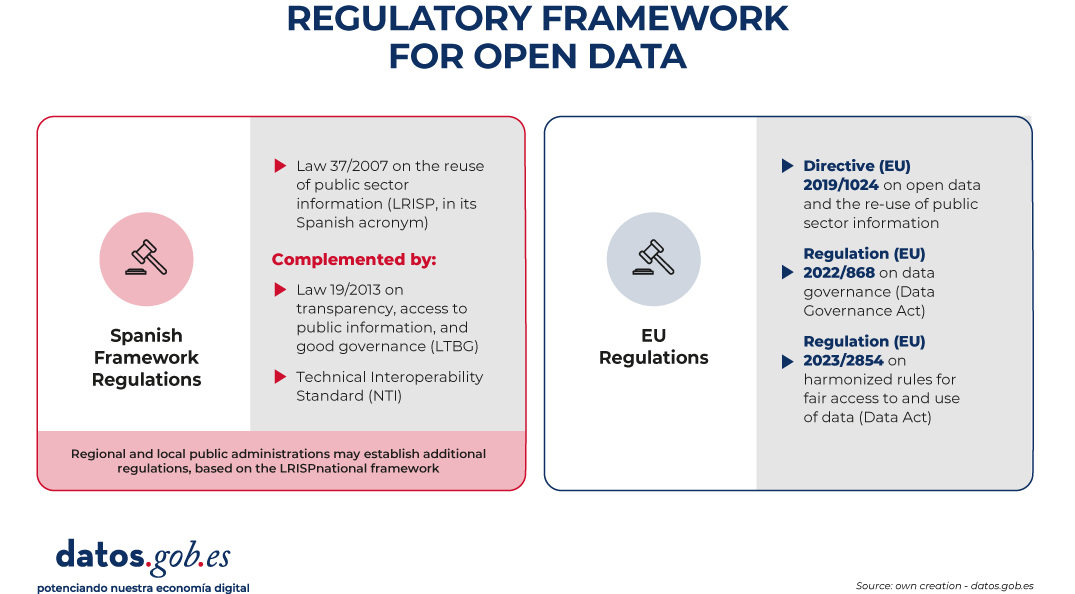
You can find out more about these regulations in the report The European and Spanish regulation on open data and reuse of public sector information.