


Publication date
01/09/2025
Update date
30/09/2025



Description
Context and need for an update
Data is a key resource in the digital transformation of public administrations. Ensuring its access, interoperability and reuse is fundamental to improve transparency, foster innovation and enable the development of efficient public services centered on citizens.
In this context, the Technical Standard for Interoperability for the Reuse of information Resources (NTI-RISP) is the regulatory framework in Spain for the management and opening of public data since 2013. The standard sets common conditions on selection, identification, description, format, terms of use and provision of documents and information resources produced or held by the public sector, relating to numerous areas of interest such as social, economic, legal, tourism, business, education information, etc., fully complying with the provisions of Law 37/2007, of November 16.
In recent months, the text has been undergoing modernization in line with the European and Spanish objective of boosting the data economy, promoting its large-scale exchange within distributed and federated environments, guaranteeing adequate cybersecurity conditions and respecting European principles and values.
The new standard, currently in the processing stage, refers to a new metadata model aligned with the latest versions of European standards, which facilitate the description of datasets and reusable information resources made publicly available.
This new metadata model, called DCAT-AP-ES, adopts the guidelines of the European metadata exchange schema DCAT-AP (Data Catalog Vocabulary – Application Profile) with some additional restrictions and adjustments. DCAT-AP-ES is aligned with the European standards DCAT-AP 2.1.1 and the extension DCAT-AP-HVD 2.2.0, which incorporates the requirements for High-Value Datasets (HVD) defined by the European Commission.
What is DCAT-AP and how is it applied in Spain?
DCAT-AP is an application profile based on the DCAT vocabulary from the W3C, designed to improve the interoperability of public sector open data catalogues in Europe. Its goal is to provide a common metadata model that facilitates the exchange, aggregation and federation of catalogues from different countries and organizations (interoperability).
DCAT-AP-ES, as the Spanish application profile of DCAT-AP, is designed to adapt to the particulars of the national context, ensuring efficient management of open data at the national, regional and local levels.
DCAT-AP-ES is established as the standard to be considered in the new version of the NTI-RISP, which in turn is framed within the National Interoperability Framework (ENI), regulated by Royal Decree 4/2010, which sets the conditions for the reuse of public sector information in Spain.
Main news in DCAT-AP-ES
The new version of DCAT-AP-ES introduces significant improvements that facilitate interoperability and data management in the digital ecosystem. Among others:
Alignment with DCAT-AP
- Greater compatibility with European open data catalogues by aligning NTI-RISP with the EU standard DCAT-AP.
- Inclusion of advanced properties to improve the description of datasets and data services, to ensure the possibilities indicated below.
Incorporation of metadata for the description of High-Value Datasets (HVD)
- Facilitates compliance with European regulation on high-value data.
- Enables detailed description of data in key sectors such as geospatial, meteorology, earth observation and environment, statistics, mobility and business.
Improvements in the description of data services
- Inclusion of specific metadata to describe APIs and data access services.
- Possibility to express a dataset in different contexts (e.g. geospatial, with a map server, or statistical, with a data API).
Support for provenance and data quality
- Incorporation of new properties to manage lifecycle, versioning and origin.
- Implementation of validation and quality control mechanisms using SHACL, ensuring consistency and structure of metadata in catalogues.
Use of controlled vocabularies and best practices
- Adaptation of standardized vocabularies for licenses, data formats, languages and themes.
- Greater clarity in data classification to facilitate discovery.
Data governance and improved agent management
- Specification of agent roles (creator, publisher) and contact points.
- Enhanced metadata to represent resource provenance.
Validation of conformity and metadata quality
- Guides to help validate metadata that comply with DCAT-AP-ES.
- Validation of DCAT-AP-ES graphs against SHACL templates.
Key benefits of the update
The adoption of DCAT-AP-ES represents a qualitative leap in the management and reuse of open data in Spain. Among its benefits are:
✅ Facilitates the federation of catalogues and the discovery of data.
✅ Improves interoperability with the European open data ecosystem.
✅ Complies with European open data regulations.
✅ Increases metadata quality through validation mechanisms.
✅ Ensures that data are FAIR (Findable, Accessible, Interoperable, Reusable).
Implementation and next steps
When will it come into force?
The new application profile DCAT-AP-ES will be progressively implemented in Spain's open data catalogues. Its application will be mandatory once the modification text of the standard comes into force which, as mentioned earlier, is currently undergoing administrative processing but is already compatible with the datos.gob.es data federator.
Are there supporting materials and resources for implementing DCAT-AP-ES?
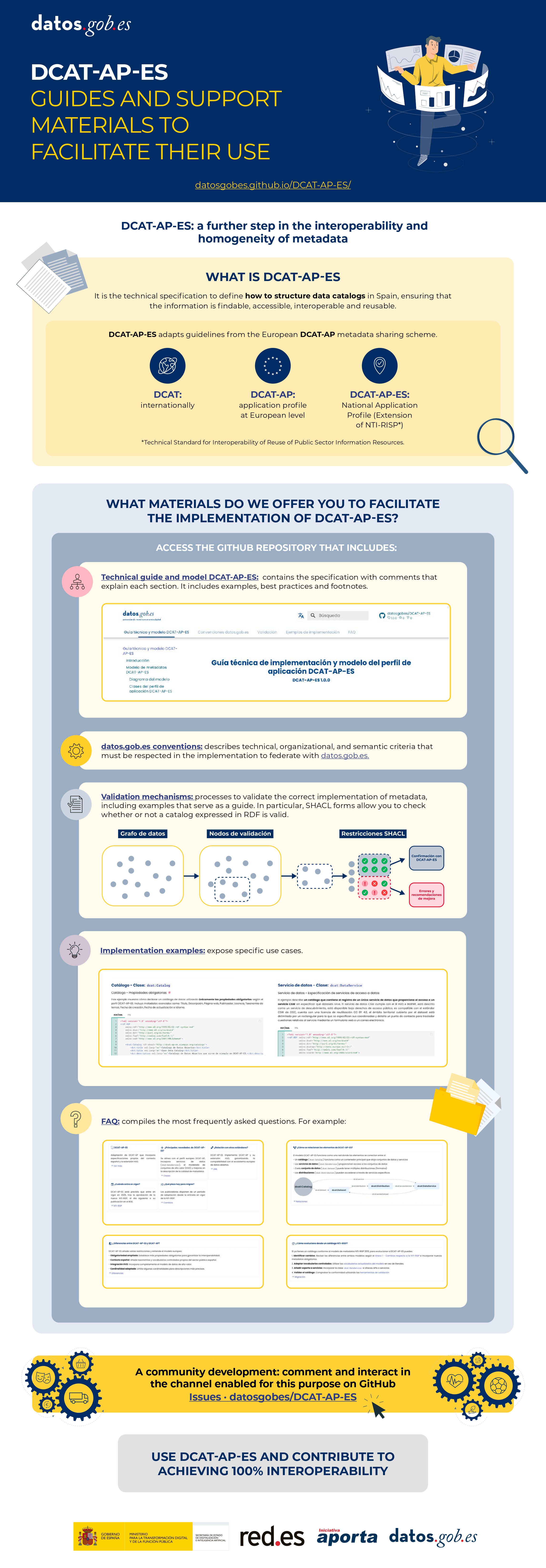
The management team of the datos.gob.es platform has developed the DCAT-AP-ES Technical guide and model, available in the datos.gob.es repository.
This repository will be enriched as new needs of users applying the standard are identified. Likewise, help guides and educational resources will be developed to facilitate its adoption by publishing organizations. All the news and resources produced in the context of the application profile will be announced and referenced punctually on datos.gob.es.
Where to find more information?
The updated documentation, guides and resources will be accessible on datos.gob.es and in the associated code repository. At present the following are available:
- DCAT-AP-ES Technical guide and model
- DCAT-AP-ES Conventions
- DCAT-AP-ES Implementation examples
- DCAT-AP-ES Frequently Asked Questions
- DCAT-AP-ES Metadata validation
- DCAT-AP explanatory video: Spanish / English
- datos.gob.es
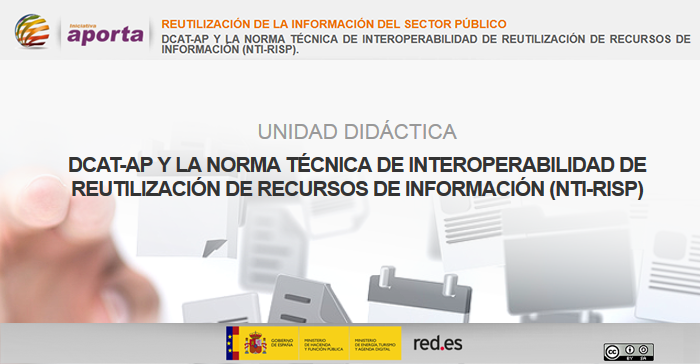
Learn more in this video:
And this infographic (click to access the interactive and accessible version):
Documentation
| Infography: DCAT-AP-ES: Guides and support materials to facilitate their use | 472.77 KB |

|

Comments