


Publication date
13/05/2026
Type
Training materials


Description
One of the biggest challenges of the open data ecosystem is its dissemination and the recognition of its value by society. Knowing their existence and understanding what they are for amplifies their impact. In an environment where algorithms are increasingly present in everyday life, data literacy has become a necessary civic skill. Civil rights are increasingly expressed in a digital key and, in this context, digital rights emerge as an essential frame of reference to ensure that technological transformation leaves no one behind. Added to this is the rise of artificial intelligence, which amplifies the value of data, but also the risks derived from its biased or non-transparent use.
Incorporating data literacy into educational curricula from an early age is key to overcoming these challenges, as it provides students with technical knowledge and tools to participate in society in an informed way. The V National Open Data Meeting held in Pamplona on 8 May focused precisely on the role of data in the education sector under the slogan "Learn and undertake". The challenge of this edition has been EDUCA-DATA, a resource that brings open data to the classroom in a practical and accessible way, showing its value in understanding reality and generating opportunities.
What does the annual challenge of the National Open Data Meeting consist of?
The National Open Data Meeting poses a different challenge every year, in which experts from different fields work together to find solutions. The challenge is proposed by the organization and volunteers related to the field of data, linked to the academic world and the public administration, collaborate throughout the year to respond to the challenge. The conclusions are presented during the annual event and all the documentation generated is public.
What is EDUCA-DATA?
Data is a citizen tool to understand and transform the world. EDUCA-DATA is an educational project that facilitates learning about the use and reuse of public open data. It seeks to strengthen digital skills, critical thinking and promote the culture of open knowledge.
EDUCA-DATA is mainly aimed at students and teachers of Compulsory Secondary Education, Baccalaureate and Vocational Training, but also at citizens in general. The educational material allows students to work on open data concepts in the classroom, contains resources that teachers can use as support in the classroom and makes it easier for anyone interested to learn independently about this topic.
During the approach to this challenge, three coordinated and complementary documentary pieces have been prepared, without it being necessary to consult all three to understand the complete content. The content of each one is detailed below. All the materials are available in section 5 of the EDUCA-DATA challenge, at the bottom of the meeting page.
Presentation of open data, a collection of essential data
The centerpiece of the materials produced is a presentation in PowerPoint format. It is a 65-slide document that allows anyone without prior knowledge to approach open data. This document includes all the content that students will work on in the classroom together with the teachers and articulates the complete didactic sequence, from the introduction to the data to the benefits of its opening.
Theoretical document: concepts, examples and resources to deepen
All the material produced is based on a solid theoretical basis. The technical document develops in greater depth the concepts, definitions and examples that appear in the presentation, and acts as a reference when students or teachers need to delve deeper into a specific point.
With a didactic approach, it traces a path that allows us to understand how open data, correctly processed and published, provides significant value in areas as diverse as investigative journalism, science against climate change or citizen participation. The inclusion of real cases, explained in a clear and accessible way, makes it easier to understand their impact on our daily lives. The document is designed to be read continuously, with a fluid and enjoyable reading, and to be consulted in a timely manner whenever you want to clarify a concept or expand on a specific aspect. In addition, it includes links to external resources for those who wish to delve into the different sections.
A teacher's guide, discovering the power of data
To enable teachers to work in the classroom, an exhaustive teaching guide has been developed, which allows them to manage their work with students autonomously. This document contains the curricular framework, the didactic guidelines and the necessary information for classroom practice. The guide is organized in two parts: the first includes the conceptual framework and the curricular fit, and the second contains the classroom materials.
At the curricular level, the material developed fits mainly into the following subjects: Digitalization, Economics, Geography and History and Mathematics.
The content is developed in five didactic units that allow you to gradually approach open data:
- Introduction. The world of data.
- Open Data. What are they and what defines them?
- The formats. The packaging of information.
- Licenses. The rules of the game.
- The benefits. Why does all this matter?
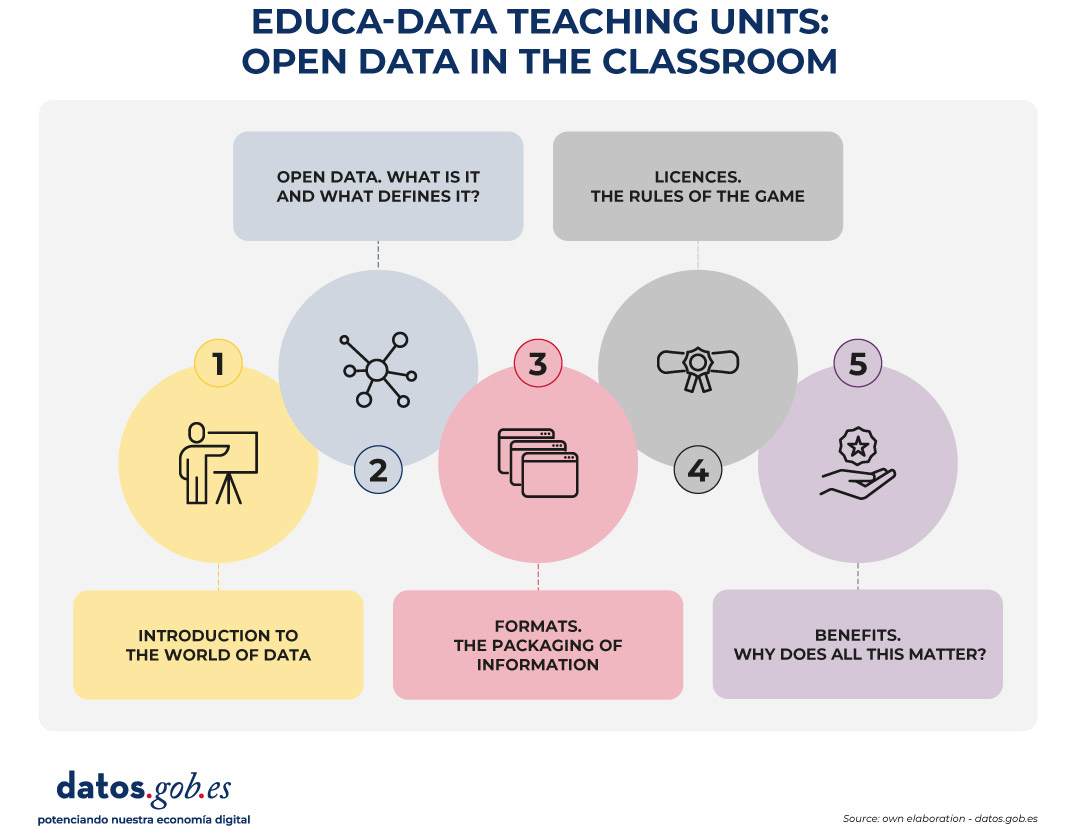
Figure 1. EDUCA-DATA teaching modules: open data in the classroom. Source: own work – datos.gob.es
In the teaching guide , teachers will find everything they need to be able to teach the five teaching units and their activities autonomously, without the need for prior specific training in open data. That is:
- The conceptual and historical context that frames open data.
- Its fit into the LOMLOE curriculum of several subjects.
- The objectives and contents of each unit.
- The key ideas that should be transferred to the classroom.
- The most common errors and confusions of students.
- Proposals for rapid evaluation.
- References for further information.
The guide covers four areas:
- A conceptual and historical framework that provides teachers with the necessary context about open data. It is information that is not designed to be transferred to the classroom as it is.
- A curricular framework with the assessment of the fit in four subjects (Digitalization, Economics, Geography and History and Mathematics), a reasoned didactic recommendation, cognitive progression according to Bloom's taxonomy and detailed alignment tables with LOMLOE.
- The five didactic units. It is the core of this material and each one follows the same structure to facilitate the work of the teaching staff.
- Two integrating pieces that close the tour, in the form of practical application exercises: an integrative case study presented as a journalistic role-playing game and an advanced practical exercise to work with data.
In addition, a basic glossary and two in-depth studies on the concepts of distribution and licensing are included as transversal contents. The guide is presented as an open proposal that teachers can take as a reference and adapt it to their class, their students and their way of teaching.
Open data in the classroom, a commitment to the citizenship of the future
Bringing open data closer to students in Secondary, Baccalaureate and Vocational Training contributes to forming citizens capable of understanding the digital ecosystem of information, of contrasting what they read with public data and of exercising their right to transparency and participation. For this reason, these educational resources have a great value that goes beyond digital and data literacy, since, in their most civic dimension, they contribute to forming people who are more informed, more critical and better prepared to understand and transform the world in which they live.

Comments