


Description
The report provides an overview of the Spanish and European legal framework on open data and reuse of public sector information.
The starting point is a paradigm shift from the general regulations on transparency and access to information, also promoted from the international level, with references such as the Open Government Partnership and the International Open Data Charter, to which Spain has been progressively adhering. Specifically, in contrast to a more formalised regulatory model of access to information, typical of the general regulations on transparency, the regulation on the reuse of public sector information is committed to the proactive availability of data through catalogues, machine-readable formats and standard licences, focusing not on the individual request but on openness by default.
At the European level, the report succinctly presents how the rules on open data and re-use of public sector information have evolved, notably since the 2019 Directive, which has progressively expanded its scope and scope to include, among others, publicly funded research data, metadata or so-called high-value data. More recent regulations have been added to this general regulation that attempt to address specific legal tensions, including:
-
The Data Governance Regulation, which aims to facilitate the reuse of sensitive information for the rights of third parties, such as the protection of personal data.
-
The Data Regulation, which regulates equitable access to information generated by connected devices, including relationships between companies and, in exceptional cases, towards the public sector.
-
The Artificial Intelligence Regulation, which sets quality and representativeness requirements for datasets used to train high-risk systems, thus connecting data openness with protection against algorithmic bias.
The report then specifically addresses the existing regulation in Spain regarding the reuse of public sector information and, in particular, the basic legislation that applies in all areas: Law 37/2007 on the reuse of public sector information (LRISP) and its reform in 2021. In a complementary way, and specifically from the territorial perspective, the notable heterogeneity that exists in the regional regulation is highlighted, on the one hand, and, on the other, the model of reference ordinance prepared by the Spanish Federation of Municipalities and Provinces is presented.
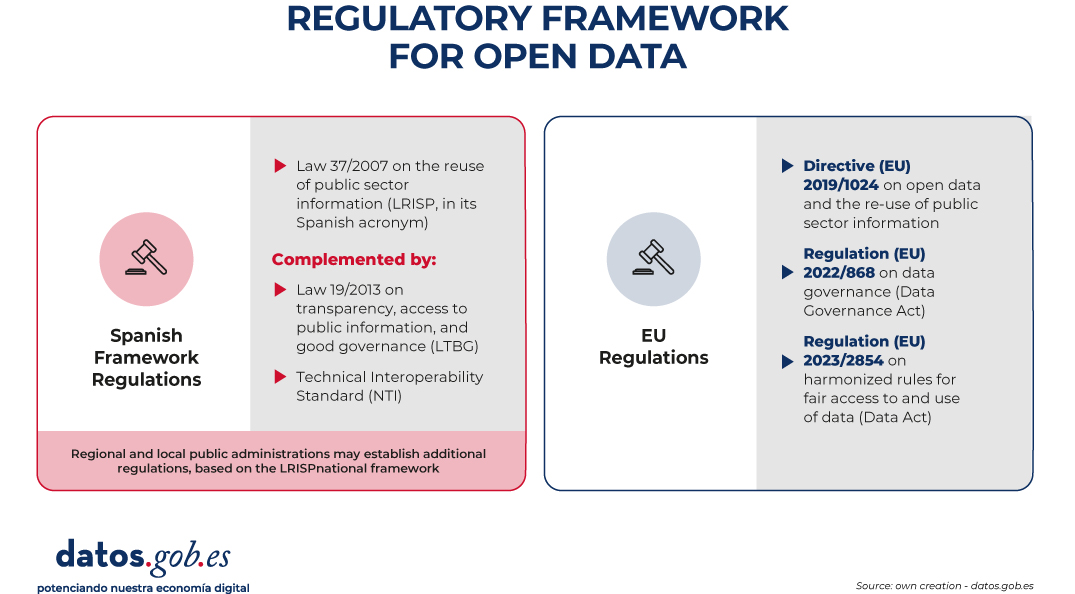
Figure 1. Regulatory framework for open data. Source: own elaboration - datos.gob.es
The report also presents the main aspects of existing regulation in various sectoral areas, illustrating how the general principles of openness and re-use are projected differently depending on the nature of each type of information:
-
In the field of health, under the European Health Data Space, the fundamental distinction between the use of data for direct clinical care to the patient and its subsequent reuse for research, innovation, planning or management purposes is explained.
-
In terms of geographic information, the existence of a very mature and consolidated data-sharing ecosystem is highlighted, to the point that it serves as a reference to organize the opening of data in other sectors.
-
In relation to environmental information, it is highlighted how a right of access that has historically been very guaranteed now converges with new technologies. The opening of detailed information on climate, territory or biodiversity is key to feeding artificial intelligence systems that help monitor, predict and mitigate the effects of climate change, betting on sustainability.
-
In the field of public procurement, decisive progress has been made in the digitization of information on tenders and awards, requiring its proactive publication in open formats through interoperable platforms. On this basis, the creation of shared environments that improve the quality of information is being promoted, promoting citizen control and the development of new value-added services by third parties.
-
Finally, in the mobility sector, access to traffic and transport data is being consolidated through centralised infrastructures and the progressive creation of integrated data spaces. These tools allow information to be structured and unified, which is key for companies and developers to create applications that improve the user experience and optimise travel throughout the territory.
The report concludes by pointing out an essential reflection for the immediate future: from a legal perspective, the main challenge is to promote true ecosystems of interoperable data between diverse and heterogeneous sectors, balancing the necessary regulatory simplification at European level with the maintenance of the legal guarantees that protect rights and freedoms in the current digital environment.
To explore the report's content in greater depth, we've recorded a podcast and a video interview in which the author explains the key points of the Decalogue. We've also created an executive summary.
Listen to the podcast with the author (only available in Spanish)
Watch the video-interview with the author
Documentation
| Report: "The European and Spanish regulation on open data and reuse of public sector information"" | 14.90 MB |

|
|
| Accessible version of the report | 3.30 MB | DOCX |
|
| Executive summary | 344.88 KB |
|
|
| Podcast transcript | 227.50 KB |
|



Comments