


Description
In Spain, there are numerous open data initiatives promoted by different levels of the administration: city councils, autonomous communities and state bodies. This ecosystem, as rich as it is diverse, generates a large volume of valuable information, but it also poses an obvious challenge: how to make it easier for any person or entity to easily locate the data they need, without having to go through dozens of different catalogs?
To respond to this need, the National Open Data Catalogue, hosted in datos.gob.es, acts as a single point of access to the set of data made available to citizens by the Spanish public sector. Its harmonizing function allows information from multiple initiatives to be centralized, offering reusers a common space to search for data more efficiently. In addition, thanks to its federation with the European Data Portal (data.europa.eu), the datasets published by Spanish administrations gain visibility at the international level.
Steps to follow
Publishing open data in the National Catalogue is a simpler process than it seems if you know the key phases.
1. Pre-planning
Before you start, it's a good idea to prepare the ground. To this end, it is recommended to carry out a plan of measures to promote the opening and reuse of open data, in which the agency defines, among other issues, what data it is going to open, for what purpose and under what criteria of quality, updating and format. Good planning allows you to anticipate technical needs, coordinate the teams involved and ensure that the published data will be really useful for reusers.
In datos.gob.es you can find multiple resources to help in this task, such as this template, or various guides, such as the Guide for the deployment of data portals. Good practices and recommendations.
2. Registration of the organism and the user
The second phase focuses on managing the registration of the body and the users who will be in charge of the publication. User accounts are reserved only for open data publishers or organizations (they are not required to access or download catalog datasets).
In order to federate data in the national catalog, the agency must be registered in the official taxonomy and validated by the datos.gob.es team. In turn, responsible users need to have an authorised account, either as staff of the organisation itself or as accredited external providers (previously authorised). Without this administrative step, it is not possible to access the tools needed to catalog and publish data. This video explains how to apply for a user account:
3. Cataloguing
In this phase, the agency prepares the metadata of its datasets following the established application profiles, preferably DCAT-AP-ES. At this point, it is determined if it has its own catalog capable of generating metadata in RDF or if it will be necessary to resort to other alternatives. Validation using SHACL templates is critical to ensure that metadata meets technical and semantic requirements, avoiding errors that can impede federation.
4. Federation
Federation is the process by which the agency's metadata is incorporated into the national catalog. This federation can be carried out in two ways:
- Manual: involves registering each dataset individually, completing a form for each dataset detailing its metadata.
- Automatic: the registration and update is done periodically from an RDF file where the metadata available through a url on the publisher's website is included. It is no longer necessary to work individually with each dataset, but the process can automatically span multiple datasets.
In both modes, before federating to production, we recommend that you use the sandbox to verify that the datasets are integrated correctly and that the metadata is displayed as expected.
5. Maintenance
In order for published data to remain useful, up-to-date, and accessible, ongoing maintenance is necessary. This involves reviewing and updating metadata and resources when necessary or fixing broken links, among others. These activities are essential to ensure the quality of the catalogue and to ensure that open data continues to generate value over time.
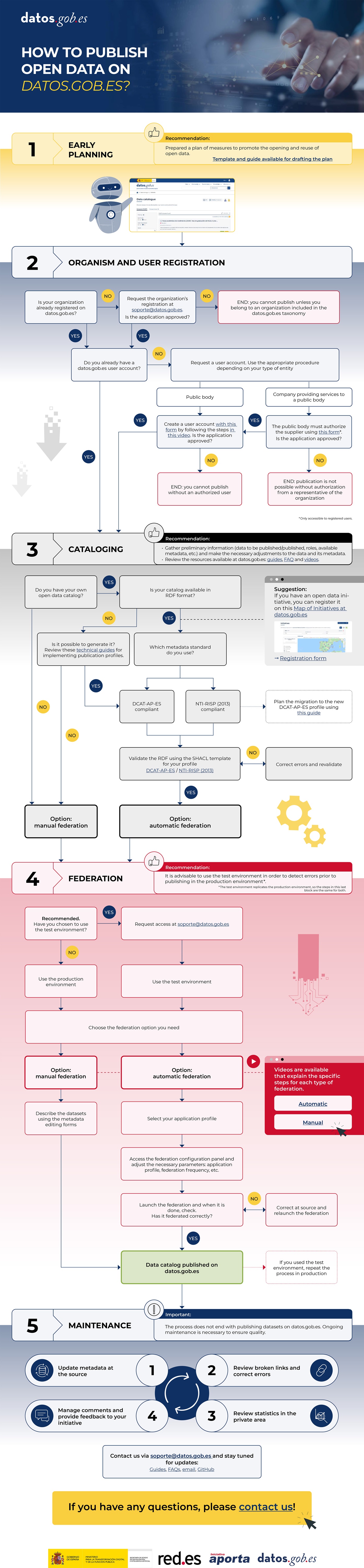
Infographic summary of the flow to follow
To facilitate the understanding of the steps to follow, we make available to users the following infographic-summary. However, the datos.gob.es support team will be happy to answer any questions or comments.
Documentation
| Inphographic: How to publish open data in the national catalog hosted on datos.gob.es | 667.96 KB |

|



Comments