


Noticia
On Wednesday, March 4, the Cajasiete Big Data, Open Data and Blockchain Chair of the University of La Laguna held a webinar to present the winning ideas of the Cabildo de Tenerife Open Data Contest: Reuse Ideas. An event to highlight the potential of public information when it is put at the service of citizens. The recording of the presentation is available here.
In this post we will review what each of the winning projects consists of – which are still pending ideas for development in apps – and what challenges they would answer.
Cultiva+ Tenerife: precision agriculture for the Tenerife countryside
The first prize-winning project was born from a very specific need that every farmer on the island knows well: to make the right decisions at the right time. Which crop is most profitable this season? What are the weather conditions forecast for the coming weeks? Is there a fair or event in the sector that should not be missed?
Cultiva+ Tenerife is an application designed specifically for the agricultural sector that integrates open data from the Cabildo to answer these questions in a simple and intuitive way.
Specifically, it is aimed at both workers already established in the sector and new farmers. In the first case, the app would facilitate daily work through irrigation recommendations and other issues that improve production; while for new farmers the application would help to select the best plot to start an agricultural activity according to soil type, weather conditions, etc.
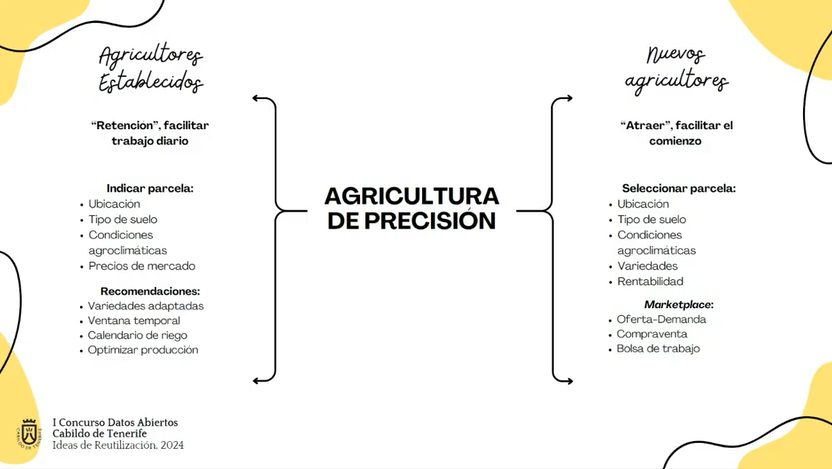
Figure 1. Possible uses of the Cultiva+ Tenerife application according to the type of user. Source: presentation by Cultiva+Tenerife in the Webinar "From data to innovation: Reuse ideas awarded in the I Open Data Contest of the Cabildo de Tenerife, Universidad de la Laguna".
The application would intuitively and clearly collect information such as:
- Price information: the farmer can consult the evolution of market prices of different products, which allows him to plan what to grow based on the expected profitability.
- Weather conditions: the app crosses weather data with the specific needs of each type of crop, helping to anticipate irrigation, protection or harvests.
-
Agenda of activities of interest: agricultural fairs, technical conferences, calls for grants... All relevant information for the sector, centralized in one place.
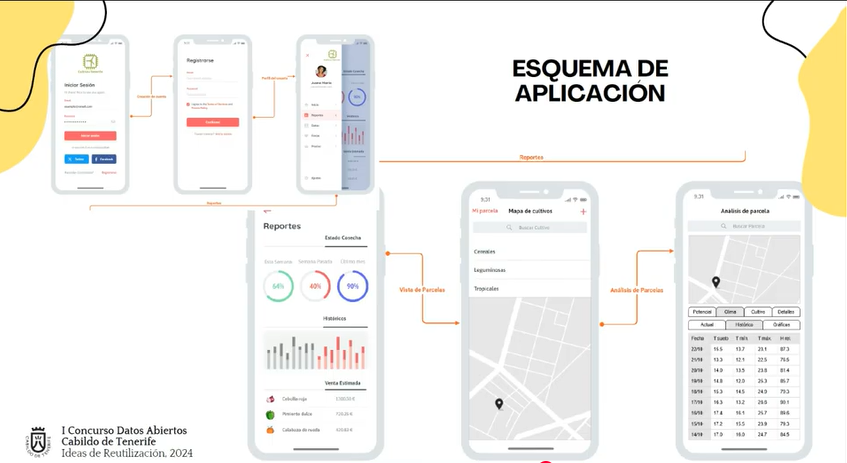
Figure 2. Visual structure of the Cultiva+Tenerife application. Source: presentation by Cultiva+Tenerife in the Webinar "From data to innovation: Reuse ideas awarded in the I Open Data Contest of the Cabildo de Tenerife, Universidad de la Laguna".
Something that was highlighted as valuable about this project in the webinar is its focus on a group that has historically had less access to digital tools: farmers in Tenerife. The proposal does not seek to complicate their day-to-day life with unnecessary technology, but to simplify decisions that today are often made by eye or with incomplete information. Precision agriculture is no longer just a matter for large farms: with open data and a good application, it can be within the reach of any local producer.
Analysis of trends and models on tourism in Tenerife: when the data reveal a crisis
The second winning project addresses one of the most complex and urgent issues in the reality of Tenerife: the relationship between tourism, housing and the labour market. An equation with multiple variables that directly affects the quality of life of residents and that, until now, was difficult to analyse rigorously without access to reliable data.
The starting point of the project is revealing: in June 2024, 35% of the new employment contracts signed in Tenerife corresponded to the hospitality sector. A figure that perfectly illustrates the structural dependence of the island's economy on tourism, but which also opens up uncomfortable questions: to what extent is tourism growth transforming the housing market? Are you displacing habitual residents from certain areas? How will tourist arrivals evolve in the coming years?
This project proposes to answer these questions through an analysis and prediction model built with data science tools. Its developer proposes to use data such as the number of tourists staying in Tenerife according to category and area of establishment, available in datos.tenerife.es, to build models with Python and NumPy that allow identifying trends and projecting future scenarios.
The objectives of the project are ambitious but concrete:
- Analyse the relationship between tourist demand and accommodation supply, identifying which areas of the island suffer the greatest pressure and at what times of the year.
- To develop a predictive model capable of estimating the future arrival of tourists and their impact on the tourist housing sector.
- Contribute to mitigating the housing crisis by providing data and analysis that allow us to understand how tourism is affecting the availability of housing for residents.
- To support business and urban planning, offering companies, investors and administrations an analysis tool that facilitates strategic decision-making.
In short, it is a matter of putting the intelligence of data at the service of one of the most current debates that Tenerife has on the table.
The university as a bridge between data and society
The choice of the Cajasiete Big Data, Open Data and Blockchain Chair of the University of La Laguna as a space to give visibility to the winners is in itself a message: the University has a key role in the construction of the open data ecosystem in Tenerife.
This chair has been working for years on the border between academic research and the practical application of technologies such as big data analysis, blockchain or the reuse of public information. Their involvement in this competition and in the dissemination of its results reinforces the idea that open data is also a valuable resource for training, research and local economic development.
The success of this first call has confirmed that there was a real demand for this type of initiative. So much so that the Cabildo has already launched the II Open Data Contest: APP Development, which gives continuity to the process by taking ideas to the next level: the development of functional applications.
If in the first edition ideas and conceptual proposals were awarded, in this second edition the challenge is to build real solutions, with code, user interface and proven functionalities. The economic endowment is 6,000 euros divided into three prizes.
Projects such as Cultiva+ Tenerife or the Analysis of the impact of tourism on housing show that there are ideas with the potential to become useful and sustainable tools. This second phase is the opportunity to materialize them.

Evento
The Cabildo Insular de Tenerife has announced the II Open Data Contest: Development of APPs, an initiative that rewards the creation of web and mobile applications that take advantage of the datasets available on its datos.tenerife.es portal. This call represents a new opportunity for developers, entrepreneurs and innovative entities that want to transform public information into digital solutions of value for society. In this post, we tell you the details about the competition.
A growing ecosystem: from ideas to applications
This initiative is part of the Cabildo de Tenerife's Open Data project, which promotes transparency, citizen participation and the generation of economic and social value through the reuse of public information.
The Cabildo has designed a strategy in two phases:
-
The I Open Data Contest: Reuse Ideas (already held) focused on identifying creative proposals.
-
The II Contest: Development of PPPs (current call) that gives continuity to the process and seeks to materialize ideas in functional applications.
This progressive approach makes it possible to build an innovation ecosystem that accompanies participants from conceptualization to the complete development of digital solutions.
The objective is to promote the creation of digital products and services that generate social and economic impact, while identifying new opportunities for innovation and entrepreneurship in the field of open data.
Awards and financial endowment
This contest has a total endowment of 6,000 euros distributed in three prizes:
-
First prize: 3,000 euros
-
Second prize: 2,000 euros
-
Third prize: 1,000 euros
Who can participate?
The call is open to:
-
Natural persons: individual developers, designers, students, or anyone interested in the reuse of open data.
-
Legal entities: startups, technology companies, cooperatives, associations or other entities.
As long as they present the development of an application based on open data from the Cabildo de Tenerife. The same person, natural or legal, can submit as many applications as they wish, both individually and jointly.
What kind of applications can be submitted?
Proposals must be web or mobile applications that use at least one dataset from the datos.tenerife.es portal. Some ideas that can serve as inspiration are:
-
Applications to optimize transport and mobility on the island.
-
Tools for visualising tourism or environmental data.
-
Real-time citizen information services.
-
Solutions to improve accessibility and social participation.
-
Economic or demographic data analysis platforms.
Evaluation criteria: what does the jury assess?
The jury will evaluate the proposals considering the following criteria:
-
Use of open data: degree of exploitation and integration of the datasets available in the portal.
-
Impact and usefulness: value that the application brings to society, ability to solve real problems or improve existing services.
-
Innovation and creativity: originality of the proposal and innovative nature of the proposed solution.
-
Technical quality: code robustness, good programming practices, scalability and maintainability of the application.
-
Design and usability: user experience (UX), attractive and intuitive visual design, guarantee of digital accessibility on Android and iOS devices.
How to participate: deadlines and form of submission:
Applications can be submitted until March 10, 2026, three months from the publication of the call in the Official Gazette of the Province.
Regarding the required documentation, proposals must be submitted in digital format and include:
-
Detailed technical description of the application.
-
Report justifying the use of open data.
-
Specification of technological environments used.
-
Video demonstration of how the application works.
-
Complete source code.
-
Technical summary sheet.
The organising institution recommends electronic submission through the Electronic Office of the Cabildo de Tenerife, although it is also possible to submit it in person at the official registers enabled. The complete bases and the official application form are available at the Cabildo's Electronic Office.
With this second call, the Cabildo de Tenerife consolidates its commitment to transparency, the reuse of public information and the creation of a digital innovation ecosystem. Initiatives like this demonstrate how open data can become a catalyst for entrepreneurship, citizen participation, and local economic development.
Noticia
In the last six months, the open data ecosystem in Spain has experienced intense activity marked by regulatory and strategic advances, the implementation of new platforms and functionalities in data portals, or the launch of innovative solutions based on public information.
In this article, we review some of those advances, so you can stay up to date. We also invite you to review the article on the news of the first half of 2025 so that you can have an overview of what has happened this year in the national data ecosystem.
Cross-cutting strategic, regulatory and policy developments
Data quality, interoperability and governance have been placed at the heart of both the national and European agenda, with initiatives seeking to foster a robust framework for harnessing the value of data as a strategic asset.
One of the main developments has been the launch of a new digital package by the European Commission in order to consolidate a robust, secure and competitive European data ecosystem. This package includes a digital bus to simplify the application of the Artificial Intelligence (AI) Regulation. In addition, it is complemented by the new Data Union Strategy, which is structured around three pillars:
- Expand access to quality data to drive artificial intelligence and innovation.
- Simplify the existing regulatory framework to reduce barriers and bureaucracy.
- Protect European digital sovereignty from external dependencies.
Its implementation will take place gradually over the next few months. It will be then that we will be able to appreciate its effects on our country and the rest of the EU territories.
Activity in Spain has also been - and will be - marked by the V Open Government Plan 2025-2029, approved last October. This plan has more than 200 initiatives and contributions from both civil society and administrations, many of them related to the opening and reuse of data. Spain's commitment to open data has also been evident in its adherence to the International Open Data Charter, a global initiative that promotes the openness and reuse of public data as tools to improve transparency, citizen participation, innovation and accountability.
Along with the promotion of data openness, work has also been done on the development of data sharing spaces. In this regard, the UNE 0087 standard was presented, which is in addition to UNE specifications on data and defines for the first time in Spain the key principles and requirements for creating and operating in data spaces, improving their interoperability and governance.
More innovative data-driven solutions
Spanish bodies continue to harness the potential of data as a driver of solutions and policies that optimise the provision of services to citizens. Some examples are:
- The Ministry of Health and citizen science initiative, Mosquito Alert, are using artificial intelligence and automated image analysis to improve real-time detection and tracking of tiger mosquitoes and invasive species.
- The Valenciaport Foundation, together with other European organisations, has launched a free tool that allows the benefits of installing wind and photovoltaic energy systems in ports to be assessed.
- The Cabildo de la Palma opted for smart agriculture with the new Smart Agro website: farmers receive personalised irrigation recommendations according to climate and location. The Cabildo has also launched a viewer to monitor mobility on the island.
- The City Council of Segovia has implemented a digital twin that centralizes high-value applications and geographic data, allowing the city to be visualized and analyzed in an interactive three-dimensional environment. It improves municipal management and promotes transparency and citizen participation.
- Vila-real City Council has launched a digital application that integrates public transport, car parks and tourist spots in real time. The project seeks to optimize urban mobility and promote sustainability through smart technology.
- Sant Boi City Council has launched an interactive map made with open data that centralises information on urban transport, parking and sustainable options on a single platform, in order to improve urban mobility.
- The DataActive International Research Network has been inaugurated, an initiative funded by the Higher Sports Council that seeks to promote the design of active urban environments through the use of open data.
Not only public bodies reuse open data, universities are also working on projects linked to digital innovation based on public information:
- Students from the Universitat de València have designed projects that use AI and open data to prevent natural disasters.
- Researchers from the University of Castilla-La Mancha have shown that it is feasible to reuse air quality prediction models in different areas of Madrid using transfer learning.
In addition to solutions, open data can also be used to shape other types of products, including sculptures. This is the case of "The skeleton of climate change", a figure presented by the National Museum of Natural Sciences, based on data on changes in global temperature from 1880 to 2024.
New portals and functionalities to extract value from data
The solutions and innovations mentioned above are possible thanks to the existence of multiple platforms for opening or sharing data that do not stop incorporating new data sets and functionalities to extract value from them. Some of the developments we have seen in this regard in recent months are:
- The National Observatory of Technology and Society (ONTSI) has launched a new website. One of its new features is Ontsi Data, a tool for preparing reports with indicators from both its portal and third parties.
- The General Council of Notaries has launched a Housing Statistical Portal, an open tool with reliable and up-to-date data on the real estate market in Spain.
- The Spanish Agency for Food Safety and Nutrition (AESAN) has inaugurated on its website an open data space with microdata on the composition of food and beverages marketed in Spain.
- The Centre for Sociological Research (CIS) launched a renewed website, adapted to any device and with a more powerful search engine to facilitate access to its studies and data.
- The National Geographic Institute (IGN) has presented a new website for SIOSE, the Information System on Land Occupation in Spain, with a more modern, intuitive and dynamic design. In addition, it has made available to the public a new version of the Geographic Reference Information of Transport Networks (IGR-RT), segmented by provinces and modes of transport, and available in Shapefile and GeoPackage.
- The AKIS Advisors Platform, promoted by the Ministry of Agriculture, Fisheries and Food, has launched a new open data API that allows registered users to download and reuse content related to the agri-food sector in Spain.
- The Government of Catalonia launched a new corporate website that centralises key aspects of European funds, public procurement, transparency and open data in a single point. It has also launched a website where it collects information on the AI systems it uses.
- PortCastelló has published its 2024 Proceedings in open data format. All the management, traffic, infrastructures and economic data of the port are now accessible and reusable by any citizen.
- Researchers from the Universitat Oberta de Catalunya and the Institute of Photonic Sciences have created an open library with data on 140 biomolecules. A pioneering resource that promotes open science and the use of open data in biomedicine.
- CitriData, a federated space for data, models and services in the Andalusian citrus value chain, was also presented. Its goal is to transform the sector through the intelligent and collaborative use of data.
Other organizations are immersed in the development of their novelties. For example, we will soon see the new Open Data Portal of Aguas de Alicante, which will allow public access to key information on water management, promoting the development of solutions based on Big Data and AI.
These months have also seen strategic advances linked to improving the quality and use of data, such as the Data Government Model of the Generalitat Valenciana or the Roadmap for the Provincial Strategy of artificial intelligence of the Provincial Council of Castellón.
Datos.gob.es also introduced a new platform aimed at optimizing both publishing and data access. If you want to know this and other news of the Aporta Initiative in 2025, we invite you to read this post.
Encouraging the use of data through events, resources and citizen actions
The second half of 2025 was the time chosen by a large number of public bodies to launch tenders aimed at promoting the reuse of the data they publish. This was the case of the Junta de Castilla y León, the Madrid City Council, the Valencia City Council and the Provincial Council of Bizkaia. Our country has also participated in international events such as the NASA Space Apps Challenge.
Among the events where the power of open data has been disseminated, the Open Government Partnership (OGP) Global Summit, the Iberian Conference on Spatial Data Infrastructures (JIIDE), the International Congress on Transparency and Open Government or the 17th International Conference on the Reuse of Public Sector Information of ASEDIE stand out. although there were many more.
Work has also been done on reports that highlight the impact of data on specific sectors, such as the DATAGRI Chair 2025 Report of the University of Cordoba, focused on the agri-food sector. Other published documents seek to help improve data management, such as "Fundamentals of Data Governance in the context of data spaces", led by DAMA Spain, in collaboration with Gaia-X Spain.
Citizen participation is also critical to the success of data-driven innovation. In this sense, we have seen both activities aimed at promoting the publication of data and improving those already published or their reuse:
- The Barcelona Open Data Initiative requested citizen help to draw up a ranking of digital solutions based on open data to promote healthy ageing. They also organized a participatory activity to improve the iCuida app, aimed at domestic and care workers. This app allows you to search for public toilets, climate shelters and other points of interest for the day-to-day life of caregivers.
- The Spanish Space Agency launched a survey to find out the needs and uses of Earth Observation images and data within the framework of strategic projects such as the Atlantic Constellation.
In conclusion, the activities carried out in the second half of 2025 highlight the consolidation of the open data ecosystem in Spain as a driver of innovation, transparency and citizen participation. Regulatory and strategic advances, together with the creation of new platforms and solutions based on data, show a firm commitment on the part of institutions and society to take advantage of public information as a key resource for sustainable development, the improvement of services and the generation of knowledge.
As always, this article is just a small sample of the activities carried out. We invite you to share other activities that you know about through the comments.
Noticia
The reuse of open data makes it possible to generate innovative solutions that improve people's lives, boost citizen participation and strengthen public transparency. Proof of this are the competitions promoted this year by the Junta de Castilla y León and the Madrid City Council.
Being the IX edition of the Castilla y León Competition and the first edition of the Madrid Competition, both administrations have presented the prizes to the selected projects, recognising both students and startups as well as professionals and researchers who have been able to transform public data into useful tools and knowledge. In this post, we review the award-winning projects in each competition and the context that drives them.
Castilla y León: ninth edition of consolidated awards in a more open administration
At the awards ceremony of the IX Open Data Contest of the Junta de Castilla y León, the budget reinforcement (+65%) in the General Directorate of Transparency and Good Governance, the expansion of active advertising content and a continuous improvement of the right of access to public information, which has reduced requests and rejection resolutions, were highlighted. The Open Data Portal of Castilla y León has 776 datasets that allow the development of services, applications and studies each year.
The Open Data Awards recognize initiatives in four categories: Ideas, Products and Services, Teaching Resources, Data Journalism.
Ideas
-
First prize: CyL Rural Hub. Proposal to develop a comprehensive platform for the rural territory that centralises services, infrastructures, job opportunities and educational offer. Its objective is to provide families and professionals with useful information to plan a life project in the villages of the community.
-
Second prize: Cultural App of Castilla y León. An idea aimed at boosting cultural activity through an application that centralises events, activities and locations, also offering an intuitive and close experience based on open data.
Products & Services
-
First prize: CyL Bridge. Application designed to support the integration of migrants through personalized routes, an artificial intelligence assistant and a resource center powered by public data.
-
Second prize: MuniCyL. A tool that brings together dispersed municipal information and presents it on a single clear, accessible and up-to-date platform.
-
Third prize: Interactive map of Natural Spaces. A resource that allows citizens to explore the protected areas of the territory dynamically and in real time.
-
Student awards: Info Salamanca. Platform that offers interactive maps, thematic filters and a conversational assistant to bring provincial information closer and facilitate the consultation of citizen data.
Teaching Resource
-
First prize: Use of open data from the Junta de Castilla y León in web development. A project that introduces open data into the learning of web development, with practical exercises and an AI search engine to work directly with real data from the portal.
Data Journalism
-
First prize: Heart attacks are no longer a matter of age, a report on the increase in heart attacks among young people.
-
Second prize: Burgos maintains regional leadership with 79 wind farms: an analysis of the deployment of renewable energies in the region.
Madrid: first edition of awards that promote reuse in the urban environment
On the other hand, the Madrid City Council has held the first edition of the Open Data Reuse Awards 2025. The ceremony highlighted the quality and diversity of the 65 applications submitted, many of them driven by university students and startups.
The awards seek to promote the use of data from the Madrid City Council's Open Data Portal, support the creation of services and studies that contribute to knowledge of the city and reinforce the role of the city council as a benchmark administration in transparency and accountability.
In this case, the awards are structured into four categories: Web Services and Applications, Visualizations, Studies and Ideas, and Portal Improvement.
Web Services & Applications
-
First prize: Madriwa. Find your place in Madrid. A tool that facilitates the search for housing through data on neighbourhoods, services and prices, allowing an informed and simplified comparison.
-
Second prize: The guardians of the air. Application developed by Tangible Data to check the city's air quality, especially designed to raise awareness among young people and educational centers.
Data viz
-
First prize: Ramp. Routes for people with reduced mobility. It presents accessible itineraries based on geospatial and orography data, offering alternative routes adapted to people with reduced mobility.
-
Second prize: AccesibiliMad. It shows public services available in each urban environment, with special attention to the specific needs of different groups.
Studies, Research and Ideas
-
First prize: Fifteen-minute cities for children. Analysis of the availability of essential services for minors within a maximum radius of 15 minutes, providing an innovative vision of urban planning.
-
Second prize: The impact of tourism in urban areas. This study delves into the relationship between tourist housing, the commercial fabric and labour dynamics, using urban and socio-economic data.
Improving Portal Quality
-
First prize: Your Open Data. Improving harvesting in data.europa.eu. Proposal that improves the way data is provided, raising the quality of metadata and boosting European interoperability.
-
Second prize: Discovery, observability and intelligent governance of open data. Solution that introduces an automated layer of intelligence and control over the municipal catalog.
Both Castilla y León, with a consolidated track record, and the Madrid City Council, which inaugurates its own recognition, contribute decisively to strengthening the Spanish open data ecosystem. Its calls are an example of how collaboration between administrations, citizens, academia and the private sector can transform public data into knowledge, participation and innovation at the service of society as a whole.
Evento
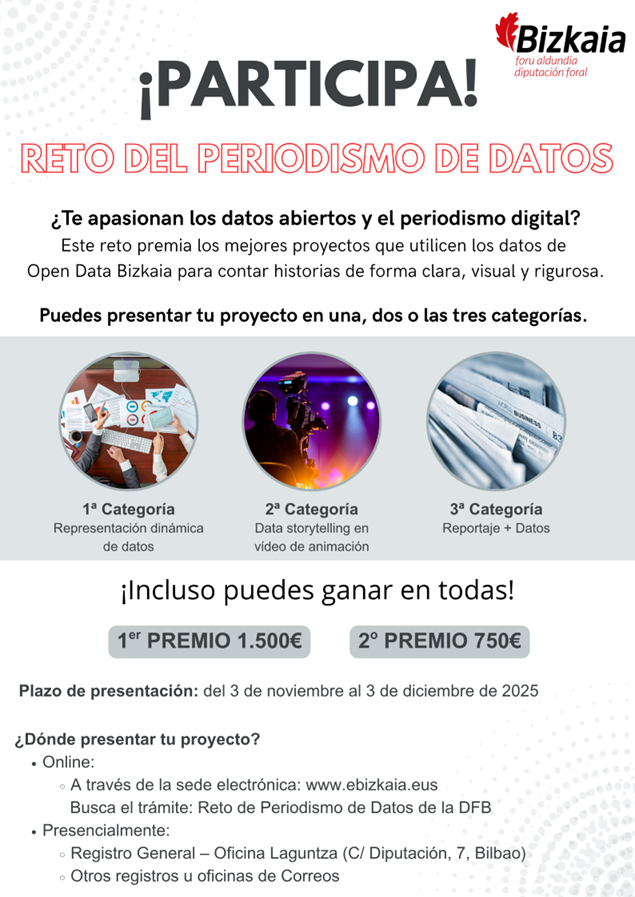
The Provincial Council of Bizkaia has launched the Data Journalism Challenge, a competition aimed at rewarding creativity, rigour and talent in the use of open data. This initiative seeks to promote journalistic projects that use the public data available on the Open Data Bizkaia platform to create informative content with a strong visual component. Whether through interactive graphics, maps, animated videos or in-depth reports, the goal is to transform data into narratives that connect with citizens.
Who can participate?
The call is open to individuals over 18 years of age, both individually and in teams of up to four members. Each participant may submit proposals in one or more of the available categories.
It is an opportunity of special relevance for students, entrepreneurs, developers, design professionals or journalists with an interest in open data.
Three categories to boost the use of open data
The competition is divided into three categories, each with its own approach and evaluation criteria:
-
Dynamic data representation: Projects that present data in an interactive, clear, and visually appealing way.
-
Data storytelling through animated video: audiovisual narratives that explain phenomena or trends using public data.
-
Reporting + Data: journalistic articles that integrate data analysis with research and depth of information.
As we have previously mentioned, all projects must be based on the public data available on the Open Data Bizkaia platform, which offers information on multiple areas: economy, environment, mobility, health, culture, etc. It is a rich and accessible source for building relevant and well-grounded stories.
Up to 4,500 euros in prizes
For each category, the following prizes will be awarded:
-
First place: 1,500 euros
-
Second place: 750 euros
The prizes will be subject to the corresponding tax withholdings. Since the same person can submit proposals to several categories, and these will be evaluated independently, it is possible for a single participant to win more than one prize. Therefore, a single participant will be able to win up to 4,500 euros, if they win in all three categories.
What are the evaluation criteria?
The awards will be made through the competitive concurrence procedure. All the projects received in the period enabled for this will be evaluated by the jury, according to a series of specific criteria for each category:
-
Dynamic data representation:
-
Communicative clarity (30%)
-
Interactivity (25%)
-
Design and usability (20%)
-
Originality in representation (15%)
-
Rigor and fidelity of data (10%)
-
Data storytelling in animation video
-
Narrative and script (30%)
-
Visual creativity and technical innovation (25%)
-
Informational clarity (20%)
-
Emotional and aesthetic impact (15%)
-
Rigorous and honest use of data (10%)
-
Feature + Data
-
Journalistic quality and analytical depth (30%)
-
Narrative integration of data (25%)
-
Originality in approach and format (20%)
-
Design and user experience (15%)
-
Transparency and traceability of sources (10%)
How are applications submitted?
The deadline for submitting projects began on November 3 and will be open until December 3, 2025 at 11:59 p.m. Applications may be submitted in a variety of ways:
-
Electronically, through the electronic office of Bizkaia, using the procedure code 2899.
-
In person, at the General Registry of the Laguntza Office (c/ Diputación, 7, Bilbao), at any other public registry or at the Post Office.
In the case of group projects, a single application signed by a representative must be submitted. This person will assume the dialogue with the organizing General Directorate, taking care of the procedures and the fulfillment of the corresponding obligations.
The documentation that must be submitted is:
-
The project to be evaluated.
-
The certificate of being up to date with tax obligations.
-
The certificate of being up to date with Social Security obligations.
-
The direct debit form, only in the event that the applicant objects to this Administration checking the bank details by its own means.
Contact Information
For queries or additional information, please contact the Provincial Council of Bizkaia. Specifically, with the Department of Public Administration and Institutional Relations, Technical Advisory Section c/ Gran Vía, 2 (48009) in the city of Bilbao. Doubts will also be answered by calling 944 068 000 and by email SAT@bizkaia.eus.
This competition represents an opportunity to explore the potential of data journalism and contribute to more transparent and accessible communication. The projects presented will be able to highlight the potential of open data to facilitate the understanding of issues of public interest, in a clear and simple way.
For more details, it is recommended to read the information
Evento
Last September, the first edition of the European Data Spaces Awards was officially launched, an initiative promoted by the Data Spaces Support Centre (DSSC) in collaboration with the European Commission. These awards were created with the aim of promoting the best data exchange initiatives, recognizing their achievements and increasing their visibility. This seeks to promote good practices that can serve as a guide for other actors in the European data ecosystem. The idea is that the awards will be awarded annually, which will help the community grow and improve.
Why are these awards important?
Data is one of Europe's most valuable economic assets, and its strategic harnessing is critical for the development of technologies such as artificial intelligence (AI). Therefore, the European strategy It involves establishing a single market for data that allows innovation to be promoted effectively. However, at present, the data is still widely distributed among many actors in the European ecosystem.
The European Data Spaces Awards are especially relevant because they recognise and promote initiatives that help to overcome this problem: data spaces. These are organisational and technical environments where multiple actors – public and private – share data in a secure, sovereign, controlled way and in accordance with common standards that promote their interoperability. This allows data to flow across sectors and borders, driving innovation.
In Spain, the development of data spaces is also being promoted through specific initiatives such as the Plan to Promote Sectoral Data Spaces.
Two award categories
In this context, two categories of awards have been created:
- Excellence in end-user engagement and financial sustainability: Recognizes data spaces with a strong user focus and viable long-term financial models.
- Most innovative emerging data space: rewards new initiatives that bring fresh and innovative ideas with high impact on the European ecosystem.

Who can participate?
The European Data Spaces Awards are open to any data space that meets these criteria:
- Its governance authority is registered in the European Union.
- It operates wholly or partially within European territory.
- It is being actively used for data exchange.
- It includes restricted data, beyond open data.
Spaces in the implementation phase can also apply, as long as they share data in pilot or pre-operational environments. In these cases, the project coordinator can act on behalf of the project.
The assessment of eligibility will be based on the applicant's self-assessment, facilitating broad and representative participation of the European data ecosystem.
The same data space can apply for both categories, although you must make two different applications.
Schedule: registration open until November 7
The competition is structured in four key phases that set the pace of the participation and evaluation process:
- On 23 September 2025, the launch event was held and the application period was officially opened.
- The application submission phase will run for 7 weeks, until November 7, allowing data spaces to prepare and register their proposals.
- This will be followed by the evaluation phase, which will begin on December 17 and last 6 weeks. During this time, the Data Spaces Support Centre (DSSC) will conduct an internal eligibility review and the jury selects the winners.
- Finally, the awards will be announced and presented during the Data Space Symposium (DSS2026) event, on February 10 and 11, 2026 in Madrid. All nominees will be invited to take the stage during the ceremony, so they will get great visibility and recognition. The winners will not receive any monetary compensation.
How to participate?
To register, participants must access the online form available on the official website of the awards. This page provides all the resources needed to prepare for your application, including reference documents, templates, and updates on the process.
The form includes three required elements:
- Basic questions about the requester and the data space.
- The eligibility self-assessment with four mandatory questions.
- A space to upload the Awards Application Document, a document in PDF format and whose template is available on the platform. (maximum 8 pages). The document, which follows a structure aligned with the Maturity Model v2.0, details the objectives and evaluation criteria by section.
In addition, participants have a space to provide, optionally, links to additional resources that help give context to their proposal.
For any questions that may arise during the process, a support platform has been set up.
The European Data Spaces Awards 2025 not only recognise excellence, but also highlight the impact of projects that are transforming the future of data in Europe. If you are interested in participating, we invite you to read the complete rules of the competition on their website.
Evento
Once again, the Junta de Castilla y León has launched its open data contest to reward the innovative use of public information.
In this post, we summarize the details to participate in the IX edition of this event, which is an opportunity for both professionals and students, creative people or multidisciplinary teams who wish to give visibility to their talent through the reuse of public data.
What does the competition consist of?
The aim of the competition is to recognize projects that use open datasets from the Junta de Castilla y León. These datasets can be combined, if the participants wish, with other public or private sources, at any level of administration.
Projects can be submitted in four categories:
- Ideas category: aimed at people or teams who want to submit a proposal to create a service, studio, application, website or any other type of development. The project does not need to be completed; the important thing is that the idea is original, viable and has a potential positive impact.
- Products and services category: designed for projects already developed and accessible to citizens, such as online services, mobile applications or websites. All developments must be available via a public URL. This category includes a specific award for students enrolled in official education during the 2024/2025 or 2025/2026 school years.
- Didactic resource category: aimed at educational projects that use open data as a support tool in the classroom. The aim is to promote innovative teaching through Creative Commons licensed resources, which can be shared and reused by teachers and students.
- Data journalism category: it will reward journalistic works published or updated in a relevant way, in written or audiovisual format, that make use of open data to inform, contextualize or analyze topics of interest to citizens. The journalistic pieces must have been published in a printed or digital media since September 24, 2024, the day following the end date of the deadline for submission of candidacies of the immediately preceding call for awards.
In all categories, it is essential that at least one dataset from the open data portal of the Junta de Castilla y León is used. This platform has hundreds of datasets on different sectors such as the environment, economy, society, public administration, culture, education, etc. that can be used as a basis to develop useful, informative and transformative ideas.
Who can participate?
The competition is open to any natural or legal person, who can be presented individually or in a group. In addition, you can submit more than one application even for different categories. Although the same project may not receive more than one award, this flexibility allows the same idea to be explored from different approaches: educational, journalistic, technical or conceptual.
What prizes are awarded?
The 2025 edition of the contest includes prizes with a financial endowment, accrediting diploma and institutional dissemination through the open data portal and other communication channels of the Board.
The distribution and amount of the prizes by category is:
- Ideas category
- First prize: €1,500
- Second prize: €500
- Category products & services
- First prize: €2,500
- Second prize: €1,500
- Third prize: €500
- Special Student Prize: €1,500
- Category teaching resource
- First prize: €1,500
- Data journalism category
- First prize: €1,500
- Second prize: €1,000
Under what criteria are the prizes awarded? The jury will assess the candidatures considering different evaluation criteria, as set out in the rules and the order of call, including their originality, social utility, technical quality, feasibility, impact, economic value and degree of innovation.
How to participate?
As in other editions, candidacies can be submitted in two ways:
- In person, at the General Registry of the Ministry of the Presidency, at the registry assistance offices of the Junta de Castilla y León or at the places established in article 16.4 of Law 39/2015.
- Electronics, through the electronic headquarters of the Junta de Castilla y León
Each application must include:
- Identification data of the author(s).
- Title of the project.
- Category or categories to which it is submitted.
- An explanatory report of the project, with a maximum length of 1,000 words, providing all the information that can be assessed by the jury according to the established scale.
- In the case of submitting an application to the Products and Services category, the URL to access the project will be specified
The deadline to submit proposals is September 22, 2025
With this contest, the Junta de Castilla y León reaffirms its commitment to the open data policy and the culture of reuse. The competition not only recognizes the creativity, innovation and usefulness of the projects presented, but also contributes to disseminating the transformative potential of open data in areas such as education, journalism, technology or social entrepreneurship.
In previous editions, solutions to improve mobility, interactive maps on forest fires, tools for the analysis of public expenditure or educational resources on the rural environment, among many other examples, have been awarded. You can read more about last year's winning proposals and others on our website. In addition, all these projects can be consulted in the history of winners available on the community's open data portal.
We encourage you to participate in the contest and get the most out of open data in Castilla y León!
Evento
Madrid City Council has launched an initiative to demonstrate the potential of open data: the first edition of the Open Data Reuse Awards 2025. With a total budget of 15,000 euros, this competition seeks to promote the reuse of the data shared by the council on its open data portal, demonstrating that they can be a driver of social innovation and citizen participation.
The challenge is clear: to turn data into useful, original and impactful ideas. If you think you can do it, below, we summarize the information you must consider to compete.
Who can participate?
The competition is open to practically everyone: from individuals to companies or groups of any kind. The only condition is to submit a project carried out between September 10, 2022 and September 9, 2025 and that uses at least one dataset from the Madrid City Council's open data portal as a base. Data from other public and private sources can also be used, as long as the Madrid City Council datasets are a key part of the project.
Of course, projects that have already been awarded, contracted or financed by the City Council itself are not accepted, nor are works submitted after the deadline or without the required documentation.
What projects can be submitted?
There are four main areas in which you can participate:
- Web services and applications: refers to projects that provide services, studios, web applications, or mobile apps.
- Studies, research and ideas: refers to projects of exploration, analysis or description of ideas aimed at the creation of services, studies, visualizations, web applications or mobile apps. Bachelor's and master's degree final university projects can also participate in this category.
- Proposals to improve the quality of the open data portal: includes projects, services, applications or initiatives that contribute to boosting the quality of the datasets published on the Madrid City Council's open data portal.
- Data visualizations: you can participate in this category with various content, such as maps, graphs, tables, 3D models, digital art, web applications and animations. Representations can be static, such as infographics, posters, or figures in publications, or dynamic, including videos, interactive dashboards, and stories.
What are the prizes?
For each category, two prizes for different economic endowments are awarded:
|
Category |
First prize |
Second prize |
|
Web services and applications |
3.000 € | 1.500 € |
| Proposals to improve the quality of the open data portal | 3.000 € | 1.500 € |
| Studies, research and ideas | 2.000 € | 1.000 € |
| Data visualizations | 2.000 € | 1.000 € |
Figure 1. Prize money for the first edition of the 2025 Open Data Reuse Awards. Source: Madrid City Council.
Beyond the economic prize, this call is a great opportunity to give visibility to ideas that take advantage of the transparency and potential of open data. In addition, if the proposal improves public services, solves a real problem or helps to better understand the city, it will have great value that goes far beyond recognition.
How are projects valued?
A jury will evaluate each project by assigning a maximum score of 50 points, which will take into account aspects such as originality, social benefit, technical quality, accessibility, ease of use, or even design, in the case of visualizations. If deemed necessary, the jury may request further information submitted to the participants.
The two projects with the highest score will win, although to be considered, the proposals must reach at least 25 points out of a possible 50. If none of them meets this requirement, the category will be declared void.
The jury will be made up of representatives from different areas of the City Council, with experience in innovation, transparency, technology and data. A representative of ASEDIE (Multisectoral Association of Information), the association that promotes the reuse and distribution of information in Spain, will also participate.
How do I participate?
The deadline to register is September 9, 2025 at 11:59 p.m. In the case of natural people, the application can be submitted:
- Online through the City Council's Electronic Office. This procedure requires identification and electronic signature.
- In person at municipal service offices.
In the case of legal people, they may only submit their candidacy electronically.
In any case, the official form must be completed and accompanied by a report explaining the project, its operation, its benefits, the use of the data, and if possible, including screenshots, links or prototypes.
You can see the complete rules here.
Evento
More than 90,000 people from all over the world participated in the latest edition of the Space App Challenge. This annual two-day event, organized by the US space agency, NASA, is an opportunity to innovate and learn about the advantages that open space data can offer.
This year the competition will be held on October 4 and 5. Through a hackathon, participants will engage first-hand with NASA's most relevant missions and research. It's an opportunity to learn how to launch and lead projects through hands-on use of NASA data in the real world. In addition, it is a free activity open to anyone (those under 18 years of age must be accompanied by a legal guardian).
In this post, we tell you some of the keys you need to know about this global benchmark event.
Where is it held?
Under the banner of the Space Apps Challenge, virtual and face-to-face events take place all over the world. Specifically, in Spain, meetings are held in several cities:
- Barcelona
- Where: in person, at 42 Barcelona (Carrer D'Albert Einstein 11).
- Madrid
- Where: face-to-face, at the School of Digital Competences – San Blas Digital (Calle Amposta, 34).
- Murcia
- Where: in person at UCAM HITECH (Av. Andrés Hernandez Ros, 1, Guadalupe).
- Malaga
- Where: Face-to-face, at a location to be determined (you can contact the event organizer through the link).
- Pamplona
- Where: face-to-face and virtual, in a location to be determined (you can contact the event organization through the link)
- San Vicente del Raspeig (Alicante)
- Where: in person, at the Alicante Science Park (University of Alicante, San Vicente del Raspeig).
- Seville
- Where: Face-to-face, at a location yet to be determined (you can contact the event organizer via the link).
- Valencia
- Where: in person, at the UPV Student House, Polytechnic University of Valencia (Camino de Vera, s/n Building 4K).
- Zaragoza
- Where: in person, at the Betancourt Building, Río Ebro Campus (EINA) Calle María de Luna, 1.
All of them will have a welcome ceremony on Friday, October 3 at 5:30 p.m . in which the details of the competition will be presented, the teams and the themes of each challenge will be organized.
To participate in any of the events, you can register individually and the organization will help you find a team. You can also register your team directly (of a maximum of 6 people).
If you can't find any in-person events near you, you can sign up for the universal event that will be online.
Are there any prizes?
Yes! Each event will award its own prizes. In addition, NASA recognizes, each year, ten global awards divided into different categories:
-
Best Use of Science Award: recognizes the project that makes the most valid and outstanding use of science and/or the scientific method.
-
Best Data Use Award: awarded to the project that makes spatial data more accessible or uses it in a unique way.
-
Best Use of Technology Award: distinguishes the project that represents the most innovative use of technology.
-
Galactic Impact Award: awarded to the project with the greatest potential to improve life on Earth or in the universe.
-
Best Mission Concept Award: recognizes the project with the most plausible concept and design.
-
Most Inspiring Award: It is awarded to the project that manages to move and inspire the public.
-
Best Narrative Award: Highlights the project that most creatively communicates the potential of open data through the art of storytelling.
-
Global Connection Award: awarded to the project that best connects people around the world through technology.
-
Art and Technology Award: recognizes the project that most effectively combines technical and creative skills.
- Local Impact Award: awarded to the project that demonstrates the greatest potential to generate impact at the local level.
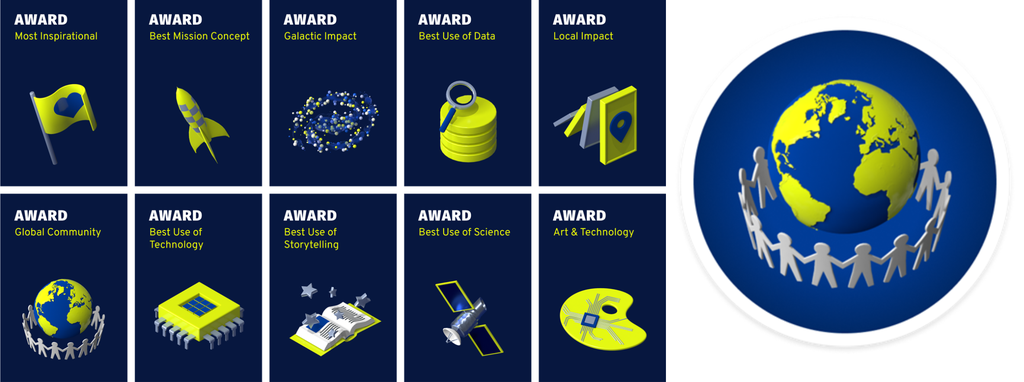
Figure 1. Space App Challenge Awards. Source: https://www.spaceappschallenge.org/brand/
From Gijón to the world: the Spanish project awarded in 2024
In last year's edition, a Spanish project, specifically from Gijón, won the global award for best mission concept with its Landsat Connect application proposal. The AsturExplorer team developed a web application designed to provide a fast, simple and intuitive way to track the path of Landsat satellites and access surface reflectance data. Their project fostered interdisciplinary and scientific learning capacities, and empowered citizens.
The Landsat program consists of a series of Earth observation satellite missions, jointly managed by NASA and the U.S. Geological Survey (USGS), providing images and data about our planet since 1972.
End users of the app developed by AsturExplorer can set a destination location and receive notifications in advance to know when the Landsat satellite will pass over each area. This allows users to prepare and take their own measurements on the ground and obtain pixel data without the need to constantly monitor satellite schedules.
The AsturExplorer team used open Landsat data from NASA and Earth Explorer. They also made use of artificial intelligence to understand the technical problem and compare multiple alternatives. You can read more about this use case here.
How do I register?
The Space App Challenge website offers a section of frequently asked questions and a video tutorial to facilitate registration. The process is simple:
- Create an account
- Register for the Hackathon
- Choose a local event
- Join a team and form your own
- Submit a project (before 11.59am on 5 October)
- Complete the Engagement Survey
We encourage you to be part of this global benchmark event where you will reuse open datasets. A great opportunity!
Evento
Valencia City Council has launched a call to reward projects that promote the culture of open information and open data in the city. Specifically, it seeks to promote the culture of government transparency and good governance through the reuse of open data.
If you are thinking of participating, here are some of the keys you should take into account (although do not forget to read the complete rules of the call for more information).
What do the prizes consist of?
The awards consist of a single category that encompasses projects that demonstrate the potential of the reuse of public open data , and may also include private data. Specifically, applications, technological solutions, services, works, etc. may be presented. that use public data from the city of Valencia to benefit the community.
The requirements that must be met are the following:
- To present an innovative character and highlight its impact on improving the lives of people and their environment.
- Be current and be implemented in general, in the territorial area of the municipality of Valencia. The final projects of bachelor's, master's or doctoral theses can have been carried out at any university, but it is mandatory that they refer to and base their research on areas of transparency in the city of Valencia.
- Use inclusive and non-sexist language.
- Be written in Spanish or Valencian.
- Have a single author, which may be a legal entity or association.
- Be written in accordance with the terms and conditions of the call, and articles previously published in journals may not participate.
- Not have received a subsidy from the Valencia City Council for the same purpose.
Who can participate?
The contest is aimed at audiences from wide sectors: students, entrepreneurs, developers, design professionals, journalists or any citizen with an interest in open data.
Both natural and legal persons from the university field, the private sector, public entities and civil society can participate, provided that they have developed the project in the municipality of Valencia.
What is valued and what do the prizes consist of?
The projects received will be evaluated by a jury that will take into account the following aspects:
- Originality and degree of innovation.
- Public value and social and urban impact.
- Viability and sustainability.
- Collaborative nature.
The jury will choose three winning projects, which will receive a diploma and a financial prize consisting of:
- First prize: 5,000 euros.
- Second prize: 3,000 euros.
- Third prize: 2,000 euros.
In addition, the City Council will disseminate and publicize the projects that have been recognized in this call, which will be a loudspeaker to gain visibility and recognition.
The awards will be presented at a public event in person or virtually in the city of Valencia, to which all participants will be invited. An opportunity to engage in conversation with other citizens and professionals interested in the subject.
How can I participate?
The deadline for submitting projects is 7 July 2025. The application can be made in two ways:
- In person, presenting the standard form and Annex 1 of the declaration of responsibility.
- Digitally through the Electronic Office, where an online application form (which includes the responsible declaration) will be completed.
In both cases, in addition, an explanatory report of the project will have to be presented. This document will contain the description of the project, its objectives, the actions developed and the results obtained, detailed in a maximum of 20 pages. It is also necessary to review the additional documentation indicated in the rules, necessary according to the nature of the participant (natural person, legal entity, associations, etc.).
For those participants who have doubts, the email address sctransparencia@valencia.es has been enabled. You can also ask any questions on the 962081741 and 962085203 phones.
You can see the complete rules at this link.