


Noticia
ASEDIE (the Multisectoral Information Association) has just published a new edition of its Infomediary Sector Report, which analyses the real, economic and social value of companies reusing data from the public and/or private sector to develop value-added products. The presentation took place at an event at the National Geographic Institute, in which the Data Office also participated.
This year is special because the report is in its 10th edition. Throughout these years, the different reports have shown the growth and consolidation of the sector. Specifically, for this edition, 701 companies have been identified, which represents a growth of 58% compared to the first report, produced in 2013. However, the figure is very similar to that already analysed in 2021.
This year's edition is subtitled "Data Economy in the Infomediary". The data economy already plays a major role in European production ecosystems and is expected to continue to grow: by 2025, it is estimated that it will contribute 4% of GDP.
In this context, ASEDIE has set among its objectives not only to promote the infomediary sector and the Data Economy, but also to contribute to raising public awareness of its benefits. To this end, it has prepared this report with various indicators that show the impact of the sector.
Main findings of the report
Below is a breakdown of the main conclusions drawn from the report:
- The 10th edition of the report shows a turnover of more than €2 billion, offering employment to almost 23,000 professionals.
- 44% of the infomediary companies surveyed use AI to create value-added products or as a tool. 72% of respondents claim to use both public and private data for the creation of their products and/or services. On the other hand, 17% of the companies indicate that they only use private information compared to 11% that only use public data.
- There are 3 sectors that continue to account for most of the activity, with geographic information standing out. The majority of infomediaries specialise in "geographic information" (24%), "market research" (20%) and the "economic and financial" sub-sector (19%).
- Only two of the subsectors account for almost half of total sales (49%): "Geographic information" and "Economic and financial". However, "Publishing", despite being the 6th sector in terms of number of companies, is the one with the highest average sales (€6M) and median (€917,000). Regarding the latter, it practically doubles the next most important sector ("Directoriales"), which has a value of around €503,000, well above the rest of the sectors.
- Most of the companies are located in the Community of Madrid (38%), Catalonia (13%) and Andalusia (11%). As in previous years, the Infomediary Sector is represented in all the Autonomous Communities.
- 71% of the infomediary companies have been created less than 20 years ago. Of these, 36% are between 11 and 20 years old and 35% are less than 10 years old. The average age continues to be 16 years, with the Publishing subsector being the oldest and the Tourism subsector the youngest.
- The average number of employees per company in the Infomediary Sector is 43, reaching 22,638 employees. As in turnover, the subsector with the highest figure is "geographic information" with 30% of the total.
- The aggregate subscribed capital reached 273,789,439 €, which represents a decrease of 12.2% with respect to the previous edition. Furthermore, the three most capitalised subsectors are "market research", "economic and financial" and "geographic information".
- The net profit generated this year exceeds 110 million euros, which represents a slight decrease compared to the previous year. "Culture" and "Directories" were the only two sub-sectors whose companies did not make a positive profit this year.
- The report identifies the opening of new public sources, the digitisation of the public sector and the interoperability of sources as the main challenges to be addressed. The updating and quality of information are some of the barriers to access and reuse of information.
- 94% of respondents see the creation of the Data Office as an opportunity for the geospatial sector. They expect this body to help in the coordination, centralisation and integration of data, and to promote openness and homogenisation of the availability of public sources.

Top 3 ASEDIE and success stories
The report includes a review of the status of the Top 3 Asedie, ASEDIE's initiative to promote the complete opening of three datasets by all Autonomous Communities, following unified criteria that facilitate their reuse. In 2019, the opening of the Cooperatives, Associations and Foundations databases was proposed. The initiative was a success, and all Communities have now opened at least two of the three proposed databases. This initiative is included in Commitment 9 of the 4th Open Government Plan.
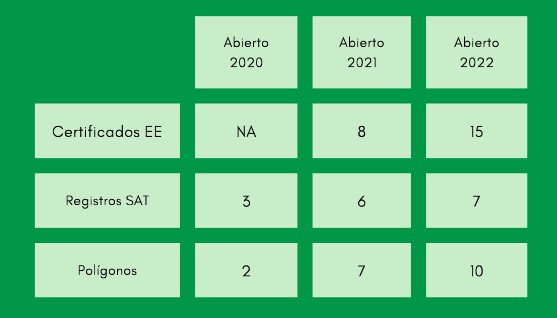
Given the good reception, a new Top 3 was launched in 2020, aimed at those Autonomous Communities that had already opened the first three databases, so that they could continue to advance in the opening of new datasets relating to: Register of Energy Efficiency Certificates, Industrial Estates and SAT Registers (Agricultural Transformation Companies). The evolution in the opening of these databases in the last year has also been remarkable, as shown in the following image.
The report concludes with several success stories of infomediary companies and examples of the products and services they produce, such as Infoempresa's web browser extension for obtaining business information or Axesor's platform (Investiga Pro) that allows online consultation of the Real Property Databases of both the Commercial Registry and the General Council of Notaries.
The report is available on Asedie's website in Spanish together with the video of the presentation of the report. It will soon be available in English together with an executive summary in French and Portuguese.
In conclusion, the sector is in good health, but this year has shown a slight decrease of 4.6% in times of pandemic. However, these figures are above the Spanish average (Spain's GDP fell by almost 10% in the same period). Although 55% of respondents have noticed the effect of Covid-19 on companies' or citizens' access to their data, the fact that 92% of respondents say they are satisfied with the level of digitisation available to them gives hope for improved results in the near future.

Noticia
The application of new techniques aimed at extracting value from data has become a reality in the current environment, accelerating its transformation into knowledge for decision making. Therefore, it is common to focus on the exploitation of data as an indispensable part of its management, arising linked to the concept of its exploitation the concept of data space, enabling its sharing, involving both the private sector and the different public agencies, whether local, national or international.
A data space is an ecosystem where the voluntary sharing of its participants' data materializes within an environment of sovereignty, trust and security, established through integrated governance, organizational, regulatory and technical mechanisms. The concept of sovereignty is key, understood as the ability of a participant to maintain control over its own data, expressing the terms and conditions that will govern its permitted uses.
What is Gaia - X?
In this context, the Gaia-X initiative was born, a European private sector initiative for the creation of an open, federated and interoperable data infrastructure, built on the values of digital sovereignty and data availability, and the promotion of the Data Economy. The challenge is to establish an ecosystem in which data from European entities are available and shared in a trusted and managed environment according to European principles of decentralization, openness, transparency, sovereignty and interoperability.
Gaia-X aims to develop a federation of cloud data services, enabling cooperation and data sharing between companies and organizations across the European Union independently of infrastructure providers. Gaia-X defines the technical concepts, as well as the governance, for the interoperability of datasets and data infrastructures, assuming the role of orchestrator, mediating between data providers and data consumers via the federated services, and creating a physical decoupling between the data layer and the infrastructure layer.
From the origins
The Gaia-X initiative began to see the light of day in October 2019, when the French and German ministries of economic affairs presented the project. Since then, its growth has been exponential. At the end of 2020, a summit was held, leading to the founding of the Gaia-X association AISBL in January 2021. During that year, Gaia-X is defined as a brand, as well as the first versions of its services. Among its objectives is the development of common standards, best practices, tools, as well as governance mechanisms.
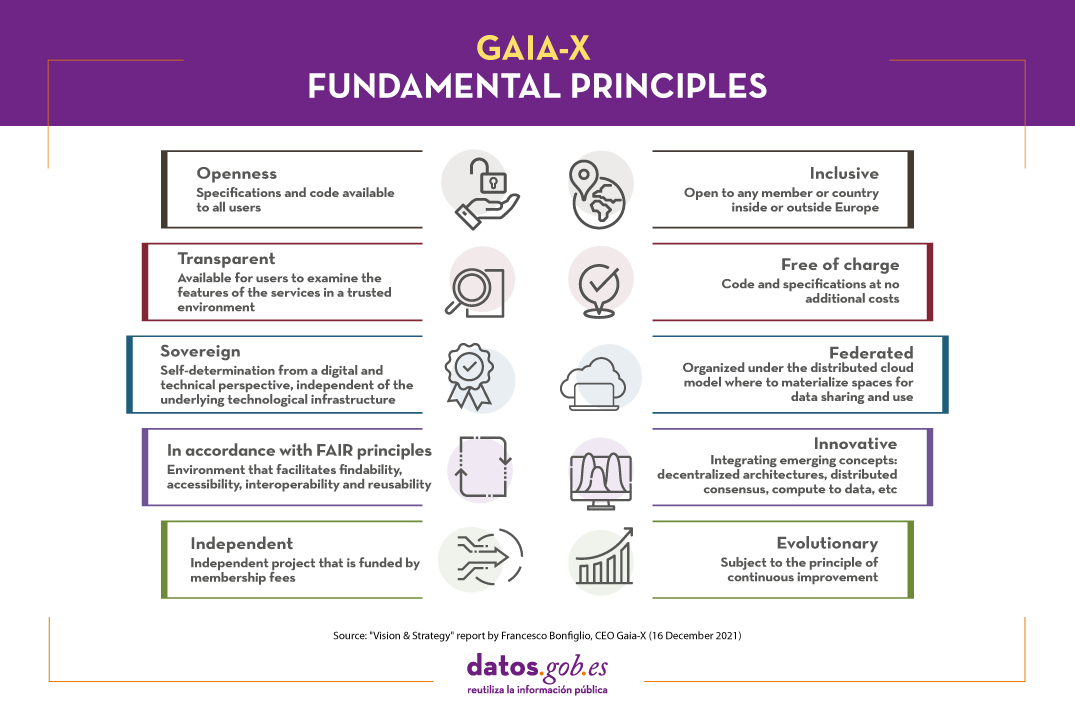
Gaia-X currently has 324 members around the world. Companies, associations, research institutions, administrations and politicians have joined forces to work together in the initiative. The 22 founding members are divided between France and Germany, where organizations such as Amadeus, Atos, OVH, Orange Business Services, Siemens, IDS, SAP SE and Deustche Telekom stand out. However, these 22 have been joined over the years by private and public organizations from Asia (China, India, Japan, Singapore, Qatar, Korea), the USA and mainly Europe (Austria, Belgium, Estonia, Finland, France, Germany, Greece, Poland, Ireland, Italy, Lithuania, Luxembourg, the Netherlands, Poland, Portugal, Slovakia, Slovenia, Spain, Sweden, Switzerland, the UK).
In Spain, in mid-2021, the Ministry of Economic Affairs and Digital Transformation, through the Secretary of State for Digitalization and Artificial Intelligence, promotes the creation of the Gaia-X national hub, an organizational initiative whose objective is to accelerate European capacity in industrial/sectoral data sharing and digital sovereignty, contributing to generate the common European infrastructure, through the launch of a manifesto of interest whose response from private sector companies was overwhelming.
In this way, Spain also joins the Government Advisory Board of Gaia-X, the European partnership to accelerate the response to data sharing. The Spanish Gaia-X Hub seeks that companies of all sizes create community around data, serving to develop and implement innovative solutions based on data and Artificial Intelligence, which boost national competitiveness, paying special attention to SMEs and micro-SMEs. Thus, it is proposed the creation of data spaces in the different productive sectors, interoperable with European spaces and without interfering in other spaces that the industry has planned to develop.
The data economy in Spain
This project aims to contribute to the economic growth of our country. According to the European Data Market study, the data economy in Spain had in 2019 a value equivalent to 2.5% of the national GDP, and it is estimated that by 2025, this value will represent more than 4% of the Spanish GDP, provided that the appropriate legal, political and financing environment is created, which highlights the importance of data in the economy.
Spain's commitment to the data economy is part of the Digital Spain 2025 strategy, which highlights the need to support the digitization of key sectors for the economy, such as tourism and healthcare in particular, but also others such as mobility, the agri-food sector and e-commerce.
Conclusions
Data are the focus of the major transformations taking place in today's environment as a result of the application of new digital technologies. For this reason, no digital economy will be able to consolidate and compete globally without a strong data economy.
The European strategy aims to create a single European data market, open to data from all over the world, in which personal and non-personal data, including sensitive business data, is secure and businesses have access to high-quality industrial data in a way that drives growth and creates value. Through the associated rules and mechanisms, the aim is to ensure that data can flow, European standards and values are fully respected, and the rules for data access and use are fair, practical and clear.
Data spaces in general, and initiatives such as Gaia-X in particular, are key elements in achieving the objectives of the European strategy, serving to foster ecosystems that create new products and services based on more accessible data.
Content prepared by Juan Mañes, expert in Data Governance, with contributions from the Data Office.
The contents and views expressed in this publication are the sole responsibility of the author.