


Evento
ASEDIE, Asociación Multisectorial de la Información, will hold its usual International Conference on the Reuse of Public Sector Information on December 13. This will be its 15th edition and the central theme is 'Learning from the past, we build the future of data'. The aim of the meeting is to address the interaction that exists between the different regulations that coexist in the data ecosystem, analyze the most significant barriers identified by the sector and discuss solutions.
When and where will it be held?
The event, which will be held in classroom format on December 13, 2023 at the Universidad Rey Juan Carlos, in the Salón de Grados of the Departmental Building (Paseo de los Artilleros, Madrid). The reception of attendees begins at 9:00 and the event will end at 13:10.
What is the program?
The focus of this edition will be on collective learning, taking as a reference the steps taken so far in the world of data and in the construction of the future of the sector.
The session will open at 9:40 am with the inauguration of the event by the President of ASEDIE, Ignacio Jiménez and the Director of Public Governance of the Ministry of Finance and Public Function, Ms. Clara Mapelli to give way to the intervention of Carlos Romero, Advisor for Digital Transformation at the Permanent Representation of Spain to the European Union.
The event will feature two round tables:
-
The first table will take place at 10:00 and will deal with 'The data economy in search of a coherent regulation'. It will be attended by Santiago Graña, Deputy Director General of Planning and Governance of the Digital Administration; Joaquín Meseguer, Technical Advisor at the Madrid City Council; Lorenzo Avello, Deputy Director General of Telecommunications Management; and Mercedes Ortuño, Advisory Member of the Deputy Directorate General of Promotion and Authorizations of the Spanish Data Protection Agency (AEPD). It will be moderated by Casilda Lazcano, president of ASEDIE's Legal Commission.
-
The second round table, at 12:00h, will focus on the future under the title 'Open data in time perspective: 2024 and beyond'. Participants will include Carmen de Pablos Heredero, Professor of Business Organization at the URJC; Agustín T. de Villar Iglesias, Deputy Director of the Information Infrastructure Area of the Institute of Statistics and Cartography of Andalusia; and Fernando de Pablo Martín, Director General of the Digital Office of the Madrid City Council.
In between, at 11:00 a.m., the ASEDIE 2023 Awards will be presented in two categories.
-
The finalists in the category Driving the Data Economy are: the Data Office, for the generation of data of proven quality from an effective and standardized government; the City Council of Zaragoza, with its project Know and explore Zaragoza; and the Generalitat de Catalunya, for the classification of datasets by the Sustainable Development Goals.
-
In the category Promoting data knowledge, the finalist initiatives are the Data Management Summit, an event that promotes data knowledge, the Spanish Federation of Municipalities and Provinces, for the standard ordinance on data governance in municipal entities, and the Geographic Institute of Aragon for ICEARAGON, with the project on spatial knowledge of the region.
After the awards ceremony, Conchita Cornejo, Coordinator of the area of the General Secretariat for Inspection and Control of Capital Movements, and Emilio López, Director of the National Center for Geographic Information, will intervene.
You can consult the complete program here.
How can I register?
Attendance is in person with limited capacity and registrations can be made on the ASEDIE website.

Blog
Two of the European Union's most relevant data regulations will soon articulate the legal contours that will delineate the development of the data economy in the coming years. The Data Governance Act (DGA) has been fully applicable since September 24, 2023, while the wording of the Data Act (DA) was approved on November 27.
They are not the only ones, as the legal framework already includes other important rules that regulate interconnected matters, thus revealing the proactive approach of the European Union in establishing rules of the game in line with the needs of European citizens and businesses. These guidelines provide the necessary legal security environment to achieve the ultimate goal of promoting a European Digital Single Market.
In the case of the DGA and the DA, the negotiations for their approval have shown that their objectives were shared by the stakeholders concerned. For both, data is a central element for digital transformation, and they share an interest in eliminating or reducing the barriers and obstacles to its sharing. They thus assume that data-driven innovation will bring enormous benefits to citizens and the economy. Therefore, creating legal frameworks that facilitate such processes is a common goal for companies, institutions and citizens.
The contributions from the academic, business and associative worlds have been abundant and enriching, both for the drafting phase of the standards and for what will be their implementation and development in practice. One of the most reiterated questions is the concern about how the different standards of this 'digital regulatory package' will interact. Particularly important is the interaction with the General Data Protection Regulation, which is why DGA and DA have established general guidelines on the pre-eminence of said regulation in case of conflict. In this regard, the increase in regulation does not prevent specific situations from arising in practice around key concepts in the field of personal data, such as consent, purposes of processing, anonymization, or portability.
Another of the issues highlighted has to do with the search for synergies between this regulation and current or future data business models. The recognized overall goal is to boost the development of data spaces and the data economy as a whole. This goal will be closer to the extent that the 'regulatory burden' does not reduce the incentives for companies to invest in collecting and managing data; that it does not weaken the competitive position of European companies (by adequately protecting trade secrets, intellectual property rights and confidentiality); and that there is an appropriate balance between general and business interests.
The case of the Data Governance Act
In the case of the DGA, the provisions related to data brokering services ––one of the central parts of the regulation–– occupied a significant part of the previous analyses carried out. For example, the question was raised as to what extent SMEs and start-ups could compete with large technology companies in the provision of these services; or whether, by requiring the structural separation required of data brokering service providers (through a separate legal entity), there could be problems related to other functionalities of the same companies.
Along the same lines, the question arises as to whether a more decentralized data economy requires new intermediaries, or whether under the new legal formulation, they can successfully compete in data markets through alternative, non-vertically integrated business models.
Considerations on the deployment of the Data Act
With regard to the DA, the final wording of the regulation clarified its scope, the definition of concepts and the categorization of data, as suggested by the industry. The specific sectoral application to be developed subsequently will further define those concepts and interpretations that provide the desirable legal certainty.
This legal certainty has also been argued in relation to trade secrets, intellectual property rights and confidentiality; an aspect that the Regulation seeks to address with safeguards aimed at preventing misuse and fraud.
Other aspects that attracted attention were compensation for making data available; dispute resolution procedures; provisions on unfair contract terms (aimed at compensating for imbalances in bargaining power); making data available in case of exceptional need; and, finally, provisions on switching from one data processing service provider to another.
A positive starting point
The starting point, in any case, is positive. The data economy in the European Union is taking hold on the basis of the European Data Strategy and the regulatory package that develops it. There are also practical examples of the potential of the industrial ecosystems that are being deployed around the Common European Data Spaces in sectors such as tourism, mobility and logistics, and agri-food, among others. In addition, initiatives that bring together public and private interests in this area are making significant progress in the deployment of technical and governance foundations, strengthening the competitive position of European companies, and achieving the ultimate goal of a single data market in the European Union.
Click here for an extended version of this note.
Blog
The European Union aims to boost the Data Economy by promoting the free flow of data between member states and between strategic sectors, for the benefit of businesses, researchers, public administrations and citizens. Undoubtedly, data is a critical factor in the industrial and technological revolution we are experiencing, and therefore one of the EU's digital priorities is to capitalise on its latent value, relying on a single market where data can be shared under conditions of security and, above all, sovereignty, as this is the only way to guarantee indisputable European values and rights.
Thus, the European Data Strategy seeks to enhance the exchange of data on a large scale, under distributed and federated environments, while ensuring cybersecurity and transparency. To achieve scale, and to unlock the full potential of data in the digital economy, a key element is building trust. This, as a basic element that conditions the liquidity of the ecosystem, must be developed coherently across different areas and among different actors (data providers, users, intermediaries, service platforms, developers, etc.). Therefore, their articulation affects different perspectives, including business and functional, legal and regulatory, operational, and even technological. Therefore, success in these highly complex projects depends on developing strategies that seek to minimise barriers to entry for participants, and maximise the efficiency and sustainability of the services offered. This in turn translates into the development of data infrastructures and governance models that are easily scalable, and that provide the basis for effective data exchange to generate value for all stakeholders.
A methodology to boost data spaces
Spain has taken on the task of putting this European strategy into practice, and has been working for years to create an environment conducive to facilitating the deployment and establishment of a Sovereign Data Economy, supported, among other instruments, by the Recovery, Transformation and Resilience Plan. In this sense, and from its coordinating and enabling role, the Data Office has made efforts to design a general conceptual methodology , agnostic to a specific sector. It shapes the creation of data ecosystems around practical projects that bring value to the members of the ecosystem.
Therefore, the methodology consists of several elements, one of them being experimentation. This is because, by their flexible nature, data can be processed, modelled and thus interpreted from different perspectives. For this reason, experimentation is key to properly calibrate those processes and treatments needed to reach the market with pilots or business cases already close to the industries, so that they are closer to generating a positive impact. In this sense, it is necessary to demonstrate tangible value and underpin its sustainability, which implies, as a minimum, having:
- Frameworks for effective data governance
- Actions to improve the availability and quality of data, also seeking to increase their interoperability by design
- Tools and platforms for data exchange and exploitation.
Furthermore, given that each sector has its own specificity in terms of data types and semantics, business models, and participants' needs, the creation of communities of experts, representing the voice of the market, is another key element in generating useful projects. Based on this active listening, which leads to an understanding of the dynamics of data in each sector, it is possible to characterise the market and governance conditions necessary for the deployment of data spaces in strategic sectors such as tourism, mobility, agri-food, commerce, health and industry.
In this process of community building, data co-operatives play a fundamental role, as well as the more general figure of the data broker, which serves to raise awareness of the existing opportunity and favour the effective creation and consolidation of these new business models.
All these elements are different pieces of a puzzle with which to explore new business development opportunities, as well as to design tangible projects to demonstrate the differential value that data sharing will bring to the reality of industries. Thus, from an operational perspective, the last element of the methodology is the development of concrete use cases. These will also allow the iterative deployment of a catalogue of reusable experience and data resources in each sector to facilitate the construction of new projects. This catalogue thus becomes the centrepiece of a common sectoral and federated platform, whose distributed architecture also facilitates cross-sectoral interconnection.
On the shoulders of giants
It should be noted that Spain is not starting from scratch, as it already has a powerful ecosystem of innovation and experimentation in data, offering advanced services. We therefore believe it would be interesting to make progress in the harmonisation or complementarity of their objectives, as well as in the dissemination of their capacities in order to gain capillarity. Furthermore, the proposed methodology reinforces the alignment with European projects in the same field, which will serve to connect learning and progress from the national level to those made at EU level, as well as to put into practice the design tasks of the "cyanotypes" promulgated by the European Commission through the Data Spaces Support Centre.
Finally,the promotion of experimental or pilot projects also enables the development of standards for innovative data technologies, which is closely related to the Gaia-X project. Thus, the Gaia-X Hub Spain has an interoperability node, which serves to certify compliance with the rules prescribed by each sector, and thus to generate the aforementioned digital trust based on their specific needs.
At the Data Office, we believe that the interconnection and future scalability of data projects are at the heart of the effort to implement the European Data Strategy, and are crucial to achieve a dynamic and rich Data Economy, but at the same time a guarantor of European values and where traceability and transparency help to collectivise the value of data, catalysing a stronger and more cohesive economy.
Noticia
Navarra has been the chosen venue to bring together, for the first time, representatives of the Data Offices of the autonomous communities around the centrality of data in public management. The meeting, promoted by the Secretary of State for Digitalization and Artificial Intelligence (SEDIA) and the Government of Navarra, was aimed at sharing the advances in the world of data at the regional level, as well as the assumption of commitments to lay the foundations for a digital future linked to data and its transformative power.
Focus on the transformative power of data
The Councilor for University, Innovation and Digital Transformation of the Government of Navarra, Juan Cruz Cigudosa García, was in charge of opening the conference, emphasizing the need to strengthen the response to social challenges and stimulate innovation and economic development through data, highlighting the unavoidable commitment to innovation through the use of disruptive technologies such as Artificial Intelligence, always under an ethical prism and respect for European values and principles. In this last line of action, the launching of an Ethics Committee for the Navarra Data Office was announced. This committee, framed in the Digital Spain Strategy and the Navarra Digital Strategy 2030, is aligned with the active policies and the national and international leadership of SEDIA, reflected in its charter of digital rights.
Next, the Chief Data Officer of the Government of Spain, Alberto Palomo, highlighted the strategy that had been designed at European level in relation to data and its sovereign management. He also pointed out the transformative power of data, a key element in the digital transformation and in the entry of technologies such as artificial intelligence. He also reported on the recent statement published as a result of the current Spanish Presidency of the Council of the European Union, which was signed at the beginning of November during the Gaia-X Summit meeting under the name "The Trinity of Trusted Cloud, Data and AI as Gateway to EU's competitiveness". This document is a declaration that shows the commitment of the participants in this meeting to boost data spaces in Europe through strategic autonomy in the cloud, data and artificial intelligence. It agrees, among other points, to expand and improve coordination in the development of European cloud and data initiatives, advocating interoperability as a backbone element and advocating the development of Artificial Intelligence based on high quality data and with solid governance. It also highlights the need to homogenize data sources to better model relationships, optimize processes and innovate and create new business models.
The day continued as a communication forum, in which, as an example, direct experiences of the participants could be shared, thus creating a space for reflection and dialogue. The day was structured through three thematic blocks, about the who, the how and the what for, with each block being contextualized, before the specific presentations, by SEDIA's Data Office and grounded in practice by the Government of Navarra.
-
The first thematic block was "The data ecosystem: who". It addressed some of the strategies around data from the Generalitat de Catalunya and from the Basque Government.
-
This was followed by presentations in a second block entitled "Governance model, ethics and culture: how". The governments of Aragon, Andalusia, the Canary Islands, Valencia and the Spanish Federation of Municipalities and Provinces made presentations of their success stories in this area.
-
In a final block entitled "Citizen service, innovation and data spaces: what for", presentations were given by Andalusia, the National Institute of Statistics, Castilla-la Mancha and the General Secretariat of Digital Administration, and Red.es, the latter presenting the services offered to the autonomous communities from the datos.gob.es platform.
Seven key principles to drive the data economy forward
The meeting culminated with the presentation of seven principles to advance the joint formulation of strategies and policies related to data management and the digital future. These are:
-
Establish effective data governance by setting policies, standards and procedures for the effective management, exploitation and sharing of data, while implementing controls and evaluations to ensure compliance.
-
Perform an ethical treatment of data, assessing the lawfulness and legitimacy of all data practices, seeking to minimize any adverse impact on individuals and society.
-
Prioritize reliable administrative processing centered on data, prioritizing the transition from document to data, capable of enabling and catalyzing the use of advanced technologies and tools for descriptive, predictive and prescriptive analytics (BI, big data, machine learning, deep learning), generative algorithms (LLM, GPT) and process automation (RPA).
-
Deployment of sovereign data sharing as a resource whose value increases with its dissemination, establishing who can access what data and under what conditions of use, security and trust.
-
Encourage the open dissemination of information, promoting its effective reuse and publication in accordance with FAIR principles, i.e., ensuring that data is findable, accessible, interoperable and reusable.
-
Designing and analyzing public policies based on evidence, in order to make informed decisions that lead to effective services and public innovation.
-
Fostering data culture, promoting the creation of new profiles, positions and responsibilities related to working with data, without neglecting the training and transmission of knowledge around data.
The success of the participation, the interventions and reflections raised show the consensus on advancing towards the achievement of a data-oriented Administration, capable of taking advantage, through the use of innovative technological means, of the potential of data, enabling the design, implementation and evaluation of public policies focused on the citizen, generating a data-oriented, sustainable, inclusive and social value-generating economy.
The Forum has thus become a meeting point and a place to generate synergies between the different public administrations. Interoperability between the various public sector agencies and between the different levels of government in the processing and exchange of information boosts territorial cohesion and enables the effective use of available technologies in the quest to satisfy the common good.
Blog
The European Open Science Cloud (EOSC) is a European Union initiative that aims to promote open science through the creation of an open, collaborative and sustainabledigital research infrastructure. EOSC's main objective is to provide European researchers with easier access to the data, tools and resources they need to conduct quality research.
EOSC on the European Research and Data Agenda
EOSC is part of the 20 actions of the European Research Area (ERA) agenda 2022-2024 and is recognised as the European data space for science, research and innovation, to be integrated with other sectoral data spaces defined in the European data strategy. Among the expected benefits of the platform are the following:
- An improvement in the confidence, quality and productivity of European science.
- The development of new innovative products and services.
- Improving the impact of research in tackling major societal challenges.
The EOSC platform
EOSC is in fact an ongoing process that sets out a roadmap in which all European states participate, based on the central idea that research data is a public good that should be available to all researchers, regardless of their location or affiliation. This model aims to ensure that scientific results comply with the FAIR (Findable, Accessible, Interoperable, Reusable) Principles to facilitate reuse, as in any other data space.
However, the most visible part of EOSC is its platform that gives access to millions of resources contributed by hundreds of content providers. This platform is designed to facilitate the search, discovery and interoperability of data and other content such as training resources, security, analysis, tools, etc. To this end, the key elements of the architecture envisaged in EOSC include two main components:
- EOSC Core: which provides all the basic elements needed to discover, share, access and reuse resources - authentication, metadata management, metrics, persistent identifiers, etc.
- EOSC Exchange: to ensure that common and thematic services for data management and exploitation are available to the scientific community.
In addition, the ESOC Interoperability Framework (EOSC-IF)is a set of policies and guidelines that enable interoperability between different resources and services and facilitate their subsequent combination.
The platform is currently available in 24 languages and is continuously updated to add new data and services. Over the next seven years, a joint investment by the EU partners of at least EUR 1 billion is foreseen for its further development.
Participation in EOSC
The evolution of EOSC is being guided by a tripartite coordinating body consisting of the European Commission itself, the participating countries represented on the EOSC Steering Board and the research community represented through the EOSC Association. In addition, in order to be part of the ESCO community, you only have to follow a series of minimum rules of participation:
- The whole EOSC concept is based on the general principle of openness.
- Existing EOSC resources must comply with the FAIR principles.
- Services must comply with the EOSC architecture and interoperability guidelines.
- EOSC follows the principles of ethical behaviour and integrity in research.
- EOSC users are also expected to contribute to EOSC.
- Users must comply with the terms and conditions associated with the data they use.
- EOSC users always cite the sources of the resources they use in their work.
- Participation in EOSC is subject to applicable policies and legislation.
EOSC in Spain
The Consejo Superior de Investigaciones Científicas (CSIC) of Spain was one of the 4 founding members of the association and is currently a commissioned member of the association, in charge of coordination at national level.
CSIC has been working for years on its open access repository DIGITAL.CSIC as a step towards its future integration into EOSC. Within its work in open science we can highlight for example the adoption of the Current Research Information System (CRIS), information systems designed to help research institutions to collect, organise and manage data on their research activity: researchers, projects, publications, patents, collaborations, funding, etc.
CRIS are already important tools in helping institutions track and manage their scientific output, promoting transparency and open access to research. But they can also play an important role as sources of information feeding into the EOSC, as data collected in CRIS can also be easily shared and used through the EOSC.
The road to open science
Collaboration between CRIS and ESCO has the potential to significantly improve the accessibility and re-use of research data, but there are also other transitional actions that can be taken on the road to producing increasingly open science:
- Ensure the quality of metadata to facilitate open data exchange.
- Disseminate the FAIR principles among the research community.
- Promote and develop common standards to facilitate interoperability.
- Encourage the use of open repositories.
- Contribute by sharing resources with the rest of the community.
This will help to boost open science, increasing the efficiency, transparency and replicability of research.
Content prepared by Carlos Iglesias, Open data Researcher and consultant, World Wide Web Foundation.
The contents and points of view reflected in this publication are the sole responsibility of its author.
Blog
Europe is developing a common data space for tourism, aiming to integrate various stakeholders, including local and regional authorities, the private sector, and multiple member states. Spain is among them, where several workshops have already been conducted as part of the process to energize the national tourism data space, focusing on discussing the challenges, opportunities, and use cases in the sector.
The future tourism data space is at the core of the transition towards greater sustainability and profound digitization in the tourism sector. This initiative is also aligned with the European data strategy, which envisions creating a single market where information can be freely shared, promoting innovation across different economic sectors and certain areas of public interest. Furthermore, future data spaces hold significant importance in Europe's quest to regain digital sovereignty, reasserting control over data, fostering innovation, and the ability to develop and implement its own legislation in the digital environment.
Even in last year's conference on the Future of the European Union, the importance of data spaces in sectors like tourism and mobility was highlighted, recognizing them as key sectors in the digital transformation. Tourism, in particular, stands to benefit greatly from such initiatives due to its dynamic and ever-evolving nature, heavily reliant on user experiences and the timely access to necessary information.
Therefore, the European common data space for tourism aims to boost data exchange and reuse, establishing a governance model that respects existing legislation. The ultimate goal is to benefit all stakeholders in various ways, including:
- Promoting innovation in the sector by enhancing and personalizing services through access to high-quality information.
- Assisting public authorities in making data-driven decisions for the sustainability of their tourism offerings.
- Supporting specialized businesses in providing better services based on data analysis and market trends.
- Facilitating market access for sector businesses in Europe.
- Improving data availability for the creation of high-quality official statistics.
However, there are several challenges in sharing existing data in the tourism sector, primarily stemming from concerns regarding reciprocity and data reuse. These challenges can be summarized as follows:
- Data interoperability: Designing and managing a European tourist experience involves handling a wide array of non-personal data across various domains like mobility, environmental management, or cultural heritage, all of which enrich the tourist experience. The primary challenge in this regard is the ability to share and cross-reference information from different sources without duplications, with a reference framework that promotes interoperability between different sectors, utilizing existing standards where possible.
- Data access: Unlike other sectors, the European Union's tourism ecosystem lacks a single marketplace platform. Various offerings are modeled and cataloged by different actors, both public and private, at national, regional, or local levels. While the tourism data space does not aim to serve as a central booking node, it can greatly contribute by providing effective information search tools, facilitating access to necessary data, decision-making, and fostering innovation in the sector.
- Data provision by public and private entities: There is a wide variety of data in this sector, from open data like schedules and weather conditions to private and commercial data such as search, bookings, and payments. A significant portion of these commercial data are managed by a small group of large private entities, making it necessary to establish inclusive dialogue for fair and appropriate rules on data access within the shared data space.
To consolidate this initiative, the Transition Path for Tourism emphasizes the need to advance in the creation and optimization of a specific data space for the tourism sector. This aims to modernize and enhance this crucial economic sector in Europe through key actions:
- Governance: The governance of the tourism data space will determine how the main enablers will relate to ensure interoperability. The goal is to ensure that data is accessed, shared, and used lawfully, fairly, transparently, proportionally, and without discrimination to build trust, support research, and foster innovation within the sector.
- Semantics for interoperability: Common data models and vocabularies are needed for effective interoperability. National statistical agencies and Eurostat already have some consensus definitions, but their adoption within the tourism sector remains uneven. Therefore, clarifying definitions within the multilingual European context is crucial to establish a common European data model, accompanied by implementation guidelines. Spain has already made pioneering efforts in semantic interoperability, such as the development of the Tourism Ontology, technical standards for semantic applied to smart tourism destinations, or the model for collecting, exploiting, and analyzing tourism data.
- Technical standards for interoperability: The Data Spaces Support Center (DSSC) is already working to identify common technical standards that can be reused, taking into account existing or ongoing initiatives and regulatory frameworks. Additionally, all data spaces will also benefit from Simpl, a cloud federation middleware that will serve as a foundation for major data initiatives funded by the European Commission. Furthermore, there are specific technical standards in the sector, such as those developed by Eurostat for sharing accommodation data.
- Defining the role of the private sector: The European common data space for tourism will clearly benefit from cooperation with the private sector and the market for new services and tools it can offer. Some platforms already share data with Eurostat, and new agreements are being developed to share other non-personal tourism data, along with the creation of a new code of conduct to foster trust among various stakeholders.
- Supporting SMEs in the transition to a data space: The European Commission has long provided specific support to SMEs through Digital Innovation Hubs (DIHs) and the Enterprise Europe Network (EEN), offering technical and financial support, as well as assistance in developing new digital skills. Some of these centers specialize in tourism. Additionally, the European Tourism Enterprises Network (SGT), with 61 members in 23 countries, also provides support for digitalization and internationalization. This support for SMEs is particularly relevant given that they represent nearly all of the companies in the tourism sector, specifically 99.9%, of which 91% are microenterprises.
- Supporting tourism destinations in the transition to a data space: Tourism destinations must integrate tourism into their urban plans to ensure sustainable and beneficial tourism for residents and the environment. Several Commission initiatives enhance the availability of necessary information for tourism management and the exchange of best practices, promoting cooperation among destinations and proposing actions to improve digital services.
- Proof of concept for the tourism data space: The European Commission, along with several member states and private actors, is currently conducting a series of pilot tests for tourism data spaces through the DSFT and DATES coordination and support actions (CSAs). The main goal of these tests is to align with existing technical standards for accommodation data and demonstrate the value of interoperability and business models that arise from data sharing through a realistic and inclusive approach, focusing on short-term rentals and accommodation. In Spain, the report on the state of the tourism data space explains the current status of the national data space design.
In conclusion, the European Commission is firmly committed to supporting the creation of a space where tourism-related data flows while respecting the principles of fairness, accessibility, security, and privacy, in line with the European data strategy and the Pact for Skills development. The goal is to build a common data space for tourism that is progressive, robust, and integrated within the existing interoperability framework. To achieve this, the Commission urges all stakeholders to share data for the mutual benefit of everyone involved in an ecosystem that will be crucial for the entire European economy.
At the end of October, there will also be a new opportunity to learn more about the tourism data space and the challenges associated with data spaces in general, through the European Big Data Value Forum in Valencia.
Content created by Carlos Iglesias, Open Data Researcher and Consultant, World Wide Web Foundation.
The content and viewpoints reflected in this publication are the sole responsibility of the author.
Noticia
The Asociación Multisectorial de la Información (ASEDIE) has published the eleventh edition of its Report on the Infomediary Sector, in which it reviews the health of companies that generate applications, products and/or services based on information from the public sector, taking into account that it is the holder of the most valuable data.
Many of the datasets that enable the infomediary sector to develop solutions are included in the lists of High Value Datasets (HVDS) recently published by the European Union. An initiative that recognises the potential of public information and adds to the aim of boosting the data economy in line with the European Parliament's proposed Data Law.
ASEDIE brings together companies from different sectors that promote the data economy, which are mainly nourished by the data provided by the public sector. Among its objectives is to promote the sector and contribute to raising society's awareness of its benefits and impact. It is estimated that the data economy will generate €270 billion of additional GDP for EU Member States by 2028.
The presentation of this edition of the report, entitled 'The Data Economy in the infomediary field', took place on 22 March in Red.es's Enredadera room. In this year's edition of the report, 710 active companies have been identified, with a turnover of more than 2,278 million euros. It should be noted that the first report in 2013 counted 444 companies. Therefore, the sector has grown by 60% in a decade.
Main conclusions of the report
- The infomediary sector has grown by 12.1%, a figure above the national GDP growth of 7.6%. These data are drawn from the analysis of the 472 companies (66% of the sample) that submitted their accounts for the previous years.
- The number of employees is 22,663. Workers are highly concentrated in a few companies: 62% of them have less than 10 workers. The subsector with the highest number of professionals is Geographic information, with 30% of the total. Together with the sub-sectors Financial economics, Technical consultancy and Market research, they account for 75% of the employees.
- Employment in the companies of the Infomediary Sector grew by 1.7%, compared to a fall of 1.1% in the previous year. All sub-sectors have grown, except for Tourism and Culture, which have remained the same, and Technical Consultancy and Market Research, which have decreased.
- The average turnover per employee exceeded 100,000 euros, an increase of 6.6% compared to the previous year. On the other hand, the average expenditure per employee was 45,000 euros.
- The aggregate turnover was 2,279,613,288 euros. The Geographical Information and Economic and Financial subsectors account for 46% of sales.
- The aggregate subscribed capital is 250,115,989 euros. The three most capitalised subsectors are Market Research, Economic and Financial and Geographic Information, which account for 66% of capitalisation.
- The net result exceeds 180 million euros, 70 million more than last year. The Economic and Financial subsector accounted for 66% of total profits.
- The sub-sectors of Geographical Information, Market Research, Financial Economics and Computer Infomediaries account for 76% of the infomediary companies, with a total of 540 companies out of the 710 active companies.
- The Community of Madrid is home to the largest number of companies in the sector, with 39%, followed by Catalonia (13%), Andalusia (11%) and the Community of Valencia (9%).
As the report shows, the arrival of new companies is driving the development of a sector that already has a turnover of around 2,300 million euros per year, and which is growing at a higher rate than other macroeconomic indicators in the country. These data show not only that the Infomediary Sector is in good health, but also its resilience and growth potential.
Progress of the Study on the impact of open data in Spain
The report also includes the results of a survey of the different actors that make up the data ecosystem, in collaboration with the Faculty of Information Sciences of the Complutense University of Madrid. This survey is presented as the first exercise of a more ambitious study that aims to know the impact of open data in Spain and to identify the main barriers to its access and availability. To this end, a questionnaire has been sent to members of the public, private and academic sectors. Among the main conclusions of this first survey, we can highlight the following:
- As main barriers to publishing information, 65% of respondents from the public sector mentioned lack of human resources, 39% lack of political leadership and 38% poor data quality.
- The biggest obstacle in accessing public data for re-use is for public sector respondents that the information provided in the data is not homogeneous (41.9%). Respondents from the academic sector point to the lack of quality of the data (43%) and from the private sector it is believed that the main barrier is the lack of updating (49%).
- In terms of the frequency of use of public data, 63% of respondents say that they use the data every day or at least once a week.
- 61% of respondents use the data published on the datos.gob.es portal.
- Respondents overwhelmingly believe that the impact of data openness on the private sector is positive. Thus, 77% of private sector respondents indicate that accessing public data is economically viable and 89% of them say that public data enables them to develop useful solutions.
- 95% of respondents call for a compendium of regulations affecting the access, publication and re-use of public sector data.
- 27% of public sector respondents say they are not aware of the six categories of high-value data set out in Commission Implementing Regulation (EU) 20137138 .
This shows that most respondents are aware of the potential of the sector and the impact of public sector data, although they indicate that some obstacles to re-use need to be overcome and believe that a compendium of the different existing regulations would facilitate their implementation and help the development of the sector.
Top 3 ASEDIE
As in previous editions, the report includes the status of the Top 3 ASEDIE, an initiative that aims for all Autonomous Communities to fully open three sets of data, following unified criteria that facilitate their reuse, and which is included in the IV Open Government Plan. In 2019, the opening of the Cooperatives, Associations and Foundations databases was proposed, and there are currently 16 Autonomous Communities in which they can be accessed in full. Moreover, in eight of them, it is possible to access the NIF with a unique identifier, which improves transparency and makes the information more accurate.
Taking into account the good results of the first proposal, in 2020 a new request for opening data was launched, the Second Top 3 ASEDIE, in this case of Energy Efficiency Certificates, SAT Registries (Agricultural Transformation Companies) and Industrial Estates, whose evolution has also been very positive. The following map shows the opening situation of these three new databases in 2023.
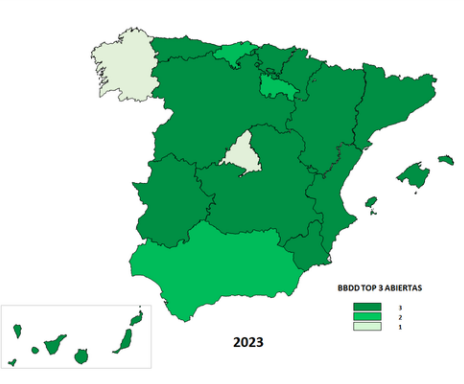
The Top 3 ASEDIE initiative has been a success and has become a reference in the sector, promoting the opening of databases in a joint manner and demonstrating that it is possible to harmonise public data sources to put them at the service of society.
The next steps in this sense will be to monitor the databases already open and to disseminate them at all levels, including the identification of good practices of the Administration and the selection of examples to encourage public-private collaboration in open data. In addition, a new top 3 will be identified to advance in the opening of new databases, and a new initiative will be launched to reach the bodies of the General State Administration, with the identification of a new Top 3 AGE.
Success stories
The report also includes a series of success stories of products and services developed with public sector data, such as Iberinform's API Market, which facilitates access to and integration of 52 sets of company and self-employed data in company management systems. Another successful case is Geocode, a solution focused on standardisation, validation, correction, codification and geolocation processes for postal addresses in Spain and Portugal.
Geomarketing makes it possible to increase the speed of calculating geospatial data and Infoempresa.com has improved its activity reports on Spanish companies, making them more visual, complete and intuitive. Finally, Pyramid Data makes it possible to access the Energy Efficiency Certificates (EEC) of a given property portfolio.
As examples of good practices in the public sector, the ASEDIE report highlights the open statistical data as a driver of the Data Economy of the Canary Islands Statistics Institute (ISTAC) and the technology for the opening of data of the Open Data Portal of the Andalusian Regional Government (Junta de Andalucía).
As a novelty, the category of examples of good practices in the academic sector has been incorporated, which recognises the work carried out by the Geospatial Code and the Report on the state of open data in Spain III, by the Rey Juan Carlos University and FIWARE Foundation.
The 11th ASEDIE Report on the Data Economy in the infomediary field can be downloaded from the ASEDIE website in Spanish. The presentations of the economic indicators and the Top 3 and the Data Ecosystem are also available.
In summary, the report shows the good health of the industry that confirms its recovery after the pandemic, its resilience and growth potential and, in addition, the good results of public-private collaboration and its impact on the data economy are observed.
Blog
Motivation
According to the European Data Proposal Law, data is a fundamental component of the digital economy and an essential resource for ensuring ecological and digital transitions. In recent years, the volume of data generated by humans and machines has experienced an exponential increase. It is essential to unlock the potential of this data by creating opportunities for its reuse, removing obstacles to the development of the data economy, and respecting European norms and values. In line with the mission of reducing the digital divide, measures must be promoted that allow everyone to benefit from these opportunities fairly and equitably.
However, a downside of the high availability of data is that as more data accumulates, chaos ensues when it is not managed properly. The increase in volume, velocity, and variety of data also implies a greater difficulty in ensuring its quality. And in situations where data quality levels are inadequate, as analytical techniques used to process datasets become more sophisticated, individuals and communities can be affected in new and unexpected ways.
In this changing scenario, it is necessary to establish common processes applicable to data assets throughout an organization's lifecycle, maximizing their value through data governance initiatives that ensure a structured, managed, coherent, and standardized approach to all activities, operations, and services related to data. Ultimately, it must be ensured that the definition, creation, storage, maintenance, access, and use of data (data management) are done following a data strategy aligned with organizational strategies (data governance), and that the data used is suitable for the intended use (data quality).
UNE Specifications for Data Governance, Management, and Quality
The Data Office, a unit responsible for promoting the sharing, management, and use of data across all productive sectors of the Spanish economy and society, in response to the need for a reference framework that supports both public and private organizations in their efforts to ensure adequate data governance, management, and quality, has sponsored, promoted, and participated in the development of national UNE specifications in this regard.
The UNE 0077:2023 Data Governance, UNE 0078:2023 Data Management, and UNE 0079:2023 Data Quality Management specifications are designed to be applied jointly, enabling the creation of a solid and harmonized reference framework that promotes the adoption of sustainable and effective data practices.
Coordination is driven by data governance, which establishes the necessary mechanisms to ensure the proper use and exploitation of data through the implementation and execution of data management processes and data quality management processes, all in accordance with the needs of the relevant business process and taking into account the limitations and possibilities of the organizations that use the data.
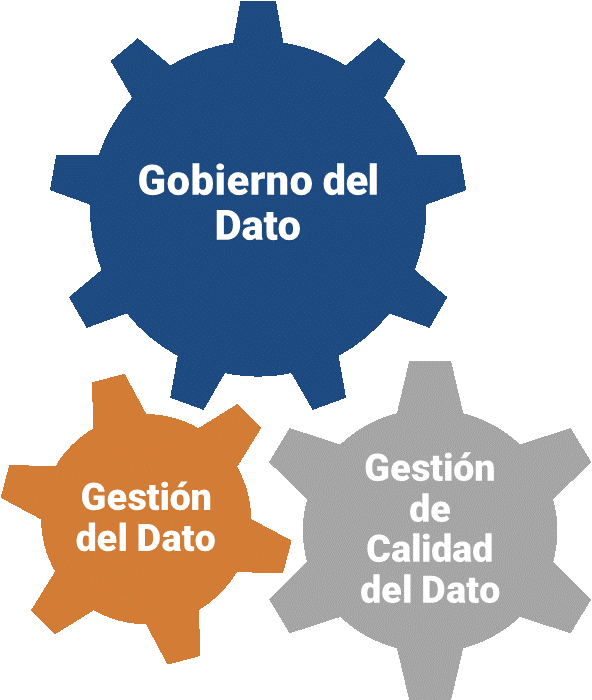
Each regulatory specification is presented with a process-oriented approach, and each of the presented processes is described in terms of its contribution to the seven components of a data governance and management system, as introduced in COBIT 2019:
- Process, detailing its purpose, outcome, tasks, and products according to ISO 8000-61.
- Principles, policies, and frameworks.
- Organizational structures, identifying the data governance bodies and decision-making structures.
- Information, required and generated in each process.
- Culture, ethics, and behavior, as a set of individual and collective behaviors of people and the organization.
- People, skills, and competencies needed to complete all activities and make decisions and corrective actions.
- Services, infrastructure, and applications that include technology-related aspects to support data management, data quality management, and data governance processes.
UNE 0077:2023 Specification_Data Governance
The UNE 0077:2023 specification covers aspects related to data governance. It describes the creation of a data governance framework to evaluate, direct, and monitor the use of an organization's data, so that it contributes to its overall performance by obtaining the maximum value from the data while mitigating risks associated with its use. Therefore, data governance has a strategic character, while data management has a more operational focus aimed at achieving the goals set in the strategy.
The implementation of proper data governance involves the correct execution of the following processes:
- Establishment of data strategy
- Establishment of data policies, best practices, and procedures
- Establishment of organizational structures
- Optimization of data risks
- Optimization of data value
UNE 0078:2023 Specification_Data Management
The UNE 0078:2023 specification covers the aspects related to data management. Data management is defined as the set of activities aimed at ensuring the successful delivery of relevant data with adequate levels of quality to the agents involved throughout the data life cycle, supporting the business processes established in the organizational strategy, following the guidelines of data governance, and in accordance with the principles of data quality management.
The implementation of adequate data management involves the development of thirteen processes:
- Data processing
- Management of the technological infrastructure
- Management of data requirements
- Management of data configuration
- Historical data management
- Data security management
- Metadata management
- Management of data architecture and design
- Data sharing, intermediation and integration
- Master data management
- Human resource management
- Data lifecycle management
- Data analysis
UNE 0079:2023 Specification_Data Quality Management
The UNE 0079:2023 specification covers the data quality management processes necessary to establish a framework for improving data quality. Data quality management is defined as the set of activities aimed at ensuring that data has adequate quality levels for use that allows an organization's strategy to be satisfied. Having quality data will allow an organization to achieve the maximum potential of data through its business processes.
According to Deming's continuous improvement PDCA cycle, data quality management involves four processes:
- Data quality planning,
- Data quality control and monitoring,
- Data quality assurance, and
- Data quality improvement.
The data quality management processes are intended to ensure that data meets the data quality requirements expressed in accordance with the ISO/IEC 25012 standard.
Maturity Model
As a joint application framework for the different specifications, a data maturity model is outlined that integrates the processes of governance, management, and data quality management, showing how the progressive implementation of processes and their capabilities can be carried out, defining a path of improvement and excellence across different levels to become a mature data organization.
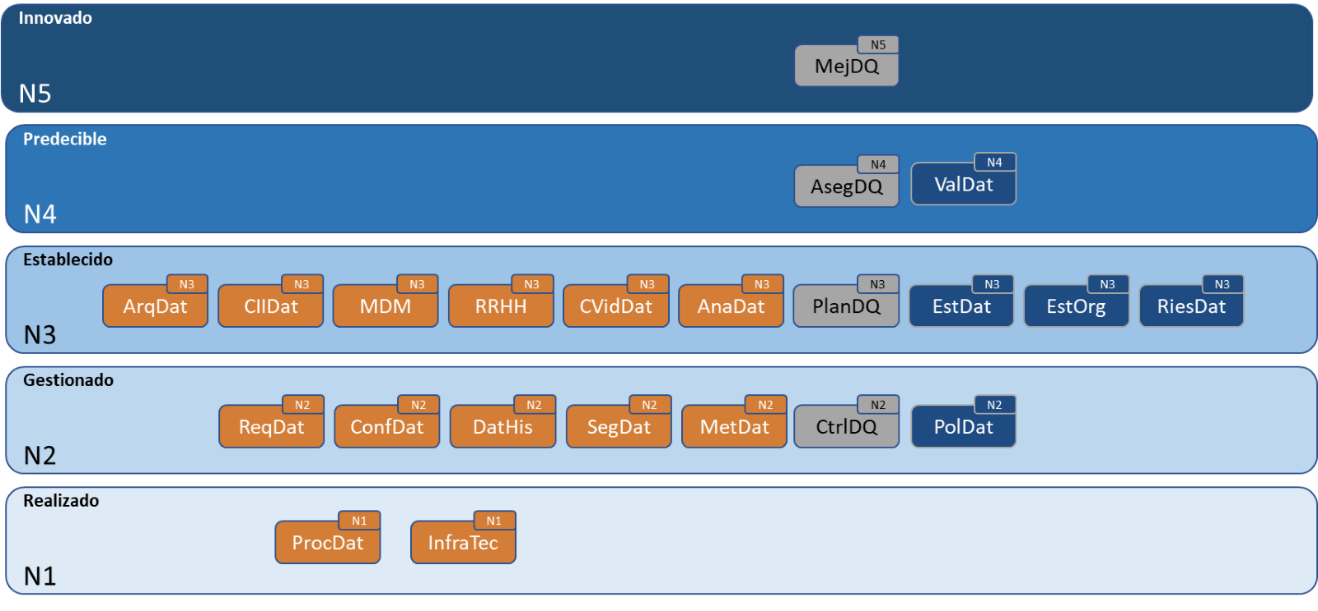
The Data Office will promote the development of the UNE 0080 specification to provide a data maturity assessment model that complies with the content of the governance, management, and data quality management specifications and the aforementioned framework.
The content of this guide, as well as the rest of the UNE specifications mentioned, can be viewed freely and free of charge from the AENOR portal through the link below by accessing the purchase section and marking “read” in the dropdown where “pdf” is pre-selected. Access to this family of UNE data specifications is sponsored by the Secretary of State for Digitalization and Artificial Intelligence, Directorate General for Data. Although viewing requires prior registration, a 100% discount on the total price is applied at the time of finalizing the purchase. After finalizing the purchase, the selected standard or standards can be accessed from the customer area in the my products section.
The content of this guide can be downloaded freely and free of charge from the AENOR portal through the link below by accessing the purchase section. Access to this family of UNE data specifications is sponsored by the Secretary of State for Digitalization and Artificial Intelligence, Directorate General for Data. Although the download requires prior registration, a 100% discount on the total price is applied at the time of finalizing the purchase. After finalizing the purchase, the selected standard or standards can be accessed from the customer area in the my products section.
- UNE 0077:2023 SPECIFICATION: https://tienda.aenor.com/norma-une-especificacion-une-0077-2023-n0071116
- UNE 0078:2023 SPECIFICATION: https://tienda.aenor.com/norma-une-especificacion-une-0078-2023-n0071117
- UNE 0079:2023 SPECIFICATION: https://tienda.aenor.com/norma-une-especificacion-une-0079-2023-n0071118
- UNE 0080:2023 SPECIFICATION: https://tienda.aenor.com/norma-une-especificacion-une-0080-2023-n0071383
Documentación
Data is a key pillar of digital transformation. Reliable and quality data are the basis of everything, from the main strategic decisions to the routine operational process, they are fundamental in the development of data spaces, as well as the basis of disruptive solutions linked to fields such as artificial intelligence or Big Data.
In this sense, the correct management and governance of data has become a strategic activity for all types of organizations, public and private.
Data governance standardization is based on 4 principles:
- Governance
- Management
- Quality
- Security and data privacy
Those organizations that want to implement a solid governance framework based on these pillars have at their disposal a series of technical standards that provide guiding principles to ensure that an organization's data is properly managed and governed, both internally and by external contracts.
With the aim of trying to clarify doubts in this matter, the Spanish Association for Standardization (UNE), has published various support materials.
The first is an article on the different technical standards to consider when developing effective data governance . The rules contained in said article, together with some additional ones, are summarized in the following infographic:
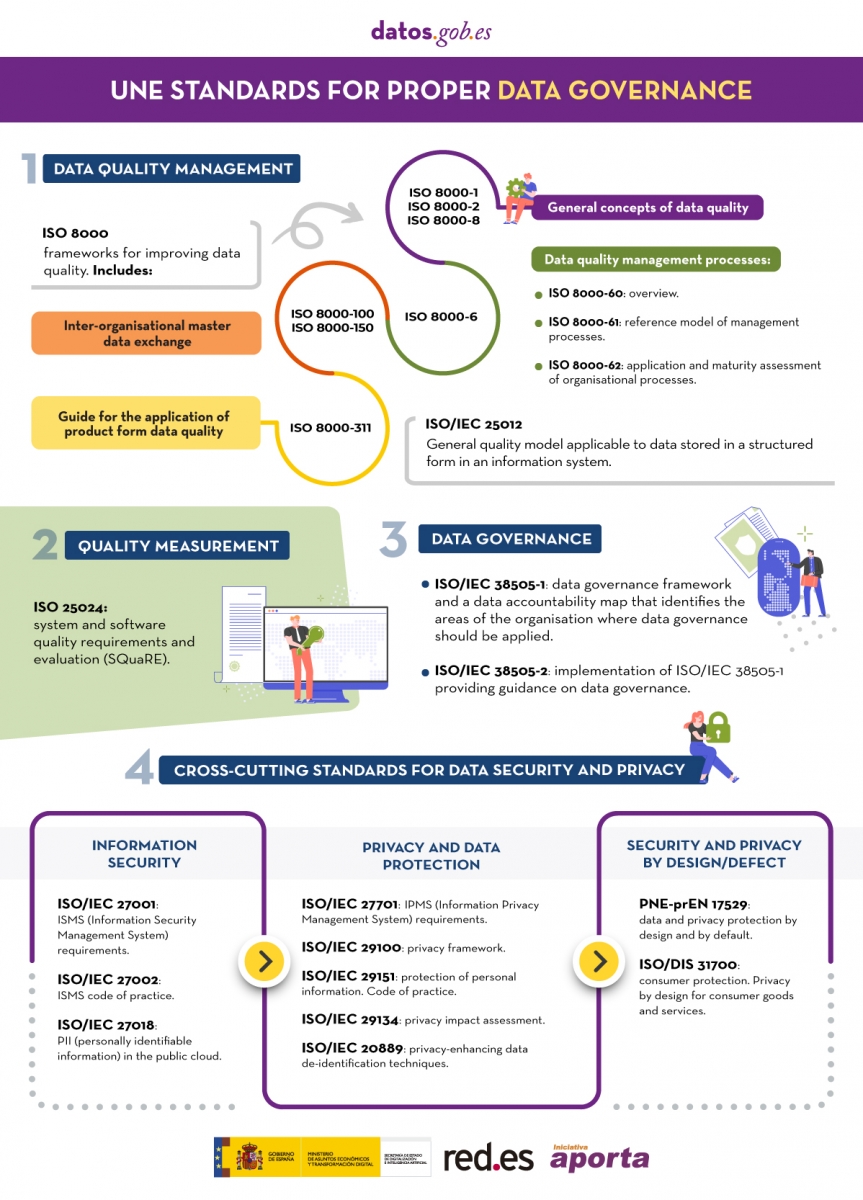
(You can download the accessible version in word here)
In addition, the UNE has also published the report "Standards for the data economy" , which can be downloaded at the end of this article. The report begins with an introduction where the European legislative context that is promoting the Data Economy is deepened and the recognition that it makes of technical standardization as a key tool when it comes to achieving the objectives set. The technical standards included in the previous infographic are analyzed in more detail below.
Entrevista
The AMETIC association represents companies of all sizes linked to the Spanish digital technology industry, a key sector for the national GDP. Among other issues, AMETIC seeks to promote a favorable environment for the growth of companies in the sector, promoting digital talent and the creation and consolidation of new companies.
At datos.gob.es we spoke with Antonio Cimorra, Director of Digital Transformation and Enabling Technologies at AMETIC, to reflect on the role of open data in innovation and as the basis for new products, services and even business models.
Full interview:
1. How does open data help drive digital transformation? What disruptive technologies are the most benefited by the opening of data?
Open data is one of the pillars of the data economy , which is called to be the basis of our present and future development and the digital transformation of our society. All industries, public administrations and citizens themselves have only just begun to discover and use the enormous potential and usefulness that the use of data brings to improving the competitiveness of companies, to the efficiency and improvement of services. of Public Administrations and to social relations and people's quality of life.
2. One of the areas in which they work from AMETIC is Artificial Intelligence and Big Data, among whose objectives is to promote the creation of public platforms for sharing open data. Could you explain to us what actions you are carrying out or have carried out for this?
At AMETIC we have an Artificial Intelligence and Big Data Commission in which the main companies that provide this technology participate . From this area, we work on the definition of initiatives and proposals that contribute to disseminating their knowledge among potential users, with the consequent advantages that their incorporation in the public and private sectors entails. Outstanding examples of actions in this area are the recent presentation of the AMETIC Artificial Intelligence Observatory, as well as the AMETIC Artificial Intelligence Summit. which in 2022 will celebrate its fifth edition that will focus on showing how Artificial Intelligence can contribute to meeting the Sustainable Development Goals and the Transformation Plans to be executed with European Funds
3. Open data can serve as a basis for developing services and solutions that give rise to new companies . Could you tell us an example of a use case carried out by your partners?
Open data, and very particularly the reuse of public sector information, are the basis for the development of countless applications and entrepreneurial initiatives both in consolidated companies in our technology sector and in many other cases of small companies or startups found in this source of information the motor of development of new businesses and approach to the market.
4. What types of data are most in demand by the companies you represent?
At present, all industrial and social activity data are in great demand by companies , due to their great value in the development of projects and solutions that have been demonstrating their interest and extension in all areas and types of organizations and users. usually.
5. It is also essential to have data sharing initiatives such as GAIA-X , built on the values of digital sovereignty and data availability. How have companies received the creation of a national hub ?
The technology sector has received the creation of the GAIA-X national hub very positively, understanding that our contribution from Spain to this European project will be of enormous value to our companies from very different fields of activity. Data sharing spaces in sectors such as tourism, health, mobility, industry, to give a few examples, have Spanish companies and experiences that are an example and a reference at European and global level .
6. Right now there is a great demand for professionals related to data collection, analysis and visualization. However, the supply of professionals, although it is growing, continues to be limited . What should be done to boost training in skills related to data and digitization?
The supply of technology professionals is one of the biggest problems for the development of our local industry and for the digital transformation of society. It is a difficulty that we can describe as historical, and that far from going less, every day there is a greater number of positions and profiles to cover. It is a worldwide problem that shows that there is no single or simple formula to solve it, but we can mention the importance of all social and professional agents developing joint and collaborative actions that allow the digital training of our population from an early age. and cycles and specialized training and degree programs that are characterized by their proximity to what will be the professional careers for which it is necessary to have the participation of the business sector
7. During the last years, you have been part of the jury of the different editions of the Aporta Challenge. How do you think these types of actions contribute to boosting data-driven businesses?
The Aporta Challenge has been an example of support and encouragement for the definition of many projects around open data and for the development of its own industry that in recent years has been growing very significantly with the availability of data of very different groups, in many cases by the Public Administrations, and their subsequent reuse and incorporation into applications and solutions of interest to very different users.
Open data constitutes one of the pillars of the data economy, which is called to be the basis of our present and future development and of the digital transformation of our society.
8. What are the next actions that are going to be carried out in AMETIC linked to the data economy?
Among the most outstanding actions of AMETIC in relation to the data economy, it is worth mentioning our recent incorporation into the national hub of GAIA-X for which we have been elected members of its board of directors, and where we will represent and incorporate the vision and contributions of the digital technology industry in all the data spaces that are constituted , serving as a channel for the participation of the technology companies that carry out their activity in our country and that have to form the basis of the projects and use cases that integrate into the European network GAIA-X in collaboration with other national hubs.