Demography
A comprehensive understanding of demographic trends is made possible through open data sets covering immigration and emigration, family composition, gender, childhood, ageing populations, and population registers. These data sets are critical for effective public policy planning and the design of tailored solutions.


Discover the most notable datasets
Imagen Media

Población por sexo, municipios y edad (grupos quinquenales)
Descripción
Tabla de INEbase
Población por sexo, municipios y edad (grupos quinquenales). Anual. Estadística del Padrón Continuo
Imagen Media

Migraciones interiores dentro de la misma isla según sexos y lugares de nacimiento. Islas de Canarias y años
Descripción
Migraciones interiores dentro de la misma isla según sexos y lugares de nacimiento. Islas de Canarias y años.
Imagen Media

Flujo de emigración con destino al extranjero de personas de 25 y más años, por provincia, año, nacionalidad (española/extranjera) y nivel de estudios (agrupación de niveles). EM
Descripción
Tabla de INEbase
Imagen Media

Estadística del registro de parejas de hecho
Descripción
Parejas que comparten su vida en una relación afectiva análoga a la conyugal, no fundamentada en el vínculo matrimonial, que requieren la existenci
Imagen Media

Población - Personas extranjeras
Descripción
Personas de otras nacionalidades empadronadas en la ciudad, distribuidas por género. Evolución en los últimos años
Imagen Media

Mostrar más…
Descripción
Búsqueda en el catálogo de datos.gob.es por la categoría Demografía
Featured current topics
Blog

Current news
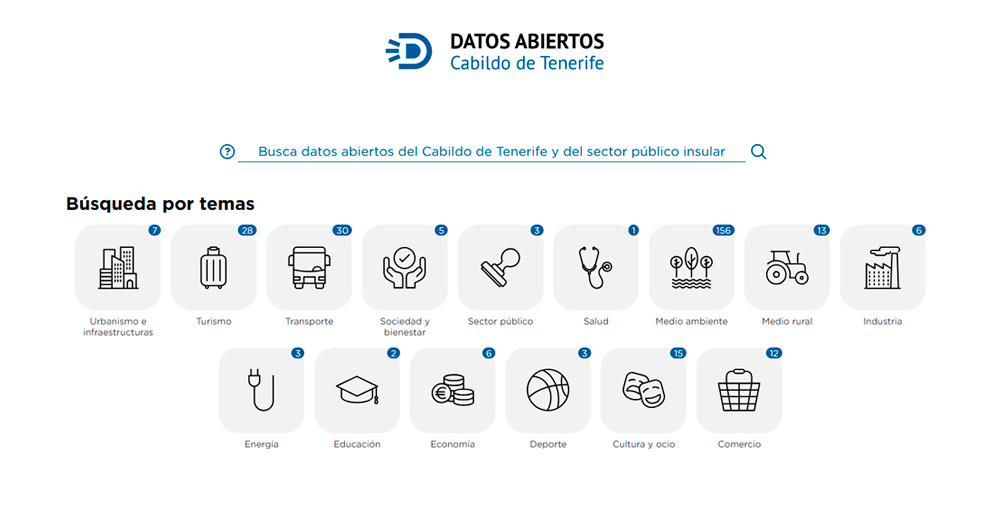
This is how the Cabildo of Tenerife promotes open data
Today, transparency, innovation and economic development are key to the progress of public institutions. In this context, the Cabildo of Tenerife has undertaken an ambitious open data project that goes beyond the mere publication of information. The aim of this strategy is to ffacilitate access to information, encourage the reuse of data and generate social and economic value for the island.
Through its open data portal, the Cabildo not only promotes transparency and accountability, but also drives innovation in areas as diverse as tourism, transport and the rural environment.
Scope and objectives of the project
The open data portal of the Cabildo de Tenerife publishes datasets of the entire public sector of the island, including all the local councils of the island. In particular, this includes municipalities with less than 20,000 inhabitants, as established in Law 8/2015 on Island Councils. The main objectives of this project are:
Strengthen the internal and external culture of data use.
Increase transparency and accountability through data.
Generate wealth in society through the reuse of information.
In this website you can find open datasets on tourism, transport, culture and leisure and rural environment, among others. In order to offer this information the Cabildo of Tenerife benefits from the collaboration of various bodies such as:
Transportes Interurbanos de Tenerife (TITSA)
Tenerife Island Water Board (CIATF)
Metropolitan of Tenerife
SINPROMI (Insular Society for the Promotion of People with Disabilities)
ITER (Technological Institute of Renewable Energies)
IASS (Insular Institute for Social and Socio-sanitary Care)
Agrocabildo
Most downloaded and significant datasets
Some of the portal's most downloaded and significant datasets include:
Network of weather stations, with updates every 10 minutes.
Influx of recreational areas, such as Punta Teno and Barranco de Masca, with information on the number of vehicles and people, and the itineraries of trails or routes on the island.
Indicators of economic development and tourist occupancy, including the number of tourists accommodated by category and area.
Prices of fruit and vegetable products in Mercatenerife.
Public transport Origin Destination Matrix, which shows the relationships between the places of origin and destination of journeys made on the island.
The Cabildo's open data project is clearly oriented towards compliance with the Technical Interoperability Standard (NTI) for the Reuse of Information Resources and the DCAT-AP model, areas in which it continues to make progress.
Use cases and applications to incentivise reuse
Beyond publishing open datasets, the Cabildo de Tenerife actively promotes their use through the development of use cases and applications. Examples of this work include:
Development of a urban development plan in the municipality of Santiago del Teide through the reuse of various datasets.
Project on meteorological data forecasting.
Tourist places and traffic scorecards. Specifically:
On tourism: tourist accommodation places by municipality and type, and the occupancy rate by type of accommodation from 1978 to 2023.
About traffic: dashboard from Power BI showing the average daily traffic intensity at a station on the island for the years 2021, 2022 and 2023.
On the other hand, in order to promote the reuse of the data on its portal, the Cabildo of Tenerife organises various activities, such as the I Ideas Reuse Competition, in which 25 proposals were received. This competition will be followed by a second edition that will reward the development of applications.
In addition, there are talks and webinars, such as the one organised in collaboration with the Chair of Big Data, Open Data and Blockchain of the University of La Laguna on how to use open data from Tenerife to drive innovation , which you can see again here.
Next steps AI and community building
In order to measure the impact of open data, the Cabildo de Tenerife uses tools such as Google Analytics which allows the analysis of user interaction with the available data. The next big step, as reported by the organisation, will be to implement a virtual assistant with generative AI that will allow:
Analysing data with natural language.
Discover trends and correlations.
Bringing information closer to any citizen.
In parallel, the Cabildo of Tenerife will also continue working on new avenues of collaboration with the island's municipalities and other entities, with the aim of expanding the amount and variety of open data available to citizens.
From datos.gob.es, we encourage development and research professionals, students and citizens to explore, reuse and create value with Tenerife's data.
Visit datos.tenerife.es
 17/03/2025
Other resources
Open data to achieve the Sustainable Development Goals
The Sustainable Development Goals (SDGs) are a set of targets adopted by the international community aimed at addressing the most pressing challenges of our time. These goals were born simultaneously with the Global Partnership for Sustainable Development Data and the International Open Data Charter, which provided a coalition of experts willing to harness the benefits of open data for the new development agenda.
In this regard, open data plays a very relevant role within the development agenda as indicators of progress towards the SDGs, as they allow measuring and evaluating their progress, as well as improving accountability through sharing that data with the rest of the community, providing great value in multiple ways:
Facilitating decision-making when designing policies and strategies to help meet the objectives;
Identifying inequalities and specific challenges among different regions or population groups;
Improving efficiency in policy and program implementation;
As an engine of innovation through research and development.
Today, there are large global databases, both generalist and thematic, that we can use for these purposes, in addition to all the national data sources available in our own country. However, there is still a long way to go in this regard: the proportion of SDG indicators that are conceptually clear and have good national coverage is still 66%, according to the latest SDG progress report published in 2023. This leads us to continue facing data gaps in vital areas such as poverty, hunger, education, equality, sustainability, climate, seas, and justice, among others. Additionally, there is also a fairly general and significant lack of data disaggregated by age and/or sex, making it very difficult to properly monitor the potential progress of the objectives regarding the most vulnerable population groups.
This report takes a journey through the dual role that open data plays in supporting national and global progress in achieving the SDGs. The first part of the report focuses on the better-known role of open data as mere indicators when measuring progress towards the objectives, while the second part addresses its role as a key tool and fundamental raw material for the development of society in general and for the achievement of the objectives themselves in particular. To this end, it explores which datasets could have the greatest potential in each case, showing some practical examples, both national and at the European level, in various specific development objectives.
If you want to learn more about the content of this report, you can watch the interview with its author.
You can download the full report below
04/03/2024