


Publication date
05/08/2026
Update date
15/09/2026


Name
Laura Castillo Martínez, communications consultant; Estefanía Díaz Viteri, communications consultant.
Description
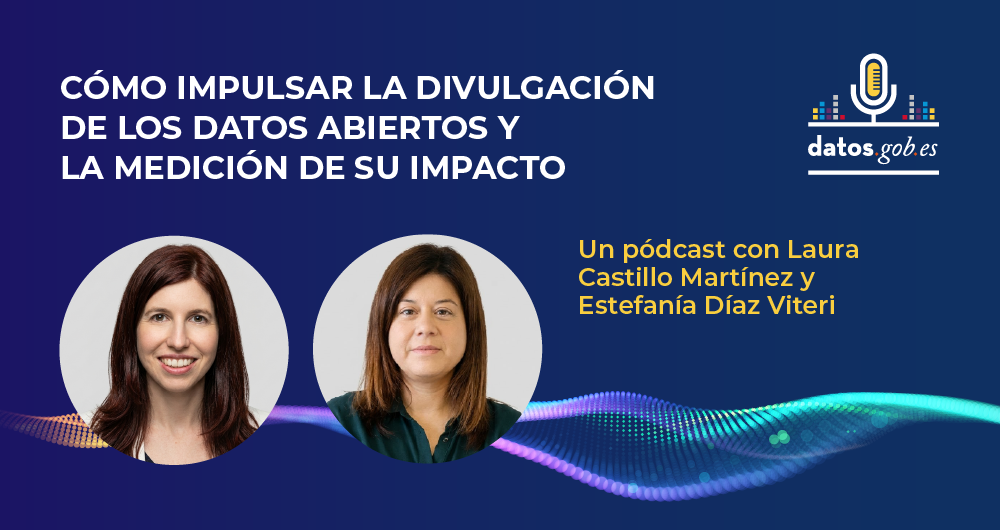
In this podcast we address a key aspect of the open data universe: how to promote the dissemination of open data so that these public datasets really reach those who can take advantage of them. For this reason, two of the people behind the dynamization of datos.gob.es are directly involved:
- Estefanía Díaz Viteri, communication consultant.
- Laura Castillo Martínez, communication consultant.
Listen to the full podcast (only available in Spanish)
Summary/Interview Transcript
1. Why is outreach around open data so important?
Laura Castillo: It is important, above all, because we are in a context in which more and more organizations are sharing their data. There are many open data portals and platforms, but the reality is that there is no point in publishing data if no one uses it. The real value of data is in its use and, in order for it to be used, users have to know that it exists and how they can use it. For this reason, communication and dissemination are key and it is necessary for an open data initiative to also dedicate time to these tasks.
When we talk about outreach and communication, we don't just mean counting what data sets there are. It is also necessary to explain what the advantages of reuse are, how they can be found, how the data is interpreted, how all that information can be used. We must not limit ourselves to saying "here is this data", but we must also give a series of clues about the contextualization of this information and its use. This is how valuable use cases are ultimately generated in different areas and how other users are inspired in fields such as economics, the environment or health.
2. Getting this information to users is not always an easy task. Before starting a dissemination project, it is necessary to know what are the obstacles that prevent the data from reaching its potential users. What challenges would you highlight?
Estefanía Díaz: The main obstacle we usually encounter is the lack of knowledge, both of the initiatives and of the open data platforms, on the part of our audience, of the users. There is a lack of knowledge about how to access data, how to get to it, and sometimes also about licenses, formats, etc. In the end, we are facing an ecosystem that has a certain technical complexity and this is sometimes a barrier to dissemination and dissemination. Nor can we forget the lack of time and the scarcity of resources in organizations.
The first step would be to identify the profiles that an open data initiative like this is aimed at. We must bear in mind that we are addressing a varied audience. We have administrations and companies, and all the people who work in these entities, both public and private. We are also addressing people who work in the media, researchers, students, citizens in general, because there are people who are also interested in open data, who want to enter and learn about this world, and they are also part of our audience.
Another thing that I think is very important to highlight is that, in the case of datos.gob.es, we are targeting both publishers and reusers of open data.
3. Each user requires a different approach, why is it necessary to use different strategies and different channels?
Laura Castillo: A more technical user who wants to know what they can do with that data is not the same as initiatives that seek to understand how to make their data available to users. That is the case of datos.gob.es. Not all profiles need the same formats. In the case of datos.gob.es, for example, we publish articles. This is a medium that is very useful for making popular articles, both for some profiles and for others. We also select use cases that we believe are relevant for users to be inspired by and we conduct workshops, trainings, etc. One thing that works very well is step-by-step data science exercises. These are exercises in which we take a dataset of those that are published on the portal and see what can be done with them. For example, one of the exercises we have done is to take a dataset with the history of car registrations and make a small model to predict how many petrol or diesel cars versus electric cars are going to be registered in the coming years. Such exercises inspire new users to generate new data services and products.
In all this, storytelling is very important, since we not only disseminate the datasets, but we also have to explain that stories can be told with them. We have to contextualize and show these examples of use. We have a catalogue of companies and a catalogue of applications where we show real cases that we can find in the market to, as I said, inspire third parties.
In this sense, the channels to disseminate the materials we make are also very varied. On the one hand, all open data platforms can generate a blog section, current news, etc. It is also very important to communicate more directly with participation in events or the creation of contests and prizes in which you can also get feedback from users; create user workshops in which you can listen to what those data reusers need; have some kind of newsletter for subscribers, etc. And among the most important channels we have at our disposal are social networks.
Estefanía Díaz: Social networks are a fundamental channel in the dissemination not only of open data, but of any project and initiative. For dissemination on social networks it is important to make short content that is very visual, show concrete examples, real cases or use cases, with direct links to the datasets used so that the user can see the real impact that the reuse of open data can have. It is also essential that administrations collaborate with developer communities, universities, companies, etc. This joint teamwork allows us to amplify the dissemination of open data and these projects. It generates conversation, new relationships, connections and promotes new projects that in the end is what we all want: that the use of that data has a real impact on society. We are fortunate that there are both business and developer communities. From the company's point of view we can mention Asedie, which publishes a very interesting report every year on the infomediary sector in Spain, and as for developer communities, we could mention many, such as R-Hispano or R-ladies who also do a very important job and who we try to support whenever we can.
4. To do all this work we need very different profiles, because the dissemination of open data is not only a technical task, it is a multidisciplinary effort that requires complementary perspectives. What profiles should be considered?
Laura Castillo: In the case of datos.gob.es, for example, we have, on the one hand, both profiles specialized in various thematic areas, and diverse profiles more linked to communication. When we talk about diverse areas we mean that we have, for example, legal experts who write articles unraveling the keys to certain regulations, European directives, Spanish laws, etc. These materials are sometimes a bit difficult for both reuser communities and data publishers. We also have ethical experts, data science experts (data scientists) who are the ones who do those kinds of hands-on exercises that I mentioned earlier. Having this variety of expert voices also helps to have very rich content that comes from the sector. These profiles are people who are carrying out professional tasks and, therefore, are very clear about the needs that exist in the sector, that is, where there are more barriers, and contribute to generating content that helps to solve these challenges.
On the other hand, when we talk about more specialized profiles in areas related to communication, we mean that it is necessary to have expert writers who write the content, designers who can transform that content into an infographic, into videos... Because it is necessary to communicate using different formats. It is also very important to have SEO (Search Engine Optimization) profiles to position content well in search engines and analytics profiles that help us know how the portal is working and draw conclusions.
5. Just as important is to take action to measure the impact of what we do. Why is analytics crucial?
Estefanía Díaz: It is essential to measure the impact of actions. It is the only way we have to know what is working, what is not and how to improve it and amplify this dissemination work. Thanks to this data, we not only measure the impact of communication actions in the different channels and formats, but we also measure the impact of the data itself, of the reuse of those datasets. To do this, we combine quantitative indicators, of course, but we also use qualitative indicators. This allows us to have a much more complete vision. We use different metrics and tools. It is important to know the downloads not only of the datasets, but also of other types of materials that we make, such as infographics, video views, activity on GitHub, traffic from the datos.gob.es portal, mentions and interactions on social networks, which content has been shared the most, the most commented, which generate the most interest, etc. We measure all this and we take into account these results to refine our strategy and try to amplify and reach more people and provide them with what they need.
6. What is the impact of artificial intelligence on this universe?
Laura Castillo: Artificial intelligence is affecting, on the one hand, the reuse of datasets and it is also affecting the measurement of impact. Regarding reuse, artificial intelligence consumes datasets to train itself. Models need quality data to be able to generate results and we are finding more and more tools that facilitate both analysis and automation of processes that also draw from artificial intelligence algorithms. As for impact measurement, we find that the panorama has changed a little. Before, we could measure very clearly through the clicks we received, the visits to our website... but now we find, and this is something general, that AI already gives us information without having to click. This is affecting our metrics, we cannot continue to measure in the same way. Although they no longer visit our website as much, they are consuming our content and may be consuming our datasets, but through other types of solutions. They may be reaching them through LLMs (Large Language Model) and other solutions. It is very important to take this into account and introduce these new indicators. We must also consider the mentions made by the LLMs. When those LLMs speak well of our initiative, this will bring us more traffic, positive impact and make people interested in our initiative, access the portal and download the data. Whereas, if they speak in a more negative way, this will also have an impact. All these issues must be implemented little by little in our measurement strategy.
7. It should be noted that in this case we are talking a lot about what we do, but there are many other initiatives, both local and sectoral, that are also carrying out very interesting actions in terms of dissemination and reuse of open data. Can you give us some examples?
Estefanía Díaz: Dissemination is not only a matter of national portals. It is also important to highlight the work that is being done from the local, sectoral and different thematic areas. We could mention many, for example, at the regional level the Open Government portal of the Junta de Castilla y León or the Open Data initiative of the Junta de Andalucía. And a key institution from the point of view of geographic and geospatial data is the IGN, the National Geographic Institute. At the municipal level we could mention different municipal initiatives, for example, the Network for Transparency and Citizen Participation of the Spanish Federation of Municipalities and Provinces, which also has a very important activity. These are just a few examples, but luckily there are many more and also internationally.
Laura Castillo: All these initiatives have among their tasks communication, the preparation of guides, communication on social networks, the sending of newsletters, etc. In the end, they help create this open data ecosystem in our country. At the international level, we find many good practices. Open data portals from France, the United Kingdom, etc. The European Open Data Portal itself shares a lot of content, has training modules on very specific areas and organises very interesting and specific webinars on various activities linked to open data and data sharing. These are good practices to look at, both to learn how to use data or improve that use if you are a reuser, and also to see what can be done to publish or better disseminate your data. It is necessary to take examples of good practices both from these international portals and from national, regional, local or sectoral initiatives.
Estefanía Díaz: We hope with this podcast that we have encouraged many more initiatives to invest efforts in the dissemination of their activity.
Laura Castillo: It is a job that takes effort. That's why in the first steps of your strategy it's very important to keep in mind that communication is a fundamental part of open data initiatives. In addition, it is a very beautiful task, which has a great impact and helps not only to make datasets more reusable, but also to ensure that users know how to use them to continue improving and offering citizens valuable tools that will have a positive impact on society.
Interview clips
1. Why is outreach around open data so important?
2. What are the obstacles that prevent the data from reaching its potential users?
Comments