



Description
Opening up public data is just the first step on a much more ambitious path. The true success of open data policies is not measured in the number of datasets published or in the volume of gigabytes downloaded, but in the real impact that this data generates on society, the economy and innovation. That is, in its reuse to generate value-added services, support strategic decision-making, etc.
However, due to the anonymity that usually prevails in downloading data, open data initiatives are often unaware of who is using the information and for what. Implementing an active methodology for capturing use cases is essential to break this barrier and know the value of data.
Next, we’ll examine why this practice is crucial, what criteria to follow when selecting cases to consider, and what key information we should gather.
Why is it important to capture and publish examples of reuse?
The capture and analysis of use cases is one of the mechanisms that open data publishers have to measure the impact of their open data initiatives. In this area, we understand a use case as any business model, application, platform, service, analytics, etc. developed by an entity (whether a company, startup, NGO or the citizens themselves) that generates tangible value through the reuse of public data. In other words, we focus on processes that transform abstract data into practical solutions that solve a real problem, improve decision-making or create a new business opportunity in the market. Open data platforms usually have a section where they publish localized use cases, either through catalogs or repositories where companies with business models based on open data, applications, services or success stories are collected through specific articles or reports. It is a showcase that benefits all actors in the data ecosystem:
- For reuse companies: it works as a free high-visibility institutional showcase. Appearing on official portals, whether international, national, regional or local, endorses its reputation, its technological capacity and its business model in the eyes of potential customers and investors.
-
For society: it acts as an inspirational element that can trigger a "pull effect". Showing real and tangible solutions fosters a culture of data and stimulates entrepreneurs, researchers and developers to create new services.
For the Public Administration: it allows us to know which datasets are the most in demand and what aspects they have in common (quality, formats, frequency of updating, etc.), which gives clues as to which issues should be promoted or improved in the publication exercise. In addition, knowledge about the use of data is very useful to justify the investment of resources in opening data and demonstrate the social return on investment (SROI).
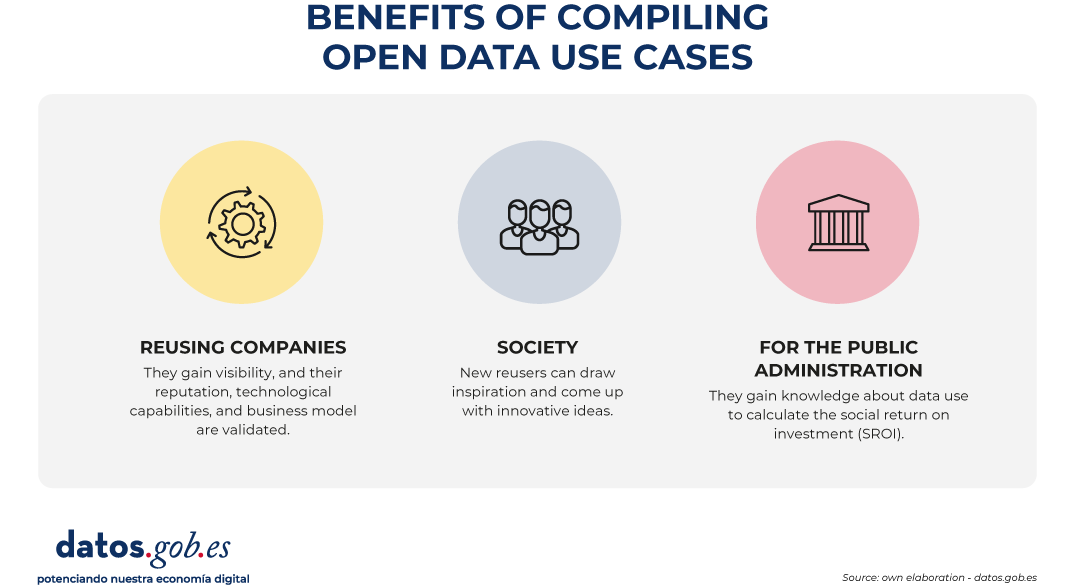
Figure 1. Benefits of compiling open data use cases. Source: own elaboration - datos.gob.es.
Three ways to nurture the repository continuously
Locating companies with open data-driven business models and specific use cases may seem like a complicated task at first, but the secret lies in combining automation with presence in the right forums. To keep the catalog constantly updated, it is recommended to activate three complementary ways:
- Proactive listening: it consists of constantly monitoring social networks, the technological media, the lists of companies from associations in the sector (such as ASEDIE), as well as the winners of hackathons and innovation awards.
- Reactive channels: in parallel to the proactive search, it is necessary to maintain a permanent and visible communication channel on the web portal. It is usual to have a simple form so that the companies themselves can apply autonomously. Disseminating this communication channel through the various means of the initiative (such as social networks, periodic newsletters, etc.) is essential to guarantee the growth of the catalog of use cases.
- Ecosystem alliances: another good option is to collaborate closely with business associations, universities, startup incubators and technology parks, which are usually the main dynamizers and birthplaces of these reuse companies.
How to choose the companies and cases to categorize?
In order for the collection of use cases to be a reference tool and maintain a high standard of quality, it is necessary to apply objective filtering criteria. It is recommended to prioritize projects under the following premises:
- Significant use of public data: the business model or solution must be based totally or partially on the reuse of datasets of public origin (local, regional, national or European), with a positive emphasis on the hybridization of different data sources (data mashup).
- Social or economic impact and relevance: priority will be given to those companies and solutions that solve real problems of citizens or the productive sectors (for example, optimisation of urban mobility, health diagnostic tools, energy efficiency or financial transparency).
- Maturity and viability: companies that offer applications, platforms or services that are already operational in the market or, at least, that have a tested and functional Minimum Viable Product (MVP) should be considered. It is advisable to avoid ideas or projects in a purely conceptual phase. These initial solutions can be showcased in the data competitions organised by various bodies, such as the Junta de Castilla y León or the Cabildo de Tenerife, among others.
- Quality and functionality: technological solutions must have a correct design and technical operation, with an optimal user experience. The goal is to ensure that the reuse of the data translates into a truly efficient and robust service for your target audience.
- Sectoral diversity: it is important to seek a thematic balance to demonstrate that open data is transversal. The repository or catalogue should reflect cases in sectors as diverse as agriculture, tourism, culture or education.
What information should be included about each use case?
In order for the use case sheets to be homogeneous, comparable and useful for portal users, the collection of information must be structured in a homogeneous way. Some of the basic pillars to include are:
- Reuser profile: name of the company, organization or person that has implemented the business model or developed the solution. In the case of companies, you can include their year of foundation, size, sector of activity, link to their corporate website, etc.
- Description of the business model/solution: name of the products or services, problems it solves, description of its functionality, target audience to which it is directed, etc.
- Open data sources used: explicit detail of the datasets consumed, including their source of origin (e.g. "Meteorological data from the State Meteorological Agency - AEMET"). This directly helps connect supply with demand for data.
- Impact obtained: Quantitative or qualitative indicators of the benefit generated for both the company and the reuser (time savings, emission reduction, turnover, jobs created, etc.).
Examples of use case catalogs
To inspire the design of your own repository or to understand how these methodologies are reflected in the real environment, it is useful to analyse how different public administrations are implementing them.
In the case of datos.gob.es, we have two different sections, one for companies and the other for applications. Both sections allow you to filter by sector of activity or tags, and also include a free text search engine, so that users can more easily find the use cases that correspond to their needs.
At the regional and local level, there are also many bodies that have decided to include a specific section on their platforms that shows the potential use of the published datasets. This is the case of the Junta de Andalucía, the Basque Government or the Madrid City Council.
If we look at Europe, our neighbours also have this functionality in their open data platforms. National initiatives such as those of France or Lithuania, which occupy the top positions in open data maturity according to Open Data Maturity 2025, also have this type of showcase.
Conclusion: moving from published data to shared value
Measuring the impact of open data is critical to ensuring the long-term sustainability of open data initiatives. Without a clear methodology for capturing and structuring success stories, portals risk becoming mere warehouses of inert digital files.
By making real examples of the usefulness of open data available to the public, the Administration not only justifies public investment in this area, but also gives back to society the knowledge necessary to continue innovating.



Comments