



Description
Spain once again stands out in the European open data landscape. The Open Data Maturity 2025 report places our country among the leaders in the opening and reuse of public sector information, consolidating an upward trajectory in digital innovation.
The report, produced annually by the European data portal, data.europa.eu, assesses the degree of maturity of open data in Europe. To do this, it analyzes several indicators, grouped into four dimensions: policy, portal, quality and impact. This year's edition has involved 36 countries, including the 27 Member States of the European Union (EU), three European Free Trade Association countries (Iceland, Norway and Switzerland) and six candidate countries (Albania, Bosnia and Herzegovina, Montenegro, North Macedonia, Serbia and Ukraine).
This year, Spain is in fifth position among the countries of the European Union and sixth out of the total number of countries analysed, tied with Italy. Specifically, a total score of 95.6% was obtained, well above the average of the countries analysed (81.1%). With this data, Spain improves its score compared to 2024, when it obtained 94.8%.
Spain, among the European leaders
With this position, Spain is once again among the countries that prescribe open data (trendsetters), i.e. those that set trends and serve as an example of good practices to other States. Spain shares a group with France, Lithuania, Poland, Ukraine, Ireland, the aforementioned Italy, Slovakia, Cyprus, Portugal, Estonia and the Czech Republic.
The countries in this group have advanced open data policies, aligned with the technical and political progress of the European Union, including the publication of high-value datasets. In addition, there is strong coordination of open data initiatives at all levels of government. Its national portals offer comprehensive features and quality metadata, with few limitations on publication or use. This means that published data can be more easily reused for multiple purposes, helping to generate a positive impact in different areas.
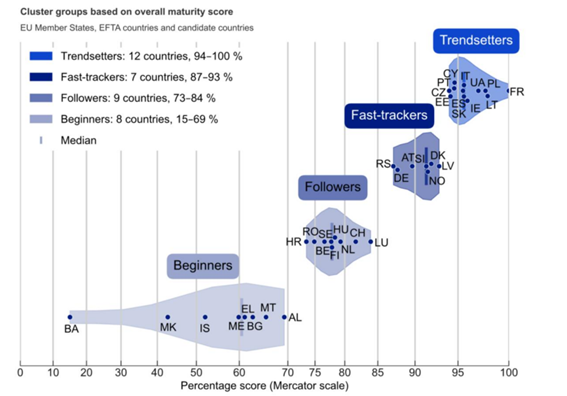
Figure 1. Member countries of the different clusters.
The keys to Spain's progress
According to the report, Spain strengthened its leadership in open data through strategic policy development, technical modernization, and reuse-driven innovation. In particular, improvements in the political sphere are what have boosted Spain's growth:
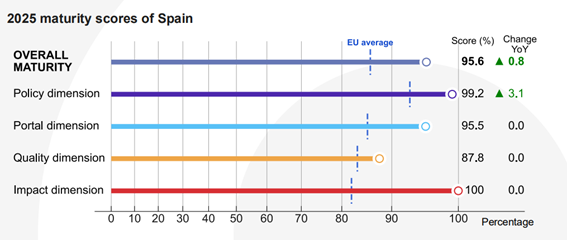
Figure 2. Spain's score in the different dimensions together with growth over the previous year.
As shown in the image, the political dimension has reached a score of 99.2% compared to 96% last year, standing out from the European average of 93.1%. The reason for this growth is the progress in the regulatory framework. In this regard, the report highlights the configuration of the V Open Government Plan, developed through a co-creation process in which all stakeholders participated. This plan has introduced new initiatives related to the governance and reuse of open data. Another noteworthy issue is that Spain promoted the publication of high-value datasets, in line with Implementing Regulation (EU) 2023/138.
The rest of the dimensions remain stable, all of them with scores above the European average: in the portal dimension, 95.5% has been obtained compared to 85.45% in Europe, while the quality dimension has been valued with 87.8% compared to 83.4% in the rest of the countries analysed. The Impact block continues to be our great asset, with 100% compared to 82.1% in Europe. In this dimension, we continue to position ourselves as great leaders, thanks to a clear definition of reuse, the systematic measurement of data use and the existence of examples of impact in the governmental, social, environmental and economic spheres.
Although there have not been major movements in the score of these dimensions, the report does highlight milestones in Spain in all areas. For example, the datos.gob.es platform underwent a major redesign, including adjustments to the DCAT-AP-ES metadata profile, in order to improve quality and interoperability. In this regard, a specific implementation guide was published and a learning and development community was consolidated through GitHub. In addition, the portal's search engine and monitoring tools were improved, including tracking external reuse through GitHub references and rich analytics through interactive dashboards.
The involvement of the infomediary sector has been key in strengthening Spain's leadership in open data. The report highlights the importance of activities such as the National Open Data Meeting, with challenges that are worked on jointly by a multidisciplinary team with representatives of public, private and academic institutions, edition after edition. In addition, the Spanish Federation of Municipalities and Provinces identified 80 essential data sets on which local governments should focus when advancing in the opening of information, promoting coherence and reuse at the municipal level.
The following image shows the specific score for each of the subdimensions analyzed:
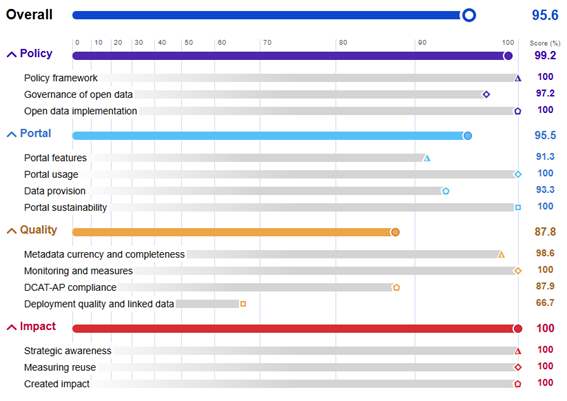
Figure 3. Spain's score in the different dimensions and subcategories.
You can see the details of the report for Spain on the website of the European portal.
Next steps and common challenges
The report concludes with a series of specific recommendations for each group of countries. For the group of trendsetters, in which Spain is located, the recommendations are not so much focused on reaching maturity – already achieved – but on deepening and expanding their role as European benchmarks. Some of the recommendations are:
- Consolidate thematic ecosystems (supplier and reuser communities) and prioritize high-value data in a systematic way.
- Align local action with the national strategy, enabling "data-driven" policies.
- Cooperate with data.europa.eu and other countries to implement and adapt an impact assessment framework with domain-by-domain metrics.
- Develop user profiles and allow their contributions to the national portal.
- Improve data and metadata quality and localization through validation tools, artificial intelligence, and user-centric flows.
- Apply domain-specific standards to harmonize datasets and maximize interoperability, quality, and reusability.
- Offer advanced and certified training in regulations and data literacy.
- Collaborate internationally on reusable solutions, such as shared or open source software.
Spain is already working on many of these points to continue improving its open data offer. The aim is for more and more reusers to be able to easily take advantage of the potential of public information to generate services and solutions that generate a positive impact on society as a whole.
The position achieved by Spain in this European ranking is the result of the work of all public initiatives, companies, user communities and reusers linked to open data, which promote an ecosystem that does not stop growing. Thank you for the effort!



Comments