


Entrevista
Copernicus is the Earth observation program of the European Union. Through 6 thematic services, and the images provided by its satellites, Copernicus provides complete, free and up-to-date geospatial data that helps the monitoring and management of the territory and the planet both at European and worldwide level.
In datos.gob.es, we have interviewed Nuria Valcárcel, Deputy Assistant Director (Observation of the Territory) of the General Directorate of Geodesy and Cartography, in the D.G. National Geographic Institute (IGN) of the Ministry of Development, an organization that represents Spain in the Copernicus Users Forum, for the monitoring and evolution of the program, together with the Ministry for Ecological Transition (MITECO).
Earth observation data, such as those linked to the Copernicus project, always awaken great interest. What are the reasons?
Copernicus geospatial data are essential as a decision-making tool in the current digital economy and government systems. These data can be used to analyze and monitor phenomena due to climate change, and help us find solutions. Its potential is also enormous in matters related to safety, transportation, emergency management, sustainability assessment...
There are many organizations that, aware of the current context, have highlighted the importance of this initiative to achieve the Sustainable Development Goals (SDGs), such as the United Nations Organization or the European Commission. The United Nations, in its document “Transforming our world: the 2030 Agenda for Sustainable Development”, indicates that national institutions should promote the use of Earth observation data and geospatial information, to follow up on the 2030 Agenda.
Specifically, what kind of data and information does Copernicus provide?
Copernicus data has 2 large components: on the one hand, the information obtained via satellite, such as the Sentinel constellations, and on the other the in-situ component, that is, any data not coming from satellites. For example, air quality data, water quality data in rivers and reservoirs, wave and sea level information through buoys, tide gauges, orthophotographs and digital elevation models ... In the case of Spain, these data are provided by different national organizations such as IGN, MITECO, AEMET or State Ports, among others.
Through the Copernicus hub you can access and download these data. The information obtained through Sentinel satellites is available for use by any citizen, but when we talk about the rest of the on-site data, we find differences according to the data policy of each country. In the case of Spain, it should be noted that we have really been pioneers in open data policies and much of the information we generate is available through Copernicus' own download platforms or national platforms.
Who are the main users of this type of data? Could you give an example?
Public administrations are the main users of Copernicus, but an increasing number of companies rely on these data to generate new opportunities and improve their competitiveness, as well as universities and research centers.
The IGN and other Spanish administrations are beginning to work with large and small Spanish companies to collaborate in the generation of data for Copernicus, but we also try to boost its reuse more and more. For example, for water management or smart agriculture, since they facilitate continuous monitoring of the state of the crops, allowing water resources to be optimized. As a concrete example, we can talk about the DIANA Project, in which the company AGRISAT and the Andalusian Federation of Irrigation Communities of Andalusia (FERAGUA) participate, to generate an innovative commercial services platform, based on Copernicus Earth Observation data and other sources, for the identification of illegal irrigation areas and the estimation of volumes of water extracted.
Forest management can also greatly benefit from Sentinel satellites and Copernicus data. This is the case of AGRESTA and its FORESMAP application, which combine satellite data with others data sources such as the Lidar provided by the IGN, to provide an online forest inventory calculation. This application has been awarded at the 2018 Copernicus Masters CGI Big Data Business Challenge.
Another area with great potential is marine services, for the sustainable exploitation of coastal resources, port management, or the optimization and safety of trade routes. Here we can mention NOLOGIN as an example. It provide a (web and mobile) real time application and predictions for decision making in system ports, based on Copernicus data, with an alert and report management interface.
And regarding public administrations, do you know any AA.PP. that intensively use Copernicus project data?
There are many experiences. To highlight some examples, the IGN provides Copernicus data directly through the Download Center and makes extensive use and dissemination of Sentinel satellite images through the National Remote Sensing Plan. These data are also used by the IGN to enrich the system for monitoring changes in the terrain, for example, to assess volcanic risk.
The data of the marine operational service are very useful for State Ports. knowing how marine currents evolve, and improving their predictive models is possible thanks to them
For its part, AEMET participates in the generation of Copernicus data and services in relation to Atmosphere and Climate Change, as a member of the European Centre for Medium-Range Weather Forecasts, which benefits Spanish institutions and scientists participating in numerous research programs.
The Spanish Agricultural Guarantee Fund, the National Parks Network, the General Water Directorate, the Autonomous Communities, as well as a large number of universities and study centers also use these type of data.
What are the main challenges and barriers to the reuse of Earth observation data?
The challenges that reusers have to face could be summarized in 4 areas.
In the first place, some technical knowledge is required to work with Copernicus data. Although sometimes we find some data or services easy to use by non-expert users, in other cases advanced capabilities are needed to locate and understand the information. Copernicus Program is making an effort to train professionals, through free courses, while working on the creation of environments where data are easily located and easy to use.
Secondly, we could talk about the coordination between the different levels of European administration (local, regional, state ...). A common effort must be made to generate better data, avoiding duplication, and for this, coordination between European and national institutions is essential. Currently, there are coordination mechanisms already established, but there are areas for improvement.
Thirdly, it is necessary to improve the interaction with users, to better understand their needs and thus be able to assess whether the Copernicus program is responding to those needs. And these needs are changing and require constant adaptation. Through the Spanish Users' Committees and Forum, the National Services Coordinators, and the Relay and Academy Networks, we are making a strong effort to approach as many users as possible, to work together in a common goal.
Finally, we cannot forget the need to encourage data to be interoperable, to meet common standards and to be harmonized. For example, the Mediterranean coast, and the different phenomena and dynamics that affect it, have to be monitored as a whole, and for this we need a common pan-European data, also harmonized with the national data that each country manages. Again, coordination between administrations is essential to achieve this goal.
One of the challenges you have mentioned is the user´s lack of knowledge about Copernicus data availability. What concrete actions are the IGN taking to publicize Copernicus data?
The European Union organizes different activities to encourage the use of Copernicus data in private companies. This is the case of the Copernicus Master competition, hackathons, the acceleration programs (Copernicus Accelerator) or business incubation (Copernicus Incubator). These types of activities, often aimed at entrepreneurs and start-ups, seek to support new ideas that involve the creation of services and commercial applications related to Copernicus.
In addition, the IGN, together with the Ministry for Ecological Transition (MITECO), in the Copernicus Users Forum, and also with representatives in the Copernicus Committee (the Ministry of Industry, Commerce and Tourism and the Centre for Technological and Industrial Development), works very actively with the different user groups in Spain. We are part of the Copernicus Users Forum, we carry out meetings and workshops for specific services and themes (Territory, Marine, Agriculture, Smart Cities, etc.), we encourage the participation of universities in Copernicus activities and proposals… In short, we seeks to generate a favorable ecosystem that facilitates the use of Copernicus.
Finally, could you tell us what your future plans are?
The Copernicus program is open to continuous review of requirements. In this regard, I would highlight two issues on the agenda.
First, the synergies between Copernicus and Galileo, the European Union navigation system, that the Ministry of Development also lead in Spain. The integration of both systems allows real-time monitoring of atmospheric phenomena to determine how vehicles move in cities. In this way, the constant impact of greenhouse gas emissions from vehicles could be monitored. It could also be used in matters of security, surveillance of natural hazards, etc.
On the other hand, the European Commission is directing its policies towards sustainability and the fight against climate change. In the new Copernicus operating cycle (2021-2027), some of the areas to be promoted are the monitoring of greenhouse gases or the monitoring of Polar Regions (snow and ice level). The civil security approach will also be expanded and the use of Copernicus data will be encouraged not only in Europe, but also in other regions, such as Latin America or Africa.

Noticia
On June 25, a Sectoral Seminar focused on the Agro sector took place. Under the slogan, "Open data in the process of digital transformation of the agri-food, forestry and rural areas", experts analyze the availability of data and disseminate new technological initiatives that are achieving improvements in the sector thanks to the reuse of public information.
The event was opened by David Cierco, CEO of Red.es, highlighting the importance of data reuse in rural areas to generate economic activity and attract people. After the presentation, the first of the two round tables of the event took place.
Round table 1: Data for innovation development in the agricultural sector
The objective of the first round table was to make a balance on the availability of data in the sector and its alignment with the needs of the reusers. Moderation was provided by Rocío Wojski, from the Ministry of Agriculture, Fisheries and Food (MAPA), and the speakers was Andrés Montero, from the Carlos III University of Madrid, Antonio J. Sánchez-Padial, from the Ministry of Science, Innovation and Universities, Francisco Javier Zarazaga-Soria, from the University of Zaragoza, and Paloma Abad, from the National Geographic Institute.
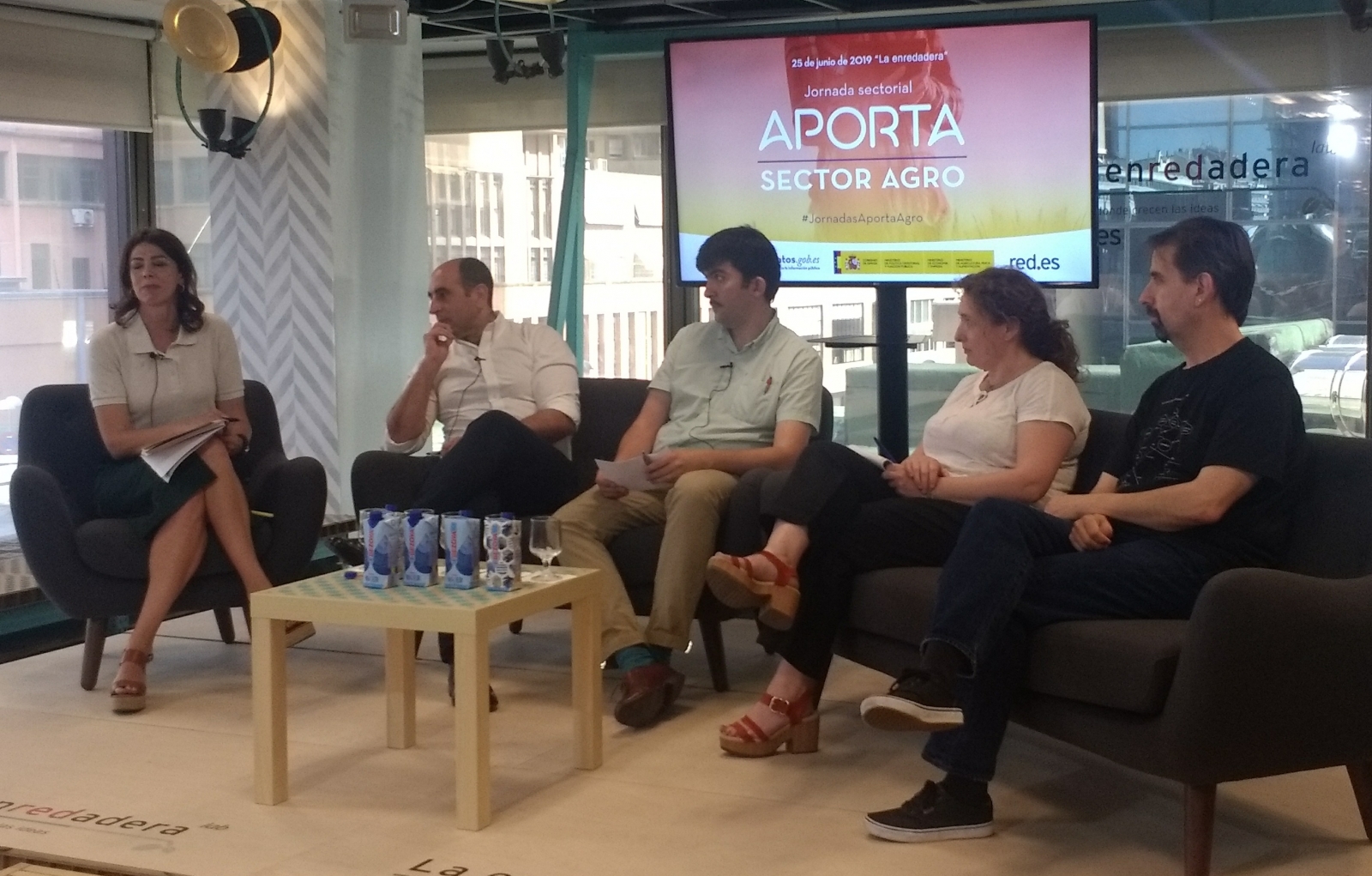
Rocío Wojski opened the debate by talking about two major challenges for farmers: satisfying food requirements in a sustainable way and reinforcing their role as an engine for development in the rural world, two challenges where open data has a lot to say. Of all the data categories, the speakers highlighted the importance of the sector data with geographic components and research data to overcome these challenges.
Geographical data is the second most reused data category, and its publication is being driven by the INSPIRE Directive. "The Geographical Institutes were already aware, but INSPIRE has been useful to raise awareness among other administrations", said Paloma Abad, who also added that "In Spain we are 80% compliant with INSPIRE”.
In addition, the publication of open research data is also being driven by legislation. In this case, by the new European PSI directive. Although in Spain we already had a positive outlook in terms of scientific publications (thanks in part to the Science Law of 2011), now "research data financed with public funds will have to be published for reuse", said Antonio J Sánchez-Padial. "In addition, it is necessary to promote other types of incentives and encourage collaboration, something that organizations such as INIA or FECYT are already doing through collaboration frameworks".
But not all data can be opened. "Data generated in the university field should be offered, but there will be exceptions: sometimes the information comes from third parties who have not transferred the rights of use" reminded Francisco Javier Zarazaga-Soria.
Another topic analysed during the event was the training offer. All attendees agreed on the importance of having data professionals specialized in the agricultural sector and interested in developing their career in rural areas. "Hybrid profiles are needed at university level, mixing degrees that cross the data processing component with more traditional degrees such as economics, biology..." said Francisco Javier Zarazaga-Soria. "In addition to formal education, we must also emphasize continuous training, aimed at professionals who want to recycle or update their knowledge", pointed out Andrés Montero.
Finally, the speakers focused on the importance of aligning data supply with demand. In the words of Paloma Abad, "it is necessary to know the end user very well in order to know what he needs: immediacy, detail, which formats are the most appropriate for his work ... This way we can adapt the information we put at his disposal".
To understand these needs, alliances between the administration and companies are fundamental, for example through Data innovation hubs, whit different actors, such as farmers, cooperatives, administration, etc. "The sector have a lack of knowledge about what already exists. These environments facilitate the identification of data that may be necessary and help to align strategies" commented Andrés Montero. The new European Directive on open data and reuse of public sector information can help in this regard: it indicates "high-value data sets" that publishers must share according to formats and conditions that favour their reuse. "We also have to take into account that the data clients are going to be machines, we have to generate data that allows the algorithms to work easily" reminded Francisco Javier Zarazaga-Soria.
Rocio Wojski closed the debate by indicating the most visited data sets of the Ministry of Agriculture, Fisheries and Food: the Operational Fishing Fleet Census, the Register of Animal Feeding Establishments, the Fertilizer product register, the Registration of organic farming operators and the Sigpac. From the MAPA, they are also promoting the internal data collection and analytical projects to offer high quality information to the productive sectors.
Round table 2: Innovative practices based on data
The second roundtable, which sought to publicize public data reuse initiatives that are promoting improvements in the agricultural sector, was moderated by José Ignacio Sánchez, from Red.es. José Luis Molina, from Hispatec, Mercedes Iborra, from VisualNACert, Carlos Callejero, from SensoWave, Eva Navascués, from Pago de Carraovejas, and Guillermo Renancio from EFOR debated with him. All of them told about their experience implementing emerging technologies based on open public information to optimize the agricultural sector.
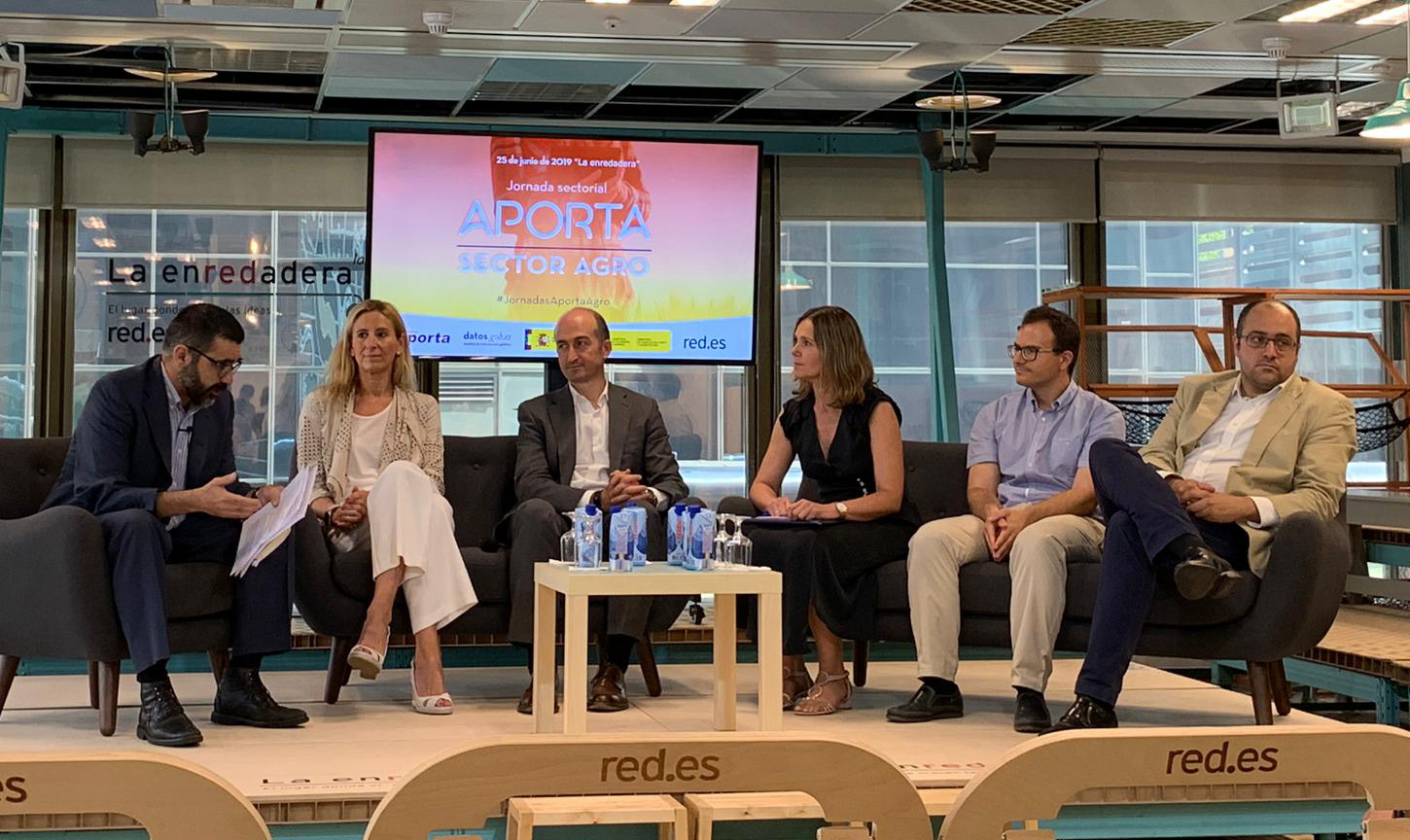
SensoWave is focused on GPS tracking on the cattle, using Internet of Things (IoT) and Blockchain technology. Through sensors, SensoWave monitors from the animal's location to its body temperature or its interactions with the environment to provide transparency to the consumer. "These data can be very useful if they are shared, but for this we must convince the farmer and guarantee that the information will be anonymous", said Carlos Callejero.
Mercedes Iborra, from VisualNacert, a company specialized in a platform that unifies farmers' own data with open data from different sources, such as the Copernicus program, took a stance along the same line. Mercedes highlighted "the culture of change in the top direction of agribusinesses and the fear of the farmer who generates the data and does not know how they are going to be used" as two of the challenges to be faced in order to promote the digitalization and use of data in the agricultural sector.
Pago de Carraovejas, for its part, applies new technologies to the wine sector for almost 10 years. In this time, they have sensorized the strains and the different elements of the environment. Thanks to these data, they have developed predictive analytics projects to minimize the impact of vine wood diseases or predict the quality and quantity of the harvest. One of the challenges that they have found in this path is financing. "One solution is to open public R & D funding programs that make easier to test new things", Eva Navascué suggested. "These programs could be low-intensity but prolonged in time, and should always go hand in hand with private companies", added José Luis Molina from Hispatec, an agricultural management software company with a focus on data analysis.
The financing challenge is accentuated if we take into account the Spanish agrarian structure, with a large number of plots of small size. "It is necessary to democratize technology through general solutions that are economical and can be implemented by many small producers", commented Guillermo Renancio from eformedia, a company that develop Internet of Things solutions to save time in decision-making. Other key issues that the attendees highlighted to promote the digitization of the sector are regulation and tax incentives.
In addition, the importance of having a universal connectivity, which allows connecting not only people, but also animals and crops, and standards that allow sharing data was also discussed. This requires platforms that integrate the data from different sources, ensuring their quality. It was also stressed that it is necessary to implement mature solutions linked to new economic activities for the rural world. "Rural and agricultural world have been divorced for a long time, so it is necessary to also develop other economic activities that can attract people to the rural world", commented José Luis Molina, from Hispatec, an agricultural management software company focused on data analysis.
Another important issue is sustainability and respect for the environment. "When we created a technology company in the agricultural sector, we have to take into account 3 clients: the final consumer that seeks transparency, companies that seek profitability and the environment, a passive and silent client, but which requires to be very careful" he also commented.
The event ended with an call from all the participants to continue promoting the digitalization and reuse of open data in the agricultural sector, a task that requires that public administrations, private companies and other stakeholders of the Spanish agrarian ecosystem join forces.
You can see the full event in the following videos:
Empresa reutilizadora
In SmartRural, they believe in the advantages of applying technology to agriculture.
Thanks to the latest advances, nowadays it is possible to modernize the field. Applying new technologies in the rural world, farmers can get benefits that some years ago was already experienced by other areas linked to the city. The objective is to increase the performance of agricultural facilities by significantly increasing their production and reducing costs.
Its main tool is precision agriculture that is based on knowing, in an exact way, the needs of crops and acting on them in a proportionate manner, that is, without spending more resources than necessary or falling short.
Evento
The agri-food and forestry sector is one of the main generators of rural wealth. Improving the efficiency of this sector, through digitization, is essential to promote entrepreneurship and address the challenges of rural areas, such as low population density or aging.
In this context, the Aporta Initiative organizes, in collaboration with the Ministry of Agriculture, Fisheries and Food, a working session that seeks to support the digital transformation of the agricultural sector, with the focus on the role of open data.
When and where?
Under the title "Open data in the digital transformation process of agri-food, forestry and rural areas", the session will be held on June 25 at the morning (from 10:00 a.m. to 1:30 p.m.).
Due to space restrictions, the event will only be available through streaming.
What topics will be addressed?
The event will be structured around two thematic round tables:
- Round table 1: Data for innovation development in the agricultural sector. During this round table, the speakers will evaluate the availability of data in the sector and its alignment with re-users’ needs. The objective is to identify measures to increase quantity and quality.
- Round table 2: Innovative practices based on data. The speakers will show public data reuse initiatives that are promoting improvements in the agri-food and forestry sector, and in rural areas. In addition, the event will be a good opportunity to discover emerging technologies that converge with data to enrich open public information.
Who are the speakers?
Representatives involved and committed to data publication and reuse will participate in both round tables:
- The round table 1 will be moderated by Rocio Wojsky, from the Ministry of Agriculture, Fisheries and Food. The moderator will be joined by Andrés Montero, from the Carlos III University of Madrid, Antonio J. Sánchez-Padial, from the Ministry of Science, Innovation and Universities, Francisco Javier Zaragoza, from the University of Zaragoza, and Paloma Abad, from the National Geographic Institute.
- The round table 2 will be moderated by Jose Ignacio Sánchez, of Red.es. The round table is completed by José Luis Molina, from Hispatec, Mercedes Iborra, from VisualNACert, Carlos Callejero, from SensoWave, Eva Navascués, from Pago de Carraovejas, and Guillermo Renancio, from EFOR.
The dynamics will drive invited experts to share opinions, experiences and proposals.
Do I need to register?
No prior registration is necessary to follow the event in a virtual way through streaming. In the next few days we will share the link to follow the broadcast.
Noticia
The first phase of the Aporta Challenge 2019 has come to an end. The deadline to present ideas to improve the efficiency of the agri-food, forestry and rural sectors ended on May 23. Now they will be evaluated by a jury of experts in the field.
42 original ideas seek the final
For 6 weeks - from April 9 to May 23 - the participants have been presenting their proposals for the first phase of the Challenge. In this first phase participant only needed to provide a detailed description of an original idea, using at least one data set generated by national or international Public Administrations and published under open license.
The result has been 42 proposals of high quality, the result of the work of private citizens (45% of the proposals) and multidisciplinary teams (55% of the proposals) that have launched their creativity to seek innovative solutions to the proposed challenge. Although the majority of proposals come from Spain, teams from Austria or the United Kingdom have also participated.
The presented solutions show a great thematic variety. There are many ways to boost efficiency in the agri-food, forestry and rural sectors, from improving the management of crops, to fostering the active rural settlement. This is well known to the participants in the Challenge, who have proposed solutions to optimize irrigation, reduce energy expenditure, prevent floods, boost rural tourism or promote entrepreneurship in rural areas, especially in areas that face a major demographic challenge. In addition, many of the solutions combine open data with new technologies such as artificial intelligence, laser scanners (LIDAR), the use of drones or blockchain.
It should be noted that 38% of the proposals are presented by women or teams that have a woman among its members. Although an increasing number of women are involved in the data world, these data show that there is still work to be done to achieve real equality.
A first level jury to choose the finalists
All the proposals received will be evaluated by an expert jury, made up of representatives of various associations and organizations:
-
Aleida Alcaide, Ministry of Finance and Public Function.
-
Salvador Luis Soriano, Ministry of Energy, Tourism and Digital Agenda.
-
Maite Ambrós, Ministry of Agriculture, Fisheries and Food.
-
José Ignacio Sánchez, Red.es.
-
Rosa Gallardo, University of Córdoba.
-
Antonio Ibáñez, Junta of Castilla y León.
-
José Nuño, Spanish Federation of Municipalities and Provinces.
-
José Luis Miguel de Diego, Farmer and Agriculture Organisation Coordinator.
-
Martín Álvarez, World Wide Web Consortium.
-
Paula Sánchez, Association of Electronics, Information Technology, Telecommunications and Digital Content Companies.
-
Olga Quirós, Multisector Information Association.
Each member of the jury will assign a value of 0 to 10 points to each proposals. The aspects to be assessed will be the relevance or originality of the idea, its quality and clarity, its viability, its economical and social impact, and their potential to improve life quality of women and / or young people in the rural environment.
10 finalists will fight for the € 4,000 prize
After the evaluation, 10 proposals will go to the second phase, which will begin during the month of July.
In this second phase the finalist teams will have to develop a prototype, which could be a simulation, visualization, video or multimedia solution. The period to present the prototype will be 4 months. The Aporta Challenge will culminate in the Encuentro Aporta.
All finalists will have to defend their proposal again in front of the jury, which will designate the three winners. The winner will receive € 4,000, while the second and third finalists will receive € 3,000 and € 2,000 respectively.
Documentación
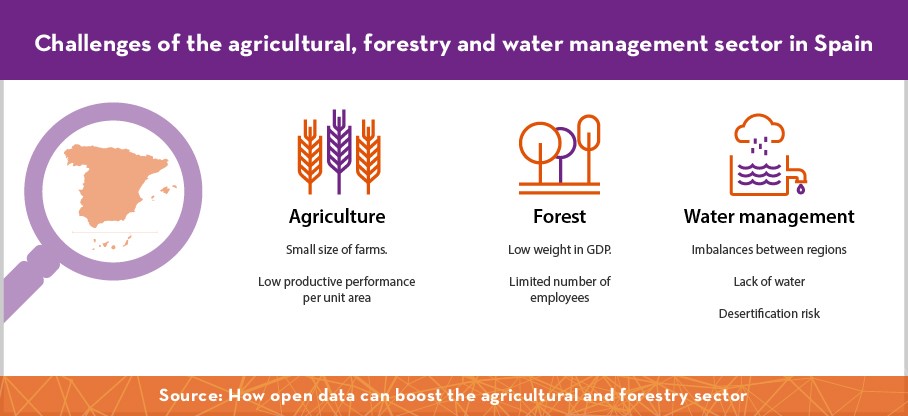
In the current context of digital transformation, all sectors are adapting to respond to the efficiency and agility improvement needs that society demands today. One of the areas where this change is most necessary is the agricultural and forestry sector.
The growth of the world population, climate change, or the depopulation of rural areas, something of particular concern in the specific case of Spain, make a paradigm shift necessary: a higher quantity of food must be generated, more quickly and sustainable with the environment.
To deepen this problem and its possible solutions, from the Aporta Initiative we have prepared the report “How open data can boost the agricultural and forestry sector”. The objective of the report is to promote the use of open data in the process of digital transformation of the agricultural and forestry sectors. Additionally, the report also focuses on water management as an element of great importance in the value chain.
The report is structured as follows:
- The first part begins with the analysis of the role that digital transformation is playing in solving the main challenges facing the agricultural and forestry sectors, highlighting the open data contribution as part of this process.
- In the second part, a series of repositories are compiled to find open data sets potentially useful to support digital transformation in these sectors.
- For the third part of the report, a series of relevant use cases have been selected in digital transformation in the agricultural and forestry sectors, both nationally and internationally and in which open data have a prominent role.
The report ends with the presentation of a series of conclusions drawn from the analysis work carried out.
It is therefore a must-read document for those interested in promoting improvements in areas such as precision agriculture, promoting a more efficient and sustainable agricultural and forestry sector. It should also be noted its great usefulness as a mechanism to understand the current scenario and source of inspiration for the participants in the Aporta 2019 Challenge.
Evento
A new edition of the Aporta Challenge is already underway. As the previous edition, new ideas and prototypes based on open data are sought to help improve the efficiency of a specific sector. In this case, the agri-food, forestry and rural sector have been chosen, due to its fundamental role in the creation of wealth and employment.
Why is the agri-food, forestry and rural sector important?
Currently, this sector is facing a series of challenges that affect all us and, ultimately, the future of humanity, such as climate change, food security, population growth or depopulation in rural areas. Generating a higher amount of food to support the whole population, in a safe way and respectful with the environment, looking for alternatives to the concentration of population into urban areas, driving the development of rural environment, as well as protecting and preserving the forests for future generations, are demanding and urgent tasks.
To these global problems, we must add the specific challenges of Spain. Depopulation, aging, desertification, digital divide, masculinization, deficit and dispersion of services ... are some of the concepts that usually come to mind when we think about the rural environment in our country.
A paradigm shift is necessary to face these challenges.
How can open data help to improve this situation?
The digital transformation can help to change the bases of agri-food operations, promoting the rural environment, in many different ways; for example, through the smart agriculture that combines technologies such as robotics and artificial intelligence with public and private data management, to maximize crop yields, increase productivity and improve their sustainability. In this context, open data has a fundamental role.
What is Aporta Challenge 2019?
Aporta Challenge seeks to promote talent, technical competence and creativity in the reuse of open data, with the aim of devising solutions that help promote improvements in the agri-food, forestry and rural sector.
The ideas and prototypes presented must use at least one source of open data generated by Public Administrations, whether national or international, and published under an open license. These data sets may be combined with others from various sources, both public or private, and national or international.
The contest will be developed in 2 phases:
- Phase I: Ideas competition. Participants must provide a detailed description of an original idea that can be used to create or enrich a service, study, web or mobile application, which leads to improvements for the agri-food, forestry and rural sector. All the ideas will be evaluated according to criteria such as: their innovative character, their economic and social impact, and their contribution to improving the life quality of young people and women, two fundamental groups for the sector survival. After the evaluation process, the 10 best ideas will be selected and their authors will go to Phase II.
- Phase II: Prototype development and face-to-face exposition. During Phase II, the authors of the 10 selected ideas will elaborate a prototype that may consist of simulations, visualizations, videos or multimedia solutions. The 3 best prototypes will be selected according to criteria such as ease-of-use or technical quality.
During the following months, dissemination and follow-up will be carried out.
Who can participate?
The Aporta Challenge is aimed at individuals and legal entities of the European Union.
Those interested in participating must register in this form.
What are the prizes?
The three best prototypes presented will opt for three monetary prizes according to the following amounts:
- First prize: € 4,000
- Second prize: € 3,000
- Third prize: € 2,000
More information in the Challenge Aporta section and the Competitions Rules.

Documentación
A few months ago we published a compilation of the main reports, studies, success stories and courses published by the Global Open Data for Agriculture and Nutrition (GODAN). This body seeks the proactive sharing of freely accessible data to make information on agriculture and nutrition available, accessible and usable.
To achieve this goal, GODAN has different teams that work in a coordinated manner for a common goal. One of them is the Capacity Development Work Group, focused on promoting open data knowledge (ongoing initiatives, innovations and good practices), as well as the development of new capacities. All of them to guarantee a more effective accessibility, use, engagement and understanding of open data.
In 2017, this group launched Godan webinar services, in order to offer a series of webinars organized in collaboration with the Technical Centre for Agricultural and Rural Co-operation (CTA). The videos, which last between 40 minutes and one hour, help to delve into different concepts: they explain how an open data initiative on agriculture should work, or how to tell stories with data to raise organizations and citizens’ awareness. Some of the organizations that have participated in the preparation of the contents are the Open Data Institute (ODI), Wageningen UR or The Land Portal Foundation, among others.
Here are some of the resources that can be found in Godan webinar services:
| Title | Content |
|---|---|
| Publishing open data from an organisational point of view | This webinar tries to answer a series of basic questions: Why is it necessary to publish open data? What benefit can publishing open data bring to the organization? Why are licenses important? How to start with publishing open data? |
| The Agriculture Open Data Package (AgPack) | In 2016, 4 agencies (GODAN, ODI, Open Data Charter and OD4D) developed the Agricultural Open Data Package (AgPack), which included 14 categories of datasets whose opening could have an important impact for the agricultural sector. This webinar shows detailed examples and use cases of governments that have achieved success in this area. |
| Effective data communication using data visualisations | Visualizations can help reveal, in a simple way, agriculture and nutrition trends to support decision making. This webinar explains the process of creating a good infographic, demonstrate some visualization software and reflects on how infographics are being applied for open data for agriculture and nutrition. |
| The Gender and Open Data Intersection | This webinar provides an analysis of open data from a gender perspective: from the current state of the question, to the challenges to overcome. The webinar ends with a series of recommendations to pave the way forward. |
| Agricultural Development: Role of Open Data in Ending Poverty | Open data can help end extreme poverty, end hunger and reduce inequalities. This webinar seeks to boost the capacity of states to openly share data and statistics for decision making. |
| Facilitating Standards and Impact Webinar | This webinar addresses the standards and impact evaluations of open data, with a special focus on weather data. Among other topics, the speakers analyse the trends and major gaps in the availability and use of weather data standards, followed by recommendations on how to make existing data standards more usable or how to develop services that facilitate the use of standards. All this through examples and success stories. |
| Farmers rights on data and ownership issues | Data ownership and privacy are two of the challenges of smart agriculture. This webinar tries to inform farmers about their rights from a legal perspective. |
| Unlocking the Potential of Blockchain for Agriculture | This webinar provides an overview of blockchain and analyzes its impact on agriculture, through examples and success stories in specific areas. The webinar also explains what capabilities people need to work with this technology. |
| Measuring the impact of open data initiatives in agriculture & nutrition | This webinar explains the methodology that GODAN uses to measure the impact of an open data initiative. Its evaluation framework focus on earlier stage assessment, as this offers better options to design new and, monitor and steer ongoing initiatives. |
In addition to these more general webinars, Godan webinar services also offers specific resources, where different initiatives tell their experience when publishing or reusing open data on agriculture and nutrition. An example is the Regional Centre for Mapping of Resources for Development (RCMRD), which shows some of the projects in which it is involved in one of the videos.
In short, whether you are a public body that wants to start or consolidate an open data initiatives on agriculture, or a reuser looking for examples and success stories to inspire you, Godan webinar services can provide resources and information of interest.
Empresa reutilizadora
Company specialized in the development of mobile and desktop applications based on GIS and Remote Sensing.
Evento
The next 26th and 27th of November DATADRI is celebrated in Córdoba. It is a reference event for the digital transformation of agricultural sector. During two days, the challenges and opportunities of the sector will be addressed, paying special attention to the competitive advantages that new technologies and data analysis can bring.
Junta de Andalucía, Ministry of Agriculture, Fisheries and Food, and Ministry of Science, Innovation and Universities, among many other organizations and companies, collaborate with the event. You can see the entire list of sponsors and contributors here.
What is the purpose of the event?
The event responds to three objectives:
- Promote digital transformation in agri-food chain.
- Sensitize about success cases.
- Contribute to reduce barriers to digital transformation implementation, creating best practices standards and opportunities for collaboration.
What is the agenda?
DATAGRI is made up of two sessions, the Forum Day, which will be held on November 26, and the Farming Day, which will take place on the next day.
The Forum Day will be integrated by different key note and round tables, with the participation of farmers, technology companies, representatives of public administration and experts who will share their vision and experience, with special focus on new trends. Among other technologies, they will talk about robotics, Internet of Things or drones, and how its application can help boost a more sustainable and efficient agri-food sector. The session will end with a debate, entitled "Who has to lead the digital transformation in the sector?".
For its part, the Farming Day will be integrated by two workspaces. On the one hand, a working space called "Operative Groups as a driver for the digitization of the sector" followed by the "Digital Agenda workday for the agri-food sector and the rural environment" (invitation will be necessary to attend this session).
In parallel, attendees could enjoy a series of demonstrations and exhibitions, to discover first-hand how the latest technologies can boost their business and improve their competitiveness.
What do I have to do to attend?
Those interested in attending the event must pre-register at the following link.