


Publication date
23/02/2026
Update date
24/02/2026



Description
The Organisation for Economic Co-operation and Development (OECD) has published the main findings of the 2025 edition of the Open, Useful and Re-usable Data Index (OURdata) and the Digital Government Index (DGI), two indices that evaluate the good work of governments in fields related to digital transformation.
Both studies are born from a central idea: "digital transformation is no longer optional for governments: it is an absolute necessity". It enables better services, smarter decision-making and collaboration across borders, but for this to work, a bold and balanced vision is needed, supported by a strong and reliable foundation. Thanks to the analysis offered by the two indices published by the OECD, it is possible to guide policies, prioritize investments and measure the progress of digital transformation in the public sector.
Specifically, the indices assess:
- OURdata Index: national efforts to design and implement useful and reusable open data policies.
- Digital Government Index (DGI): Governments' progress in building the foundations for a coherent and people-centred digital transformation.
Both analyses are based on data collected during the first half of 2025, covering initiatives and policies implemented between January 1, 2023 and December 31, 2024. Its results will also feed into the OECD Digital Government Outlook 2026, which will include more in-depth analysis, key trends and country notes.
Keys to the OURdata Index 2025
The OURdata Index 2025 shows important progress in the opening and reuse of public data in OECD countries. In this index, Spain is in the top 5, consolidating its position among the countries with the best open data policies.
The OECD average rises from 0.48 to 0.53 out of a total score of 1, with almost 60% of countries exceeding the 0.50 threshold. France leads the ranking, followed by South Korea, Poland, Estonia and the aforementioned Spain, as can be seen in the following graph.
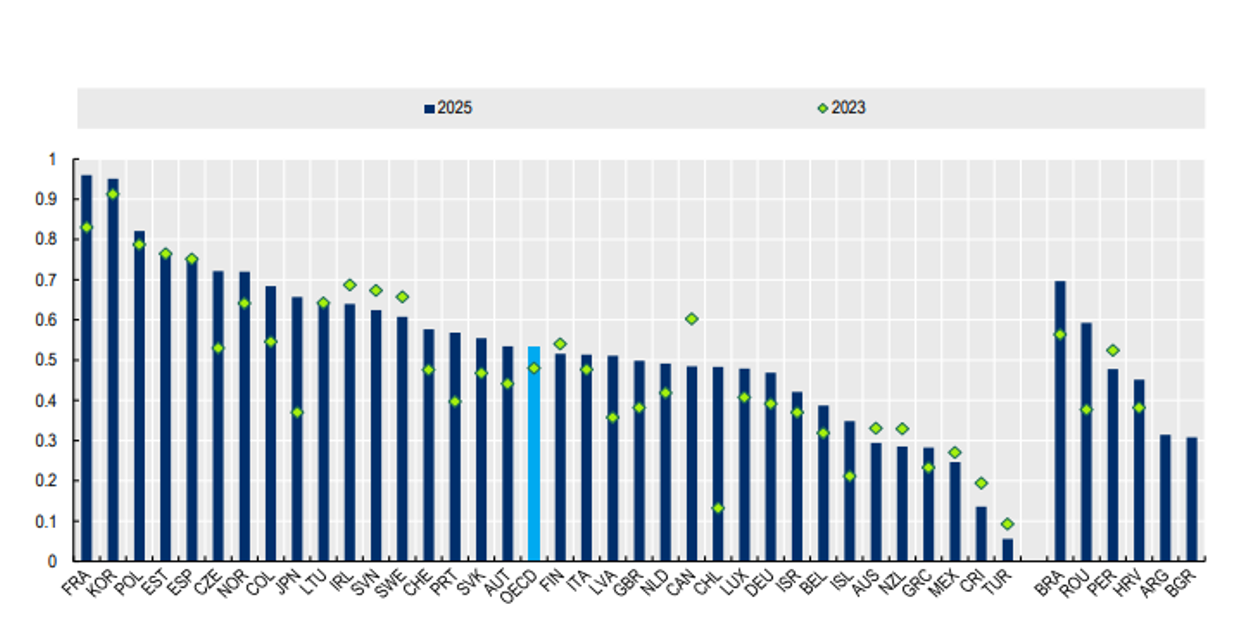
Figure 1. Result by country of the Open, Useful and Re-usable Data Index (OURdata). Source: 2025 Open, Useful and Re-usable Data Index (OURdata), OECD.
To arrive at these data, the report analyzes three pillars, as in 2023:
- Pillar 1: Data availability. It measures the extent to which governments have adopted and implemented formal requirements for publishing open data. It also assesses the involvement of relevant actors to identify the demand for data and the availability of high-value datasets such as open data. It should be noted that, although the report talks about high value datasets, it is not the same concept that the EU handles. In the case of the OECD, other high-impact categories are also taken into account, such as health, education, crime and justice or public finances, among others.
- Pillar 2: Data accessibility. It assesses the existence of requirements to offer open data in reusable formats. In addition, it focuses on the degree to which high-value government datasets are published in a timely manner, in open formats, with standardized and detailed metadata, and through Application Programming Interfaces (APIs). It also analyzes the participation of relevant actors (stakeholders) in the central open data portal and in initiatives to improve its quality.
- Pillar 3: Government support for data reuse. It measures the extent to which governments play a proactive role in promoting the reuse of open data both inside and outside the public sector. Specifically, it analyzes whether there are alliances and organizes events that increase awareness of open data and promote its reuse; whether public officials are involved in the publication of open data and in data analysis and reuse activities; and whether impact assessments of open data are carried out and examples of reuse are collected.
The results show that, as in previous editions, OECD countries perform better in Data Availability (Pillar 1) and Data Accessibility (Pillar 2) than in Government Support for Data Reuse. However, Spain is an exception: it ranks third (0.91) in government support when it comes to promoting the creation of public value from open data and in measuring its real impact. In the rest of the pillars, 1 and 2, it is in 14th position, also ahead of the average of OECD countries.
Claves del Digital Government Index
The 2025 edition of the DGI assesses the digital maturity of governments. To do this, it analyzes whether they have the necessary foundations to leverage data and technology in a comprehensive transformation of the public sector focused on people.
As with the OURData index, the DGI score is based on the same methodology used in the 2023 edition, which allows a longitudinal evaluation to be carried out and progress between that year and 2025 to be compared. In this period, the OECD average in the DGI increased by 0.08 points, from 0.61 (out of 1) in 2023 to 0.70 in 2025, representing a total increase of 14%. Almost all governments exceeded the 0.50 threshold, and 17 of them were above the OECD average, including Spain.
The ranking is headed by South Korea, Australia, Portugal, the United Kingdom and Norway, with Spain in twelfth position, as shown in the following graph.
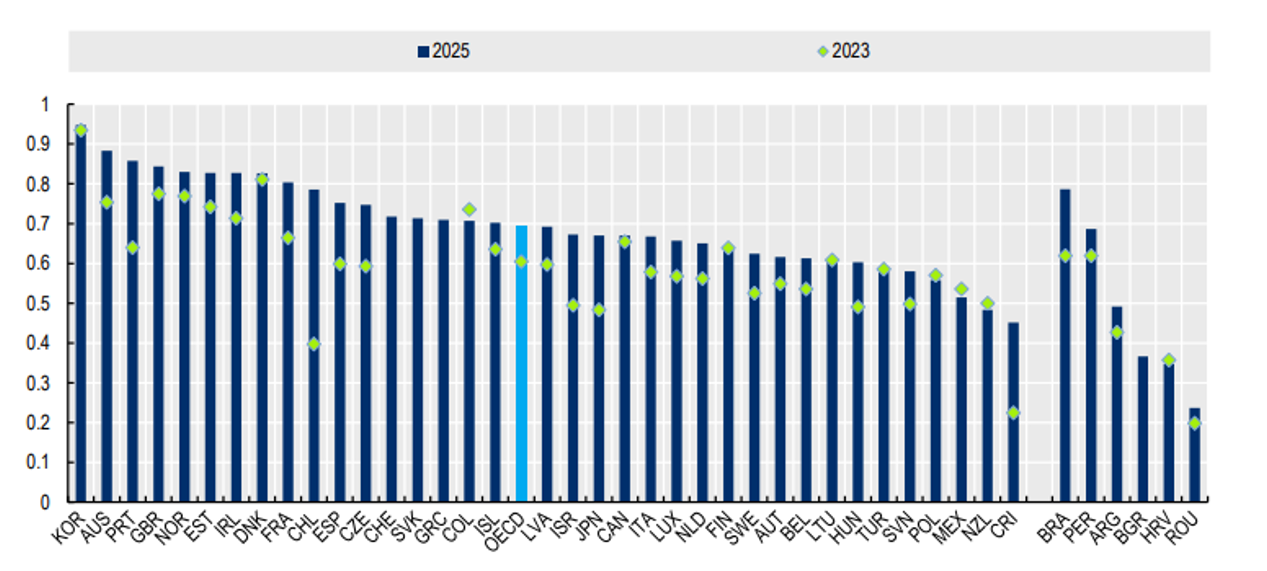
Figure 2. Result by country of the Digital Government Index. Source: 2025 Digital Government Index (DGI), OECD.
The DGI measures the maturity of digital government along six dimensions:
- Dimension 1: Digital by design. It assesses how digital government policies enable the public sector to use digital tools and data consistently to transform services.
- Dimension 2: Data-driven. It discusses advances in governance and the enablers for data access, sharing, and reuse in the public sector.
- Dimension 3: Government as a platform. It measures the deployment of common components such as guides, tools, data, digital identity, and software to drive consistent transformation of processes and services.
- Dimension 4: Open by default. It assesses openness beyond open data, including the use of technologies and data to communicate and engage with different actors.
- Dimension 5: User-centered. It measures the ability of governments to place people's needs at the centre of the design and delivery of policies and services.
- Dimension 6: Proactivity. It analyzes the ability to anticipate the needs of users and service providers to proactively offer public services.
The DGI assessment focuses on both the strategic and operational levels. Therefore, for each dimension, it examines four cross-cutting facets of the policy cycle: strategic approach (strategies and general frameworks), policy levers (resources and tools), implementation (concrete practices), and monitoring (monitoring and evaluation).
While countries have made progress compared to 2023, the 2025 results show that there is still room to increase the pace and depth of digital government policies. As in 2023, OECD countries excel in the Digital by Design, Data-Driven Public Sector, Government as a Platform and User-Centric dimensions, with widespread improvements in their scores. These advances are explained by the strengthening of governance and the use of data, the development of digital infrastructures -such as digital identity systems and service platforms-, the consolidation of digital talent in public administrations and the adoption of service standards.
In contrast, the Proactivity and Open dimensions by default continue to show lower performance, as was already the case in 2023. This is due to weaker results in the use and governance of artificial intelligence in the public sector, in service design and delivery practices, and in open data. Even so, improvements are observed in areas such as the availability of governance instruments for a reliable use of AI and the expansion of tools to test and monitor whether services are adapted to the needs of users.
In this case, Spain does follow the general trend, standing out especially in Digital by design where it enters the top 10 with a ninth position, although with one exception: it also obtains a good score in Proactivity, with a 12th place. In the rest of the indicators, it remains fairly stable, between positions 13 and 19.
Conclusion
Governments around the world face a common challenge: rigid structures, slow processes, and rules that sometimes make it difficult to respond with agility to today's challenges. As a result, digital modernization has become a strategic necessity.
Embracing digital technologies, connecting data, and working with agile methodologies allows governments to be faster, more efficient, and proactive while remaining active in accountability and facilitates collaboration between institutions and countries. Studies conducted by the OECD allow countries to determine their areas for improvement, facilitating informed decision-making regarding digital infrastructure, data or the use of AI.
To find out more about the details of Spain's position, we will have to wait for the country notes to be published in the OECD Digital Government Outlook 2026, but for now, we can take note of our strengths (government support for the reuse of data or the development of digital government policies) and the challenges to be faced (continuing to promote the accessibility and availability of data).



Comments