


Blog
The construction of the ecosystem for the secondary use of e-health data in the European Health Data Space (EHDS) poses a significant scenario of opportunities for Spanish research, innovation and entrepreneurship. To this end, the European Union is promoting a multitude of strategic projects in which hospitals, health research foundations, universities, research centres and Spanish companies participate. The list of projects is extensive and aims to satisfy at least two objectives: to promote the generation of infrastructures capable of generating quality datasets and to promote conditions for their reuse.
The role of Spain. Strengths in the deployment of the European Health Area
Spain offers significantly favourable conditions not only to participate but also to contribute significantly to the tasks of creating the EHDS
- First, our public health system is characterized by a high level of integration and structuring. Unlike systems based on reimbursement mechanisms, in which there may be an atomisation in the field of service provision, in our system we have a clear frame of reference in primary care, medical specialities and hospital services.
- On the other hand, the experience deployed by our health environments from the General Data Protection Regulation (GDPR) and, particularly, the lessons learned from the seventeenth additional provision on health data processing of Organic Law 3/2018, of 5 December, on the Protection of Personal Data and guarantee of digital rights (LOPDGDD) they constitute a valuable experience.
- The opening of the National Health Data Space promoted by the Government of Spain and promoted by the Ministry for Digital Transformation and Public Function, the Ministry of Health and the Autonomous Communities allows the deployment of an essential infrastructure for the EHDS.
The National Health Data space was presented on January 29. The event highlighted how this project represents a paradigm shift that revolutionizes the management of health data, promoting a federated, secure and ethical model that preserves the sovereignty and privacy of information while facilitating its use for research, innovation and public policies. Its operation is based on a federated catalog of metadata and a rigorous process of access and analysis in secure environments, which seeks to promote open science and scientific and technological advances, benefiting patients, researchers, managers and industry.
Lessons learned from European Projects
The path taken by Regulation (EU) 2025/327 of the European Parliament and of the Council of 11 February 2025 on the European Health Data Space, amending Directive 2011/24/EU and Regulation (EU) 2024/2847 (EEDSR), poses significant challenges that are addressed in research projects funded by European and national funds. The lessons learned in some of them can be extraordinarily useful for the research and entrepreneurship community in our country. We cannot forget that we start from significant strengths.
1.-Compliance by design
The existence of a new regulation requires a rigorous analysis of the state of the art in our organizations, not only to implement its deployment but also to ensure the preconditions of legal reliability of the datasets and the research that is proposed.
2.-Accountability: proactive responsibility and documentary strength
In our country we come from a long tradition of accountability. The EEDSR will impose on the data requester a set of relevant documentary requirements, such as, for example, having provided safeguards to prevent any misuse of electronic health data. This issue cannot be neglected from the point of view of data holders, who will also have to meet certain requirements. For example, proving that data is legitimate and reusable is an ethical and legally documentable issue; and the simplified procedure for accessing electronic health data through a trusted health data holder requires the latter to document the security of its data space or capabilities to evaluate requests for access to health data.
One of the main obstacles we face in this intermediate period of implementation of the EHDS lies precisely in the organizational culture for the generation of verifiable evidence. As standardization and the set of common rules of the EEDS scale, it will be necessary to deepen the dynamics of proactive responsibility understood as demonstrated responsibility.
3. Secure processing environments
In our country, health environments by their very definition must be safe environments. The deployment of the National Security Scheme (ENS) and the GDPR have allowed the entire health system, public or private, to adopt maturity models that are perfectly consistent with the conditions of the secure processing environments defined by the EEDSR.
Challenges of the Spanish system
Along with the inherent strengths of our system, it is necessary to consider those aspects that present themselves as challenges.
1. Anonymisation and pseudonymisation
In the national context, the aforementioned seventeenth additional provision of Organic Law 3/2018, of 5 December, on the Protection of Personal Data and guarantee of digital rights, defines specific conditions for pseudonymisation. These consist of the functional separation between the teams that pseudonymize and those that reuse data, and the definition of a secure environment that prevents any attempt at re-identification. In addition, there are legal guarantees in terms of individual commitments not to re-identify, deployment of the impact assessment tool related to data protection and supervision by ethics committees. The challenge of anonymization is more demanding, since it implies the impossibility of linking health data with those of the original patient under any conditions.
2. Reeskilling of teams
The European Health Data Space (EHDS) will pose an unprecedented training challenge that will cut across all sectors involved in the health data ecosystem. Research ethics committees should familiarise themselves not only with the permissible secondary uses of health data, but also with the integration of the Artificial Intelligence Regulation and with the ethical principles of the ALTAI (Assessment List for Trustworthy Artificial Intelligence) framework. This need for reeskilling will also extend to health systems and health administration, where Health Data Access Bodies will require highly qualified personnel in these new ethical and regulatory frameworks, as well as reliable data holders who will safeguard sensitive information. Development staff and IT teams will also need to acquire new skills in critical technical areas, such as cataloguing, validation, and curation of data, as well as in interoperability standards that enable effective communication between systems. Perhaps the most sensitive training challenge will fall on new entrants, who will be able to take advantage of opportunities to access datasets for innovative secondary uses. This especially concerns technology startups in the health sector. To face a very demanding regulatory framework (GDPR, Regalmento de AI, EEDSR), the resources and capabilities for legal compliance in Spanish SMEs is notably limited. For this reason, it will be necessary to build a solid culture of data protection and ethical development of reliable artificial intelligence systems from the beginning.
3. Data cataloguing: the challenge of quality and standardization
In the context of the European Health Data Space, deepen the standardization of data through the most functional methodologies – such as OMOP CDM for observational clinical data, HL7 FHIR for dynamic information exchange, DICOM for medical imaging, or reference terminologies such as SNOMED CT, LOINC and RxNorm— is presented as a key strategic element for the creation and re-use of high-quality datasets. However, the adoption of these standards is not enough on its own: the processes of validation, semantic annotation and data enrichment require highly qualified human resources capable of ensuring the coherence, completeness and accuracy of the information, making this training a real precondition for effective participation in the European health data ecosystem. Alignment with the standardized cataloguing of datasets following the HealthDCAT-AP (Health Data Catalog Application Profile) standard, which allows the descriptive metadata of health data resources to be described in a homogeneous way, is presented as one of the immediate challenges, along with the implementation of the work that has been deployed in relation to the data utility quality label, a quality label that assesses the real usefulness of data for secondary uses and is becoming a seal of trust for users and researchers.
If previously in this article the very high capacities of the Spanish health system to generate health data in a systematic way and in significant volumes were highlighted, these aspects of cataloguing, standardization and quality certification will occupy an absolutely central place in designing optimal conditions of European competitiveness in their reuse, transforming the abundance of data into a real strategic advantage that allows Spain to position itself as a relevant player in the research and innovation landscape with electronic health data.
The experience of the EUCAIM project (Cancer Image EU)
The European Health Data Space Regulation aims to enable the secondary use of electronic health data across Europe through harmonised rules in a federated ecosystem. In the cancer arena, fragmented access to high-quality datasets slows down research, limits reproducibility and undermines Europe's ability to develop and validate reliable AI tools for oncology.
EUCAIM demonstrates the viability of an ecosystem for the secondary use of cancer through a federated model that allows cross-border access under harmonized rules guaranteeing adequate control of resources at the local level. And this is deployed through a set of enabling components:
1) A Secure Processing Environment (SPE) federated at European level
EUCAIM is creating a federated PES to enforce data access conditions, control processing, and support secure cross-border analysis under EEDS restrictions. This PES is fully in line with the requirements and measures laid down in Article 73 EEDSR for safe environments.
2) Overcoming the "anonymisation barrier"
EUCAIM promotes a layered anonymization strategy that combines dataholder-autonomous local anonymization processes with platform controls to enable datasets to remain useful for AI research and development. The importance of this approach lies in the fact that it aims to reconcile the protection of privacy with the practical need to have sets with large volumes of data characterized by their diversity.
3) Data cataloguing and standardization
EUCAIM aligns cataloguing with the HealthDCAT-AP principles whose main objective is to apply the FAIR principles, that is, to ensure that data is findable, accessible, interoperable and reusable.
4) Reduction of legal costs
EUCAIM has deployed its own compliance framework aimed at the General Data Protection Regulation and the Artificial Intelligence Regulation. To do this, a robust compliance framework is in place at the platform level that is deployed across complex data ecosystems. This is based on data protection impact assessments (included in the GDPR) with a particular focus on fundamental rights. It also incorporates training and professional retraining of users as a functional requirement, so that compliance capability becomes an essential feature.
5) Support for data users
EUCAIM offers significant advantages to data users, including researchers and AI developers, by establishing a transparent and well-governed environment for data access. The adoption of transparent governance criteria, clearly defined obligations and their technical application by the platform, provide data users with the guarantee that their access is adequate and lawful, fully auditable and remains stable over time. The platform's design ensures that users can leverage powerful data for advanced analytics, including federated processing in a secure environment. Through mandatory training and implementation of standardized procedures, teams benefit from less uncertainty and are better equipped to align with compliance requirements set forth by the EEDSR, GDPR, and AI governance frameworks.
6) Guarantee of patients' rights
EUCAIM's approach is based on data protection by design and by default that unites organisational safeguards with robust technical controls. This framework has been purpose-built to minimise the risk of data misuse, while supporting safe and effective cross-border cancer research and innovation. The result is a system in which the protection of privacy is not an obstacle but a fundamental element that allows the responsible use of data for the benefit of society and science. The model reinforces accountability for the secondary use of health data by combining strong governance oversight, a comprehensive record of actions, and strict and enforceable obligations for all participating entities. All actions taken with patient data are recorded and reviewed, ensuring that all uses are fully auditable. This traceability ensures that the processing of data is kept within the limits of the permitted use and that any deviations can be identified and addressed quickly.
Multi-level governance: the key to sustainable success
The most relevant lesson learned at EUCAIM concerns the imperative need for articulated, coherent and operational multilevel governance. In a broad sense, it is essential to provide effective governance tools and frameworks on three fundamental dimensions:
- Firstly, on the processes for generating datasets and their sharing conditions, establishing clear criteria on what data is generated, how it is standardised, who holds rights over it and under what licences and restrictions it can be shared with third parties.
- Second, on data access request processes, defining transparent and efficient procedures so that researchers, innovators, and policymakers can identify, request, and obtain access to the data needed for their projects, minimizing administrative burdens without compromising ethical and legal guarantees.
- Thirdly, on the processes of validating the correctness of the datasets and adherence to the system, as well as the procedures for authorising access to data, ensuring that only data of certified quality feed the infrastructure and that only authorised users with legitimate purposes access sensitive information.
This procedural governance cannot function without strategic and operational decisions regarding the definition of human resources roles and functions. To do this, it is necessary to have the necessary professional profiles such as data managers, experts in research ethics, cybersecurity specialists, data curators and quality managers. Secondly, it will be essential to define the secure processing environments where analyses are carried out on sensitive data, ensuring that these spaces comply with the highest technical standards of security, traceability, auditing and privacy preservation, and that they are designed to operate under the principle of zero trust) adapted to the health context. Only through this multi-level governance architecture, which integrates technical, organizational, ethical and legal dimensions at all levels of decision-making – from the design of national policies to the day-to-day operational management of platforms – will it be possible to build health data infrastructures that are truly sustainable, reliable and capable of generating long-term social, scientific and economic value. positioning the Spanish healthcare system as a strategic player in the European healthcare innovation ecosystem.
Content prepared by Ricard Martínez Martínez, Director of the Chair of Privacy and Digital Transformation, Department of Constitutional Law, University of Valencia. The contents and views expressed in this publication are the sole responsibility of the author.

Blog
Open health data is one of the most valuable assets of our society. Well managed and shared responsibly, they can save lives, drive medical discoveries, or even optimize hospital resources. However, for decades, this data has remained fragmented in institutional silos, with incompatible formats and technical and legal barriers that made it difficult to reuse. Now, the European Union is radically changing the landscape with an ambitious strategy that combines two complementary approaches:
- Facilitate open access to statistics and non-sensitive aggregated data.
- Create secure infrastructures to share personal health data under strict privacy guarantees.
In Spain, this transformation is already underway through the National Health Data Space or research groups that are at the forefront of the innovative use of health data. Initiatives such as IMPACT-Data, which integrates medical data to drive precision medicine, demonstrate the potential of working with health data in a structured and secure way. And to make it easier for all this data to be easy to find and reuse, standards such as HealthDCAT-AP are implemented.
All this is perfectly aligned with the European strategy of the European Health Data Space Regulation (EHDS), officially published in March 2025, which is also integrated with the Open Data Directive (ODD), in force since 2019. Although the two regulatory frameworks have different scopes, their interaction offers extraordinary opportunities for innovation, research and the improvement of healthcare across Europe.
A recent report prepared by Capgemini Invent for data.europa.eu analyzes these synergies. In this post, we explore the main conclusions of this work and reflect on its relevance for the Spanish open data ecosystem.
-
Two complementary frameworks for a common goal
On the one hand, the European Health Data Space focuses specifically on health data and pursues three fundamental objectives:
- Facilitate international access to health data for patient care (primary use).
- Promote the reuse of this data for research, public policy, and innovation (secondary use).
- Technically standardize electronic health record (EHR) systems to improve cross-border interoperability.

For its part, the Open Data Directive has a broader scope: it encourages the public sector to make government data available to any user for free reuse. This includes High-Value Datasets that must be published for free, in machine-readable formats, and via APIs in six categories that did not originally include "health." However, in the proposal to expand the new categories published by the EU, the health category does appear.
The complementarity between the two regulatory frameworks is evident: while the ODD facilitates open access to aggregated and non-sensitive health statistics, the EHDS regulates controlled access to individual health data under strict conditions of security, consent and governance. Together, they form a tiered data sharing system that maximizes its social value without compromising privacy, in full compliance with the General Data Protection Regulation (GDPR).
Main benefits computer by user groups
The report looks at four main user groups and examines both the potential benefits and challenges they face in combining EHDS data with open data.
-
Patients: Informed Empowerment with Practical Barriers
European patients will gain faster and more secure access to their own electronic health records, especially in cross-border contexts thanks to infrastructures such as MyHealth@EU. This project is particularly useful for European citizens who are displaced in another European country. .
Another interesting project that informs the public is PatientsLikeMe, which brings together more than 850,000 patients with rare or chronic diseases in an online community that shares information of interest about treatments and other issues.
-
Potential health professionals subordinate to integration
On the other hand, healthcare professionals will be able to access clinical patient data earlier and more easily, even across borders, improving continuity of care and the quality of diagnosis and treatment.
The combination with open data could amplify these benefits if tools are developed that integrate both sources of information directly into electronic health record systems.
3. Policymakers: data for better decisions
Public officials are natural beneficiaries of the convergence between EHDS and open data. The possibility of combining detailed health data (upon request and authorisation through the Health Data Access Bodies that each Member State must establish) with open statistical and contextual information would allow for much more robust evidence-based policies to be developed.
The report mentions use cases such as combining health data with environmental information to assess health impacts. A real example is the French Green Data for Health project, which crosses open data on noise pollution with information on prescriptions for sleep medications from more than 10 million inhabitants, investigating correlations between environmental noise and sleep disorders.
4. Researchers and reusers: the main immediate beneficiaries
Researchers, academics and innovators are the group that will most directly benefit from the EHDS-ODD synergy as they have the skills and tools to locate, access, combine and analyse data from multiple sources. In addition, their work already routinely involves the integration of various data sets.
A recent study published in PLOS Digital Health on the case of Andalusia demonstrates how open data in health can democratize research in health AI and improve equity in treatment.
The development of EHDS is being supported by European programmes such as EU4Health, Horizon Europe and specific projects such as TEHDAS2, which help to define technical standards and pilot real applications.
-
Recommendations to maximize impact
The report concludes with four key recommendations that are particularly relevant to the Spanish open data ecosystem:
- Stimulate research at the EHDS-open data intersection through dedicated funding. It is essential to encourage researchers who combine these sources to translate their findings into practical applications: improved clinical protocols, decision tools, updated quality standards.
- Evaluate and facilitate direct use by professionals and patients. Promoting data literacy and developing intuitive applications integrated into existing systems (such as electronic health records) could change this.
- Strengthen governance through education and clear regulatory frameworks. As EHDS technical entities become operationalized, clear regulation defining common regulatory frameworks will be essential.
- Monitor, evaluate and adapt. The period 2025-2031 will see the gradual entry into force of the various EHDS requirements. Regular evaluations are recommended to assess how EHDS is actually being used, which combinations with open data are generating the most value, and what adjustments are needed.
Moreover, for all this to work, the report suggests that portals such as data.europa.eu (and by extension, datos.gob.es) should highlight practical examples that demonstrate how open data complements protected data from sectoral spaces, thus inspiring new applications.
Overall, the role of open data portals will be fundamental in this emerging ecosystem: not only as providers of quality datasets, but also as facilitators of knowledge, meeting spaces between communities and catalysts for innovation. The future of European healthcare is now being written, and open data plays a leading role in that story.
Blog
Data is the engine of innovation, and its transformative potential is reflected in all areas, especially in health. From faster diagnoses to personalized treatments to more effective public policies, the intelligent use of health information has the power to change lives in profound and meaningful ways.
But, for this data to unfold its full value and become a real force for progress, it is essential that it "speaks the same language". That is, they must be well organized, easy to find, and can be shared securely and consistently across systems, countries, and practitioners.
This is where HealthDCAT-AP comes into play, a new European specification that, although it sounds technical, has a lot to do with our well-being as citizens. HealthDCAT-AP is designed to describe health data—from aggregated statistics to anonymized clinical records—in a homogeneous, clear, and reusable way, through metadata. In short, it does not act on the clinical data itself, but rather makes it easier for them to be located and better understood thanks to a standardized description.HealthDCAT-AP is exclusively concerned with metadata, i.e., how datasets are described and organized in catalogs, unlike HL7, FHIR, and DICOM, which structure the exchange of clinical information and images. CDA, which describes the architecture of documents; and SNOMED CT, LOINC, and ICD-10, which standardize the semantics of diagnoses, procedures, and observations to ensure that data have the same meaning in any context.
This article explores how HealthDCAT-AP, in the context of the European Health Data Space (EHDS) and the National Health Data Space (ENDS), brings value primarily to those who reuse data—such as researchers, innovators, or policymakers—and ultimately benefits citizens through the advances they generate.
What is HealthDCAT-AP and how does it relate to DCAT-AP?
Imagine a huge library full of health books, but without any system to organize them. Searching for specific information would be a chaotic task. Something similar happens with health data: if it is not well described, locating and reusing it is practically impossible.
HealthDCAT-AP was born to solve this challenge. It is a European technical specification that allows for a clear and uniform description of health datasets within data catalogues, making it easier to search, access, understand and reuse them. In other words, it makes the description of health data speak the same language across Europe, which is key to improving health care, research and policy.
This technical specification is based on DCAT-AP, the general specification used to describe catalogues of public sector datasets in Europe. While DCAT-AP provides a common structure for all types of data, HealthDCAT-AP is your specialized health extension, adapting and extending that model to cover the particularities of clinical, epidemiological, or biomedical data.
HealthDCAT-AP was developed within the framework of the European EHDS2 (European Health Data Space 2) pilot project and continues to evolve thanks to the support of projects such as HealthData@EU Pilot, which are working on the deployment of the future European health data infrastructure. The specification is under active development and its most recent version, along with documentation and examples, can be publicly consulted in its official GitHub repository.
HealthDCAT-AP is also designed to apply the FAIR principles: that data is Findable, Accessible, Interoperable and Reusable. This means that although health data may be complex or sensitive, its description (metadata) is clear, standardized, and useful. Any professional or institution – whether in Spain or in another European country – can know what data exists, how to access it and under what conditions. This fosters trust, transparency, and responsible use of health data. HealthDCAT-AP is also a cornerstone of EHDS and therefore ENDS. Its adoption will allow hospitals, research centres or administrations to share information consistently and securely across Europe. Thus, collaboration between countries is promoted and the value of data is maximized for the benefit of all citizens.
To facilitate its use and adoption, from Europe, under the initiatives mentioned above, tools such as the HealthDCAT-AP editor and validator have been created, which allow any organization to generate descriptions of datasets through metadata that are compatible without the need for advanced technical knowledge. This removes barriers and encourages more entities to participate in this networked health data ecosystem.
How does HealthDCAT-AP contribute to the public value of health data?
Although HealthDCAT-AP is a technical specification focused on the description of health datasets, its adoption has practical implications that go beyond the technological realm. By offering a common and structured way of documenting what data exists, how it can be used and under what conditions, it helps different actors – from hospitals and administrations to research centres or startups – to better access, combine and reuse the available information, enabling the so-called secondary use of the same, beyond its primary healthcare use.
- Faster diagnoses and personalized treatments: When data is well-organized and accessible to those who need it, advances in medical research accelerate. This makes it possible to develop artificial intelligence tools that detect diseases earlier, identify patterns in large populations and adapt treatments to the profile of each patient. It is the basis of personalized medicine, which improves results and reduces risks.
- Better access to knowledge about what data exists: HealthDCAT-AP makes it easier for researchers, healthcare managers or authorities to locate useful datasets, thanks to its standardized description. This can facilitate, for example, the analysis of health inequalities or resource planning in crisis situations.
- Greater transparency and traceability: The use of metadata allows us to know who is responsible for each set of data, for what purpose it can be used and under what conditions. This strengthens trust in the data reuse ecosystem.
- More efficient healthcare services: Standardizing metadata improves information flows between sites, regions, and systems. This reduces bureaucracy, avoids duplication, optimizes the use of resources, and frees up time and money that can be reinvested in improving direct patient care.
- More innovation and new solutions for the citizen: by facilitating access to larger datasets, HealthDCAT-AP promotes the development of new patient-centric digital tools: self-care apps, remote monitoring systems, service comparators, etc. Many of these solutions are born outside the health system – in universities, startups or associations – but directly benefit citizens.
- A connected Europe around health: By sharing a common way of describing data, HealthDCAT-AP makes it possible for a dataset created in Spain to be understood and used in Germany or Finland, and vice versa. This promotes international collaboration, strengthens European cohesion and ensures that citizens benefit from scientific advances regardless of their country.
And what role does Spain play in all this?
Spain is not only aligned with the future of health data in Europe: it is actively participating in its construction. Thanks to a solid legal foundation, a largely digitized healthcare system, accumulated experience in the secure sharing of health information within the Spanish National Health System (SNS), and a long history of open data—through initiatives such as datos.gob.es—our country is in a privileged position to contribute to and benefit from the European Health Data Space (EHDS).
Over the years, Spain has developed legal frameworks and technical capacities that anticipate many of the requirements of the EHDS Regulation. The widespread digitalization of healthcare and the experience in using data in a secure and responsible way allow us to move towards an interoperable, ethical and common good-oriented model.
In this context, the National Health Data Space project represents a decisive step forward. This initiative aims to become the national reference platform for the analysis and exploitation of health data for secondary use, conceived as a catalyst for research and innovation in health, a benchmark in the application of disruptive solutions, and a gateway to different data sources. All of this is carried out under strict conditions of anonymization, security, transparency, and protection of rights, ensuring that the data is only used for legitimate purposes and in full compliance with current regulations.
Spain's familiarity with standards such as DCAT-AP facilitates the deployment of HealthDCAT-AP. Platforms such as datos.gob.es, which already act as a reference point for the publication of open data, will be key in its deployment and dissemination.
Conclusions
HealthDCAT-AP may sound technical, but it is actually a specification that can have an impact on our daily lives. By helping to better describe health data, it makes it easier for that information to be used in a useful, safe, and responsible manner.
This specification allows the description of data sets to speak the same language across Europe. This makes it easier to find, share with the right people, and reuse for purposes that benefit us all: faster diagnoses, more personalized treatments, better public health decisions, and new digital tools that improve our quality of life.
Spain, thanks to its experience in open data and its digitized healthcare system, is actively participating in this transformation through a joint effort between professionals, institutions, companies, researchers, etc., and also citizens. Because when data is understood and managed well, it can make a difference. It can save time, resources, and even lives.
HealthDCAT-AP is not just a technical specification: it is a step forward towards more connected, transparent, and people-centered healthcare. A specification designed to maximize the secondary use of health information, so that all of us as citizens can benefit from it.
Content created by Dr. Fernando Gualo, Professor at UCLM and Government and Data Quality Consultant. The content and views expressed in this publication are the sole responsibility of the author.
Blog
Artificial intelligence is no longer a thing of the future: it is here and can become an ally in our daily lives. From making tasks easier for us at work, such as writing emails or summarizing documents, to helping us organize a trip, learn a new language, or plan our weekly menus, AI adapts to our routines to make our lives easier. You don't have to be tech-savvy to take advantage of it; while today's tools are very accessible, understanding their capabilities and knowing how to ask the right questions will maximize their usefulness.
AI Passive and Active Subjects
The applications of artificial intelligence in everyday life are transforming our daily lives. AI already covers multiple fields of our routines. Virtual assistants, such as Siri or Alexa, are among the most well-known tools that incorporate artificial intelligence, and are used to answer questions, schedule appointments, or control devices.
Many people use tools or applications with artificial intelligence on a daily basis, even if it operates imperceptibly to the user and does not require their intervention. Google Maps, for example, uses AI to optimize routes in real time, predict traffic conditions, suggest alternative routes or estimate the time of arrival. Spotify applies it to personalize playlists or suggest songs, and Netflix to make recommendations and tailor the content shown to each user.
But it is also possible to be an active user of artificial intelligence using tools that interact directly with the models. Thus, we can ask questions, generate texts, summarize documents or plan tasks. AI is no longer a hidden mechanism but a kind of digital co-pilot that assists us in our day-to-day lives. ChatGPT, Copilot or Gemini are tools that allow us to use AI without having to be experts. This makes it easier for us to automate daily tasks, freeing up time to spend on other activities.
AI in Home and Personal Life
Virtual assistants respond to voice commands and inform us what time it is, the weather or play the music we want to listen to. But their possibilities go much further, as they are able to learn from our habits to anticipate our needs. They can control different devices that we have in the home in a centralized way, such as heating, air conditioning, lights or security devices. It is also possible to configure custom actions that are triggered via a voice command. For example, a "good morning" routine that turns on the lights, informs us of the weather forecast and the traffic conditions.
When we have lost the manual of one of the appliances or electronic devices we have at home, artificial intelligence is a good ally. By sending a photo of the device, you will help us interpret the instructions, set it up, or troubleshoot basic issues.
If you want to go further, AI can do some everyday tasks for you. Through these tools we can plan our weekly menus, indicating needs or preferences, such as dishes suitable for celiacs or vegetarians, prepare the shopping list and obtain the recipes. It can also help us choose between the dishes on a restaurant's menu taking into account our preferences and dietary restrictions, such as allergies or intolerances. Through a simple photo of the menu, the AI will offer us personalized suggestions.
Physical exercise is another area of our personal lives in which these digital co-pilots are very valuable. We may ask you, for example, to create exercise routines adapted to different physical conditions, goals and available equipment.
Planning a vacation is another of the most interesting features of these digital assistants. If we provide them with a destination, a number of days, interests, and even a budget, we will have a complete plan for our next trip.
Applications of AI in studies
AI is profoundly transforming the way we study, offering tools that personalize learning. Helping the little ones in the house with their schoolwork, learning a language or acquiring new skills for our professional development are just some of the possibilities.
There are platforms that generate personalized content in just a few minutes and didactic material made from open data that can be used both in the classroom and at home to review. Among university students or high school students, some of the most popular options are applications that summarize or make outlines from longer texts. It is even possible to generate a podcast from a file, which can help us understand and become familiar with a topic while playing sports or cooking.
But we can also create our applications to study or even simulate exams. Without having programming knowledge, it is possible to generate an application to learn multiplication tables, irregular verbs in English or whatever we can think of.
How to Use AI in Work and Personal Finance
In the professional field, artificial intelligence offers tools that increase productivity. In fact, it is estimated that in Spain 78% of workers already use AI tools in the workplace. By automating processes, we save time to focus on higher-value tasks. These digital assistants summarize long documents, generate specialized reports in a field, compose emails, or take notes in meetings.
Some platforms already incorporate the transcription of meetings in real time, something that can be very useful if we do not master the language. Microsoft Teams, for example, offers useful options through Copilot from the "Summary" tab of the meeting itself, such as transcription, a summary or the possibility of adding notes.
The management of personal finances has also evolved thanks to applications that use AI, allowing you to control expenses and manage a budget. But we can also create our own personal financial advisor using an AI tool, such as ChatGPT. By providing you with insights into income, fixed expenses, variables, and savings goals, it analyzes the data and creates personalized financial plans.
Prompts and creation of useful applications for everyday life
We have seen the great possibilities that artificial intelligence offers us as a co-pilot in our day-to-day lives. But to make it a good digital assistant, we must know how to ask it and give it precise instructions.
A prompt is a basic instruction or request that is made to an AI model to guide it, with the aim of providing us with a coherent and quality response. Good prompting is the key to getting the most out of AI. It is essential to ask well and provide the necessary information.
To write effective prompts we have to be clear, specific, and avoid ambiguities. We must indicate what the objective is, that is, what we want the AI to do: summarize, translate, generate an image, etc. It is also key to provide it with context, explaining who it is aimed at or why we need it, as well as how we expect the response to be. This can include the tone of the message, the formatting, the fonts used to generate it, etc.
Here are some tips for creating effective prompts:
- Use short, direct and concrete sentences. The clearer the request, the more accurate the answer. Avoid expressions such as "please" or "thank you", as they only add unnecessary noise and consume more resources. Instead, use words like "must," "do," "include," or "list." To reinforce the request, you can capitalize those words. These expressions are especially useful for fine-tuning a first response from the model that doesn't meet your expectations.
- It indicates the audience to which it is addressed. Specify whether the answer is aimed at an expert audience, inexperienced audience, children, adolescents, adults, etc. When we want a simple answer, we can, for example, ask the AI to explain it to us as if we were ten years old.
- Use delimiters. Separate the instructions using a symbol, such as slashes (//) or quotation marks to help the model understand the instruction better. For example, if you want it to do a translation, it uses delimiters to separate the command ("Translate into English") from the phrase it is supposed to translate.
- Indicates the function that the model should adopt. Specifies the role that the model should assume to generate the response. Telling them whether they should act like an expert in finance or nutrition, for example, will help generate more specialized answers as they will adapt both the content and the tone.
- Break down entire requests into simple requests. If you're going to make a complex request that requires an excessively long prompt, it's a good idea to break it down into simpler steps. If you need detailed explanations, use expressions like "Think by step" to give you a more structured answer.
- Use examples. Include examples of what you're looking for in the prompt to guide the model to the answer.
- Provide positive instructions. Instead of asking them not to do or include something, state the request in the affirmative. For example, instead of "Don't use long sentences," say, "Use short, concise sentences." Positive instructions avoid ambiguities and make it easier for the AI to understand what it needs to do. This happens because negative prompts put extra effort on the model, as it has to deduce what the opposite action is.
- Offer tips or penalties. This serves to reinforce desired behaviors and restrict inappropriate responses. For example, "If you use vague or ambiguous phrases, you will lose 100 euros."
- Ask them to ask you what they need. If we instruct you to ask us for additional information we reduce the possibility of hallucinations, as we are improving the context of our request.
- Request that they respond like a human. If the texts seem too artificial or mechanical, specify in the prompt that the response is more natural or that it seems to be crafted by a human.
- Provides the start of the answer. This simple trick is very useful in guiding the model towards the response we expect.
- Define the fonts to use. If we narrow down the type of information you should use to generate the answer, we will get more refined answers. It asks, for example, that it only use data after a specific year.
- Request that it mimic a style. We can provide you with an example to make your response consistent with the style of the reference or ask you to follow the style of a famous author.
While it is possible to generate functional code for simple tasks and applications without programming knowledge, it is important to note that developing more complex or robust solutions at a professional level still requires programming and software development expertise. To create, for example, an application that helps us manage our pending tasks, we ask AI tools to generate the code, explaining in detail what we want it to do, how we expect it to behave, and what it should look like. From these instructions, the tool will generate the code and guide us to test, modify and implement it. We can ask you how and where to run it for free and ask for help making improvements.
As we've seen, the potential of these digital assistants is enormous, but their true power lies in large part in how we communicate with them. Clear and well-structured prompts are the key to getting accurate answers without needing to be tech-savvy. AI not only helps us automate routine tasks, but it expands our capabilities, allowing us to do more in less time. These tools are redefining our day-to-day lives, making it more efficient and leaving us time for other things. And best of all: it is now within our reach.
Application
More Cancer Data is an initiative that brings together 24 scientific organisations and patient associations, with the aim of developing an integrated model of knowledge about cancer. This project makes 69 key indicators available to the public, organised into six fundamental dimensions of the cancer journey: health promotion and primary prevention, secondary prevention, early detection, diagnosis, health care, follow-up and end of life.
The main purpose of the application is to promote equity in access to cancer information throughout the country. Through the use of open data, it seeks to improve the accessibility, homogeneity and quality of the information available, thus facilitating more informed decision-making for both professionals and patients.
The indicators have been compiled from primary and official sources, which guarantees the reliability and quality of the data. The sources used include the National Statistics Institute (INE), the information system of the Ministry of Haematology and Haemotherapy (SEHH), the Spanish Society of Palliative Care (SECPAL), as well as other data from the Observatory of the Spanish Association Against Cancer and grey literature. All these resources make it possible to generate a broad and detailed overview of the cancer situation in Spain, which is accessible through this open data portal.
See here the report of the project results and here the methodological information.
Noticia
Promoting the data culture is a key objective at the national level that is also shared by the regional administrations. One of the ways to achieve this purpose is to award those solutions that have been developed with open datasets, an initiative that enhances their reuse and impact on society.
On this mission, the Junta de Castilla y León and the Basque Government have been organising open data competitions for years, a subject we talked about in our first episode of the datos.gob.es podcast that you can listen to here.
In this post, we take a look at the winning projects in the latest editions of the open data competitions in the Basque Country and Castilla y León.
Winners of the 8th Castile and Leon Open Data Competition
In the eighth edition of this annual competition, which usually opens at the end of summer, 35 entries were submitted, from which 8 winners were chosen in different categories.
Ideas category: participants had to describe an idea to create studies, services, websites or applications for mobile devices. A first prize of 1,500€ and a second prize of 500€ were awarded.
- First prize: Green Guardians of Castilla y León presented by Sergio José Ruiz Sainz. This is a proposal to develop a mobile application to guide visitors to the natural parks of Castilla y León. Users can access information (such as interactive maps with points of interest) as well as contribute useful data from their visit, which enriches the application.
- Second prize: ParkNature: intelligent parking management system in natural spaces presented by Víctor Manuel Gutiérrez Martín. It consists of an idea to create an application that optimises the experience of visitors to the natural areas of Castilla y León, by integrating real-time data on parking and connecting with nearby cultural and tourist events.
Products and Services Category: Awarded studies, services, websites or applications for mobile devices, which must be accessible to all citizens via the web through a URL. In this category, first, second and third prizes of €2,500, €1,500 and €500 respectively were awarded, as well as a specific prize of €1,500 for students.
- First prize: AquaCyL from Pablo Varela Vázquez. It is an application that provides information about the bathing areas in the autonomous community.
- Second prize: ConquistaCyL presented by Markel Juaristi Mendarozketa and Maite del Corte Sanz. It is an interactive game designed for tourism in Castilla y León and learning through a gamified process.
- Third prize: All the sport of Castilla y León presented by Laura Folgado Galache. It is an app that presents all the information of interest associated with a sport according to the province.
- Student prize: Otto Wunderlich en Segovia by Jorge Martín Arévalo. It is a photographic repository sorted according to type of monuments and location of Otto Wunderlich's photographs.
Didactic Resource Category: consisted of the creation of new and innovative open didactic resources to support classroom teaching. These resources were to be published under Creative Commons licences. A single first prize of €1,500 was awarded in this category.
- First prize: StartUp CyL: Business creation through Artificial Intelligence and Open Data presented by José María Pérez Ramos. It is a chatbot that uses the ChatGPT API to assist in setting up a business using open data.
Data Journalism category: awarded for published or updated (in a relevant way) journalistic pieces, both in written and audiovisual media, and offered a prize of €1,500.
- First prize: Codorniz, perdiz y paloma torcaz son las especies más cazadas en Burgos, presented by Sara Sendino Cantera, which analyses data on hunting in Burgos.
Winners of the 5th edition of the Open Data Euskadi Open Data Competition
As in previous editions, the Basque open data portal opened two prize categories: an ideas competition and an applications competition, each of which was divided into several categories. On this occasion, 41 applications were submitted for the ideas competition and 30 for the applications competition.
Idea competition: In this category, two prizes of €3,000 and €1,500 have been awarded in each category.
Health and Social Category
- First prize: Development of a Model for Predicting the Volume of Patients attending the Emergency Department of Osakidetza by Miren Bacete Martínez. It proposes the development of a predictive model using time series capable of anticipating both the volume of people attending the emergency department and the level of severity of cases.
- Second prize: Euskoeduca by Sandra García Arias. It is a proposed digital solution designed to provide personalised academic and career guidance to students, parents and guardians.
Category Environment and Sustainability
- First prize: Baratzapp by Leire Zubizarreta Barrenetxea. The idea consists of the development of a software that facilitates and assists in the planning of a vegetable garden by means of algorithms that seek to enhance the knowledge related to the self-consumption vegetable garden, while integrating, among others, climatological, environmental and plot information in a personalised way for the user.
- Second prize: Euskal Advice by Javier Carpintero Ordoñez. The aim of this proposal is to define a tourism recommender based on artificial intelligence.
General Category
- First prize: Lanbila by Hodei Gonçalves Barkaiztegi. It is a proposed app that uses generative AI and open data to match curriculum vitae with job offers in a semantic way.. It provides personalised recommendations, proactive employment and training alerts, and enables informed decisions through labour and territorial indicators.
- Second prize: Development of an LLM for the interactive consultation of Open Data of the Basque Government by Ibai Alberdi Martín. The proposal consists in the development of a Large Scale Language Model (LLM) similar to ChatGPT, specifically trained with open data, focused on providing a conversational and graphical interface that allows users to get accurate answers and dynamic visualisations.
Applications competition: this modality has selected one project in the web services category, awarded with €8,000, and two more in the General Category, which have received a first prize of €8,000 and a second prize of €5,000.
Category Web Services
- First prize: Bizidata: Plataforma de visualización del uso de bicicletas en Vitoria-Gasteiz by Igor Díaz de Guereñu de los Ríos. It is a platform that visualises, analyses and downloads data on bicycle use in Vitoria-Gasteiz, and explores how external factors, such as the weather and traffic, influence bicycle use.
General Category
- First prize: Garbiñe AI by Beatriz Arenal Redondo. It is an intelligent assistant that combines Artificial Intelligence (AI) with open data from Open Data Euskadi to promote the circular economy and improve recycling rates in the Basque Country.
- Second prize: Vitoria-Gasteiz Businessmap by Zaira Gil Ozaeta. It is an interactive visualisation tool based on open data, designed to improve strategic decisions in the field of entrepreneurship and economic activity in Vitoria-Gasteiz.
All these award-winning solutions reuse open datasets from the regional portal of Castilla y León or Euskadi, as the case may be. We encourage you to take a look at the proposals that may inspire you to participate in the next edition of these competitions. Follow us on social media so you don't miss out on this year's calls!
Blog
IMPaCT, the Infrastructure for Precision Medicine associated with Science and Technology, is an innovative programme that aims to revolutionise medical care. Coordinated and funded by the Carlos III Health Institute, it aims to boost the effective deployment of personalised precision medicine.
Personalised medicine is a medical approach that recognises that each patient is unique. By analysing the genetic, physiological and lifestyle characteristics of each person, more efficient and safer tailor-made treatments with fewer side effects are developed. Access to this information is also key to making progress in prevention and early detection, as well as in research and medical advances.
IMPaCT consists of 3 strategic axes:
- Axis 1 Predictive medicine: COHORTE Programme. It is an epidemiological research project consisting of the development and implementation of a structure for the recruitment of 200,000 people to participate in a prospective study.
- Strand 2 Data science: DATA Programme. It is a programme focused on the development of a common, interoperable and integrated system for the collection and analysis of clinical and molecular data. It develops criteria, techniques and best practices for the collection of information from electronic medical records, medical images and genomic data.
- Axis 3 Genomic medicine: GENOMICS Programme. It is a cooperative infrastructure for the diagnosis of rare and genetic diseases. Among other issues, it develops standardised procedures for the correct development of genomic analyses and the management of the data obtained, as well as for the standardisation and homogenisation of the information and criteria used.
In addition to these axes, there are two transversal strategic lines: one focused on ethics and scientific integrity and the other on internationalisation, as summarised in the following visual.
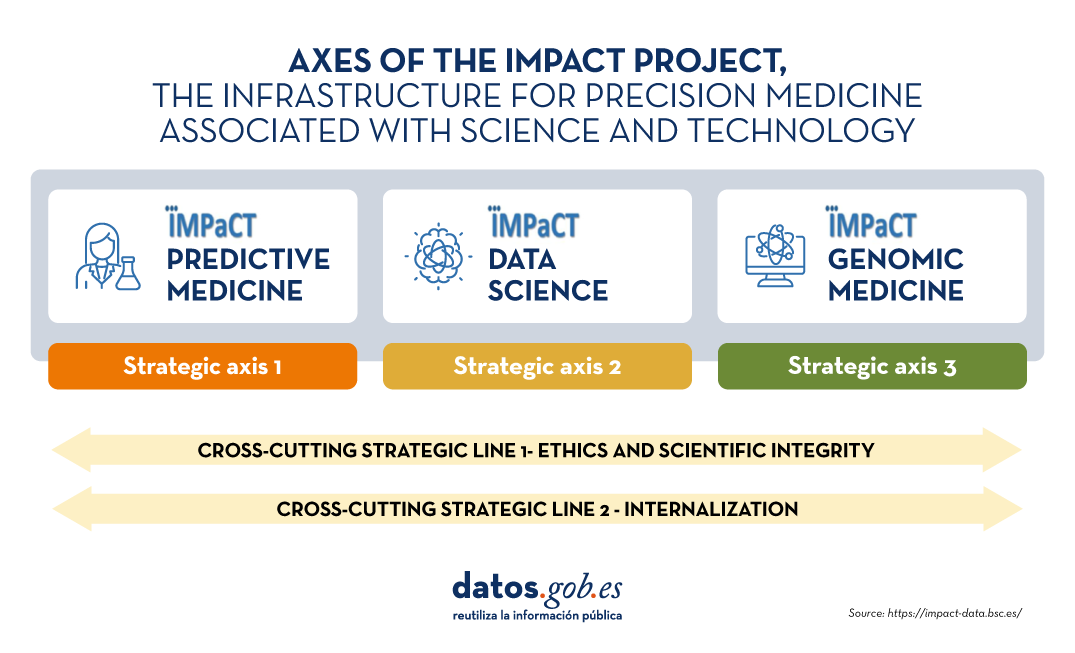
Source: IMPaCT-Data
In the following, we will focus on the functioning and results of IMPaCT-Data, the project linked to axis 2.
IMPaCT-Data, an integrated environment for interoperable data analysis
IMPaCT-Data is oriented towards the development and validation of an environment for the integration and joint analysis of clinical, molecular and genetic data, for secondary use, with the ultimate goal of facilitating the effective and coordinated implementation of personalised precision medicine in the National Health System. It is currently made up of a consortium of 45 entities associated by an agreement that runs until 31 December 2025.
Through this programme, the aim is to create a cloud infrastructure for medical data for research, as well as the necessary protocols to coordinate, integrate, manage and analyse such data. To this end, a roadmap with the following technical objectives is followed:

Source: IMPaCT-Data.
Results of IMPaCT-Data
As we can see, this infrastructure, still under development, will provide a virtual research environment for data analysis through a variety of services and products:
- IMPaCT-Data Federated Cloud. It includes access to public and access-controlled data, as well as tools and workflows for the analysis of genomic data, medical records and images. At this video shows how federated user access and job execution is realised through the use of shared computational resources. This allows for viewing and accessing the results in HTML and raw format, as well as their metadata. For those who want to go deeper into the user access options, please see this video another video where the linking of institutional accounts to the IMPaCT-Data account and the use of passports and visas for local access to protected data is shown.
- Compilation of software tools for the analysis of IMPaCT-Data. These tools are publicly accessible through the iMPaCT-Data domain domain at bio.tools a registry of software components and databases aimed at researchers in the field of biological and biomedical sciences. It includes a wide range of tools. On the one hand, we find general solutions, for example, focused on privacy through actions related to data de-identification and anonymisation (FAIR4Health Data Privacy Tool). On the other hand, there are specific tools, focused on very specific issues, such as gene expression meta-analysis (ImaGEO).
- Guidelines with recommendations and good practices for the collection of medical information. There are currently three guides available: "IMPaCT-Data recommendations on data and software", "IMPaCT-Data additional considerations to the IMPaCT 2022 call for projects" and "IMPaCT-Data recommendations on data and software" .
In addition to these, there are a number of deliverables related to technical aspects of the project, such as comparisons of techniques or proofs of concept, as well as scientific publications.
Driving use cases through demonstrators
One of the objectives of IMPaCT-Data is to contribute to the evaluation of technologies associated with the project's developments, through an ecosystem of demonstrators. The aim is to encourage contributions from companies, organisations and academic groups to drive improvements and achieve large-scale implementation of the project.
To meet this objective, different activities are organised where specific components are evaluated in collaboration with members of IMPaCT-Data. One example is the oRBITS terminology server for the encoding of clinical phenotypes into HPO (Human Phenotype Ontology) aimed at automatically extracting and encoding information contained in unstructured clinical reports using natural language processing. It uses the HPO terminology, which aims to standardise the collection of phenotypic data, making it accessible for further analysis.
Another example of demonstrators refers to the sharing of virtualised medical data between different centres for research projects, within a governed, efficient and secure environment, where all data quality standards defined by each entity are met within a governed, efficient and secure environment, where all data quality standards defined by each entity are met.
A strategic project aligned with Europe
IMPaCT-Data fits directly into the National Strategy for the Secondary Use of National Health System Data, as described in the PERTE on health (Strategic Projects for Economic Recovery and Transformation), with its knowledge, experience and input being of great value for the development of the National Health Data Space.
Furthermore, IMPaCT-Data's developments are directly aligned with the guidelines proposed by GAIA-X both at a general level and in the specific health environment.
The impact of the project in Europe is also evidenced by its participation in the european project GDI (Genomic Data Infrastructure) which aims to facilitate access to genomic, phenotypic and clinical data across Europe, where IMPaCT-Data is being used as a tool at national level.
This shows that thanks to IMPaCT-Data it will be possible to promote biomedical research projects not only in Spain, but also in Europe, thus contributing to the improvement of public health and individualised treatment of patients.
Blog
In the medical sector, access to information can transform lives. This is one of the main reasons why data sharing and open data communities or open science linked to medical research have become such a valuable resource. Medical research groups that champion the use and reuse of data are leading this transformation, driving innovation, improving collaboration and accelerating the advancement of science.
As we saw in the case of FISABIO Fundation, the open data in the health sector foster collaboration between researchers, speed up the process of validating study results and, ultimately, help save lives. This trend not only facilitates faster discoveries, but also helps to create more effective solutions. In Spain, the Consejo Superior de Investigación Científica (CSIC) is committed to open data and some renowned hospitals also share their research results while protecting their patients' sensitive data.
In this post, we will explore how research groups and health communities are sharing and reusing data to drive groundbreaking research and showcase more inspiring use cases. From developing new treatments to identifying trends in public health, data is redefining the medical research landscape and opening up new opportunities to improve global health.
Medical research groups committed to working with shared data
In Spain, there are several research groups and communities that share their findings more freely through platforms and databases that facilitate global collaboration and data reuse in the field of health. Below, we highlight some of the most influential cases, demonstrating how access to information can accelerate scientific progress and improve health outcomes.
-
H2O - Health Outcomes Observatory clinical data repository
H2O is a strategic public-private partnership to create a robust data infrastructure and governance model to collect and incorporate patient outcomes at scale into health decision-making at the individual and population level. H2O's approach puts patients in ultimate control of their health and ensures that only they exercise that control and ensures that only they exercise that control. Hospitals from all over the world participate in this consortium, including the Spanish Hospital Universitario Fundación Jiménez Díaz and the Hospital Vall d'Hebron. The Spain Research Unit collects patient-reported health outcomes and other clinical data to build an observatory to improve patient care.
-
Carlos III Health Institute: IMPaCT open science research projects
Within the framework of the IMPaCT infrastructure, different projects are being developed and approved as part of the Action in Health's grants for Precision Personalised Medicine Research Projects:
- COHORTE Programme - Predictive Medicine
- DATA programme: Data science
- GENOMICS Programme - Genomic medicine
The information, data, metadata and scientific products generated in IMPaCT are open access, to make science more accessible, efficient, democratic and transparent. Hospitals and research institutes from all over Spain are participating in this project.
-
POP Health Data: medical research project of the Instituto de Salud Carlos III (ISCIII) and the Platform of Patients' Organisations (POP)
This is a data project developed collaboratively between ISCIII and POP to improve knowledge and evidence on the clinical, occupational and social reality of chronic patients, and social reality of chronic patients, which is crucial for us. This initiative involves 36 national patient organisations, 16 scientific societies and 3 public administrations, including the Ministry of Social Rights and Agenda 2030, the Carlos III Health Institute and the Spanish Agency for Medicines and Health Products.
-
European Cancer Imaging Initiative european project to provide cancer imaging and support cancer research.
One of the objectives of the European Cancer Plan is to maximise the potential of data and digital technologies such as artificial intelligence (AI) or high performance computing (HPC). The cornerstone of the initiative will be a federated European infrastructure for cancer imaging data, developed by the European Federation of Cancer Imaging (EUCAIM). The project starts with 21 clinical centres in 12 countries, including 4 Spanish centres located in Valencia, Barcelona, Seville and Madrid.
-
4CE: Research Consortium
It is an international consortium for the study of the COVID-19 pandemic using electronic health record (EHR) data. The aim of the project - led by the international international academic user group i2b2 - isto inform clinicians, epidemiologists and the general public about COVID-19 patients with data acquired through the healthcare process. The platform offers aggregated data that are available on the project's own website divided between adult and paediatric data. In both cases, the data must be used for academic and research purposes; the project does not allow the use of the data for medical guidance or clinical diagnosis.
In conclusion, the commitment to data sharing and reuse in medical research is proving to be a fundamental catalyst for scientific progress and the improvement of public health. Through initiatives such as H2O, IMPaCT, and the European Cancer Imaging Initiative, we see how accessibility in data management is redefining the way we approach disease research and treatment.
The integration of data analytics practices promises a future where innovation in healthcare is achieved faster, more equitably and efficiently, thus delivering better outcomes for patients globally.
Blog
Building the European Health Data Space is one of the challenges of our generation. The COVID 19 pandemic put us in front of the mirror and brought back at least two images. The first was none other than the result of the application of formalistic, bureaucratised and old-fashioned models of data management. Second, the enormous potential offered by data sharing, collaboration of interdisciplinary teams and the use of health information for the common good. The European Union is clearly committed to the second strategy. This article examines the challenges of building a National Health Data Space as an instrument to enhance the reuse of health data for secondary uses from a variety of perspectives.
The error of focusing on formalist visions
The data processing and sharing scenario prior to the deployment of the European data strategy and its commitment to data spaces produced not only counter-intuitive, but also counter-factual effects. The framework of the General Data Protection Regulation (GDPR) instead of favouring processing operated as a barrier. Strict enforcement was chosen, based on the prevalence of privacy. Instead of seeking to manage risk through legal and technical solutions, the decision was made not to process data or to use technically complex anonymisations that are unfeasible in practice.
This model is not sustainable. Technological acceleration forces a shift in the centre of gravity from prohibition to risk management and data governance. And this is what Regulation of the European Parliament and of the Council on the European Health Data Space (EHDS) is committed to: finding solutions and defining guarantees to protect people. And this transformation finds Spain's healthcare sector in an unbeatable situation from any point of view, although it is not without risks.
Spain, a pioneer in the change of approach
Our country did its homework with the seventeenth additional provision on the processing of health data in Organic Law 3/2018, of 5 December, on the Protection of Personal Data and Guarantee of Digital Rights (LOPDGDD, in Spanish acronyms). The regulation circumvented most of the problems affecting the secondary use of health data and did so with the methodology derived from the GDPR and the jurisprudence of the Constitutional Court. To this end, he opted for:
- A clear systematisation and normative predetermination of use cases.
- A precise definition of treatment entitlements.
- Procedural, contractual and security guarantees.
The Provision was five years ahead of the EHDS in terms of its aims, objectives and safeguards. Not only that, it puts our healthcare system at a competitive advantage from a legal and material point of view.
From this point of view, the National Health Data Space as the backbone is a project that is as essential as it is unpostponable, as reflected in the National Health System's Digital Health strategy and the Recovery, Transformation and Resilience Plan. However, this assertion cannot be based on uncritical enthusiasm. Much work remains to be done.
Lessons learned and challenges to overcome
European research projects managed by the ecosystem of health foundations at the Carlos Tercero Institute, university and business, provide interesting lessons. In our country we are working on precision medicine, on the construction of data lakes, on mobile applications, on high capacities of pseudonymisation and anonymisation, on medical imaging, on predictive artificial intelligence..., and we could go on. This ecosystem needs a layer of governance innovation. Part of it will be provided directly by the EHDS. Data access bodies, the supervisory authority and cross-border access structures shall ensure the lifecycle from the formation of catalogued and reliable datasets to their actual processing. These governance infrastructures require an organisational and human deployment to support them. Previous experience helps to anticipate the risks that a stress test may pose for the whole value chain:
- The training of human resources in crucial aspects of data protection, information security and new ethical requirements is not always adequate in terms of format, volume and profile segmentation. Not 100% of the workforce is trained, while voluntary continuing education for health professionals is of a high legal standard, causing an effect that is as counterproductive as it is perverse: curtailing the capacity to innovate. If instead of empowering and engaging, we offer an endless list of GDPR obligations, research staff end up self-censoring their ability to imagine. The content and the training target are confused. High-level training should focus on project managers and technical and legal support staff. And in these, data protection officer plays a vehicular role, as it is the person who must provide non-binary advice - of the legal or non-legal type - and cannot transfer all the responsibility to the research team.
- Governance of treatment resources and processes needs to be improved. In certain research areas, and universities are the best example of this, information systems are segmented and managed at the smallest project or research team level. These are insufficient resources, with little control over risk management and security monitoring, including support for the management and maintenance of the treatment environment. Moreover, data access procedures are based on rigid models, anchored in the case study or clinical trial. Thus, more often than not, we handle datasets in very specific environments outside the main data processing centres. This multiplies the risk, and the costs, in areas such as data protection impact assessments or the deployment of security measures.
Lack of expertise can pose systemic risks. To begin with, Ethics Committees are confronted with issues of data protection and artificial intelligence ethics that overwhelm their habits, customs and knowledge, and mothball their processes. On the other hand, what we commonly refer to as big data is not something that happens by magic. Pseudonymisation or anonymisation, annotation, enrichment and validation of the dataset and the processes implemented on it require highly skilled professionals.
Effects of EHDS
We should reflect on whether our leading position in digitisation could also be our Achilles' heel. Few countries have a high degree of digitisation of every level of healthcare, from primary to hospital. Virtually none have regulated the use of pseudonymised data without consent, nor the broad consent model of our LOPDGDD. In this sense, under the umbrella of the EHDS there could be two effects that we need to manage:
- New opportunities in research projects. Firstly, as soon as Spanish health institutions publish their data catalogues at European level, requests for access from other countries could multiply. And, therefore, the opportunities to participate in research projects as information providers, data holders, or as data users.
- Boosting the ecosystem of innovative companies. Moreover, the wide range of secondary uses foreseen by the EHDS will broaden the profile of actors submitting data access requests. This points to the possibility of a unique ecosystem of innovative companies for the deployment of health solutions from wellness to artificial intelligence-assisted medical diagnostics.
This forces those responsible for the public health system to ask themselves a rather simple question: what level of availability, process capability, security and interoperability can the available information systems offer? Let us not forget that many trans-European research projects, or the deployment of Artificial Intelligence tools in the health sector, are backed by budgets running into millions. This presents enormous opportunities to deepen the deployment of new models of health service delivery that also feed back into research, innovation and entrepreneurship. But there is also the risk of not being able to take advantage of the available resources due to shortcomings in the design of repositories and their processing capabilities.
What data space model are we pursuing?
The answer to this question can be found very clearly both in the European Union's data space strategy and in the Spanish Government's own strategy. The task that the EHDS attributes to data access bodies, beyond the mere granting of an access permit, is to support and assist in the development of the processing. This requires a National Health Data Space to ensure service level, anonymisation or pseudonymisation standards, interoperability and information security.
In this context, individual researchers in non-health settings, but especially small and medium-sized innovative companies, do not possess the necessary muscle and expertise to meet ethical and regulatory requirements. Therefore, the need to provide them with support in terms of the design of regulatory and ethical compliance models should not be neglected, if they are not to act as a barrier to entry or exclusion.
This does not exclude or preclude regional efforts, those of foundations or reference hospitals, or nascent data infrastructures in the field of medical imaging of cancer or genomics. It is precisely the idea of a federation of data spaces that inspires European legislation that can bear fruit of the highest quality here. The Ministry of Health and public health departments should move in this direction, with the support of the new Ministry of Digital Transformation and Public Administration. The autonomous communities reflect and act on the development of governable models and participate, together with the Ministry of Health, in the governance model that should govern the national framework. Regulators such as the Spanish Data Protection Agency are providing viable frameworks for the development of data spaces. Entire hospitals design, implement and deploy information systems that seek to integrate hundreds of data sources and generate data lakes for research. Data infrastructures such as EUCAIM lead the way and generate high-quality know-how in highly specialised areas.
The work on the roll-out of a National Health Data Space, and each and every one of the unique initiatives underway, show us a way forward in which the federation of effort, solidarity and data sharing ensure that our privileged position in health digitisation stimulates leadership in research, innovation and digital entrepreneurship. The National Health Data Space will be able to offer differential value to stakeholders. It will provide data quality and volume, support advanced compute-intensive data analytics and AI tools and can provide security in software brokering processes for the processing of pseudonymised data with high requirements.
It is necessary to recall a core value for the European Union: the guarantee of fundamental rights and the human-centred approach. The Charter of Digital Rights promoted by the Spanish government proposes successively the right of access to data for scientific research, innovation and development purposes, as well as the right to the protection of health in the digital environment. The National Health Data Space is called to be the indispensable instrument to achieve a sustainable, inclusive digital health at the service of the common good, which at the same time boosts this dimension of the data economy, promoting research and entrepreneurship in our country.
Content prepared by Ricard Martínez, Director of the Chair of Privacy and Digital Transformation. Professor, Department of Constitutional Law, Universitat de València. The contents and points of view reflected in this publication are the sole responsibility of its author.