


Evento
Promote the use of open data in the European Union to generate new ideas, products and innovative services. That is the objective of EU Datathon, which this year celebrates its third edition, organized by the Publications Office and the presidency of the Council of the European Union.
The competition offers participants the opportunity to demonstrate their skills in data-related issues and show their ideas to the world. To do this, they will have to develop applications - web or mobile -, visualizations and insights that combine at least one data set produced by the EU institutions, agencies and bodies with other sources of public or private data.
There are 3 different categories, one horizontal challenge and two thematic challenges:
- Challenge 1: 'Innovative ideas through open data'. Participants should develop innovative ideas using open data from the EU. Specifically, they must use at least one data set from the EU Open Data Portal, and combine it with other open or not data sources.
- Challenge 2: 'New insights in economics and finance'. Participants will have to develop a new insight, business model or business concept through open data. To do this, they must work with at least one dataset from the European Central Bank, the European Commission's Directorate-General for Budget, the European Commission's Directorate-General for Economic and Finance, the European Investment Bank, the European Investment Fund or Eurostat, and combine it with other open or private data sources.
- Challenge 3: 'Tackling climate change'. Participants will have to develop a new business concept or business model to fight against climate change using open data. To do this, they will have to combine at least one dataset in the domain of climate change and environment from the EU Open Data Portal, with any other source (for example, the FAO or the European Environment Agency).
Those interested in participating have to register their project using this online form, before March 24, 2019.
Then, the evaluation process begins, which will consist of two phases: preselection and final selection.
- Pre-selection: an independent experts jury will evaluate the projects description, and select a maximum of 4 teams for each category, based on its relevance to digital transformation in Europe and the potential of the proposed solution, among other factors.
- Final selection: The preselected teams will be invited to develop their application or visualization in almost two months. Then, they will have to present their proyect during the final conference, which will take place on June 13 in Brussels. In addition to its relevance, the applications will be evaluated against some criteria such as solutions scalability or its interoperability to other data sources.

As a prize, € 25,000 will be allocated for each challenge, which will be split in the following order:
- First prize: EUR 15,000
- Second prize: EUR 7,000
- Third prize: EUR 3,000
For all those interested, the organizers have prepared a series of webinars, to detail the bases of the contest and show some data sources that can be used.
If you have an idea, do not hesitate to participate!

Noticia
Data has become the main value of companies. An increasing number of economic sectors are incorporating the capture and analysis of data not only as a fundamental metric to know how their business has evolved, but also to predict how they will behave in the future.
The analysis of large volumes of data is an essential resource for economic growth, job creation and social progress. There are hundreds of examples: industry companies that analyse the performance of their machinery to predict when maintenance tasks will be necessary; utilities that base their production adjustments based on energy consumption patterns that allow to predict users demands; or farmers who schedule irrigation according to weather and crops behavior.
For this ecosystem to work properly, companies not only need internal data, but also need to have access to external information: open data from public or private sources that enrich the analysis models or work as a basis for the creation of new products and services. In other words, it is necessary to create a Single Digital Market, where certain data are shared between the member states.
The European Union is aware of this situation and, therefore, they started a conversation with states and other stakeholders. The objective is to develop the most appropriate actions to take advantage of the full potential of European data economy. According to the EU, the value of the EU data economy was €272 billion in 2015, close to 1.9% of GDP, but this value could more than double by 2020, with adapted policy and legal solutions.
One of the first actions that EU is carrying out is to analyze the possible challenges and propose solutions, as detailed below:
Free flow of data
Legal or administrative restrictions on data location may prevent the private and public sectors from having access to data. It is difficult for a small service provider to offer competitive prices in several markets within the EU, because it would have to arrange data storage or processing capacity in every member state.
The solution is removing data localisation restrictions except if they are required for national security. Data does not have to be stored in one specific member state, because free flow of data is guaranteed based on the General Data Protection Regulation (GDPR).
Data access and transfer
As we have anticipated before, companies tend to analyse data only in-house. The exchange of data with other stakeholders remains uncommon, because there are no comprehensive policy frameworks for the economic use of non-personal and anonymized data generated by machines and sensors.
Therefore, it is necessary to facilitate and encourage the exchange and reuse of data, protecting investments and assets. For example, encouraging the use of common suppliers that help to optimize costs and improve efficiency: while agricultural machines need 90 minutes to map yields from one hectare, a specialized provider can do the same in 10 minutes, using drones and unified data from different farms.
Legal responsibility for data based products
An Internet of Things ecosystem is made up of many market players (software providers, hardware providers, management platforms, security providers, etc.). This generates a complex context where it is difficult to identify who is responsible for each task, which affects innovation and uptake of data driven products and services.
To solve it, it is necessary to define the responsibilities previously.
Data portability, interoperability and standards
Personal data portability is a right and, therefore, it cannot be complex or expensive. However, a business using cloud services cannot easily extract or port their data because it might be too expensive or technically complicated (for example, to switch providers).
Therefore, it would be necessary to reduce switching costs in order to stimulate an innovation-friendly environment and improve technical interoperability and data standards.
The creation of a digital single market is one of EU priorities. Overcoming these challenges requires a common effort from member countries and companies to create clear rules that allow the sharing of interesting data in a simple manner and without great costs. In this way, it will be possible to improve innovation and boost the European economy.
Main conclusions of the revision of the European Directive on the Reuse of Public Sector Information
Noticia
The European Union was created to facilitate commercial transactions between its member states, eliminating barriers and ensuring the free movement of goods, people and services. With the rise of data and the digital economy, the institution had to expand its scope beyond physical assets, and include among its functions the creation of a Digital Single Market that promotes the exchange of information in a secure way.
The public organisms do not stop generating data, which are a valuable raw material to favour economic growth. The power of public open data is evident according to European Union studies: more than 50% surveyed companies use open data to create new products and services; and a third of start-ups supported by ODINE would not exist without open data.
In order to facilitate the reuse of information from the public sector, Directive 2003/98/EC of the European Parliament and of the Council (PSI Directive) was created. It introduced provisions on non-discrimination, cost, exclusive agreements, transparency and licenses, among other aspects. In 2013 this directive was amended by Directive 2013/37/EU. The 2013 Directive incorporated the need to carry out a review of the initiative on accessibility and reuse of public information before July 18th, 2018, with the aim of increasing the amount of public sector data available for reuse, ensuring fair competition and easy access to markets based on public sector information, and enhancing cross-border innovation.
To carry out this review, a thorough analysis of other current directives (INSPIRE or Database Directive) has been carried out in order to be aligned. Likewise, a public hearing and an analysis of the impact on the economy of the changes introduced in 2013 has been carried out. During the hearing process, all interested parties, including public authorities and reusers (public, private, commercial and non-commercial) were invited to contribute
The conclusions have confirmed that the Directive has helped to stimulate the European economy, achieving its objectives. In addition, it has had a favourable impact on transparency, citizen empowerment, and public sector efficiency. However, they also indicate that there are still challenges to overcome in order to fully exploit the potential of public sector information for the European economy and society. Some of these challenges are related to the following aspects:
- Limited real-time access to data. More dynamic data should be provided in real time and more technical solutions developed to facilitate data usability.
- Charges about cost. Charge for reusing public sector data should not cost more than “the marginal costs for reproducing, making available and dissemination the open data”. However, a widespread practice of demanding much higher amounts has been found. This create market entry barriers for SMEs and startups.
- The lack of availability of high interest data, because they are in the hands of private operators. For example, data generated by companies providing public services (utilities, transport, etc.) or research data from public funding.
- The need to avoid exclusivity agreements. Public-private agreements can lead to situations in which public sector information is blocked.
- The relationship between the PSI Directive and certain related legal instruments.
Given these challenges, the Commission is in the revision process of the PSI Directive, regarding the following aspects:
- Stimulate the publishing of dynamic data and the uptake of APIs.
- Limit the exceptions allowing public bodies to charge for the reuse of their data more than the marginal costs of dissemination.
- Enlarge the scope of the Directive, including data held by public undertakings – in this case, charges for the reuse of such data can be above marginal costs for dissemination- and research data resulting from public funding.
- Strengthen the transparency requirements for public–private agreements involving public sector information, avoiding exclusive arrangements.
Until July 3th, the deadline is open for those who wish to provide their opinion on the different aspects included in the review.
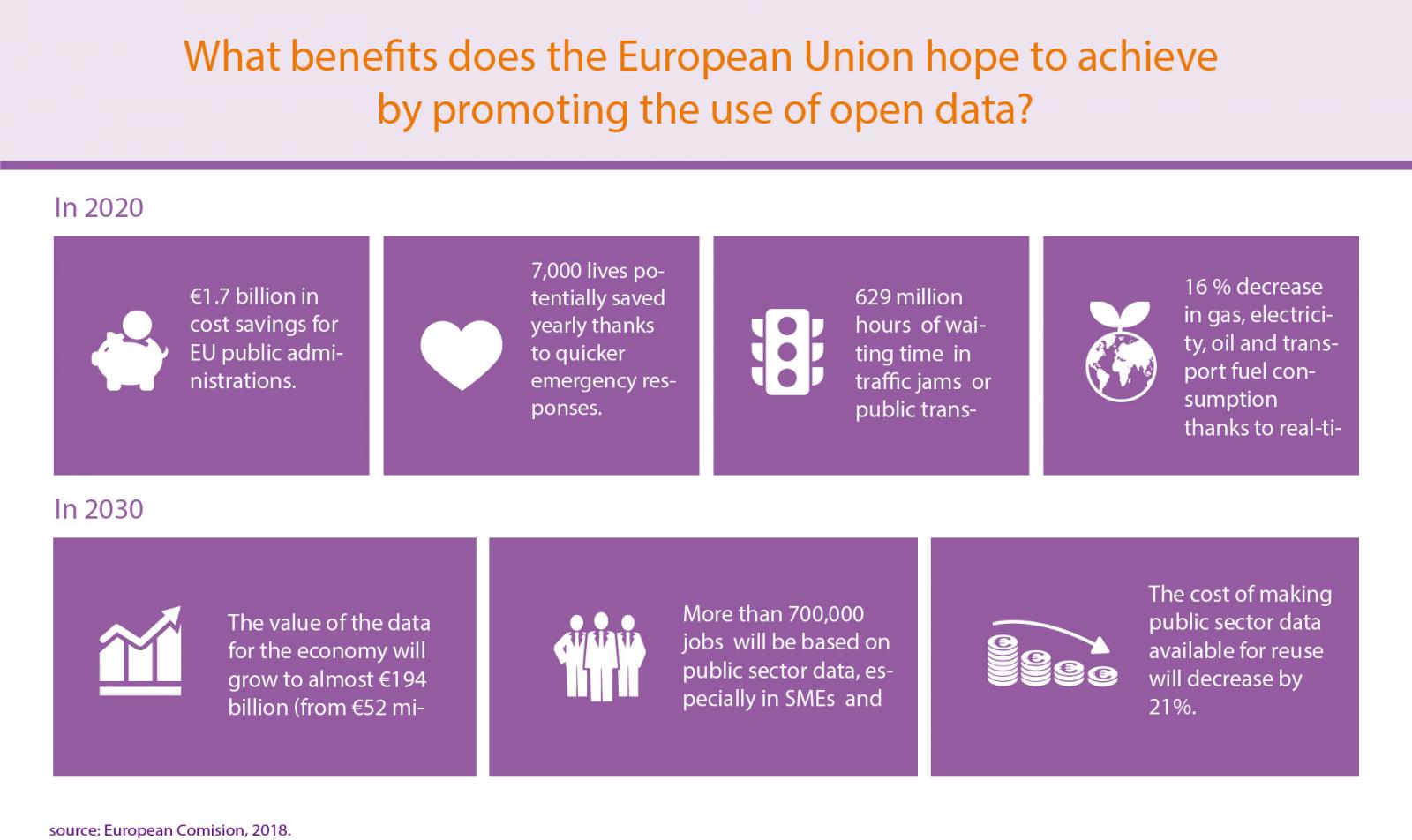
In summary, the revision of the PSI Directive aim to continue promoting an open data ecosystem that allows a further step towards the creation of a Digital Single Market. With the new PSI Directive as a driver for the cross-border reuse of open data, it will be easier to start new data-based businesses, as well as to improve existing ones, with the consequent value for society, as shown in the following figure.
Noticia
Under the Horizon 2020 framework, the CLARITY project will support European Member States in their pursuit for greater trust, transparency and efficiency within their open eGovernment initiatives, fostering good practices in this field in conjunction with e-government, especially within local government sectors, SMEs and self-employed, general medicine and disability. This initiative is formed by a team of seven members, who combine experience in several areas: from public administration, open government, data science, computer science and engineering, social sciences, humanities, business and economics.
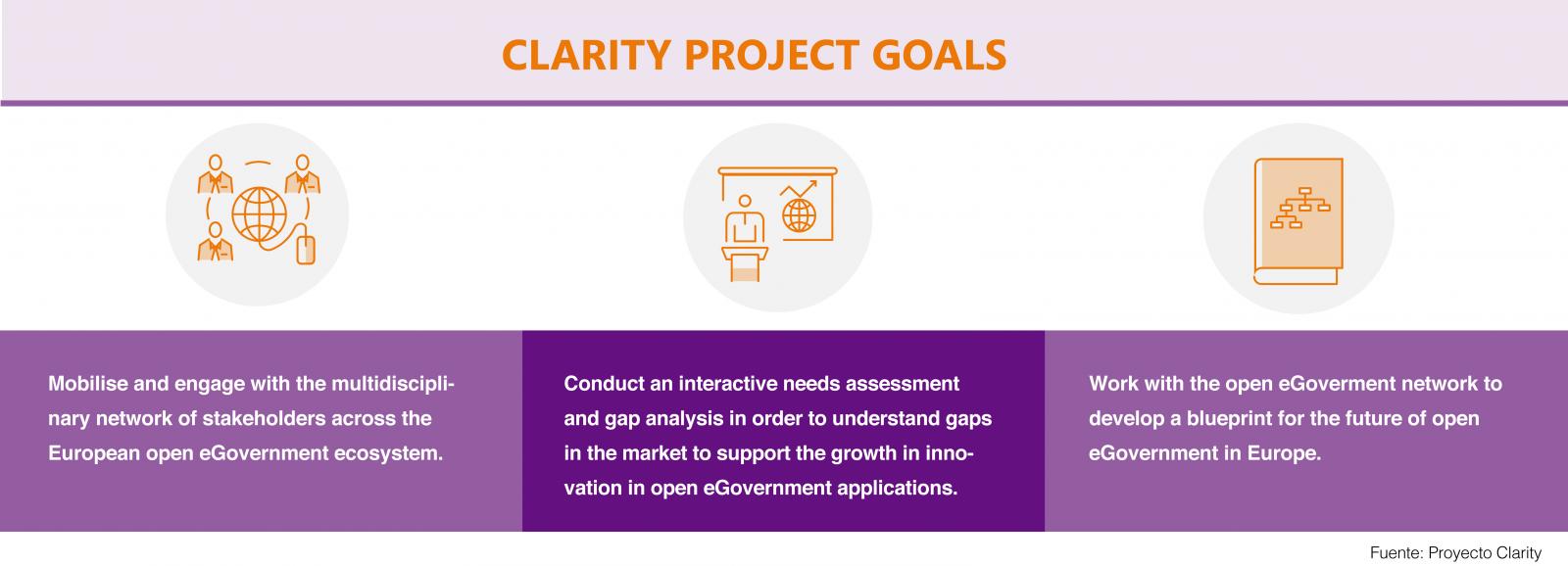
Perfectly integrated on the current open Government networkds, the CLARITY Project members keep bringing together stakeholder networks across Europe into an engaged and mobilised community that supports innovation in open eGovernment applications in order to reach the following global goals:
- Mobilise and engage with the multidisciplinary network of stakeholders across the European open eGovernment ecosystem.
- Conduct an interactive needs assessment and gap analysis in order to understand gaps in the market to support the growth in innovation in open eGovernment applications.
- Work with the open eGoverment network to develop a blueprint for the future of open eGovernment in Europe.
CLARITY Project Resources
The CLARITY project, through its online platform (https://clarity-csa.eu/), makes available to the community a set of open reports of this sector in Europe and invites those interested in contributing to the evolution towards an open electronic government to share its vision, collaborating in the improvement of the previous guide (http://clarity.oeg-upm.net/blueprint/) and the application market that shows the open electronic government services channels in the EU (https://clarity-csa.eu/portfolio-clean-2cols).
In addition, it provides users with information and access to the European Futurium platform (https://ec.europa.eu/futurium/en/egovernment4eu), which contributes to the 2016-2020 Electronic Government Action Plan.
CLARITY Conference, the Open Government of the future
In 2018, from 14 to 15 February, the CLARITY Conference will take place in the Swedish city of Skellefteå: two days during which the technologies, regulations and knowledge needed to carry out open government initiatives will be explored and discussions on digital transformation and its benefits will be held.
Noticia
The European Union is committed to open science, ensuring that all investigations carried out in its territory are available without any technical, legal or financial restriction as agreed in the Competitiveness Council that took place on May 27th in Brussels and attended by the ministers of Industry, Competitiveness and Research of the EU.
According to the general principles of Horizon 2020 Program, which guarantee open access to scientific publications and to the data resulting from the research financed with public funds in the EU, there is a recognition that open science is not only an opportunity to improve the quality and benefits of science itself; it also contributes to the progress, efficiency and reliability of the common European knowledge.
Thus, through the Council, ministers committed their governments to implement an action plan within the next four years. In the transition to an open system of scientific results, member states and stakeholders are asked to take appropriate measures to ensure that open science is a reality at national level and to defend the program in the European and international forums.
Chaired by the Secretary of Education, Culture and Science of the Netherlands, Sander Dekker, European ministers decided unanimously to take appropriate action to ensure that all scientific publications from 2020 are open and accessible, except for those data that should be restricted for safety or privacy purposes.
Thanks to this decision, not only the re-use of scientific information will be possible, but the member states are also calling on the research world to no longer judge scientists and researchers only on the number of publications, but more attention should be paid to the societal impact of their work.
Additionally, to boost the European economy and make the EU more attractive for foreign start-ups and businesses, member states are looking into introducing a unique European visa for foreign start-up founders so that they will not have to apply for a separate visa in each member state.
The Commission Communication on May 6th recognized the importance of science and research to drive innovation, while aiming at improving the conditions of science-based data. Promoting growth and innovation by re-using scientific results provides a more favourable environment for investment and new business. For these reasons, governments, businesses and institutions are working together to eliminate legal, organizational and economic barriers to access to scientific results and innovation, achieving an optimum level of knowledge sharing in Europe.