


Blog
Last November 2023, Crue Spanish Universities published the report TIC360 "Data Analytics in the University". The report is an initiative of the Crue-Digitalisation IT Management working group and aims to show how the optimisation of data extraction and processing processes is key to the generation of knowledge in Spanish public university environments. To this end, five chapters address certain aspects related to data holdings and the analytical capacities of universities to generate knowledge about their functioning.
The following is a summary of the chapters, explaining to the reader what can be found in each chapter.
Why is data analytics important and what are the challenges?
In the introduction, the concept of data analytics is recalled as the extraction of knowledge from available data, highlighting its growing importance in the current era. Data analytics is the right tool to obtain the necessary information to support decision-making in different fields. Among other things, it helps to optimise management processes or improve the energy efficiency of the organisation, to give a few examples. While fundamental to all sectors, the paper focuses on the potential impact of data on the economy and education, emphasising the need for an ethical and responsible approach.
The report explores the accelerated development of this discipline, driven by the abundance of data and advanced computing power; however, it also warns about the inherent risks of tools based on techniques and algorithms that are still under development, and that may introduce biases based on age, background, gender, socio-economic status, etc.In this regard, it is important to bear in mind the importance of privacy, personal data protection, transparency and explainability, i.e. when an algorithm generates a result, it must be possible to explain how that result has been arrived at.
A good summary of this chapter is the following sentence by the author: "Good use of data will not lead us to paradise, but it can build a more sustainable, just and inclusive society. On the contrary, its misuse could bring us closer to a digital hell.
How would universities benefit from participating in Data Spaces?
The first chapter, starting from the premise that data is the main protagonist and the backbone asset of the digital transformation, addresses the concept of the Data Spacehighlighting its relevance in the European Commission's strategy as the most important asset of the data economy.
Highlighting the potential benefits of data sharing, the chapter highlights how the data economy, driven by a single market for shared data, can be aligned with European values and contribute to a fairer and more inclusive digital economy. Initiatives such as the Digital Spain Strategy 2026which highlights the role of data as a key asset in digital transformation.
There are many advantages to university participation in data spaces, such as sharing, accessing and reusing data resources generated by other university communities. This allows for faster progress in research, optimising the public resources previously dedicated to research. One initiative that demonstrates these benefits is the European Open Science Space (EOSC)which aims to link researchers and practitioners in science and technology in a virtual environment with open and seamless services for the storage, management, analysis and re-use of scientific data, across physical boundaries and scientific disciplines. The chapter also introduces different aspects related to data spaces such as guiding principles, legislation, participants and roles to be considered. It also highlights some issues related to the governance of data spaces and the technologies needed for their deployment.
What is the European Skill Data Space (ESDS)?
This second chapter explores the creation of a common European data space, with a focus on skills. This space aims to reduce the gap between educational skills and labour market needs, increasing productivity and competitiveness through cross-border access to key data for the creation of applications and other innovative uses. In this respect, it is essential to take into account the release of the version 3.1 of the European Learning Model (ELM)which is to be consolidated as the single European data model for all types of learning (formal, non-formal, informal) as the basis for the European Skills Data Space.
The report defines the key phases and elements for the creation and integration into the European Skills Data Space, highlighting what contributions the different roles (education and training provider, jobseeker, citizen, learner and employer) could make and expect.
what is the role of the Spanish university in the context of European Data Spaces?
This chapter focuses on the role of Spanish universities within European data spaces as a key agent for the country's digital transformation. To achieve these results and reap the benefits of data analytics and interaction with European data spaces, institutions must move from a static model, based on medium- and long-term planning criteria, to flexible models more suited to the liquid reality in which we live, so that data can be harnessed to improve education and research.
In this context, the importance of collaboration and data exchange at European level is crucial, but taking into account existing legislation, both generic and domain-specific. In this sense, we are witnessing a revolution for which compliance and commitment on the part of the university organisation is crucial. There is a risk that organisations that are not able to comply with the regulatory block will not be able to generate high quality datasets.
Finally, the chapter offers a number of indications as to what kind of staff universities should have in order not to be deprived of creating a corps of analysts and computer experts, vital for the future.
What kind of certifications exist in the field of data?
In order to address the challenges introduced in the chapters of the report, universities need to have in place: (1) data with adequate standards; (2) good practices with regard to governance, management and quality; and (3) sufficiently qualified and skilled professionals to perform the different tasks. To convey confidence in these elements, this chapter justifies the importance of having certifications for the three elements presented:
- Data product quality level certifications such as ISO/IEC 25012, ISO/IEC 25024 and ISO/IEC 25040.
- Organisational maturity level certifications with respect to data governance, data management and data quality management, based on the MAMD model.
- Certifications of personal data competences, such as those related to technological skills or professional competence certifications, including those issued by CDMP or the CertGed Certification.
What is the state of the University in the data age?
Although progress has been made in this area, Spanish universities still have a long way to go to adapt and transform themselves into data-driven organisations in order to get the maximum benefit from data analytics. In this sense, it is necessary to update the way of operating in all the areas covered by the university, which requires acting and leading the necessary changes in order to be competitive in the new reality in which we are already living.
The aim is for analytics to have an impact on the improvement of university teaching, for which the digitisation of teaching and learning processesis fundamental. This will also generate benefits in the personalisation of learning and the optimisation of administrative and management processes.
In summary, data analytics is an area of great importance for improving the efficiency of the university sector, but to achieve its full benefits, further work is needed on both the development of data spaces and staff training. This report seeks to provide information to move the issue forward in both directions.
The document is publicly available for reading at: https://www.crue.org/wp-content/uploads/2023/10/TIC-360_2023_WEB.pdf
Content prepared by Dr. Ismael Caballero, Full Professor at UCLM
The contents and points of view reflected in this publication are the sole responsibility of its author.

Blog
2023 was a year full of new developments in artificial intelligence, algorithms and data-related technologies. Therefore, these Christmas holidays are a good time to take advantage of the arrival of the Three Wise Men and ask them for a book to enjoy reading during the holidays, the well-deserved rest and the return to routine after the holiday period.
Whether you are looking for a reading that will improve your professional profile, learn about new technological developments and applications linked to the world of data and artificial intelligence, or if you want to offer your loved ones a didactic and interesting gift, from datos.gob.es we want to offer you some examples. For the elaboration of the list we have counted on the opinion of experts in the field.
Take paper and pencil because you still have time to include them in your letter to the Three Wise Men!
1. Inteligencia Artificial: Ficción, Realidad y... sueños, Nuria Oliver, Real Academia de Ingeniería GTT (2023)
What it’s about: The book has its origin in the author's acceptance speech to the Royal Academy of Engineering. In it, she explores the history of AI, its implications and development, describes its current impact and raises several perspectives.
Who should read it: It is designed for people interested in entering the world of Artificial Intelligence, its history and practical applications. It is also aimed at those who want to enter the world of ethical AI and learn how to use it for social good.
2. A Data-Driven Company. 21 Claves para crear valor a través de los datos y de la Inteligencia Artificial, Richard Benjamins, Lid Editorial (2022)
What it's about: A Data-Driven Company looks at 21 key decisions companies need to face in order to become a data-driven, AI-driven enterprise. It addresses the typical organizational, technological, business, personnel, business, and ethical decisions that organizations must face to start making data-driven decisions, including how to fund their data strategy, organize teams, measure results, and scale.
Who should read it: It is suitable for professionals who are just starting to work with data, as well as for those who already have experience, but need to adapt to work with big data, analytics or artificial intelligence.
3. Digital Empires: The Global Battle to Regulate Technology, Anu Bradford, OUP USA (2023)
What it's about: In the face of technological advances around the world and the arrival of corporate giants spread across international powers, Bradford examines three competing regulatory approaches: the market-driven U.S. model, the state-driven Chinese model, and the rights-based European regulatory model. It examines how governments and technology companies navigate the inevitable conflicts that arise when these regulatory approaches clash internationally.
Who should read it: This is a book for those who want to learn more about the regulatory approach to technologies around the world and how it affects business. It is written in a clear and understandable way, despite the complexity of the subject. However, the reader will need to know English, because it has not yet been translated into Spanish.
4. El mito del algoritmo, Richard Benjamins e Idoia Salazar, Anaya Multimedia (2020)
What it's about: Artificial intelligence and its exponential use in multiple disciplines is causing an unprecedented social change. With it, philosophical thoughts as deep as the existence of the soul or debates related to the possibility of machines having feelings are beginning to emerge. This is a book to learn about the challenges, challenges and opportunities of this technology.
Who should read it: It is aimed at people with an interest in the philosophy of technology and the development of technological advances. By using simple and enlightening language, it is a book within the reach of a general public.
5. ¿Cómo sobrevivir a la incertidumbre?, de Anabel Forte Deltell, Next Door Publishers
What it is about: It explains in a simple way and with examples how statistics and probability are more present in daily life. The book starts from the present day, in which data, numbers, percentages and graphs have taken over our daily lives and have become indispensable for making decisions or for understanding the world around us.
Who should read it: A general public that wants to understand how the analysis of data, statistics and probability are shaping a large part of political, social, economic and social decisions?
6. Análisis espacial con R: Usa R como un Sistema de Información Geográfica, Jean François Mas, European Scientific Institute
What it is about: This is a more technical book, which provides a brief introduction to the main concepts for handling the R programming language and environment (types of objects and basic operations) and then introduces the reader to the use of the sf library or package for spatial data in vector format through its main functions for reading, writing and analysis. The book approaches, from a practical and applicative perspective with an easy-to-understand language, the first steps to get started with the use of R in spatial analysis applications; for this, it is necessary that users have basic knowledge of Geographic Information Systems.
Who should read it: A public with some knowledge of R and basic knowledge of GIS who wish to enter the world of spatial analysis applications.
This is just a small sample of the great variety of existing literature related to the world of data. We are sure that we have left some interesting book without including it, so if you have any extra recommendation you would like to make, do not hesitate to leave us your favorite title in the comments. Those of us on the datos.gob.es team would be delighted to read your recommendations.
Noticia
Mark them on your calendar, make a note in your agenda, or set reminders on your mobile to not forget about this list of events on data and open government taking place this autumn. This time of year brings plenty of opportunities to learn about technological innovation and discuss the transformative power of open data in society.
From practical workshops to congresses and keynote speeches, in this post, we present some of the standout events happening in October and November. Sign up before the slots fill up!
Data spaces in the EU: synergies between data protection and data spaces
At the beginning of the tenth month of the year, the Spanish Data Protection Agency (AEPD) and the European Cybersecurity Agency (ENISA) will hold an event in English to address the challenges and opportunities of implementing the provisions of the General Data Protection Regulation (GDPR) in EU data spaces.
During the conference, the conference will review best practices of existing EU data spaces, analyse the interaction between EU legislation and policies on data exchange and present data protection engineering as an integral element in the structure of data spaces, as well as its legal implications.
- Who is it aimed at? This event promises to be a platform for knowledge and collaboration of interest to anyone interested in the future of data in the region.
- When and where is it? On October 2nd in Madrid from 9:30 AM to 6:00 PM and available for streaming with prior registration until 2:45 PM.
- Registration: link no longer available
SEMIC Conference 'Interoperable Europe in the age of AI'
Also in October, the annual SEMIC conference organised by the European Commission in collaboration with the Spanish Presidency of the Council of the European Union returns. This year's event takes place in Madrid and will explore how interoperability in the public sector and artificial intelligence can benefit each other through concrete use cases and successful projects.
Sessions will address the latest trends in data spaces, digital governance, data quality assurance and generative artificial intelligence, among others. In addition, a proposal for an Interoperable Europe Act will be presented.
- Who is it aimed at? Public or private sector professionals working with data, governance and/or technology. Last year's edition attracted more than 1,000 professionals from 60 countries.
- When and where is it? The conference will be held on October 18th at the Hotel Riu Plaza in Madrid and can also be followed online. Pre-conference workshops will take place on October 17th at the National Institute of Public Administration
- Registration: https://semic2023.eu/registration/
Data and AI in action: sustainable impact and future realities
From October 25th to 27th, an event on the value of data in artificial intelligence is taking place in Valencia, with the collaboration of the European Commission and the Spanish Presidency of the Council of the European Union, among others.
Over the course of the three days, approximately one-hour presentations will be given on a variety of topics such as sectoral data spaces, the data economy and cybersecurity.
- Who is it aimed at? Members of the European Big Data Value Forum will receive a discounted entrance fee and associate members receive three tickets per organisation. The ticket price varies from 120 to 370 euros.
- When and where is it? It will take place on October 25th, 26th and 27th in Valencia.
- Registration: bipeek.
European Webinars: open data for research, regional growth with open data and data spaces
The European Open Data Portal organises regular webinars on open data projects and technologies. In datos.gob.es we report on this in summary publications on each session or in social networks. In addition, once the event is over, the materials used to carry out the didactic session are published. The October events calendar is now available on the portal's website. Sign up to receive a reminder of the webinar and, subsequently, the materials used.
Data spaces: Discovering block architecture
- When? On October 6th from 10:00 AM to 11:30 AM
- Registration: data.europa academy 'Data spaces: Discovering the building blocks' (clickmeeting.com)
How to use open data in your research?
- When? On October 19th from 10:00 AM to 11:30 AM
- Registration: How to use open data for your research (clickmeeting.com)
Open Data Maturity Report: The in-depth impact dimension
- When? On October 27th from 10:00 AM to 11.30 AM
- Registration: data.europa academy 'Open Data Maturity 2022: Diving deeper into the impact dimension' (clickmeeting.com)
ODI SUMMIT 2023: Changes in data
November starts with an Open Data Institute (ODI) event that poses the following question by way of introduction: how does data impact on technology development to address global challenges? For society to benefit from such innovative technologies as artificial intelligence, data is needed.
This year's ODI SUMMIT features speakers of the calibre of World Wide Web founder Tim Berners-Lee, Women Income Network co-founder Alicia Mbalire and ODI CEO Louise Burke. It is a free event with prior registration.
- Who is it aimed at? Teachers, students, industry professionals and researchers are welcome to attend the event.
- When and where is it? It is on November 7th, online.
- Entry: Form (hsforms.com)
These are some of the events that are scheduled for this autumn. Anyway, don't forget to follow us on social media so you don't miss any news about innovation and open data. We are on Twitter and LinkedIn; you can also write to us at dinamizacion@datos.gob.es if you want us to add any other event to the list or if you need extra information.
Application
The UNA Women application offers a personalized dashboard with training options for young women according to their socioeconomic circumstances.
The main objective of the project is to contribute to reducing the gender employment gap. For this purpose, the company ITER IDEA has used more than 6 million lines of data processed from different sources, such as data.europa.eu, Eurostat, Censis, Istat (Italian National Institute of Statistics) or NUMBEO.
In terms of user experience, the application first asks the user to fill in a form to find out key data about the person seeking information: age, education or professional sector, training budget, etc. Once the data has been collected, the app offers an interactive map with all the training options in Europe. Each city has a panel that shows interesting data about studies, cost of living in the city, etc.
Blog
Open solutions, including Open Educational Resources (OER), Open Access to Scientific Information (OA), Free and Open-Source Software (FOSS), and open data, encourage the free flow of information and knowledge, serving as a foundation for addressing global challenges, as reminded by UNESCO.
The United Nations Educational, Scientific and Cultural Organization (UNESCO) recognizes the value of open data in the educational field and believes that its use can contribute to measuring the compliance of the Sustainable Development Goals, especially Goal 4 of Quality Education. Other international organizations also recognize the potential of open data in education. For example, the European Commission has classified the education sector as an area with high potential for open data.
Open data can be used as a tool for education and training in different ways. They can be used to develop new educational materials and to collect and analyze information about the state of the educational system, which can be used to drive improvement.
The global pandemic marked a milestone in the education field, as the use of new technologies became essential in the teaching and learning process, which became entirely virtual for months. Although the benefits of incorporating ICT and open solutions into education, a trend known as Edtech, had been talked about for years, COVID-19 accelerated this process.
Benefits of Using Open Data in the Classroom
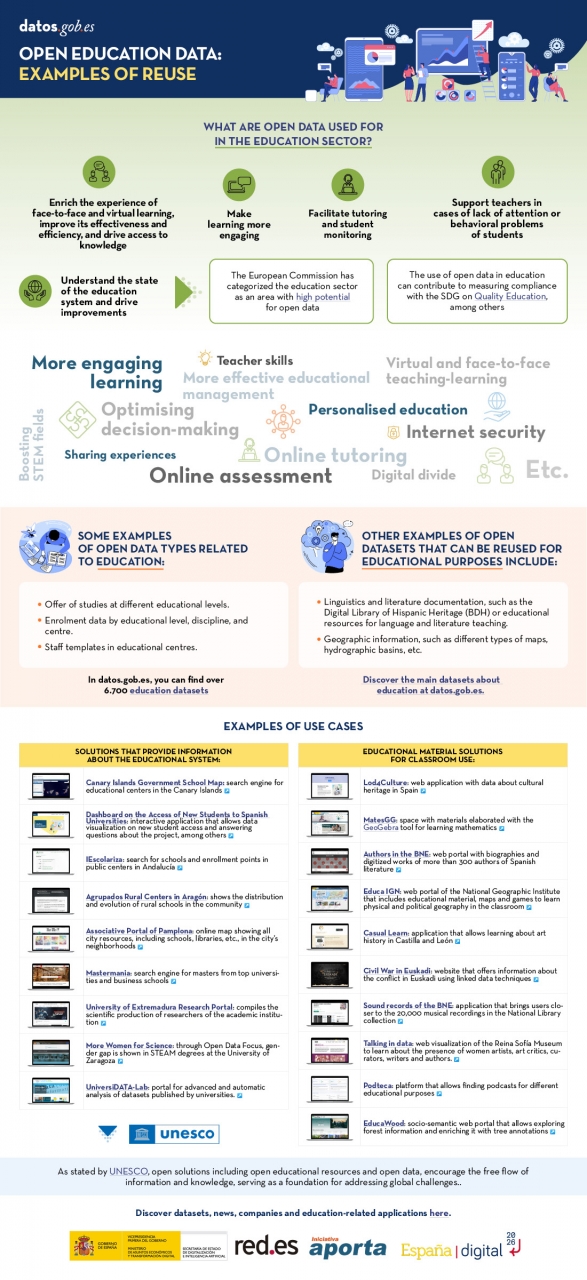
In the following infographic, we summarize the benefits of utilizing open data in education and training, from the perspective of both students and educators, as well as administrators of the education system.
There are many datasets that can be used for developing educational solutions. At datos.gob.es, there are more than 6,700 datasets available, which can be supplemented by others used for educational purposes in different fields, such as literature, geography, history, etc.
Many solutions have been developed using open data for these purposes. We gather some of them based on their purpose: firstly, solutions that provide information on the education system to understand its situation and plan new measures, and secondly, those that offer educational material to use in the classroom.
In essence, open data is a key tool for the strengthening and progress of education, and we must not forget that education is a universal right and one of the main tools for the progress of humanity.
Noticia
In recent years, we have been witnessing a technological revolution that increasingly pushes us to broaden our training to adapt to the new digital devices, tools and services that are already part of our daily lives. In this context, training in digital skills is more relevant than ever.
Last October, the European Commission, led by its President Ursula Von Der Leyen, announced its intention to make 2023 the "European Year of Skills", including digital skills. The reason lies in the difficulties that have been identified among European citizens in adapting to new technologies and exploiting their full potential, especially in the professional sphere.
The European digital skills gap
According to data provided by Eurostat, more than 75% of EU companies have reported difficulties in finding professionals with the necessary skills to do the job they are looking for. Moreover, the European Labour Agency warns that there is a severe shortage of ICT specialists and STEM-qualified workers in Europe. This is exacerbated by the fact that currently only 1 in 6 IT specialists is female.
When it comes to digital skills, the figures are not flattering either. As noted in the Digital Economy and Society Index (DESI), based on data from 2021, only 56% of the European population possesses basic digital skills, including information and data literacy, communication and collaboration, digital content creation, security and problem-solving skills.
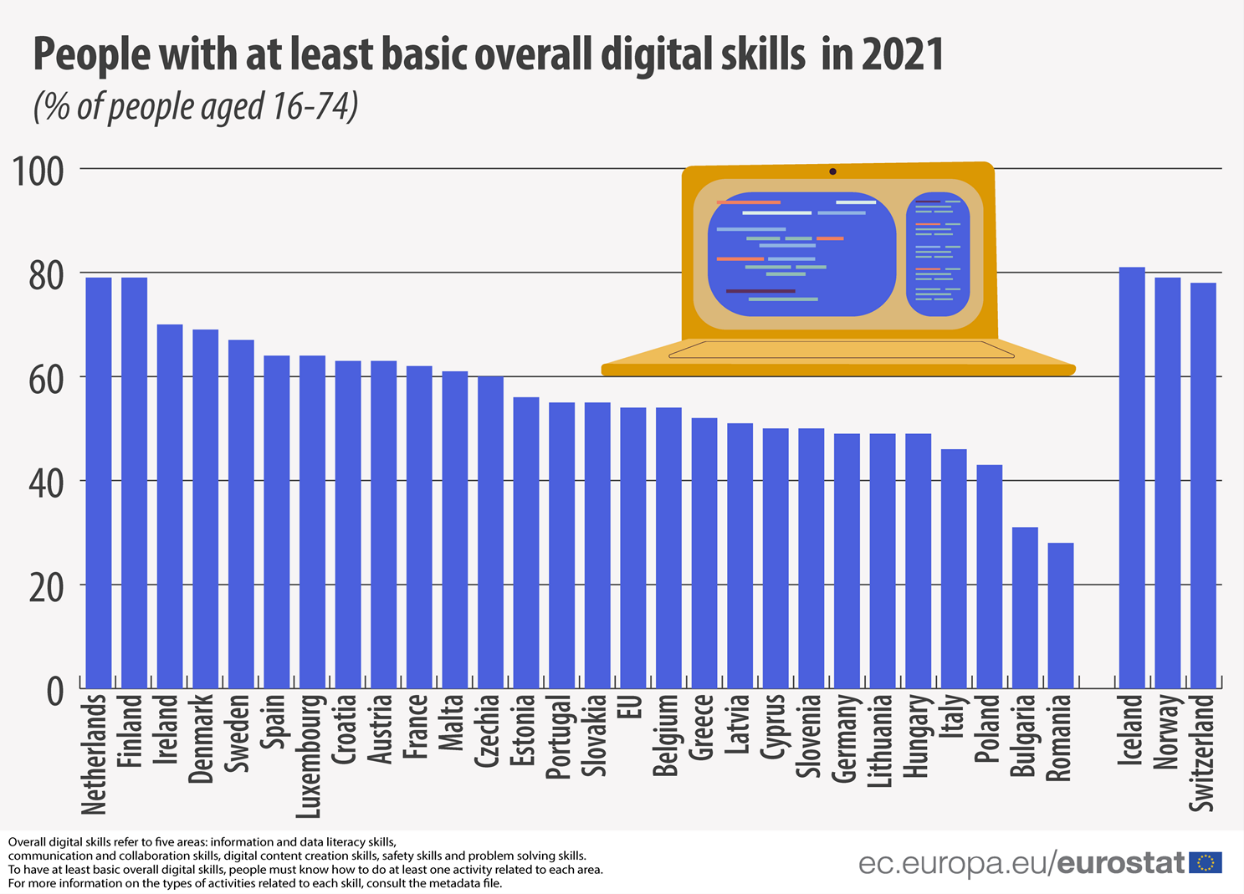
EU citizens with the least basic digital skills by country. Source: Eurostat, 2022.
European initiatives to promote the development of digital competences
As mentioned above, improving education and digital skills is one of the major objectives that the European Commission has set for 2023. If we look at the longer term, the goal is more ambitious: The EU aims for at least 80% of EU adults to have basic digital skills such as those mentioned above by 2030. In terms of the professional sector, the target focuses on having around 20 million ICT professionals, with a significant number of women in the sector.
In order to realise these objectives, there are a number of measures and initiatives that have been launched at European level. One of them stems from the European Skills Agency, whose action points 6 and 7 are focused on improving all relevant skills for the green and digital transitions, as well as increasing the number of ICT graduates.
Through the NextGenerationEU funds and its Resilience and Recovery Mechanism, EU member states will be eligible for support to finance digital skills-related reforms, as €560 million will be made available for this purpose.
In addition, other EU funding programmes such as the Digital Europe Programme (DEP) or the Connecting Europe Facility (CEF) will respectively offer financial support for the development of education programmes specialised in digital skills or the launch of the European Digital Skills and Jobs Platform to make information and related resources available to citizens.
Alongside these, there are also other initiatives dedicated to digital skills training in the Digital Education Action Plan, which has created the European Centre for Digital Education, or in the mission of the Digital Skills and Jobs Coalition, which aims to raise awareness and address the digital skills gap together with public administrations, companies and NGOs.
The importance of open data in the 'European Year of Digital Skills'.
In order to promote the development of digital skills among European citizens, the European open data portal carries out several actions that contribute to this end and where open data plays a key role. Along these lines, Data Europa remains firmly committed to promoting training and the dissemination of open data. Thus, in addition to the objectives listed below, it is also worth highlighting the value at the knowledge level that lies behind each of the workshops and seminars programmed by its academic section throughout the year.
- To support Member States in the collection of data and statistics on the demand for digital skills in order to develop specific measures and policies.
- Work together with national open data portals to make data available, easily accessible and understandable.
- Provide support to regional and local open data portals where there is a greater need for help with digitisation.
- Encourage data literacy, as well as the collection of use cases of interest that can be reused.
- Develop collaborative environments that facilitate public data providers in the creation of a smart data-driven society.
Thus, just as data.europa academy functions as a knowledge centre created so that open data communities can find relevant webinars and trainings to improve their digital skills, in Spain, the National Institute of Public Training includes among its training options several courses on data whose task is to keep public administration workers up to date with the latest trends in this field.
In this line, during the spring of 2023, a training on Open Data and Information Reuse will take place, through which an approach to the open data ecosystem and the general principles of reuse will be carried out. Likewise, from 24 May to 5 June, the INAP is organising another course on the Fundamentals of Big Data, which will address blocks of knowledge such as data visualisation, cloud computing, artificial intelligence and the different strategies in the field of Data Governance.
Likewise, if you are not a public sector worker, but you are interested in expanding your knowledge of open data, artificial intelligence, machine learning or other topics related to the data economy, in the blog and documentation section of datos.gob.es you can find adapted training materials, monographs on various topics, case studies, infographs and step-by-step visualisations that will help you to understand more tangibly the different theoretical applications involving open data.
At datos.gob.es, we have prepared publications that compile different free training courses on different topics and specialisations. For example, on artificial intelligence or data visualisations.
Finally, if you know of more examples or other initiatives dedicated to fostering digital skills both at national and European level, do not hesitate to let us know through our mailbox dinamizacion@datos.gob.es. We look forward to all your suggestions!
Empresa reutilizadora
Graddus provides an AI-based platform that helps students answer the question, ‘What to study after high school?’
Blog
Talking about GPT-3 these days is not the most original topic in the world, we know it. The entire technology community is publishing examples, holding events and predicting the end of the world of language and content generation as we know it today. In this post, we ask ChatGPT to help us in programming an example of data visualisation with R from an open dataset available at datos.gob.es.
Introduction
Our previous post talked about Dall-e and GPT-3's ability to generate synthetic images from a description of what we want to generate in natural language. In this new post, we have done a completely practical exercise in which we ask artificial intelligence to help us make a simple program in R that loads an open dataset and generates some graphical representations.
We have chosen an open dataset from the platform datos.gob.es. Specifically, a simple dataset of usage data from madrid.es portals. The description of the repository explains that it includes information related to users, sessions and number of page views of the following portals of the Madrid City Council: Municipal Web Portal, Sede Electrónica, Transparency Portal, Open Data Portal, Libraries and Decide Madrid.
The file can be downloaded in .csv or .xslx format and if we preview it, it looks as follows:

OK, let's start co-programming with ChatGPT!
First we access the website and log in with our username and password. You need to be registered on the openai.com website to be able to access GPT-3 capabilities, including ChatGPT.
We start our conversation:

During this exercise we have tried to have a conversation in the same way as we would have with a programming partner. So the first step we do is to say ‘hello’ and mention the problem we have. When we ask the AI to help us create a small program in R that graphically represents some data, it gives us some examples and helps us with the explanation of the program:

Since we have no data, we cannot do anything practical at the moment, so we ask it to help us generate some synthetic data.
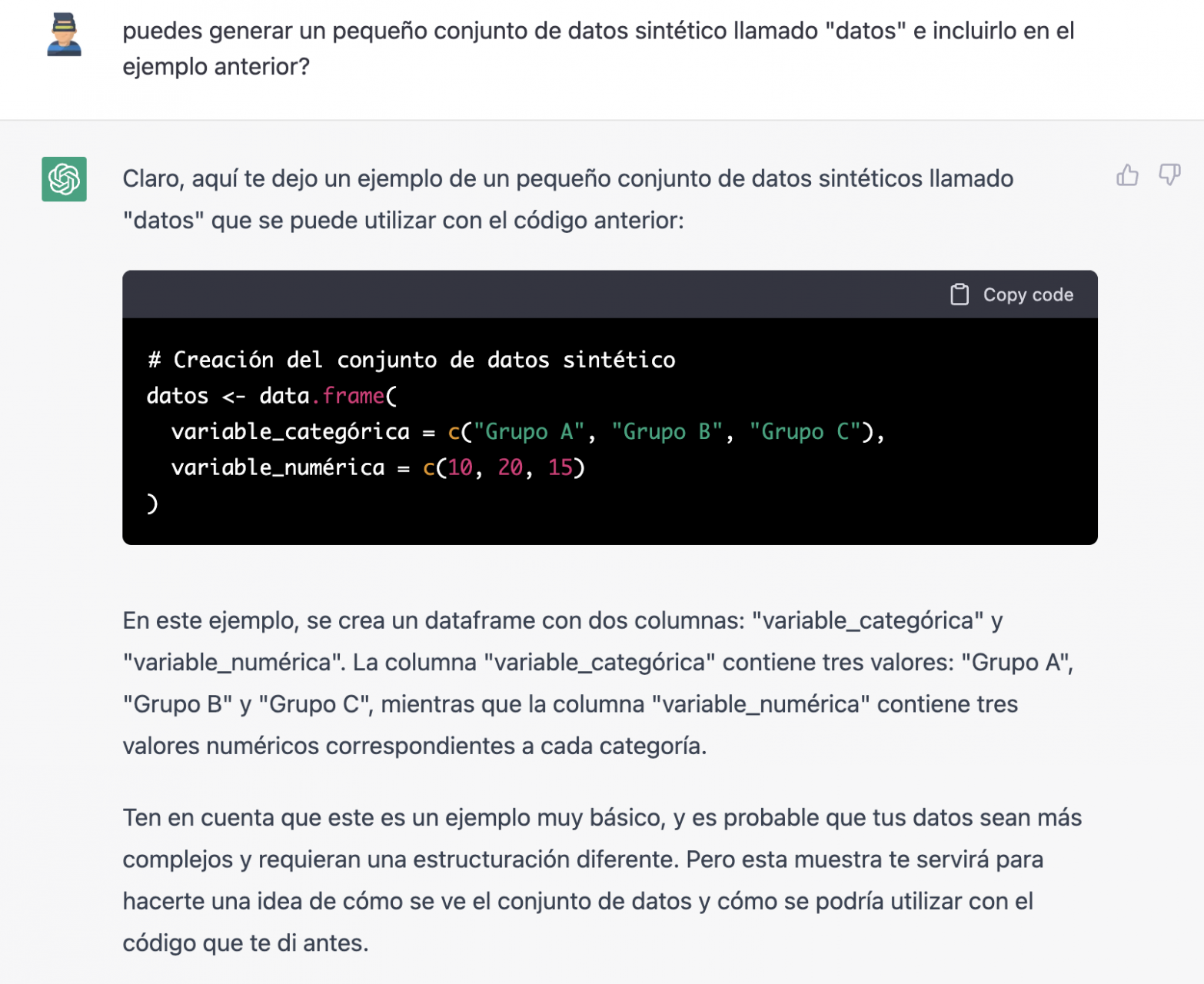
As we say, we behave with the AI as we would with a person (it looks good).

Once the AI seems to easily answer our questions, we go to the next step, we are going to give it the data. And here the magic begins... We have opened the data file that we have downloaded from datos.gob.es and we have copied and pasted a sample.
| Note: ChatGPT has no internet connection and therefore cannot access external data, so all we can do is give it an example of the actual data we want to work with. |
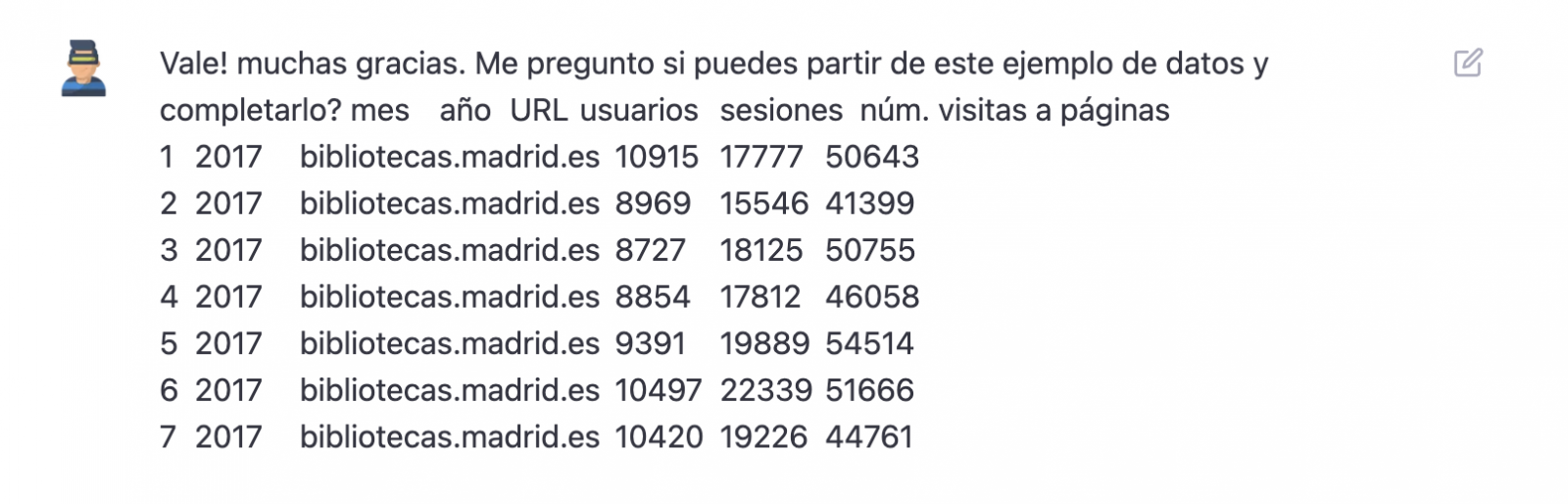

With the data copied and pasted as we have given it to it, the AI writes the code in R to load it manually into a dataframe called \"data\". It then gives us the code for ggplot2 (the most popular graphics library in R) to plot the data along with an explanation of how the code works.

Great! This is a spectacular result with a totally natural language and not at all adapted to talk to a machine. Let's see what happens next:
But it turns out that when we copy and paste the code into an RStudio environment it is no running.

So, we tell to it what's going on and ask it to help us to solve it.

We tried again and, in this case, it works!
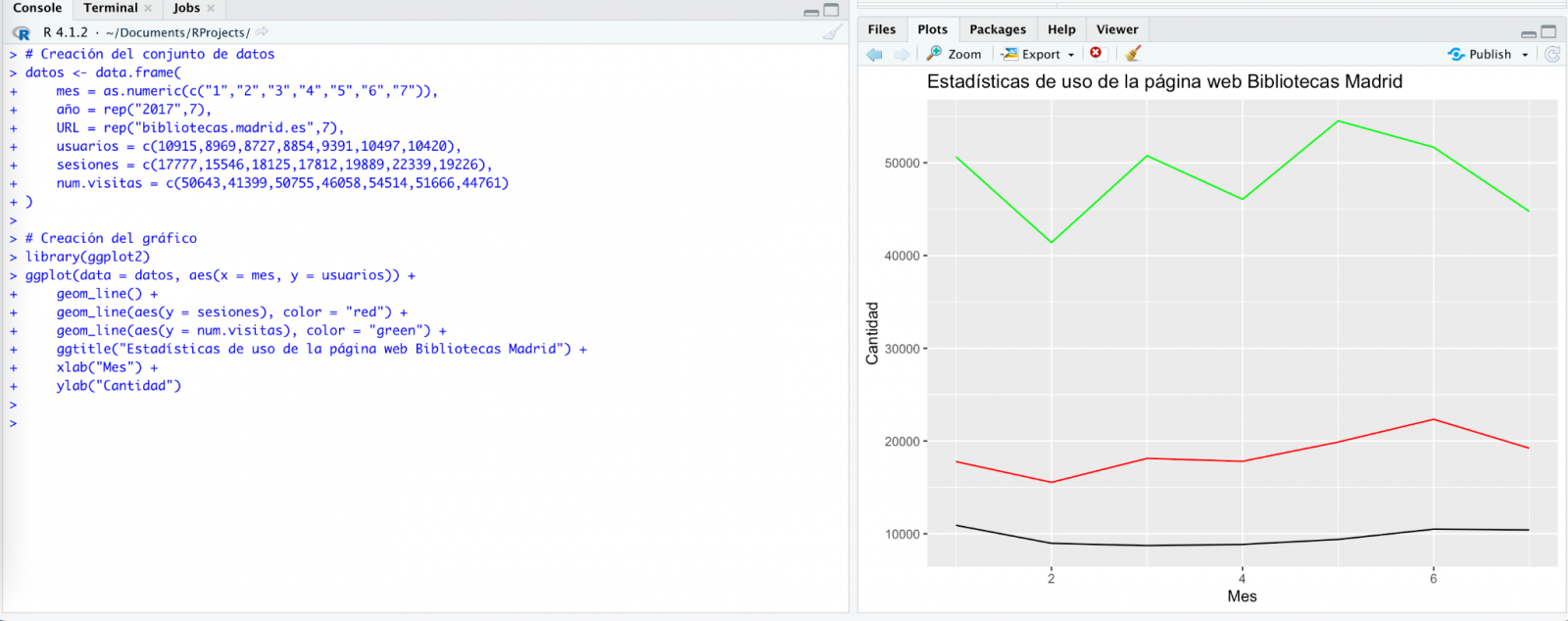
However, the result is a bit clumsy. So, we tell it.

From here (and after several attempts to copy and paste more and more rows of data) the AI changes the approach slightly and provides me with instructions and code to load my own data file from my computer instead of manually entering the data into the code.

We take its opinion into account and copy a couple of years of data into a text file on our computer. Watch what happens next:
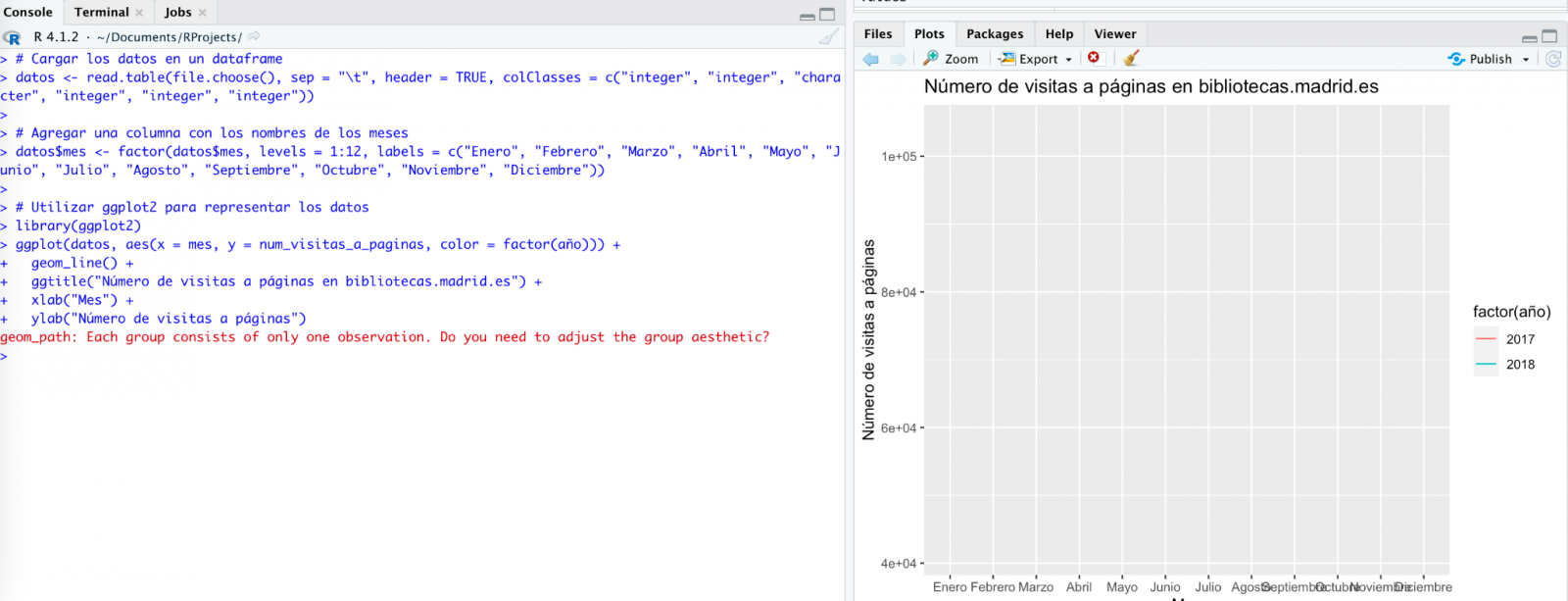

We try again:
As you can see, it works, but the result is not quite right.
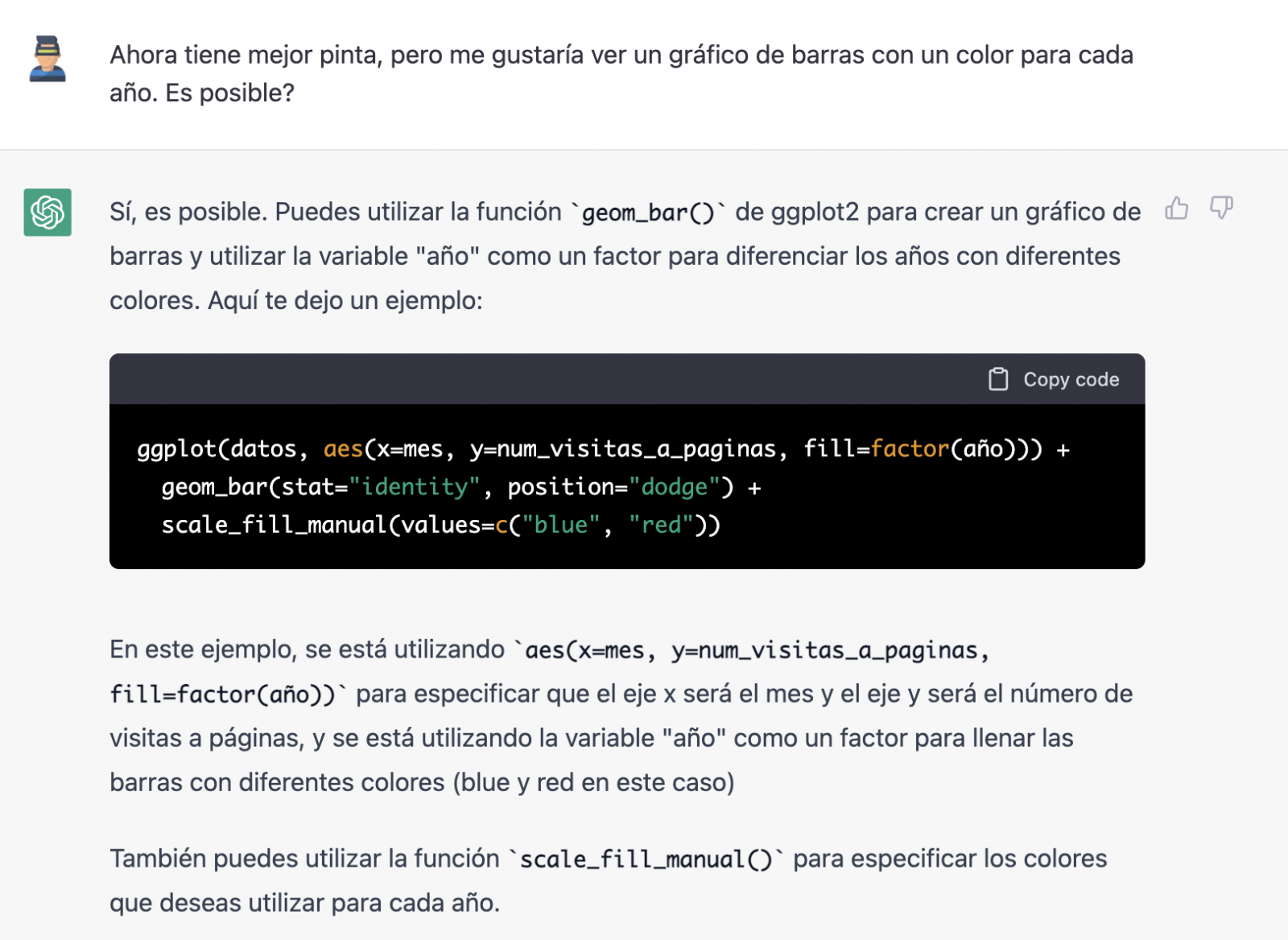
And let's see what happens.

Finally, it looks like it has understood us! That is, we have a bar chart with the visits to the website per month, for the years 2017 (blue) and 2018 (red). However, I am not convinced by the format of the axis title and the numbering of the axis itself.

Let's look at the result now.

It looks much better, doesn't it? But what if we give it one more twist?
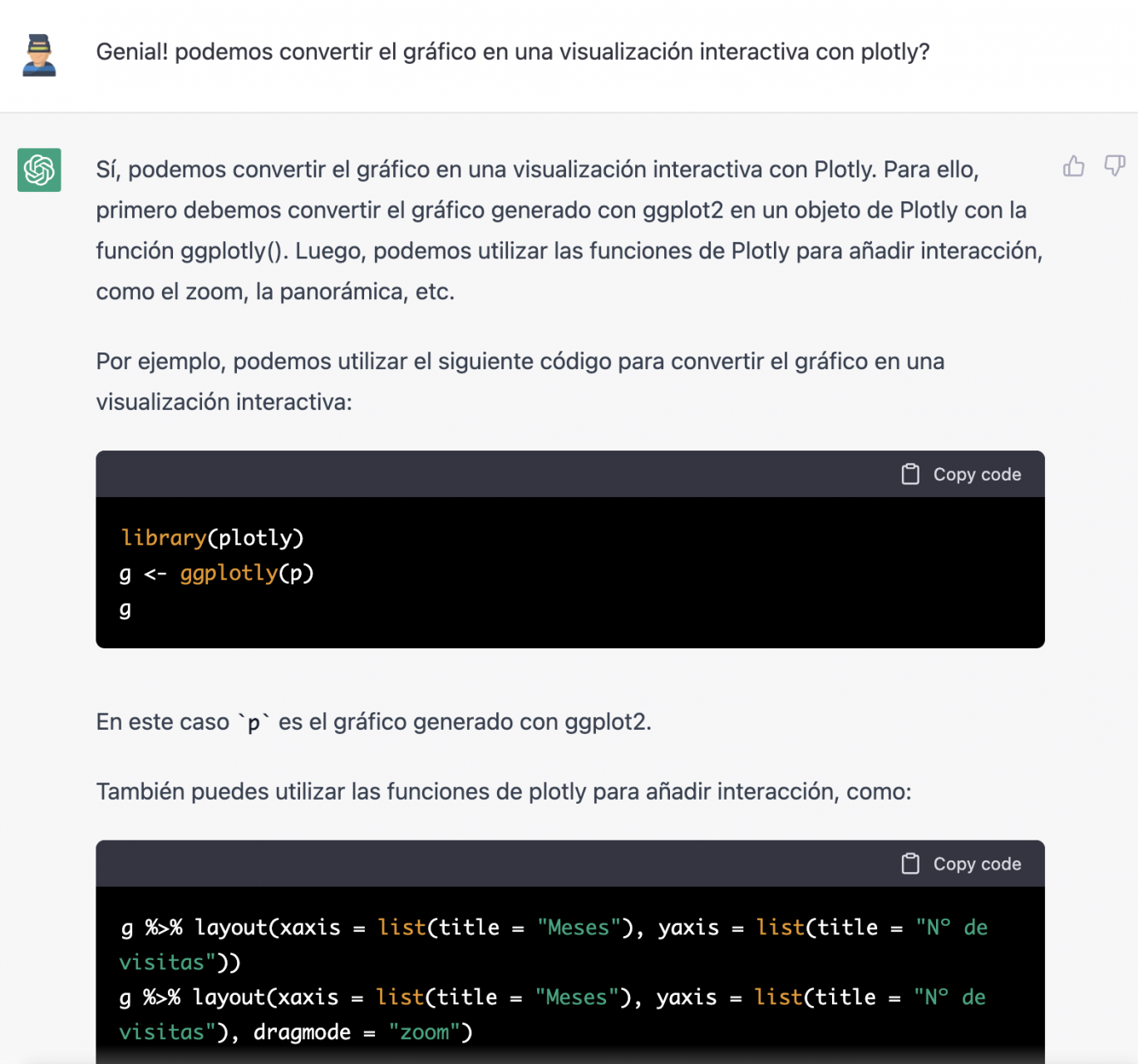
However, it forgot to tell us that we must install the plotly package or library in R. So, we remind it.
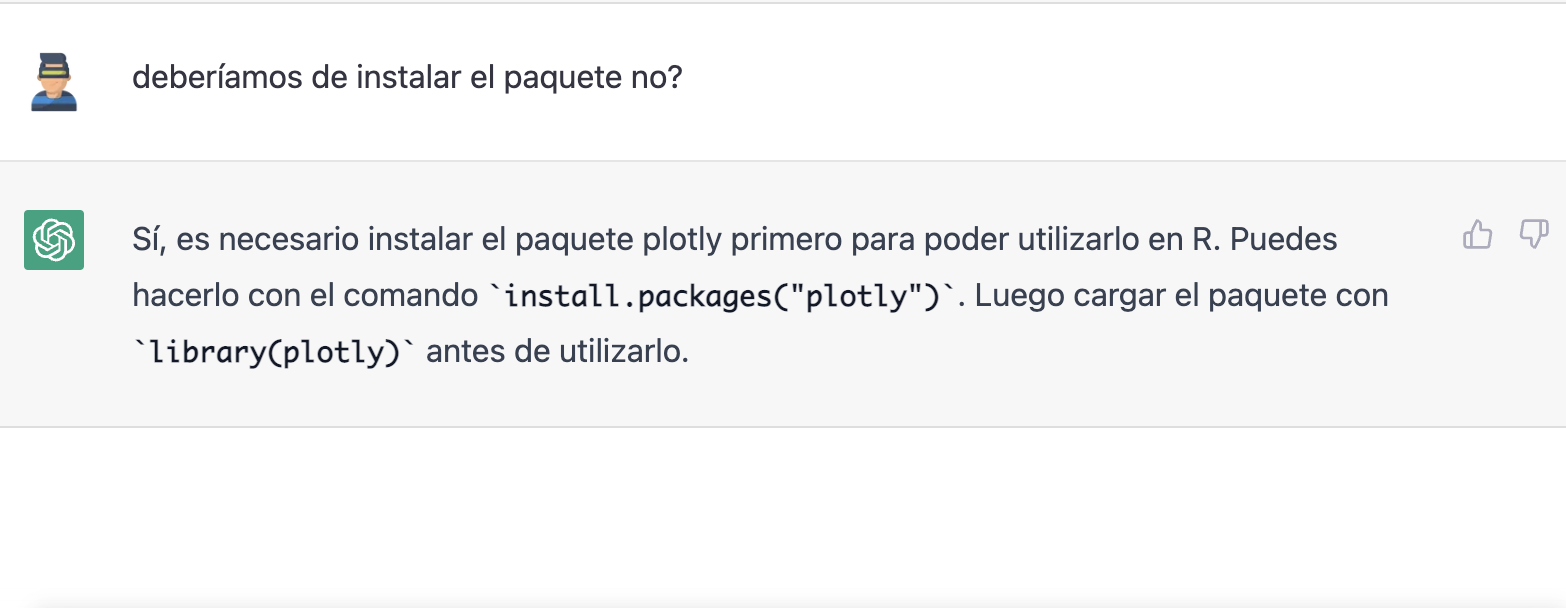
Let's have a look at the result:

As you can see, we have now the interactive chart controls, so that we can select a particular year from the legend, zoom in and out, and so on.
Conclusion
You may be one of those sceptics, conservatives or cautious people who think that the capabilities demonstrated by GPT-3 so far (ChatGPT, Dall-E2, etc) are still very infantile and impractical in real life. All considerations in this respect are legitimate and, many of them, probably well-founded.
However, some of us have spent a good part of our lives writing programs, looking for documentation and code examples that we could adapt or take inspiration from; debugging bugs, etc. For all of us (programmers, analysts, scientists, etc.) to be able to experience this level of interlocution with an artificial intelligence in beta mode, made freely available to the public and being able to demonstrate this capacity for assistance in co-programming, is undoubtedly a qualitative and quantitative leap in the discipline of programming.
We don't know what is going to happen, but we are probably on the verge of a major paradigm shift in computer science, to the point that perhaps the way we program has changed forever and we haven't even realised it yet.
Content prepared by Alejandro Alija, Digital Transformation expert.
The contents and points of view reflected in this publication are the sole responsibility of the author.
Noticia
The Plenary Session of the Council of the Valencian Community has approved a collaboration agreement between the Ministry of Participation, Transparency, Cooperation and Democratic Quality and the Polytechnic University of Valencia (UPV) with the aim of promoting the development of activities in the field of transparency and open data during 2023.
Thus, the Transparency Ministry will allocate 65,000 euros to promote the activities of the agreement focused on the opening and reuse of data present at different levels of public administrations.
Among the planned actions, the third edition of the Open Data Datathon stands out, an event that seeks to encourage the use of open data to develop applications and services that provide benefits to citizens. This collaboration will also promote the reuse of data related to the business sector, promoting innovation, dissemination, and awareness in various fields.
In parallel, it is planned to work jointly with different entities from civil society to establish a series of intelligent sensors for collecting data, while also promoting workshops and seminars on data journalism.
In turn, a series of informative sessions are included aimed at disseminating knowledge on the use and sharing of open data, the presentation of the Datos y Mujeres project, or the dissemination of open data repositories for research or transparency in algorithms.
Likewise, the collaboration includes the programming of talks and workshops to promote the use of open data in high schools, the integration of open data in different subjects of the PhD, bachelor's, and master's degrees on Public Management and Administration, the Master's degree in Cultural Management, and some transversal doctoral subjects.
Finally, this collaboration between the university and the administration also seeks to promote and mentor a large part of the work on transparency and open data, including the development of a guide to the reuse of open data aimed at reuse organizations, as well as activities to disseminate the Open Government Alliance (OGP) and action plans of the Valencian Community.
Previous projects related to open data
Apart from the plan of activities designed for this 2023 and detailed in the previous lines, this is not the first time that the Polytechnic University of Valencia and the Department of Participation and Transparency have worked together in the dissemination and promotion of open data. In fact, to be exact, they have been actively working through the Open Data and Transparency Observatory, belonging to the same university, to promote the value and sharing of data both in the academic and social spheres.
For instance, in line with this dissemination work, last year 2022, they promoted the 'Women and Data' initiative from the same entity, a project that brought together several women from the data field to talk about their professional experience, the challenges and opportunities addressed in the sector.
Among the interviewees, prominent names included Sonia Castro, coordinator of datos.gob.es, Ana Tudela, co-founder of Datadista, or Laura Castro, data visualization designer at Affective Advisory, among many other professionals.
Likewise, last spring and coinciding with the International Open Data Day, the second edition of Datathon took place, whose purpose was to promote the development of new tools from open data linked to responsible consumption, the environment or culture.
Thus, this particular alliance between the Department of Participation and Transparency and the Polytechnic University of Valencia demonstrates that not only is it possible to showcase the potential of open data, but also that dissemination opportunities are multiplied when institutions and the academic sphere work together in a coordinated and planned manner towards the same objectives.
Blog
The promotion of the so-called data economy is one of the main priorities on which the European Union, in general, and Spain, in particular, are currently working. Having a single digital market for data exchange is one of the keys to achieving this momentum among the Member States, and data spaces come into play for this purpose.
Data Spaces Business Alliance (DSBA)
A data space is an ecosystem capable of realising the voluntary sharing of data among its participants, while respecting their sovereignty over it, i.e. being able to set the conditions for its access and use. The DSBA, founded in 2021, is composed of the main actors in the definition of standards, models and technological frameworks for the construction and operation of data spaces. Specifically, the alliance is composed of the Big Data Value Association (BDVA), the FIWARE Foundation and the Gaia-X European Association for Data and Cloud AISBL and the International Data Spaces Association (IDSA). The purpose of the alliance is to agree on a common technological framework that avoids technological fragmentation of the activity, as well as harmonisation in messaging and dissemination activities.
Technical Convergence Discussion Document
On the technological side, the DSBA published in September 2022 a first approximation of the desired technological convergence.
The document technically analyses the anchor points for creating trusted data spaces, federated catalogues and shared markets, and the ability to define data use policies (based on the use of a common language). This ability to share while respecting the sovereignty of the data owner is what makes these spaces novel and truly disruptive, offering for the first time technical elements with which to control the risks associated with information sharing.
The document explains, step by step and from a purely technical perspective, the actions to be addressed by each of the identified roles, with the purpose of guiding potential scenarios that could occur in reality.
To achieve technical convergence, the partnership agreed on the development of a minimum viable framework (MVF) based on three pillars:
- Interoperability in data exchange through the use of the standard NGSI-LD data exchange protocol/API and the extended Smart Data Models for the adoption of the information model defined by the IDS architecture.
- Sovereignty and trust in data exchange through the adoption of a decentralised model (Self-Sovereign Identity) as proposed by Gaia-X (with its Trust Framework) that would use the DLT (Distributed Ledger Technologies) promoted by the European Commission (EBSI). The result will be a trust environment compatible with the EU's eIDAS 2.0 regulation.
- Value creation (brokering) services consisting of a decentralised data catalogue and trading services based on TM Forum standards.
The alliance believes that this MVF would be a good starting point from which to work towards the desired technological convergence, counting and reusing parts of the current solutions provided by the different suppliers.
Example of a public data marketplace
The paper gives the example of a data service provider offering its service in a public data marketplace, so that consumers can easily access this offer. In addition, providers can also delegate access to their users to modify attributes of the service they contract.
This is an example that can be seen in detail in the document, which is interesting because different authentication systems, security and access policies and, in short, different systems that must interoperate with each other come into play.

Additionally, an example of integration between the Data Marketplace and a data catalogue is presented using the approach followed by the European Horizon 2020 project 'Digital Open Marketplace Ecosystem' (DOME). In this way, offers are created in the shared catalogue and can be subsequently consulted following the defined access policies.
The future of the DSBA
The DSBA considers that the aforementioned MVF is only the first step towards the convergence of the different existing architectures and technologies in the construction of data spaces. The next steps of the alliance will take into account the roles assigned to each of the participants. More specifically:
-
IDSA: Develops data space architectures and standards. In particular, a model for connectors to ensure sovereign data sharing in a scalable way.
-
Gaia-X: Develops and deploys an architecture, a governance model according to business specifications for sectoral data spaces, as well as a toolkit (Gaia-X Federation Services toolkit) to instantiate interoperability, composability and transparency of infrastructure and cloud data services.
- FIWARE: With a technology stack that comes from the world of Digital Twins, the community develops software components that allow to implement the construction of data spaces.
The DSBA has also set itself the following priority objectives:
- The compatibility of the IDS architecture with an identity management mechanism based on decentralised identifiers.
- The integration of a federated catalogue such as the one proposed with the metadata broker proposed in the IDS architecture.
- The definition of a common vocabulary.
- Advancing jointly with the work of the Data Space Support Center (a programme funded by the European Commission, where these associations play a leading role), as well as with the standardisation efforts based on the EC's Smart Middleware Platform (SIMPL) project.
Content prepared by Juan Mañes, expert in Data Governance.
The contents and views expressed in this publication are the sole responsibility of the author.