


Description
The universe of data and artificial intelligence is advancing at a frenetic pace, consolidating itself as the undisputed engine of public and business innovation. To learn more about the state of this issue, in this new edition of our "What's New in the Data Ecosystem" we compile examples of initiatives, projects and activities that have taken place in the last six months and that are shaping the digital future, with a focus on Spain.
Strategic boost to the data economy
Public administrations and regulatory bodies continue to define the rules of the game and action plans to promote orderly, competitive and citizen-oriented technological growth. In Europe, progress continues in the Digital Omnibus, which seeks to simplify and unify the European digital legislative framework, affecting data regulation. After a period of public consultations and political agreements, the package of amendments has been approved by the European Parliament, although it still needs to be approved by the European Council. A milestone in this period is the reconfiguration of the regulatory calendar: transparency and labelling obligations for AI-generated content will come into force in August 2026, while the requirements for high-risk AI systems will come into force in December 2027 (in August 2028 for those integrated into products).
Another European legislative advance has been the adoption of the Open Source Strategy as part of the Technological Sovereignty package. The initiative promotes open, interoperable and resilient digital ecosystems, in order to reduce dependence on suppliers through open standards.
At the national level, the first half of 2026 has been marked by the acceleration in the creation of federated infrastructures through the Data Spaces Promotion Plan, highlighting the activation of the National Health Data Space. Also noteworthy is the Impulsa DATA program, which seeks the sharing of data under a unified governance model that guarantees the quality of information to feed artificial intelligence solutions. Work has also continued to promote Smart Territories through grants for projects that use AI, digital twins or urban data to boost the economy and the local productive sector. All this is in line with the roadmap presented in February to strengthen digital sovereignty in Spain.
The boost in the data economy is also reflected at the regional and local level. In this sense, the Spanish Federation of Municipalities and Provinces has signed an agreement with the Spanish Association for Digitalization (DigitalES) to share knowledge and coordinate digitization projects at the municipal level. In addition, at a strategic level, we find initiatives such as that of Castilla-La Mancha, which makes the "Single Data" the central axis of the Regional Statistics Plan 2026-2029. This plan includes more than 280 operations designed to provide up-to-date, open, and useful data that inform better public policies.
Thanks to all these actions, and many more, Spain continues to position itself as a leading country in terms of data. If we end 2025 as one of the European benchmarks in terms of open data according to the European data portal, at the beginning of 2026 we knew the result of two other rankings that also highlight the work of our country, this time published by the Organisation for Economic Co-operation and Development (OECD). In these new rankings, Spain is above average in digitization, standing out once again in the openness and reuse of public data.
Data reuse as a basis for technological innovation
The data shared continues to enrich projects aimed at improving our lives. Some of the initiatives with outstanding participation of public bodies that we have known these months are:
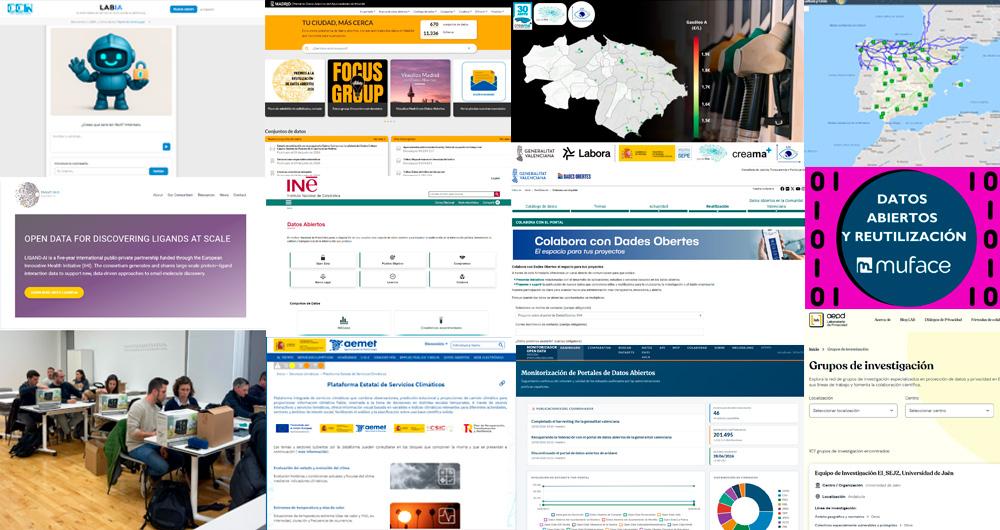
- The new simulator of the Universitat Autònoma de Barcelona combines open data from satellites, meteorology and vegetation maps with real-time sensors to predict fires almost to the minute and improve decisions in forest emergencies.
- XarMet is an educational project to promote the use of real data in classrooms in the Balearic Islands. Through the installation of 100 stations in educational centers, real-time, public, accessible and reusable weather information is generated.
- The Vall d'Hebron Institute of Oncology is participating in Ligand-IA, a European project that uses artificial intelligence and open data to predict new molecules with therapeutic potential.
- The Universitat Politècnica de València promotes OBEREK, a platform with sensors to monitor the health of the Albufera de València in real time using open data on salinity, turbidity and oxygen.
- LabIA is the new Artificial Intelligence challenge platform of the National Cryptologic Center. It allows you to train the detection and mitigation of AI model manipulation techniques through practical and interactive challenges.
- The DigitAldeas project seeks to promote the sustainable development of rural areas through a collaborative digital model based on open geospatial data and citizen participation. The Provincial Council of Badajoz participates in this initiative.
- A study by the University of Alicante has used one of the largest open epidemiological datasets on COVID-19 to train AI models aimed at improving ICU management in health emergency situations.
- The Observatori Marina Alta has presented a cartographic tool to compare refueling costs in the different municipalities of the region.
Advancements in platforms to continue providing quality data
In order to be able to implement projects such as the above, it is necessary for open data platforms to offer quality datasets and functionalities that favour their exploitation. In this regard, here are some of the new developments presented in this period:
- The Madrid City Council has presented a new open data portal with a clearer design and improvements in usability that facilitate navigation, easy access filters to datasets and more download and connection options. In addition, it includes built-in graphics and maps.
- The National Institute of Statistics has also launched a new open data portal. A more accessible, transparent and user-friendly space to promote the reuse of public information.
- The State Meteorological Agency (AEMET) and the Spanish National Research Council (CSIC) have presented a new state platform for the consultation and analysis of climate information. This tool allows access to regionalised climate change scenarios for Spain.
- The Spatial Data Infrastructure of Spain (IDEE) has facilitated access to information on the Vía de la Plata in the NCO (Nature, Culture and Leisure) viewer, within the "Culture" section in "Cultural Routes of Spain".
- MUFACE has updated its open data space with information on human resources, administrative activity, group composition and other data of interest.
- The Spanish Data Protection Agency has launched a public network that brings together almost 100 groups and research projects in privacy and emerging technologies. It is a multidisciplinary community to promote collaboration, share knowledge and strengthen the culture of data protection in Spain.
- The Generalitat Valenciana promotes "Collaborate" in the Portal de Dades Obertes. It is a channel to propose new datasets and share projects and research.
To continuously monitor the volume and quality of datasets published by Spanish public administrations, you can visit this interactive dashboard, launched by the Meloda team.
Activities to boost the use of data
Public agencies are also making efforts to publicize the potential of the data they share. This semester has concentrated a large number of events aimed at promoting the publication and reuse of data, highlighting the V National Open Data Meeting (ENDA), some activities of the Open Administration Week and Open Data Day 2026. It should be noted that an educational resource was presented at ENDA to bring open data closer to students and teachers of Compulsory Secondary Education (ESO), Baccalaureate and Vocational Training.
More and more sectoral events are being held, reflecting the maturity of this field and its cross-cutting value for different areas of economic activity. Some examples are "The International Congress on AI and Data Applied to the Agri-Food Sector", or the XI edition of the LEXDATUM Conference, this time focused on open data and privacy in the field of law. Our country also hosted the Statistics Conference of the Autonomous Communities and Fira FAIR Data, focused on the management and reuse of data according to the FAIR principles (Findable, Accessible, Interoperable and Reusable). Associations such as the Open Data Initiative also highlight the power of data with sessions such as Woman Data Lab to present data tools that support decision-making Another example: at the Connected Heritage conference, the Prado Museum and Wikimedia highlighted how open data and knowledge graphs make it possible to connect collections, enriching content with AI and making art more accessible and interoperable on a global scale.
Also noteworthy are the activities aimed at getting to know the users of the platforms better, in order to adapt content and functionalities to their needs. This is the case of this discussion group of the Madrid City Council's Open Data Portal, and this collaborative session to analyse useful open data that helps to strengthen care services for the elderly and active ageing, held in Mataró.
Data spaces were also the protagonists of multiple events, starting with the II National Meeting on the Data Economy, and continuing with sectoral or local activities, such as the session "Connected tourism: the transformative power of a unique data space" organized by SEGITTUR (State Mercantile Society for the Management of Innovation and Tourism Technologies) or the training day on the Zaragoza Data Space.
Mention should also be made of the competitions held to promote the reuse of data published by public bodies. In this period, for example, the winners of the I Open Data Contest of the Cabildo de Tenerife were announced and the 2nd edition of the Open Data Reuse Awards of Madrid City Council or the Awards for Open Data and Data Journalism Projects 2026 of the Valencia City Council were launched. Universities and associations have also presented initiatives such as the "Data & Culture" hackathon, promoted by the ESPACIOS Chair of the University of Valencia. Another example is the school competition "Andalusia on a map" aimed at promoting the use of cartography and statistics of Andalusia. At the ONCE Foundation, they held a collaborative data analysis session to explore, cross-reference and interpret real information on public financing and generate useful knowledge.
On a more entrepreneurial level, Asedie has opened the call to participate in the 12th edition of its Awards, which recognize projects and initiatives that promote the data economy and the reuse of information. The Cotec Foundation, for its part, launched the PIA 2026 Call, which seeks projects that promote Spanish industry in areas such as R+D+I, talent, technological sovereignty, sustainability or the security of value chains.
Some recommended readings
If you want to know more about data-driven innovation, we have compiled several examples of reports published in the last six months:
- The 14th edition of Asedie's Infomediary Sector Report shows how the public sector of information reuse in Spain is evolving.
- The chapter "Open Data and Smart Cities in the Management of Healthy Municipalities: A Systematic Review", of this free to download book, addresses the role of open data in promoting more active, healthy and innovative environments at the municipal level.
- The guide "How to use AI in your company: legal aspects and governance of AI" published by the Cotec Foundation details five key steps in the implementation of AI.
- The book "Legal Architecture of Data Spaces" covers everything from technological aspects to their legal implications.
Other interesting readings, these published internationally, are the methodological framework to evaluate how institutions can strengthen the production and use of data, published by OpenDataWatch, or the report on innovation in data governance by The Gov Lab.
Share more examples!
In short, the dynamism and variety of cases we have seen are just a few examples of a sector that is in a moment of expansion and that does not stop growing. The maturity of our data ecosystem is a reality and is consolidated as a key driver of innovation.
The initiatives and tools we've reviewed throughout this post are just a few illustrative examples of the enormous potential of data. Given that the sector is advancing by leaps and bounds, we are sure that we have left great projects in the inkwell. We encourage you to use the comments section to share other examples of platforms, events, or reports that you are familiar with.


Comments