


Evento
Next October 19th will be the second workshop of “The Culture of Open Data”, which this year has the aim of opening the focus to discover how the re-use of public sector information, in general, and cultural data especially, is helping to transform research, professional development, how we communicate and collaborative creation.
This workshop, one of four pre events in the sector that will be included as part of the Aporta Meeting 2017 this year, will take place at the National Library of Spain (BNE).
The BNE Director, Ana Santos Aramburo, and the Director General of Red.es, José Manuel Leceta, will open the meeting at 9.30. Then, an introductory talk will take place, “What to do, why data?” which will be directed by Marcelo Soria-Rodríguez, partner at Tramontana. Afterwards, there will be the talk “The leading role of Administration” (10:30) by Manuel Ruiz del Corral, representative of MECD. At 10:45, the round table “Data for research” will begin, which will include participation from Pura Fernández, of CSIC, who will show how data is being used in the EDI-RED project and Juan de Dios Llorens, from SESIAD, whose participation is entitled “open data and language technology, an opportunity we cannot miss”. Next, at 12:00, the table “Data for corporate and professional (re)creation” where Elena González-Blanco, from Indra (Minsait), Paula Carrión, from Kantar Insight Spain and Valentín Fernández, from Telefónica Open Future will participate. The final debate of the workshops will focus on Data for social collaborative (re)creation, from 13:00 onwards, where Daniel Villatoro (Databeers), Juan Quemada (Hackforgood), and Cristina Aranda (MujeresTech) will contribute.
The first conclusions of the workshop, promoted by the National Library of Spain (BNE), Red.es and the Spanish Society for Scientific Documentation and Information (SEDIC), will be presented by Agnés Ponsati Obiols, Director of the Digital Library and Information Systems of the BNE, in the afternoon workshop of the Aporta Meeting 2017, which will take place on October 24th in Madrid.
The workshop “The culture of open data” has its own website where you can find more information, see details on the schedule and access the form to register for the event, for free.
You can follow the event live online at http://www.bne.es/es/ComunidadBNE/Retransmisiones/1019-Jornada-Laculturaylosdatosabiertos, and on social media via the hashtags #culturaenabierto and #BNEAporta.

Evento
The seventh edition of the Aporta Meeting will be held next October 24, and this year has as its motto "The value of data in the global ecosystem", in which experts in open data, both national and international, will describe their views regarding the publication of public sector data and its reuse.
The meeting, open to all, will be organized in morning and afternoon sessions with round tables, talks and presentations. In the afternoon, as the final act of the conference, the Aporta awards will be given (aimed at recognizing the best experiences already completed in reuse of public data), as well as the awards to the winners of the Aporta Challenge (ideas, applications , solutions and/or services that use and reuse public data contributing to an improvement of efficiency in public administrations in Spain).
The event, which will also have various pre-events of a sectoral nature on the previous days, is organized by Red.es in collaboration with the Ministries of Energy, Tourism and Digital Agenda, and Finance and Public Function.
Evento
On Friday, April 21, a workshop dedicated to data science in the social and health sector will take place in Media-Lab Prado, Madrid. A meeting designed for professionals and researchers specialized in the data analysis for social purposes and belonging to the health science.
The event will start with a specific session on the analysis of urban mobility through big data, followed by two talks related to the healthcare sector under the titles "Big4Cast: prediction of crisis in bipolar disorder" and "machine learning in EGG predictive analysis ".
As a clousure of the day, the attendees will be able to learn about the work of other experts in the field through the poster exhibition that will take place during the workshop. Those professionals who have sent their pieces of work to vlopezlo@ucm.es will obtain the corresponding certificate. Afterwards, a round table will be held where five representatives of public and private entities will discuss on the following topics:
-
Social development with maps (ESRI España).
-
Healthcare research (Fujitsu).
-
Madrid Salud (WAP).
-
Innovation in the cloud (AWS).
-
Open Data (City of Madrid).
To attend at the workshop, participants need to register before through the Eventbrite webpage.
Evento
Data have become high-value assets for both public and private organisations. But only by being secured, accessible, shareable and reusable they deliver their full potential. This is the reason why several data and information management and governance initiatives are becoming increasingly important. Aiming at shaping long-term visions, these initiatives put in place the right processes, standards and tools for information sharing and reuse.
Next June 14 SEMIC 2017 will be held in Valletta (Malta), the international conference on semantic interoperability framed within the ISA² Program, which has been organized together with the Malta Information Technology Agency. For its seventh edition, several talks and presentations have been organized on the data management initiatives from the European public administrations and the private sector.
The program is divided into four sessions, the first of them will be devoted to information governance in member states, EU institutions and agencies; then there will be two talks on data analysis and the base registries as a source of master data and their interoperability. After a break, the conference will continue with a fourth session where attendees will be able to share their knowledge on the open data sector to close the day with a specific metadata panel that will deal with the information delivery and retrieval.
Thus, this event has become a good opportunity to learn how leading organizations in Europe are creating value from the data both for the entities themselves and for other stakeholders by:
- Investing in data and information governance and management activities;
- Rethinking information retrieval and delivery within and beyond organisational boundaries;
- Sharing information and collaborating;
- Using data and information to improve decision-making.
The conference brings together around two hundred European professionals interested in belonging to the international semantic interoperability community, who have the opportunity to discuss in person with industry leaders while discovering new solutions, knowing real implementations and enriching their network of contacts.
Noticia
Only if data are opened and made available to society, their real potential can be re-used to improve the existing services, optimize business processes and find solutions to corporate challenges through information analysis. In fact, according to the European Data Portal (EDP), 23% of the companies analyzed expect their turnover related to the re-use of open data to increase between 11% to 60% in the coming years, while 37% of the respondents forecast their turnover to increase by at least 61% annually.
These figures are the result of EDP's latest report Re-using Open Data: a study on companies transforming open data into economic & societal value, a new material from the pan-European initiative to understand how organizations, especially those in the private sector, re-use open data and identify the business models based on them.
Thus, with a greater knowledge about the transformation of open data into real value, the European Data Portal can make data providers better understand how open data helps adapt their data strategy and, therefore, improve the reusability of public sector information; whereas the society is shown the potential of open data by collecting real cases that use open data to generate value.
Report's methodology
First, the macroeconomic benefits of open data in the European Union were analyzed, from which the market in this sector is expected to reach 75.7 billion euros and to generate up to 100,000 jobs in 2021. In addition to these numbers, an interview was conducted with different companies from 21 countries to learn how they had re-used the open data in their services and products.
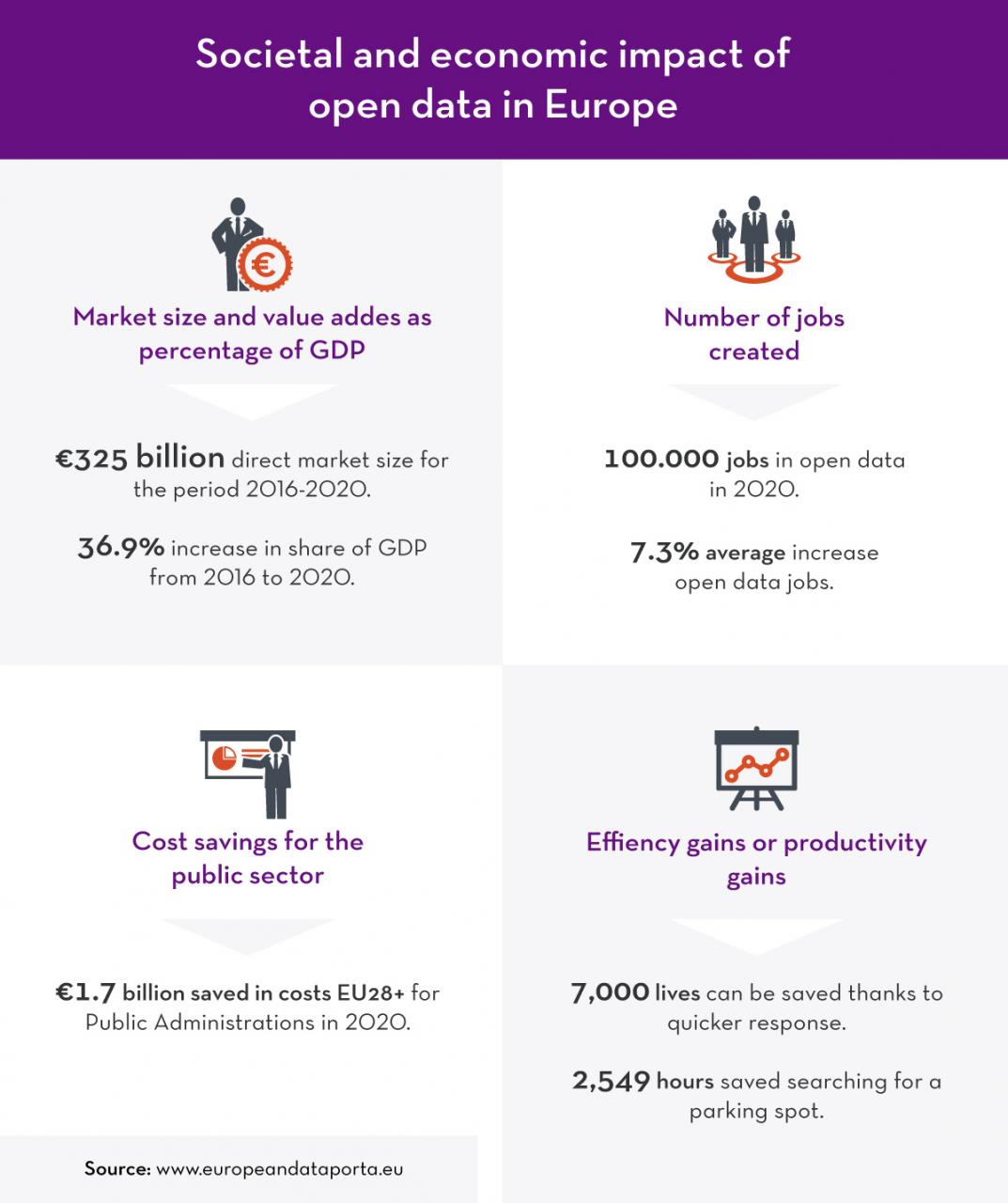
A number of entities were selected from the total sample to learn in detail their reusability experiences, the findings were interspersed with the results of a survey conducted during the last edition of the International Open Data Conference held last October in Madrid. All this added to the knowledge and experience shared by European companies through the EDP portal.
Typology and origin of open data re-used by companies
In order to understand what data categories are the most re-used by the business sector, firms surveyed had to select among thirteen sectors identified by the European Commission during the review of the DCAT application profile: science and technology, society, health, justice, government and Public sector, culture and education, environment, international, economy, transport, cities, energy, agriculture and food.
76 of the companies indicated to re-use at least one or more data categories, government & public sector (11.9%), economy & finance (11.6%), regions & cities (10.1%), population & society (9.5%), and environment (8.9%) are the five most re-used sectors, representing 52% of the total re-use of open data by the respondents.
Although the companies use data from all over Europe, and even from the USA, the United Kingdom and Spain are the most popular countries among the companies. These two nations have a greater representation in the sample given their high level of open data maturity compared to the rest of the European Union. In addition, most of the businesses surveyed claim to combine information from the public sector with their own corporate data when developing their products and services.
Business models and clients
In order to know how entities generate business based on open data, respondents were asked to indicate their source of income, concluding that 21% of them base their re-use activity on the sale of services or products (or the combination of both), focusing on two main areas: the provision of software services (41%) and consulting (25%).

In addition, the businesses surveyed were also asked to define to whom they deliver their goods or services e.g. to other businesses (B2B), consumers (B2C) or governmental organisations (B2G).The results show that there is not a clear tendency as under one third serve all client segments while more than half serve two or more client segments.
The role of open data in business models
The survey conducted by the European Data Portal included seven options for respondents to select how open data is integrated into their business models: Enhancing products, enhancing services, process optimization, data as a service, information as a service, answers as a service, development of web or mobile applications.
From all the answers, it was found that the most recurrent business model, related to the re-use of open data, is the optimization of services; using, in addition, the open data within the company with the following goals:
- Improving internal processes.
- Providing access to third party information.
- Offering services developed from re-use.
- Creating social impact from the open data.
Finally, companies have also identified the barriers to access and re-use open data, highlighting poor quality of information, lack of standardization and homogeneity, and difficulties in obtaining the data (with their corresponding metadata) suitable for their needs.
The report concludes with a set of recommendations for both the public sector which needs to better align its data publishing strategy with user requirements and the private sector which is invited to share its experience in the re-use of open data to be able to show the benefits of growth and innovation that the open data offers to the society as a whole. After all, knowing the value of data not only helps improve open data policies but it also helps other companies discover the potential of open data and join a booming sector, which will increase its market share by 37% in the coming years.
Evento
In 2011 the project Sharing is caring was born in Denmark. An initiative to organize different national seminars that promote the openness of the information of the GLAM sector (galleries, libraries, archives and museums).
The first event took place in November 2011 bringing together a large number of participants from all over Denmark, from large and small institutions, museums, libraries, archives, educational institutions and members of the Wikipedia community. Such was the success of this initial call that Sharing's Caring also attracted assistants of other Nordic countries, working together in the development of a technological framework that allowed to share the digitized collections with the rest of the world, promoting the international cooperation for the development of the GLAM sector in the XXI century.
Desde entonces, Sharing’s Caring organiza cada dos años una conferencia donde se abordan diferentes aspectos relevantes en la apertura de los datos culturales que incluyen desde casos reales que muestran el impacto de la digitalización de contenidos hasta paneles específicos donde artistas, profesionales del sector y expertos en copyright debaten sobre arte contemporáneo, medios digitales y derecho de propiedad.
Since then, Sharing's Caring has organized a conference every two years where different aspects of the open cultural data are discussed, including real cases that show the impact of the content digitization and specific panels where artists, professionals and experts in Copyright discuss on contemporary art, digital media and property rights.
Digitization and social impact?
As digitalisation has become an important task for the cultural sector, more and more institutions are providing access to their collections in digital format. However, open data goes beyond the mere online access to information, it involves sharing the authority to interpret those assets and encourage their re-use.
In this context, the following questions arise: How can open data in the GLAM sector become a joint advantage for institutions, as well as for their public and society in general? What are the challenges faced by the movement in terms of copyright, institutional policies and social impact? These issues will be answered at the next two conferences that Sharing is Caring has organized this year.
For the first time in its history, the initiative crosses its borders in April 2017 to hold an extension of its national conference in the city of Hamburg. With the collaboration of the Museum für Kunst und Gewerbe and the University of Hamburg, from 20 to 21 April there will be different talks and workshops where participants will share their experiences and knowledge about open access to cultural content.
Moreover, the fifth edition of the Sharing is Caring seminar will be held in Aarhus (Denmark) in November, where, under the same motto as the German call, the role of the open cultural data in citizen participation and its impact on society will be discussed.
Would you like to assit? For more information on each event, visit the official Sharing's Caring website: http://sharecare.nu/
Entrevista
Interview with Josema Alonso, Open Data Program Director at the World Wide Web Foundation.
1. According to your experience with the open data program at the WWW Foundation, what are the greatest impacts of open data publication?
One of the greatest impacts of open data publication is the transparency and accountability of Public Administrations. Moreover, open data enable the creation of added value services by companies, which subsequently commercialize them.
Another important aspect that should be highlighted is the improvement of public services. The eGoverment has long arrived, enabling a number of changes and facilities in the relation between the citizens and the Administration. In this way, the open data help optimize those services, which to a great extent are new services provided by the Administration. For example, in the last years there are so easy apps that a citizen can report to a local administration on a bump in a road to make the Administration repair it in an effective way.
2. How were the beginnings of open data in Europe and what is the future of this sector?
In Europe the open data came introduced by the re-use of public sector information, though both concepts are not exactly the same, but we started to see the use by the industry and there was an important industrial base in the private sector. The transformation of the re-use of the PSI into open data has made the community that uses those data increase significantly.
In addition, there was a wave of campaigns, usually developed by the social society to promote government accountability, aimed at publishing data regardless of the format, where or how they were, with the only goal of “knowing”: learning about the information collected by the Administrations and subsequently checking if it was useful or not.
For a time, in my opinion, it worked. It had an effect on the public administration worldwide and data began to be published. The problem, about which I have been talking since a couple of years, is that we are focusing on the tool instead of the impact of this tool in society.
In the last two or three years, from the WWW Foundation we have insisted on the open data utility: we shall see problems in the world that can be solved through open data. Nowadays, this evolution is starting to have effect. I think that in the next years we will see a greater recognition by the citizens. Perhaps, they will ignore that open data are being used but they will see services and applications that re-use that information which, at the end, benefits them.
3. Which is the role played by the World Wide Web Foundation? What is the place of open data in those functions?
The Foundation was established by the Web creator, Tim Berners-Lee, with the goal of keeping the Web free and free-of-charge, maintaining the freedom of expression and any type of association, while care is taken to keep it decentralized, no monopolized or governed by any administration or government in the world.
The WWW Foundation works in three areas: access, digital rights and participation. In the first of them, we try that the web access is the most affordable as possible to make its cost no be over the 5% of the average monthly salary in the developing countries. Though we are a long way from achieving this goal.
As regards the Digital Rights, we work especially with the freedom of expression and individual privacy. Always taking into account the security that governments must have and carry out in any web activity. And, finally, in the Participation program, led by me, we work to give voice to citizens through open data.
We have been working together in these three areas in the last years, since the Foundation was created. Now we are seeing an increasing evolution in the intersection of the three pillar in which we work, for example, there is increasingly a talk of open data and privacy. In this way, we are seeing that this type of areas where our pillars join is where we will have to work more in the following years.
4. How has the Open Data Charter helped open data in the world?
The idea behind the Open Data Charter is pretty simple: harvesting the knowledge and best practices of those countries which are more advanced in open data and helping other nation develop properly their open data policies. In this way, administrations around the world were invited to make those best practices be applied globally.
Nowadays, we are creating implementation guidelines, both general and sectoral ones, to make the agencies implement more easily the Open Data Charter principles. At the moment, we are in the phase of the Charter adoption. Currently, thirty local and regional Administration throughout the world have signed the Charter, including the Spanish Government or the Madrid City Council. We expect that in the future the number of Charter members increases considerably.
There are already important success cases of both external and internal economic benefits for the administrations. There are many cases on the European Data Portal, for example, of efficiency in the administration that allow saving public money or of accountability of parliamentary activity.
5. How can open data help eradicate poverty and corruption in the world, two of the Sustainable Development Goals established by the UN?
Open data will not eradicate poverty, but they can contribute to its eradication in some way. How? The WWW Foundation has investigation cases in Africa where, for example, open data can help improve the water quality, detect the pollution or identify where breakdowns are to solve them as soon as possible.
In addition, this is the year of the fight against corruption and the countries commitment has been growing steadily. Finally, it has been understood that this is a black hole in the global economies, affecting the citizens.
Evento
From September 26th to October 5th the international workshop Visualizar'16 Open Cities will take place in the cultural space Medialab Prado (Madrid), an event dedicated to those cities in the world that are committed to openness of information, transparency and re-use of data to improve services provided for citizens.
On this occasion, two simultaneous calls are opened: one call for projects related to open cities and an application for collaborators. During the workshop a maximum of 8 proposals will be developed, selected among those submitted until August 14th and the final list will be published on August 25th. The project proposals may be submitted individually or collectively, but they must necessarily be open to other collaborators who can contribute to their development during the workshop.
Secondly, those interested in participating as collaborators may submit their request until next September 19th. The collaborators, led by the project leaders, will be part of the working groups, providing expertise and ideas in the development of the selected projects. As there will be no selection process, all applications will be accepted until full capacity. Moreover, working groups will be completely organized during the initial presentation of the projects.
Participants in the workshop may register through the online platform Community, an interactive network of Medialab Prado that allows collaborators to contact the project leaders and send questions, opinions or comments.
The projects developed during Visualizar'16 Open Cities will be presented at the Open Cities Summit, to be held in the same place in October 5th and included in the agenda of events before the International Open Data Conference. Once the summit is over, the work will be exposed in Medialab Prado until December 12th.
The aim of the Visualizar'16 workshop is to re-use the city open data in different fields such as environmental sustainability, infrastructure, citizenship or socio-cultural sector. The proposals may include visualization tools, mechanisms of participatory data collection, development of open hardware tools for information collection, open data initiatives ... or any idea to exploit the potential of this resource in urban environments.
During nine days, a solution prototype will be developed and tested through eight working groups that will be coordinated by each project leader. Projects will be developed with free software, open standards and under licenses that allow their re-use and redistribution.
This workshop is included within the Medialab Prado program, Visualizar, which organizes annual sessions on research processes related to theories, tools and data visualization strategies to improve their understanding and to use them for the general good.
Evento
Madrid City Council has announced the first edition of the Datathon and Data Journalism Awards, aimed at entrepreneurs, developers, designers, journalists and students interested in open data. The aim of this competition is to foster the re-use of public sector information, promote http://datos.madrid.es/ and convert it into, not only a point of access to local datasets, but into a tool to boost the development of innovative solutions based on open data.
The awards are divided into two different categories; firstly a Datathon where participants will develop an innovative solution based on the re-use of local datasets such as a computer applications a websites or a data visualizations.
Individually or in groups, projects must be submitted under the AGPLv3 license and, in the case they include data from other sources, the participant must be entitled to use them in accordance with the regulations.
In parallel, the Data Journalism Awards presents two different categories; one for professionals, where newspaper articles written from 2015 to date will be assessed. And secondly, a category for students to award the best texts published in any type of media, or piece of work belonging to their studies. In both cases, the content must be related to the activity of the Madrid City Council, re-using the local open data.
To be eligible, the applicant have to submit his proposal according to the application form available on Madrid website or electronically on the website created for the Datathon and Data Journalism Awards. The deadline is 6th August.
Evento
On the occasion of the International Open Data Conference and included on the agenda of events before IODC 2016, the Open Cities Summit will take place on 5th October at Media-Lab Prado in Madrid.
This meeting will bring together international open data practitioners in order to show how open data is being used around the world to improve the lives of citizens at the city level, facilitate knowledge exchange around open cities, and ideate solutions to overcome identified challenges in creating open cities as regards four areas: management of an open data policy, urban planning, environment and competitiveness.
The Open Cities Summit is aimed at civil servants, journalists, civil society organizations, researchers and any citizen who believes in the potential of open data to improve the environments in which they live. Thus, the event will consist of workshops, lectures and round tables, which will be structured in three parts. Firstly, the experts will share policies of their open data cities and show how their open data policies are helping improve the lives of citizens. Secondly, participants will be working in groups to ideate solutions to overcome the four different challenges mentioned above and finally, there will be open space to discuss the challenges and opportunities of creating an open city.

The organizing committee has opened a Call for Actions for open data practitioners who can submit initiatives in the field, especially those that offer an answer to the problems of urban development, environment, competitiveness and management of open data policies. The aim is capture a representative sample of best practices and to enrich the debate on the potential of open data for subnational governments. The deadline for the proposals is 15th August.