


Evento
Part of the European Union's new strategy to create a digital single market focuses its attention on the construction of a Data Economy. In carrying out this process, European data spaces are of paramount importance. Data spaces are ecosystems that make it easy to share, find, access, and use data.
To talk about it, Cajasiete Chair of Big Data, Open Data and Blockchain of the University of La Laguna will arrange a new online webinar focused on this theme. The event will take place next Thursday, May 24, at 12:00 p.m. (11:00 a.m. in the Canary Islands) and will be attended by Carlos Alonso Peña, director of the Data Office Division.
The webinar will focus on the importance of this ecosystem when materializing the voluntary sharing of the data of its participants, within an environment of sovereignty, trust and security. This requires the establishment of integrated governance, organizational, regulatory and technical mechanisms.
The boost of the Data Economy
Promoting the Data Economy is one of the main priorities set by both the European Union and our country. In fact, one of the EU's goals is to become a leader in a data-driven society, relying on a single digital market where data is shared freely between member countries. For this purpose, the European Data Strategy was launched, from which you can obtain more information through this link.
Digital Spain 2025, the plan designed to promote digital transformation in our country includes the Data Economy as one of its main axes. This document sets out, among other aspects, the need to make Spain a benchmark in the digital transformation towards a Data Economy, using the opportunities offered by cloud services or new technologies such as Artificial Intelligence.
The role of the Data Office in this process
One of the measures that it was agreed to carry out to achieve the above objectives was the implementation of a Data Office, something that is already a reality. This body is in charge of designing and proposing strategies that promote the sharing, management and use of data in all productive sectors of the economy and society, thus guaranteeing good governance and security.
In this sense, the Data Office seeks to face the main challenges that currently exist in the Data Economy, defining legal and policy frameworks for data sharing and governance, as well as collaborating in the promotion of data spaces and initiatives such as the Spanish hub of Gaia-X, which will enhance and support the competitiveness of the Data Economy.
Both the data spaces and initiatives of the nature of Gaia-X are undoubtedly presented as elements of great importance when it comes to achieving the objectives of the European strategy, also helping to promote the creation of ecosystems capable of promoting development new products and services based on more accessible data.

Blog
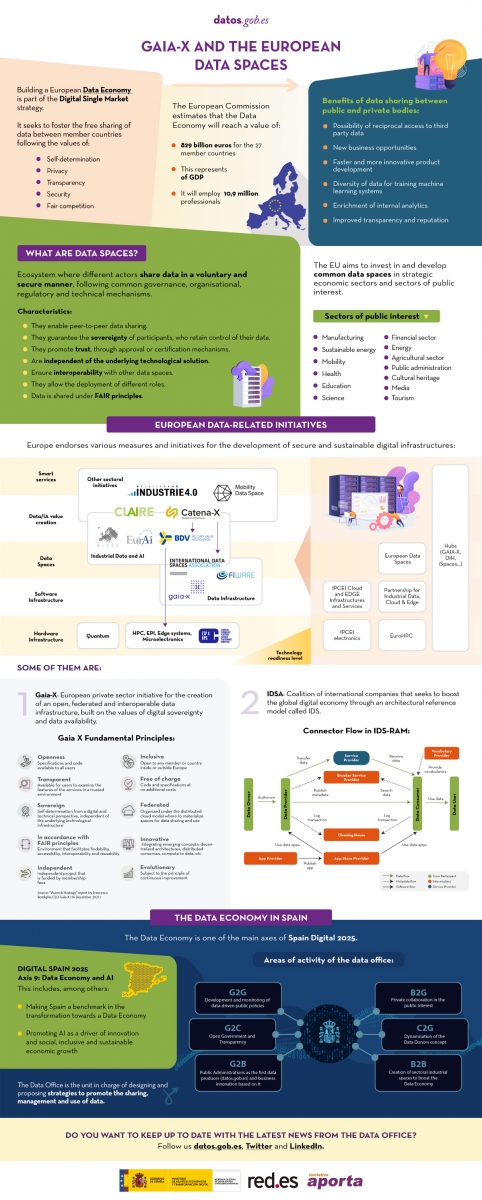
The following infographic shows the context driving the development of data spaces, focusing on some related European initiatives such as Gaia-X and ISDA. For more in-depth content you can read the following articles:
- The importance of deploying European Data Spaces
- Gaia-X and the drive for the data economy
- https://datos.gob.es/en/blog/ids-ram-reference-architecture-model-and-its-role-data-spaces
- The Data Office: the challenge of promoting the Data Economy
Click on the infographic to see it in full size and access the links:
Blog
The data economy represents a huge business opportunity for companies of all sizes and sectors. According to European Commission estimates, the Data Economy will be worth €829 billion in 2025 for the 27 member states. But for the data economy to develop properly, structures are needed to facilitate the exchange of data and, with it, the development of business models based on its exploration and exploitation.
Data spaces fulfil this function by facilitating the development of an ecosystem where different actors share data in a voluntary and secure manner. To do so, they must follow common governance, organisational, regulatory and technical mechanisms.
One way to ensure that this is done properly is through reference models, such as the IDS-RAM (International Data Spaces Reference Architect Model), an initiative developed by the International Data Space Association and endorsed by the European Union.
What is the International Data Space Association?
IDSA (International Data Spaces Association) is a coalition currently comprised of 133 international, not-for-profit companies, which emerged in 2016 to work on the concept of data spaces and the principles that their design should follow in order to obtain value from data through sharing, based on secure, transparent and fair mechanisms for participants, which guarantee sovereignty and trust. These companies represent dozens of industry sectors and are based in 22 countries around the world.
IDSA is connected to different European initiatives, including BDVA, FIWARE and Plattform Industrie 4.0, participating in more than twenty European research projects, mainly in the Horizon 2020 programme.
IDSA's mission is to drive the global digital economy. To this end, among other things, it promotes an architectural reference model called IDS (International Data Spaces), a secure and sovereign data exchange system. The aim of this model is to standardise data exchange in such a way that participants can obtain all possible value from their information without losing control over it, setting the conditions for the use of their own data.
IDS-RAM architecture
The IDS-RAM (Reference Architecture model) is characterised by an open architecture (they publish their code as open source software), reliable and federated for cross-sector data exchange, facilitating sovereignty and interoperability.
IDS-RAM establishes a series of standardised roles and interactions through a 5-layer structure (business, functional, process, information and system) that are addressed from the perspective of security, certification and governance, as shown in the following figure.

These layers are critical to ensure the success of a data sharing initiative. Let's look at each of them based on the IDSA's own "Reference architecture model" and Planetic's "Positioning on Data Spaces" report, where IDS-RAM is analysed as a success story.
The business layer defines the different existing roles and the interaction patterns between them, including contracts and data usage policies. Specifically, there are four roles:
- Essential participant: any organisation that owns, offers or consumes data.
- Intermediary: trusted entities and intermediaries, such as brokers, clearing houses, identity providers and others.
- Service/Software Provider: companies that provide services and/or software to participants.
- Governance body: such as certification bodies, which are essential to guarantee the capabilities of organisations and generate an environment of trust. The IDS Association itself would also be included in this section.
These roles are related in an ecosystem marked by six categories of requirements, defined in the functional layer:
- Trust, achieved through identity management and user certification.
- Security and data sovereignty, which includes authentication and authorisation, usage policies, trusted communication and technical certification.
- Data Ecosystem, which includes the description of data sources, data brokering and vocabularies used for metadata.
- Standardisation and interoperability, which ensures the operability necessary for successful data exchange.
- Value-added applications, which allow data to be transformed or processed.
- Data marketisation, which covers aspects such as billing, usage restrictions, governance, etc., necessary when data sharing is done under payment models.
The process layer captures the interactions that take place within the data space, including the on-boarding of users, for which they need to acquire an identity provided by a certification body and request a data connector (a technical component to be installed) from a software provider.
identity provided by a certification body and request a data connector (a technical component to be installed) from a software provider. This layer also defines the processes required for data exchange and the publication and use of data apps.
The information layer explains the information model and the common vocabulary to be used to facilitate compatibility and interoperability, so that data exchange can be automated. A proprietary ontology based on an RDF schema is used for its definition.
Finally, the system layer assigns a concrete architecture of data and services to each role in order to guarantee functional requirements.
All these abstractions of layers and perspectives enable the exchange of data between data providers and data consumers, using the appropriate software connectors, accessing the metadata broker where data catalogues and their conditions of use are specified, with the possibility of deploying applications for data processing and keeping track of the transactions carried out (clearing house), all of this guaranteeing the identity of the participants.
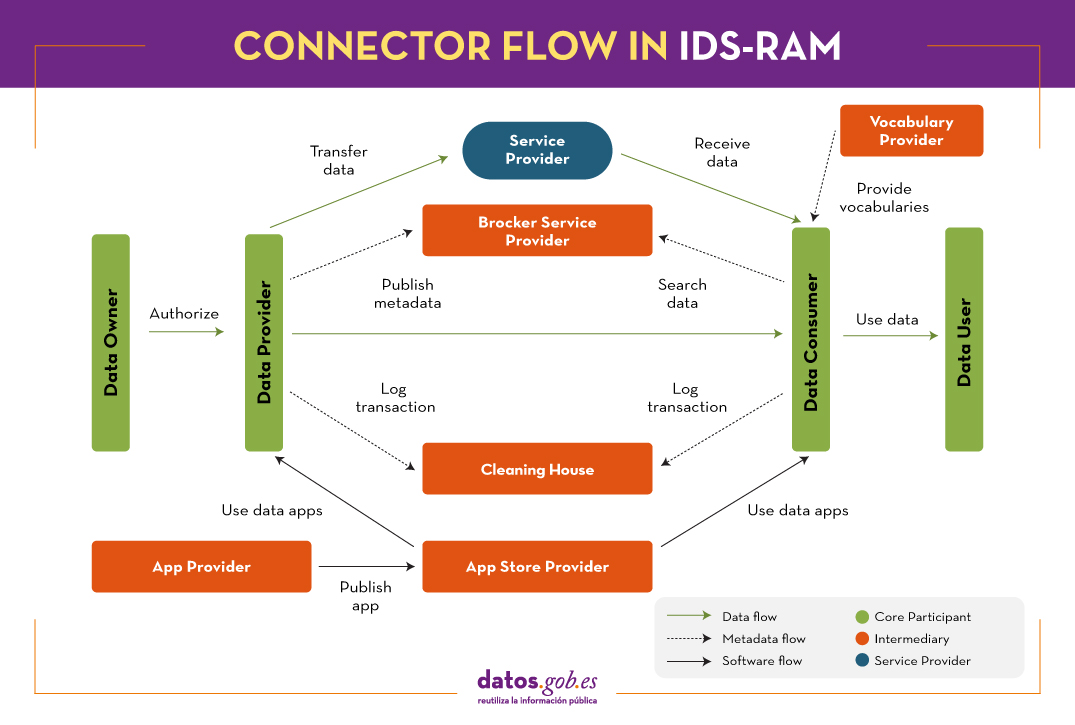
Ultimately, it is a functional framework that provides a governance framework for secure and reliable interoperability and an open software architecture to ensure maximum adoption. In this sense, the IDSA has set itself the following objectives:
- Establish the IDS model (RAM) as the international standard for data exchange in the economy of the future.
- Evolve this reference model according to use cases.
- Develop and evolve an adoption strategy for the model.
- Support its deployment based on certifiable software solutions and commercial models.
This standard is already being used by many companies as diverse as Deutsche Telekom, IBM or Volkswagen.
The role of IDS-RAM in Gaia-X and the European Data Strategy
The IDS reference architecture model is part of the initiatives deployed within the overall framework of the EU data strategy.
Through various initiatives, the European Commission seeks to promote and interconnect data spaces in order to foster the consultation, sharing and cross-exploitation of available data, while ensuring their privacy. It is in this framework that Gaia-X has been launched, an European private sector initiative for the creation of an open, federated and interoperable data infrastructure, built on the values of digital sovereignty and data availability, and the promotion of the data economy.
The IDSA association, promoter of the IDS reference architecture, is actively participating in Gaia-X, so that the initiatives currently underway to develop reference models and implementations for data sharing with sovereignty and trust can be brought together in a de facto open standard.
Content prepared by the datos.gob.es team.
Blog
There is no doubt that data is a fundamental asset for companies. Properly processed, they generate great competitive advantages, both in decision-making and in the generation of new products and services, enabling technologies such as Artificial Intelligence. This situation has made many organisations wary of sharing their data. However, the situation is changing and more and more companies and organisations are becoming aware of the advantages of this practice.
Data sharing drives efficiency in supply chains, enabling faster and more innovative product development. By sharing their data, organisations also benefit from access to third-party data, which can be of great use in a variety of fields: from training machine learning systems to enriching internal analytics. In addition, the fact that several companies are working in the same field, generating advances, means that the market matures earlier, opening up new business opportunities, as well as reducing the time and costs of marketing products. There are also benefits in terms of transparency and reputation.
Secure and controlled environments, such as data spaces, are necessary for this data exchange to take place in a safe and secure manner.
What are data spaces?
A data space is an ecosystem where diverse actors share data in a voluntary and secure manner, following common governance, organisational, regulatory and technical mechanisms. Some of the characteristics of advanced data spaces include:
- They ensure participants' trust and sovereignty over their data, creating an ecosystem of peer-to-peer data sharing. In a data space, each participant retains control over its own data, indicating the terms and conditions under which it can be used.
- They are independent of the underlying technological solution. This allows for portability and deployment in different physical infrastructures.
- Data is shared under FAIR principles, which facilitates the location, access and use of the data. To this end, datasets must be properly described, including the taxonomies used and their restrictions on use.
- They enable the deployment of different roles, such as data producers, consumers, data service providers, component developers or operators of essential services, facilitating the development of data intermediaries.
- They ensure the identity of the participants, as well as the suitability of the software components used, by means of appropriate approval or certification mechanisms.
- They enable different policies of access and use of information, so that data subjects can determine whether data is shared for free or not, under mechanisms that guarantee its proportionality.
- They ensure interoperability
European data spaces key to boosting the data economy
Data spaces are a key element of the European Data Strategy, which, among other issues, seeks to boost the region's economy through the creation of a single European data market, where data flows between Member States and between sectors of activity, in accordance with the European values of self-determination, privacy, transparency, security and fair competition.
In this strategy, the European Commission has already announced its interest in investing in and developing common data spaces in strategic economic sectors and sectors of public interest, notably those related to manufacturing, sustainable energy, mobility, health, finance, energy, agriculture, public administrations and skills. Once developed, these spaces are expected to be interconnected, so that the data available in them can be cross-exploited.
The creation of these data spaces seeks to overcome the legal and technical barriers linked to data sharing, through common standards, tools and infrastructures in a context of digital sovereignty. According to the European data strategy, the development of European data spaces should be carried out taking into account the following elements:
- The deployment of tools and services for data processing, exchange and sharing, as well as the federation of secure and energy-efficient cloud capabilities and related services. These tools should enable access to data in a fair, transparent, proportionate and non- discriminatory manner.
- The development of clear and reliable data governance structures, in compliance with EU law, with particular attention to the protection of personal data, consumer and competition law.
- Improving the availability, quality and interoperability of data, both within specific domains and across sectors.
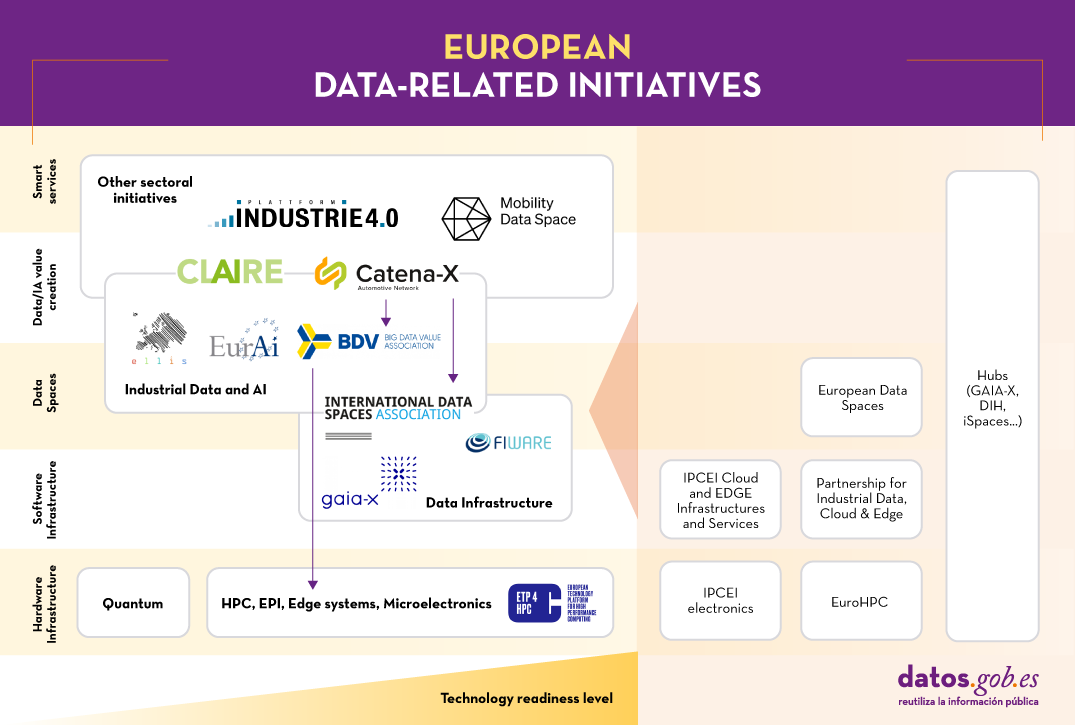
In this regard, the European Commission endorses various measures and initiatives for the development of secure and sustainable digital infrastructures. These include Gaia-X, which seeks the development of an open, federated and interoperable data infrastructure in the cloud, and the International Data Spaces Association (IDSA), probably a substantial part of Gaia-X, which promotes an architectural reference model for the development of data spaces.
In the image below you can see these and other European initiatives at different levels related to data spaces. The left and central part shows some of the main European data initiatives, and how these are supported by hardware infrastructures. The right hand side shows the alignment with the most important EU initiatives within the European Data Strategy.
Spain is aligned with Europe in this area: the transition to a data economy is among the axes of the Digital Spain 2025 Plan. Work is currently underway to promote the enabling environment for the creation of sectoral data spaces, through the various data initiatives included in the Recovery, Transformation and Resilience Plan. One example is the Spanish Gaia-X Hub, aimed at deploying a robust ecosystem in the field of industrial data sharing, comprising companies of all sizes. The aim of this type of action is to create a community around data that favours innovation and economic growth, with the consequent benefit for society.
Content written by the datos.gob.es team
Noticia
The application of new techniques aimed at extracting value from data has become a reality in the current environment, accelerating its transformation into knowledge for decision making. Therefore, it is common to focus on the exploitation of data as an indispensable part of its management, arising linked to the concept of its exploitation the concept of data space, enabling its sharing, involving both the private sector and the different public agencies, whether local, national or international.
A data space is an ecosystem where the voluntary sharing of its participants' data materializes within an environment of sovereignty, trust and security, established through integrated governance, organizational, regulatory and technical mechanisms. The concept of sovereignty is key, understood as the ability of a participant to maintain control over its own data, expressing the terms and conditions that will govern its permitted uses.
What is Gaia - X?
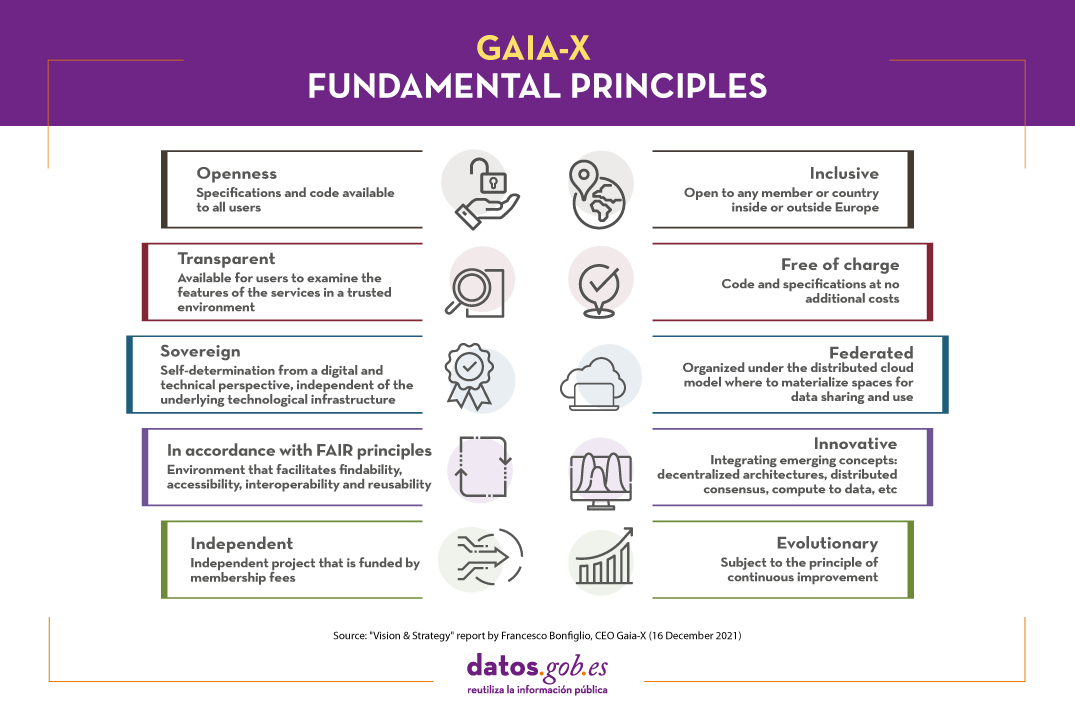
In this context, the Gaia-X initiative was born, a European private sector initiative for the creation of an open, federated and interoperable data infrastructure, built on the values of digital sovereignty and data availability, and the promotion of the Data Economy. The challenge is to establish an ecosystem in which data from European entities are available and shared in a trusted and managed environment according to European principles of decentralization, openness, transparency, sovereignty and interoperability.
Gaia-X aims to develop a federation of cloud data services, enabling cooperation and data sharing between companies and organizations across the European Union independently of infrastructure providers. Gaia-X defines the technical concepts, as well as the governance, for the interoperability of datasets and data infrastructures, assuming the role of orchestrator, mediating between data providers and data consumers via the federated services, and creating a physical decoupling between the data layer and the infrastructure layer.
From the origins
The Gaia-X initiative began to see the light of day in October 2019, when the French and German ministries of economic affairs presented the project. Since then, its growth has been exponential. At the end of 2020, a summit was held, leading to the founding of the Gaia-X association AISBL in January 2021. During that year, Gaia-X is defined as a brand, as well as the first versions of its services. Among its objectives is the development of common standards, best practices, tools, as well as governance mechanisms.
Gaia-X currently has 324 members around the world. Companies, associations, research institutions, administrations and politicians have joined forces to work together in the initiative. The 22 founding members are divided between France and Germany, where organizations such as Amadeus, Atos, OVH, Orange Business Services, Siemens, IDS, SAP SE and Deustche Telekom stand out. However, these 22 have been joined over the years by private and public organizations from Asia (China, India, Japan, Singapore, Qatar, Korea), the USA and mainly Europe (Austria, Belgium, Estonia, Finland, France, Germany, Greece, Poland, Ireland, Italy, Lithuania, Luxembourg, the Netherlands, Poland, Portugal, Slovakia, Slovenia, Spain, Sweden, Switzerland, the UK).
In Spain, in mid-2021, the Ministry of Economic Affairs and Digital Transformation, through the Secretary of State for Digitalization and Artificial Intelligence, promotes the creation of the Gaia-X national hub, an organizational initiative whose objective is to accelerate European capacity in industrial/sectoral data sharing and digital sovereignty, contributing to generate the common European infrastructure, through the launch of a manifesto of interest whose response from private sector companies was overwhelming.
In this way, Spain also joins the Government Advisory Board of Gaia-X, the European partnership to accelerate the response to data sharing. The Spanish Gaia-X Hub seeks that companies of all sizes create community around data, serving to develop and implement innovative solutions based on data and Artificial Intelligence, which boost national competitiveness, paying special attention to SMEs and micro-SMEs. Thus, it is proposed the creation of data spaces in the different productive sectors, interoperable with European spaces and without interfering in other spaces that the industry has planned to develop.
The data economy in Spain
This project aims to contribute to the economic growth of our country. According to the European Data Market study, the data economy in Spain had in 2019 a value equivalent to 2.5% of the national GDP, and it is estimated that by 2025, this value will represent more than 4% of the Spanish GDP, provided that the appropriate legal, political and financing environment is created, which highlights the importance of data in the economy.
Spain's commitment to the data economy is part of the Digital Spain 2025 strategy, which highlights the need to support the digitization of key sectors for the economy, such as tourism and healthcare in particular, but also others such as mobility, the agri-food sector and e-commerce.
Conclusions
Data are the focus of the major transformations taking place in today's environment as a result of the application of new digital technologies. For this reason, no digital economy will be able to consolidate and compete globally without a strong data economy.
The European strategy aims to create a single European data market, open to data from all over the world, in which personal and non-personal data, including sensitive business data, is secure and businesses have access to high-quality industrial data in a way that drives growth and creates value. Through the associated rules and mechanisms, the aim is to ensure that data can flow, European standards and values are fully respected, and the rules for data access and use are fair, practical and clear.
Data spaces in general, and initiatives such as Gaia-X in particular, are key elements in achieving the objectives of the European strategy, serving to foster ecosystems that create new products and services based on more accessible data.
Content prepared by Juan Mañes, expert in Data Governance, with contributions from the Data Office.
The contents and views expressed in this publication are the sole responsibility of the author.