


Blog
Since the publication of Directive (EU) 2019/1024 on open data and re-use of public sector information, the European Commission is undertaking a number of actions to develop the concept of high-value data that this directive introduced as an important novelty in June 2019.
We recall that high-value datasets are defined in this directive as "documents whose re-use is associated with considerable benefits for society, the environment and the economy, in particular because of their suitability for the creation of value-added services, applications and new, decent and quality jobs". The Directive further proposes a first list of six thematic categories of high-value datasets: geospatial, earth observation and environment, meteorology, statistics, corporate and company ownership, and mobility.
In the last three years, numerous initiatives have been launched with the aim of deepening the liberation of this type of datasets and moving towards realising the economic and social benefits derived from their re-use. Studies have been launched such as the “Impact Assessment study on the list of High Value Datasets” by the Commission's DG CONNECT, which presents different options identified for policy-level interventions linked to high-value datasets in the six thematic areas. Or the report “High-value datasets: understanding the perspective of data providers” published by the official European data portal, which aims to understand the perspective of data providers and contains interesting conclusions such as that the perspective is not sufficient to understand where the "high value" actually lies.
A public consultation has also been launched in 2022 to gather public opinion on its draft High-Value Data Act. This draft act already contains a list of specific high-value datasets and provisions for their publication and re-use, which will represent a very significant advance on the objectives of the directive itself. At the end of June, the draft act was also presented to the Committee on Open Data and Re-use of Public Sector Information composed of representatives from EU countries and further progress is expected in September 2022.
For their part, Member States are also carrying out their own work in parallel, as in the case of Spain, which has already started by dedicating the 2019 Aporta Meeting to the promotion of high-value data.
However, the EU's focus on high-value data as a driver of the economy is not unique in the world and there are other initiatives with different degrees of progress and impact that have similar objectives.
Datasets of national interest in Australia
In the case of Australia, a pioneer in this regard, the first National Action Plan of the Australian Open Government Partnership 2016-2018 already contained among its objectives the implementation of actions to develop and publish a framework for high-value datasets and to design how best to facilitate the sharing and use of these datasets through the legislative consultation process.
The Productivity Commission in 2018 recommended recognising a new type of data asset, national interest datasets, defined as datasets that would generate significant benefits for society and would be a special subset of high-value data. At the time, the Australian government committed to appoint a National Data Commissioner, to implement, oversee and regulate a simpler and more efficient data sharing and publishing framework.
However, in 2019 the end-of-term self-assessment report for Australia's first national open government action plan 2016-18 already acknowledged the delay in the initiative. Work was resumed by the National Data Commissioner, who building on previous work continues to conceptualise a framework for identifying high-value data, although no documentation has been released to the general public at this stage.
Aligning open data in Canada
The Canadian Open Government Working Group (COGWG) already started in its 2016-2018 action plan to work on its commitment to align datasets across the country and specifically on the development of a list of priority high-value datasets for collaborative publication across jurisdictions. The plan recognised that publishing common types of data across Canadian jurisdictions would help foster innovation and provide significant socio-economic impact.
In 2018, Canada's Open Government Working Group released an initial list of 17 high-value datasets to be prioritised for publication by federal, provincial, territorial and municipal governments across Canada. This list is part of a report providing common criteria to help identify high-value datasets and is based on work done to unify criteria across levels of government, stakeholder surveys and international standards.
The National Open Government Action Plan 2018-2020 includes a commitment to carry out a pilot project to standardise across jurisdictions five high-value datasets from the list previously identified in the previous plan.
Although the results have not been openly published, the plan's evaluation system acknowledges the delay in meeting this objective as preliminary standards could only be completed for 4 of the 5 high-value datasets. These standards are available through an intranet system to all Canadian public servants (federal, provincial, territorial and municipal), academics and students, as well as to all Canadians by invitation. However, none of the work has been made public nor is it known what datasets they are working on.
India begins work on identifying datasets
More recently, in 2022, the Indian government has published a background note on data accessibility and usage policy in India announcing the development of new policies to improve data access, quality and usage, in line with the technological needs of the next decade.
As with other initiatives in other regions of the world, it recognises the lack of common criteria for consistently identifying and maintaining high-value datasets. It therefore envisages developing a data policy framework that makes data from multiple sources (public and private) accessible through G2G, G2B, B2G and B2B channels.
The objective is also similar to other initiatives, on the one hand, to make public services more efficient, and to enable a new generation of start-ups to drive digital innovation and growth in the Indian economy.
The approaches being followed in different regions of the world to identify and release high-value datasets are very similar and include public consultations, the formation of expert committees, pilot projects and the definition of assessment frameworks. However, we see that development is much slower than expected and that some initiatives, such as those started in Canada or Australia before the EU itself, have not yet been finalised and therefore their impact is not yet known.
For the time being, it seems that the work initiated by the EU is more advanced and, more importantly, more transparent, as the results are being published openly. Let us hope that the initiative does not lose momentum as seems to have happened in Australia or Canada and that we will soon be able to enjoy high-value datasets available for re-use and discuss the impact they have had on society and the European economy.
Content written by Jose Luis Marín, Senior Consultant in Data, Strategy, Innovation & Digitalization.
The contents and views reflected in this publication are the sole responsibility of the author.

Noticia
The Tourism Data Space event took place on 9 June, organised by Gaia-X, the European private sector initiative for the creation of an open, federated and interoperable data infrastructure to drive the Data Economy while respecting digital sovereignty. During the event, which was held online, international experts from the public and private sector discussed "How can data spaces contribute to the development of tourism in Europe through citizen-centric offerings?”. The event was a success with more than 250 attendees from 21 countries.
The tourism sector has a strong economic weight in Europe, although it has been affected by the COVID-19 pandemic and the drop in international tourist arrivals, which exceeded 70% worldwide. In this context, Gaia-X and data spaces are positioned as a great opportunity for companies in the sector. Gaia-X aims to make European data available to improve the ability to attract tourists by creating more personalised offers, products and services, resulting in an enhanced experience tailored to customers' needs. It was with this premise in mind that the event kicked off, focusing on the requirements and need for a secure, decentralised and citizen-oriented European tourism data space.
The opening speech of the event was given by Carme Artigas, Secretary of State for Digitalisation and Artificial Intelligence of the Spanish Ministry of Economy and Digital Transformation, who highlighted the importance of the tourism sector: "“Finally, we are giving the tourism the importance it deserves also in the data economy. At the EU level, the tourism sector directly contributes to almost 4% of GDP with 2.3 million businesses, majority of which are SMEs”. This sector also employs 22.4% of the service sector workforce, as Francesco Bonfiglio, Director General of Gaia-X AISBL, commented: "This market is worth billions of euros, and is one of the areas with the greatest impact if we decide to invest in a common European data space".
Artigas also stressed that "Before the end of the year we will have a new digital space for tourism at European level, and this is great news", always respecting the basic principles of data sovereignty, privacy, security and interoperability.
Yvo Volman, Chief Data Officer at DG-CNECT (European Commission), explained that in order to achieve the set objectives, empowerment and data sharing also across sectors is essential. This is the only way to establish better services and promote sustainability. The importance of education was also stressed by Natalia Bayona, Director of Innovation, Education and Investment at the World Tourism Organisation (UNWTO): "Tourism is the main employer of women and young people. However, 50% of people working in tourism have only secondary skills. If we want to develop a high-level economic sector, we have to develop education". In her speech, she also focused on the need for a public-private relationship, with projects such as Gaia-X as a spearhead to drive innovation.
This was followed by several presentations focused on providing an overview of the landscape of the Gaia-X Tourism data space in Europe, with experts from different countries. From Spain, Ana Moniche, Senior Analyst at Turismo Andaluz and NECSTourR, and Cristina Núñez, Director of Necstour, spoke about European regional practices for competitive and sustainable tourism, highlighting how European data sharing is fundamental to develop strategies based on quality information. Data sharing also offers companies with fewer resources the possibility of accessing large amounts of data, which they would not be able to access through their own mechanisms.
Dolores Ordóñez, Director of AnySolution and Vice President of the Spanish Gaia-X Hub, also spoke in this section. In her speech, she highlighted the need for collaboration between companies of different sizes and sectors, especially in four major areas: tourism, health, industry 4.0 and mobility. In the section dedicated to the pillars of tourism data spaces, among other speakers, Alberto Palomo, CDO of the Government of Spain, pointed out the importance of generating scalability in data sharing, as well as the creation of a common framework that shapes governance mechanisms that are useful and accepted by industry players. He also warned that the paradigm we are facing is that of an "innovative decentralised infrastructure", something that all participants must be clear about, because of the cultural change it implies.
To conclude, the event was divided into 3 thematic sessions, designed to create an atmosphere of cross-border collaboration and help create a sustainable data infrastructure for the tourism industry. These sessions focused on smart destinations, the tourism value chain and its technological enablers. More information about the event can be found in the video teaser. This event is part of a series of meetings organised by Gaia-X around data spaces. Two previous events have focused on mobility and health. Gaia-X will continue to hold such activities in the coming months, as can be seen in its calendar. In addition, it has launched a magazine and a podcast series to keep up to date with the latest trends related to the data space.
Blog
The Commission's drive to promote data spaces within the framework of a European Strategy is based on the firm commitment to a regulatory framework that provides regulatory coherence throughout the Union. In particular, the aim is to establish a solid regulation that offers legal certainty to a model based on respect for rights and freedoms. Thus, initially, two initiatives have been promoted to, on the one hand, establish the regulatory bases of the governance model - already definitively adopted by Regulation (EU) 2022/868 of 30 May - and, on the other hand, to establish harmonised rules on the access and fair use of data throughout the Union.
However, while recognising the importance of the design of this general legal architecture, the effective opening and exchange of data requires a more concrete approach that takes into account the specificities of each sectoral area and, in particular, the difficulties and challenges to be faced. Therefore, taking into account the general regulatory framework referred to above, the Commission has presented the first regulatory initiative for one of these areas, related to health data, which is currently under public consultation and negotiation in the Council of the EU and in the European Parliament, and which is part of the project to create a European health data area.
In particular, beyond facilitating the development of cross-border e-services, the proposal aims to address a triple objective:
• Establish a uniform legal framework to facilitate the development, marketing and use of electronic health record systems by establishing a compulsory self-certification scheme for certain systems, which in any case provides for some exceptions, e.g. general purpose software used in healthcare environments.
• Facilitating patients' electronic access to their own data in the framework of healthcare provision (primary use of health data). In this respect, the proposal seeks to strengthen consistency across Member States in protecting health data irrespective of where the healthcare provision takes place or the type of entity carrying it out.
• Encourage the re-use of such data for other secondary purposes. To this end, a specific governance model is envisaged with a specific body at the head - the so-called European Health Data Space Board - and the deployment of duly coordinated state administrative structures - health data access bodies.
We will look at this last point in more detail below.
The promotion of secondary uses
With regard to the re-use of data for purposes other than health care, the proposed regulation is based on the following evidence: although health data are already being collected and processed using electronic means, in many cases, however, access to them is not facilitated to satisfy other purposes of general interest. For this reason, in general, it is intended to establish a broad regulation that facilitates secondary uses of health data. For example, the elaboration of statistics, the development of training and research activities, such as technological innovation -including the training of algorithms- or personalised medicine.
However, for the purposes of denying access to health data, some secondary uses are expressly declared incompatible, such as:
• The adoption of decisions detrimental to natural persons, meaning not only those that produce legal effects but also those that significantly affect them. In this respect, changes relating to insurance contracts, such as an increase in the amounts to be paid, are specifically highlighted.
• The carrying out of advertising or marketing activities aimed at healthcare professionals, organisations in the sector or natural persons.
• Making data available to third parties that are not covered by the data permission granted.
• The development of harmful products and services, including in particular illicit drugs, alcoholic beverages, tobacco products or goods or services that contravene public order or morality.
With regard to the parties obliged to share data, in principle the proposed regulation extends to those who collect and process data with public funding, who must make them available to the competent bodies for access to health data in order to facilitate their re-use. However, given their importance in some States, the regulation also extends its scope of application to private parties providing health services - except in the case of micro-enterprises - and also to professional associations. Specifically, this regulation would affect "any natural or legal person, which is an entity or a body in the health or care sector, or performing research in relation to these sectors, as well as Union institutions, bodies, offices and agencies who has the right or obligation, in accordance with this Regulation, applicable Union law or national legislation implementing Union law, or in the case of non-personal data, through control of the technical design of a product and related services, the ability to make available, including to register, provide, restrict access or exchange certain data".
Purpose and conditions of access to health data
The proposed Regulation is based on a broad concept of health data, which includes the following categories:
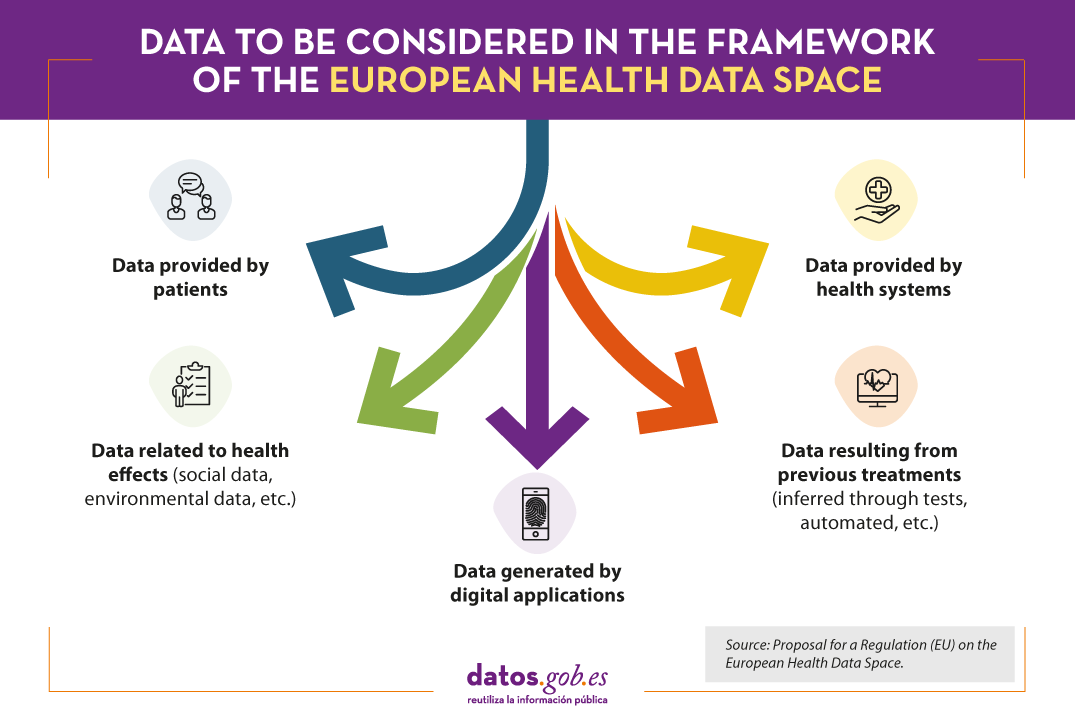
The regulation is based on a general rule: access to anonymised data as a measure to reduce privacy risks, although a specific regime is also envisaged for personal data. In this case, the request must include an adequate justification and the data will only be provided in pseudonymised form.
As regards the form of access, the particular sensitivity of health data determines that it is proposed that they should be made available through a secure processing environment that complies with the technical and security standards included in the proposal. In particular, the proposal does not allow that, except for non-personal data, the data are transmitted directly to the person who will re-use them. Furthermore, it provides for processing to take place in secure environments under the control of the access authorities.
Access authorities for health data
From the perspective of the governance model underpinning the proposal, States should have at least one health data access body to provide electronic access to health data for secondary purposes. In the case of multiple bodies due to requirements arising from their political-administrative organisation, one of them will have a coordinating role. Beyond the organisational freedom of the States to choose one or another organisational formula, it is essential that the independence of the coordinating body be guaranteed, without prejudice to the mechanisms of financial or judicial control.
As already indicated, the main purpose of this measure is to ensure a uniform and consistent application of the regulatory framework for access to health data for secondary purposes across the European Union, in particular as regards the protection of personal data in this sector. In this respect, it is proposed that these bodies should be given the powers to verify compliance with these rules and, in particular, to impose sanctions and other measures such as temporary or definitive exclusion from the European Health Data Area of those who do not comply with their obligations.
The harmonisation sought by the proposed Regulation is also envisaged in the establishment of a standardised process for the issuing of permissions to re-use data for secondary purposes. In particular, in cases where anonymised access to the data is not enough, reasons should be given as to why pseudonymised access is necessary. In the latter case, the request must specify the legal basis for requesting access to the data from the perspective of personal data protection law, the secondary purposes for which the data are intended to be re-used, as well as a description of the data and tools necessary for their processing.
Finally, the proposed regulation includes active disclosure obligations addressed to these bodies about the available datasets. This is an essential measure, since the existence of a catalogue of datasets at European level - based on the interconnection of national datasets - would be extremely useful for promoting not only research and innovation but also decision-making at regulatory and political level. Specifically, for each set of available data, the nature of the data, its source and the conditions for making it available will have to be indicated.
In short, this is a certainly innovative initiative to address the regulatory diversity existing in each Member State, which is, however, at an early stage of processing. Precisely, a participation procedure is currently open that allows for the submission of allegations against the initial drafting until 28 July 2022 through a simple procedure accessible via this link.
Content prepared by Julián Valero, Professor at the University of Murcia and Coordinator of the Research Group "Innovation, Law and Technology" (iDerTec).
The contents and views expressed in this publication are the sole responsibility of the author.
Documentación
This report published by the European Data Portal (EDP) aims to help open data users in harnessing the potential of the data generated by the Copernicus program.
The Copernicus project generates high-value satellite data, generating a large amount of Earth observation data, this is in line with the European Data Portal's objective of increasing the accessibility and value of open data.
The report addresses the following questions, What can I do with Copernicus data? How can I access the data?, and What tools do I need to use the data? using the information found in the European Data Portal, specialized catalogues and examining practical examples of applications using Copernicus data.
This report is available at this link: "Copernicus data for the open data community"
Documentación
This report published by the European Data Portal (EDP) covers the following topics.
What are the needs of open data re-users of public sector institutions in Europe? This question is key to facilitate the publication of open data and support for re-users of EU institutions and Member States' public authorities based on their needs for policy-making, service delivery and organizational management.
This discussion paper provides an overview of the state of existing methods and indicators in the European open data landscape to assess the needs of public institutions as data re-users.
This overview serves as a basis for a discussion with public sector stakeholders on appropriate methods and indicators for measuring the demand for data from public institutions to encourage the publication of demand-driven data.
The report is available at this link: "Measuring Data Demand Within the Public Sector"
Documentación
This report published by the European Data Portal (EDP) covers the following topics.
Making data available as open data in all EU Member States is vital to harnessing its potential for European society and economy. In order to increase impact effectively, efforts must target the datasets that have the greatest potential in society and the economy.
In the regulation on open data and re-use of public sector information, the European Commission is mandated to adopt an implementing regulation specifying high-value datasets.
The line of argument developed in this report parallels what the Commission has done during the first quarter of 2021, to prepare the implementing regulation that includes a list of high-value datasets. This report reviews relevant literature, policy decisions and national initiatives to enable a deeper understanding of the situation around assessing the value of datasets.
The report is available at this link: "High-Value Datasets: Understanding the Data Providers' Perspective"
Documentación
This report published by the European Data Portal (EDP) explores existing and emerging developments and initiatives around data sharing using data spaces.
The objective is twofold: to identify the owners of open data involved in the implementation of data spaces and to reflect on the role that open data portals (with special attention to data.europa.eu) could play in this implementation.
After documentary research and interviews with the promoters of data spaces, it is analyzed how data.europa.eu could be positioned in the common European data spaces that are emerging.
The report is available at this link: "Data.europa.eu y los espacios comunes de datos europeos: un informe sobre retos y oportunidades"
Documentación
This report published by the European Data Portal (EDP) aims to advance the debate on the medium and long-term sustainability of open data portal infrastructures.
It provides recommendations to open data publishers and data publishers on how to make open data available and how to promote its reuse. It is based on the previous work done by the data.europa.eu team, on research on open data management, and on the interaction between humans and data.
Considering the conclusions, 10 recommendations are proposed for increasing the reuse of data.
The report is available at this link: " Principles and recommendations to make data.europa.eu data more reusable: A strategy mapping report "
Noticia
What role can data portals play in the context of the data spaces identified in the European Data Strategy? This is the question posed by the European Commission, through its open data initiative 'data.europa.eu', and which serves as the starting point for the report "data.europa.eu and the European common data spaces".
Data.europa.eu and the Common European Data Spaces: Report Methodology
"data.europa.eu and the European common data spaces" is the first of two reports analysing the role that data.europa.eu could play in the context of the emerging European Union common data spaces envisaged in the European Data Strategy. It should be noted that part of this strategy is the development of interoperable common European data spaces across different sectors, an initiative that is still in the process of consolidation.
The objective of the report is twofold. On the one hand, it seeks to identify open data holders who are involved in ongoing implementations of data spaces. On the other hand, it offers a reflection on the role that open data portals could play in these implementations, especially the European portal.
To carry out the development of this first report, its authors (Óscar Corcho and Elena Simperl), conducted an in-depth analysis of the existing official documentation on the European Data Strategy, as well as reviewing online resources and use cases of initiatives such as IDSA, Gaia-X or Open DEI.
Simultaneously, they conducted interviews with developers of data architectures and data spaces. As full implementations do not yet exist, the analysis was based on use cases, work in progress and roadmaps, rather than on operational data spaces.
Main findings of the report
Although this is only the first of two studies, the authors have been able to highlight several far-reaching conclusions:
- Open data is commonly mentioned alongside private and personal data as a type of data source. However, open data owners are often not involved in initiatives to develop reference data space architectures or their implementations. This situation needs to change by ensuring their involvement.
- Open data holders have extensive experience in data publishing, metadata management, quality indicators, dataset discovery and federation, as well as in technologies and standards such as DCAT. However, there is very little transfer of knowledge and technologies from the open data community to the data space community.
- The use of data from multiple sources requires interoperability at various levels. The need for data intermediaries acting as neutral brokers to ensure interoperability is an under-explored issue in the context of data spaces. Public administrations, building on their experience in data publishing, are best placed to take on this role.
The second report - to be published once the data space implementations are available in 2023 - will explore three data space scenarios, with data.europa.eu as data holder or data broker. In addition, it will analyse in detail the challenges and opportunities for the European portal in the context of these developments.
A webinar to further explore the role of the European Data Portal in data spaces
The concept of "data space" arises from the need to provide as much openness of information as possible, while recognising that some data should not be completely open. As a result of this dichotomy, the idea of creating a community of participants who share and use data on the basis of pre-established rules, guaranteeing an environment of sovereignty and trust, was born.
Ideas such as these prompted a webinar on open data and how it fits into broader data space ecosystems to be held on 4 May in the framework of the data.europa.academy. During this session in English, which you can access via this link, some key points of the report's analysis were explored in more detail. In addition to the recording of the session, you can view and download for free the PDF presentation that was used as a guide for the webinar.
Next steps
Ultimately, data spaces belong to an emerging field that still has some biases and limitations. Open government data sources, portals and their practitioners are not as well represented as they could be, even in sectors where they play a key role, such as mobility or smart cities. This needs to change.
The future of the research conducted in this report is to await the publication of the aforementioned second report, which will become effective once more developed European common data spaces are available and the work on reference resources has been completed by IDSA and Gaia-X. These forthcoming actions will allow the formulation of more specific recommendations that can be based on the characteristics of the actual data spaces in operation.
Noticia
The current Directive 2019/1024 on open data and re-use of public sector information, adopted in June 2019, was established to replace and improve the former Directive 2003/98/EC. Among its objectives was to boost the availability of public sector data for re-use by establishing some minimum harmonisation rules that favour its use as a raw material for innovation in all economic sectors. It should be noted that this directive has been incorporated into Spanish law through Royal Decree-Law 24/2021, of 2 November, transposing several European Union directives.
Among the most significant changes introduced by Directive 2019/1024 was the drawing up of a list of high-value datasets to be highlighted among those held by public bodies.
High-value data: definition and characteristics
The Directive describes high-value data as "documents whose re-use is associated with considerable benefits for society, the environment and the economy, in particular because of their suitability for the creation of new, decent and quality value-added services, applications and jobs, and the number of potential beneficiaries of value-added services and applications based on such datasets".
This definition provides some clues as to how such high-value datasets can be identified. Identification can be carried out through a series of indicators including:
- Potential to generate:
- Significant social or environmental benefits
- Economic benefits and new revenues
- Innovative services
- Potential in terms of number of users benefited, with a particular focus on SMEs.
- Ability to be combined with other datasets.
How should high-value data be published?
According to the Directive, the publication of these datasets has to meet the following requirements:
- Be reusable free of charge.
- Available through application programming interfaces (APIs).
- Available in a machine-readable format.
- Feature a bulk download option, where possible.
In addition, they should be compatible with open standard licences.
Which thematic categories are considered high-value data?
The European Data Strategy incorporates high-value data as a common data layer that facilitates, together with data from the private sector, the deployment of sectoral data spaces in strategic areas.
Originally, the directive included in its annex a number of priority themes that could be considered high-value data: geospatial data, earth observation and environmental data, meteorological data, statistical data, business registers or transport data.
However, these categories were very broad. The EU has therefore launched an initiative to establish a list indicating more precisely what types of data are considered high-value and how they should be published. Following an extensive consultation of stakeholders and taking into account the outcome of the impact assessment, the Commission identified, within each of the six data categories, a number of datasets of particular value and the arrangements for their publication and re-use.
The list takes the form of a binding implementing act. The granularity and modality of publication varies from one dataset to another, trying to strike a balance between the potential socio-economic and environmental benefits and the financial and organisational burden to be borne by public data holders. Existing sectoral legislation governing these datasets should also be taken into account.
Open comment period on the draft law "Open Data: Availability of public datasets".
The next step is to get citizens' feedback on the proposed datasets. The European Commission currently has a specific section open on its website, at the end of which any citizen of the European Union can provide their comments to help improve and enrich this initiative. The public consultation will run for four weeks, from 24 May to 21 June 2022.
In order to submit your comments, you need to register using your email address or popular social networks such as Twitter or Facebook.
Remember that in order to express your opinion and for it to be taken into account by the public body, your comment must comply with the established rules and standards. In addition, you can consult the comments already made by other citizens from different countries and which are offered publicly. The website also includes a visualisation that presents data on the number of opinions offered per country or the category to which the participants belong (private companies, academic institutions, research institutions, NGOs, citizens, etc.).
This list will be a really important milestone as, for the first time in many years, it will be possible to establish an explicit and common guide on what are the minimum datasets that should always be available and what should be the conditions for their re-use throughout the European Union.
At the Spanish level, the Data Office, in collaboration with stakeholders, will be in charge of landing this list and specifying other additional datasets, both public and private, based on what is indicated in Royal Decree-Law 24/2021.