


Documentación
Este informe, que publica el Portal de Datos Europeo, analiza el potencial de reutilización de los datos en tiempo real. Los datos en tiempo real ofrecen información con alta frecuencia de actualización sobre el entorno que nos rodea (por ejemplo, información sobre el tráfico, datos meteorológicos, mediciones de la contaminación ambiental, información sobre riesgos naturales, etc.).
El documento resume los resultados y conclusiones de un seminario web organizado por el equipo del Portal de Datos Europeo celebrado el pasado 5 de abril de 2022, donde se explicaron diferentes formas de compartir datos en tiempo real desde plataformas de datos abiertos.
En primer lugar, el informe hace un repaso sobre el fundamento de los datos en tiempo real e incluye ejemplos que justifican el valor que aporta este tipo de datos para, a continuación, describir dos enfoques tecnológicos sobre cómo compartir datos en tiempo real del ámbito de IoT y el transporte. Incluye, además, un bloque que resume las principales conclusiones de las preguntas y comentarios de los participantes que giran, principalmente, en torno a difentes necesidades de fuentes de datos y funcionalidades requeridas para su reutilización.
Para terminar, basándose en el feedback y la discusión generada, se proporciona un conjunto de recomendaciones y acciones a corto y medio plazo sobre cómo mejorar la capacidad para localizar fuentes de datos en tiempo real a través del Portal de Datos Europeo.
Este informe se encuentra disponible en el siguiente enlace: "Datos en tiempo real: Enfoques para integrar fuentes de datos en tiempo real en data.europa.eu"

Noticia
Measuring the impact of open data is one of the challenges facing open data initiatives. Ther are a variety of methods, most of which combine quantitative and qualitative analysis in order to understand the value of specific datasets.
In this context, data.europa.eu, the European Open Data Portal, has launched a Use Case Observatory. This is a research project on the economic, governmental, social and environmental impact of open data.
What is the Use Case Observatory?
For three years, from 2022 to 2025, the European Data Portal will monitor 30 cases of re-use of open data. The aim is to:
- Assess how the impact of open data is created.
- Share the challenges and achievements of the analysed re-use cases
- Contribute to the debate on the methodology to be used to measure such impact.
The analysed use cases refer to four areas of impact:
- Economic impact: includes reuse cases related to business creation and (re)training of workers, among others. For example, solutions that help identify public tenders or apply for jobs are included.
- Governmental impact: This refers to reuse cases that drive e-government, transparency and accountability.
- Social impact: includes cases of re-use in the fields of healthcare, welfare and tackling inequality.
- Environmental impact: This is limited to cases of re-use that promote sustainability and energy reduction, including solutions related to air quality control or forest preservation.
To select the use cases, an inventory was made based on three sources: the examples collected in the maturity studies carried out each year by the European portal, the solutions participating in the EU Datathon and the examples of reuse available in the repository of use cases on data.europa.eu. Only projects developed in Europe were taken into account, trying to maintain a balance between the different countries. In addition, projects that had won an award or were aligned with the European Commission's priorities for 2019 to 2024 were highlighted. To finalise the selection process, data.europa.eu conducted interviews with representatives of the use cases that met the requirements and were interested in participating in the project.
Three Spanish projects among the use cases analysed
The selected use cases are shown in the following image:
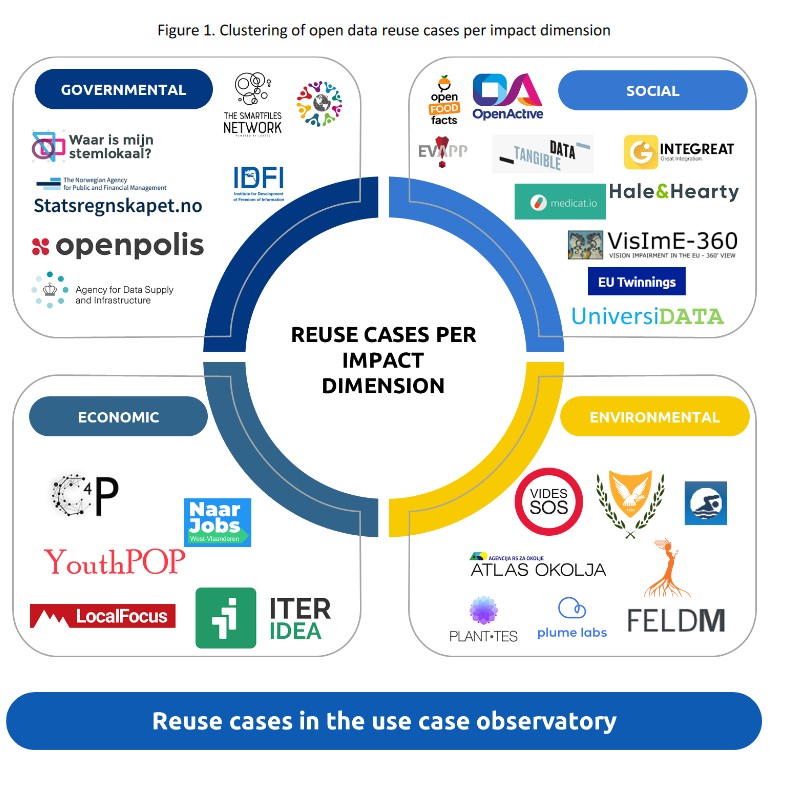
Among them, there are three Spaniards:
- In the Social Impact category is UniversiDATA-Lab, a public portal for the advanced and automatic analysis of datasets published by universities. This project, which won the first prize in the III Desafío Aporta, was conceived by the team that created UniversiData, a collaborative initiative oriented and driven by public universities with the aim of promoting open data in the higher education sector in Spain in a harmonised way. You can learn more about these projects in this interview.
- In the same category we also find Tangible data, a project focused on the creation of sculptures based on data, to bring them closer to non-technical people. Among other data sources, it uses datasets from NASA or Our World in Data.
- In the environment category is Planttes. This is a citizen science project designed to report on the presence of allergenic plants in our environment and the level of allergy risk depending on their condition. This project is promoted by the Aerobiological Information Point (PIA) of the Institute of Environmental Science and Technology (ICTA-UAB) and the Department of Animal Biology, Plant Biology and Ecology (BABVE), in collaboration with the Computer Vision Centre (CVC) and the Library Living Lab, all of them at the Autonomous University of Barcelona (UAB).
First report now available
As a result of the analysis carried out, three reports will be developed. The first report, which has just been published, presents the methodology and the 30 selected cases of re-use. It includes information on the services they offer, the (open) data they use and their impact at the time of writing. The report ends with a summary of the general conclusions and lessons learned from this first part of the research project, giving an overview of the next steps of the observatory.
The second and third reports, to be released in 2024 and 2025, will assess the progress of the same use cases and expand on the findings of this first volume. The reports will focus on identifying achievements and challenges over a three-year period, allowing concrete ideas to be extrapolated to improve methodologies for assessing the impact of open data.
The project was presented in a webinar on 7 October, a recording of which is available, together with the presentation used. Representatives from 4 of the use cases were invited to participate in the webinar: Openpolis, Integreat, ANP, and OpenFoodFacts.
Noticia
On 20 October, the EU's open data competition came to an end after several months of competition. The final of this sixth edition of the EU Datathon was held in Brussels in the framework of the European Year of Youth and was streamed worldwide.
It is a competition that gives open data enthusiasts and application developers from around the world the opportunity to demonstrate the potential of open data, while their innovative ideas gain international visibility and compete for a portion of the total prize money of €200,000.
The finalist teams were pre-selected from a total of 156 initial submissions. They came from 38 different countries, the largest participation in the history of the competition, to compete in four different categories related to the challenges facing Europe today.
Before the final, the selected participants had the opportunity to present in video format each of the proposals they have been developing based on the open data from the European catalogues.
Here is a breakdown of the winning teams in each challenge, the content of the proposal and the amount of the prize.
Winners of the “European Green Deal” Challenge
The European Green Deal is the blueprint for a modern, sustainable and competitive European economy. Participants who took up the challenge had to develop applications or services aimed at creating a green Europe, capable of driving resource efficiency.
1st prize: CROZ RenEUwable (Croatia)
The application developed by this Croatian team, "renEUwable", combines the analysis of environmental, social and economic data to provide specific and personal recommendations on sustainable energy use.
- Prize: €25,000
2nd prize: MyBioEUBuddy (France, Montenegro)
This project was created to help farm workers and local governments find regions that grow organic produce and can serve as an example to build a more sustainable agricultural network.
- Prize: €15,000
3rd prize: Green Land Dashboard for Cities (Italy)
The bronze in this category went to an Italian project that aims to analyse and visualise the evolution of green spaces in order to help cities, regional governments and non-governmental organisations to make them more liveable and sustainable.
- Prize: €7,000
"Winners of the “Transparency in Public Procurement” Challenge
Transparency in public procurement helps to track how money is spent, combat fraud and analyse economic and market trends. Participants who chose this challenge had to explore the information available to develop an application to improve transparency.
1st prize: Free Software Foundation Europe e.V (Germany)
This team of developers aims to make the links between the private sector, public administrations, users and tenders accessible.
- Prize: €25,000
2nd prize: The AI-Team (Germany)
This is a project that proposes to visualise data from TED, the European public procurement journal, in a graphical database and combine them with ownership information and a list of sanctioned entities. This will allow public officials and competitors to trace the amounts and values of contracts awarded back to the owners of the companies.
- Prize: €15,000
3rd prize: EMMA (France)
This fraud prevention and early detection tool allows public institutions, journalists and civil society to automatically monitor how the relationship between companies and administration is established at the beginning of a public procurement process.
- Prize: €7,000
Winners of the “Public Procurement Opportunities for Young People” Challenge
Public procurement is often perceived as a complex field, where only specialists feel comfortable finding the information they need. Thus, the developers who participated in this challenge had to design, for example, apps aimed at helping young people find the information they need to apply for public procurement positions.
1st prize: Hermix (Belgium, Romania)
It is a tool that develops a strategic marketing methodology aimed at the B2G (business to government) sector so that it is possible to automate the creation and monitoring of strategies for this sector.
- Prize: €25,000
2nd prize: YouthPOP (France)
YouthPOP is a tool designed to democratise employment and public procurement opportunities to bring them closer to young workers and entrepreneurs. It does this by combining historical data with machine learning technology.
- Prize: €15,000
3rd prize: HasPopEU (Romania)
This proposal takes advantage of open EU public procurement data and machine learning techniques to improve the communication of the skills required to access this type of job vacancies. The application focuses on young people, immigrants and SMEs.
- Prize: €7,000
Winners of the “A Europe Fit for the Digital Age” Challenge
The EU aims for a digital transformation that works for people and businesses. Therefore, participants in this challenge developed applications and services aimed at improving data skills, connectivity or data dissemination, always based on the European Data Strategy.
1st prize:: Lobium/Gavagai (Netherlands, Sweden, United Kingdom)
This application, developed using natural language processing techniques, was created with the aim of facilitating the work of investigative journalists, promoting transparency and rapid access to certain information.
- Prize: €25,000
2nd prize: 100 Europeans (France)
It is an interactive app that uses open data to raise awareness of the great challenges of our time. In this way, and aware of how difficult it is to communicate the impact that these challenges have on society, '100 Europeans' changes the way of conveying the message and personalises the effects of climate change, pollution or overweight in a total of one hundred people. The aim of this project is to make society more aware of these challenges by telling them through the stories of people close to them.
- Prize: €15,000
3rd prize: UNIOR NLP (Italy)
Leveraging European natural language processing techniques and data collection, the Computational Linguistics and Automatic Natural Language Processing research group at the University of Naples L'Orientale has developed a personal assistant called Maggie that guides users to explore cultural content across Europe, answering their questions and offering personalised suggestions.
- Prize: €7,000
Finally, the Audience Award of this 2022 edition also went to CROZ RenEUwable, the same team that won the first prize in the challenge dedicated to fostering commitment to the European Green Pact.
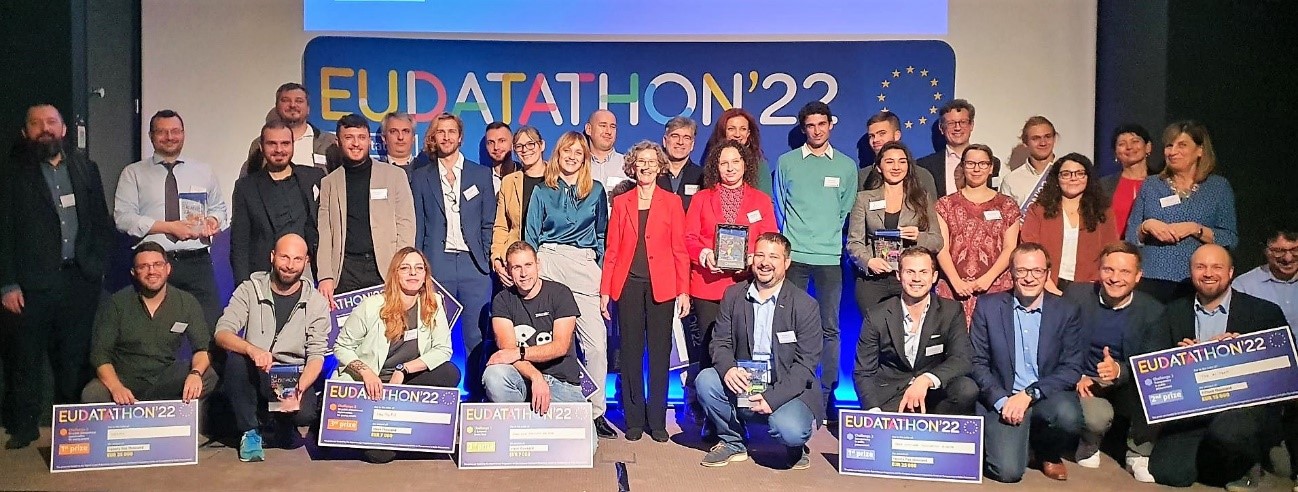
As in previous editions, the EU Datathon is a competition organised by the Publications Office of the European Union in collaboration with the European Data Strategy. Thus, the recently closed 2022 edition has managed to activate the support of some twenty partners representing open data stakeholders inside and outside the European institutions.
Blog
On 24 February Europe entered a scenario that not even the data could have predicted: Russia invaded Ukraine, unleashing the first war on European soil so far in the 21st century.
Almost five months later, on 26 September, the United Nations (UN) published its official figures: 4,889 dead and 6,263 wounded. According to the official UN data, month after month, the reality of the Ukrainian victims was as follows:
| Date | Deceased | Injured |
|---|---|---|
| 24-28 February | 336 | 461 |
| March | 3028 | 2384 |
| April | 660 | 1253 |
| May | 453 | 1012 |
| Jun | 361 | 1029 |
| 1-3 july | 51 | 124 |
According to data extracted by the mission that the UN High Commissioner for Human Rights has been carrying out in Ukraine since Russia invaded Crimea in 2014, the total number of civilians displaced as a result of the conflict is more than 7 million people.
However, as in other areas, the data serve not only to develop solutions, but also to gain an in-depth understanding of aspects of reality that would otherwise not be possible. In the case of the war in Ukraine, the collection, monitoring and analysis of data on the territory allows organisations such as the United Nations to draw their own conclusions.
With the aim of making visible how data can be used to achieve peace, we will now analyse the role of data in relation to the following tasks:
Prediction
In this area, data are used to try to anticipate situations and plan an appropriate response to the anticipated risk. Whereas before the outbreak of war, data was used to assess the risk of future conflict, it is now being used to establish control and anticipate escalation.
For example, satellite images provided by applications such as Google Maps have made it possible to monitor the advance of Russian troops. Similarly, visualisers such as Subnational Surge Tracker identify peaks of violence at different administrative levels: states, provinces or municipalities.
Information
It is just as important to know the facts in order to prevent violence as it is to use them to limit misinformation and communicate the facts objectively, truthfully and in line with official figures. To achieve this, fact-checking applications have begun to be used, capable of responding to fake news with official data.
Among them is Newsguard, a verification entity that has developed a tracker that gathers all the websites that share disinformation about the conflict, placing special emphasis on the most popular false narratives circulating on the web. It even catalogues this type of content according to the language in which it is promoted.
Material damage
The data can also be used to locate material damage and track the occurrence of new damage. Over the past months, the Russian offensive has damaged the Ukrainian public infrastructure network, rendering roads, bridges, water and electricity supplies, and even hospitals unusable.
Data on this reality is very useful for organising a response aimed at reconstructing these areas and sending humanitarian assistance to civilians who have been left without services.
In this sense, we highlight the following use cases:
- The United Nations Development Programme''s (UNDP) machine learning algorithm has been developed and improved to identify and classify war-damaged infrastructure.
- In parallel, the HALO Trust uses social media mining capable of capturing information from social media, satellite imagery and even geographic data to help identify areas with ''explosive remnants''. Thanks to this finding, organisations deployed across the Ukrainian terrain can move more safely to organise a coordinated humanitarian response.
- The light information captured by NASA satellites is also being used to build a database to help identify areas of active conflict in Ukraine. As in the previous examples, this data can be used to track and send aid to where it is most needed.
Human rights violations and abuses
Unfortunately, in such conflicts, violations of the human rights of the civilian population are the order of the day. In fact, according to experience on the ground and information gathered by the UN High Commissioner for Human Rights, such violations have been documented throughout the entire period of war in Ukraine.
In order to understand what is happening to Ukrainian civilians, monitoring and human rights officers collect data, public information and first-person accounts of the war in Ukraine. From this, they develop a mosaic map that facilitates decision-making and the search for just solutions for the population.
Another very interesting work developed with open data is carried out by Conflict Observatory. Thanks to the collaboration of analysts and developers, and the use of geospatial information and artificial intelligence, it has been possible to discover and map war crimes that might otherwise remain invisible.
Migratory movements
Since the outbreak of war last February, more than 7 million Ukrainians have fled the war and thus their own country. As in previous cases, data on migration flows can be used to bolster humanitarian efforts for refugees and IDPs.
Some of the initiatives where open data contributes include the following:
The Displacement Tracking Matrix is a project developed by the International Organization for Migration and aimed at obtaining data on migration flows within Ukraine. Based on the information provided by approximately 2,000 respondents through telephone interviews, a database was created and used to ensure the effective distribution of humanitarian actions according to the needs of each area of the country
Humanitarian response
Similar to the analysis carried out to monitor migratory movements, the data collected on the conflict also serves to design humanitarian response actions and track the aid provided.
In this line, one of the most active actors in recent months has been the United Nations Population Fund (UNFPA), which created a dataset containing updated projections by gender, age and Ukrainian region. In other words, thanks to this updated mapping of the Ukrainian population, it is much easier to think about what needs each area has in terms of medical supplies, food or even mental health support.
Another initiative that is also providing support in this area is the Ukraine Data Explorer, an open source project developed on the Humanitarian Data Exchange (HDX) platform that provides collaboratively collected information on refugees, victims and funding needs for humanitarian efforts.
Finally, the data collected and subsequently analysed by Premise provides visibility on areas with food and fuel shortages. Monitoring this information is really useful for locating the areas of the country with the least resources for people who have migrated internally and, in turn, for signalling to humanitarian organisations which areas are most in need of assistance.
Innovation and the development of tools capable of collecting data and drawing conclusions from it is undoubtedly a major step towards reducing the impact of armed conflict. Thanks to this type of forecasting and data analysis, it is possible to respond quickly and in a coordinated manner to the needs of civil society in the most affected areas, without neglecting the refugees who are displaced thousands of kilometres from their homes.
We are facing a humanitarian crisis that has generated more than 12.6 million cross-border movements. Specifically, our country has attended to more than 145,600 people since the beginning of the invasion and more than 142,190 applications for temporary protection have been granted, 35% of them to minors. These figures make Spain the fifth Member State with the highest number of favourable temporary protection decisions. Likewise, more than 63,500 displaced persons have been registered in the National Health System and with the start of the academic year, there are 30,919 displaced Ukrainian students enrolled in school, of whom 28,060 are minors..
Content prepared by the datos.gob.es team.
Blog
Open data portals are experiencing a significant growth in the number of datasets being published in the transport and mobility category. For example, the EU's open data portal already has almost 48,000 datasets in the transport category or Spain's own portal datos.gob.es, which has around 2,000 datasets if we include those in the public sector category. One of the main reasons for the growth in the publication of transport-related data is the existence of three directives that aim to maximise the re-use of datasets in the area. The PSI directive on the re-use of public sector information in combination with the INSPIRE directive on spatial information infrastructure and the ITS directive on the implementation of intelligent transport systems, together with other legislative developments, make it increasingly difficult to justify keeping transport and mobility data closed.
In this sense, in Spain, Law 37/2007, as amended in November 2021, adds the obligation to publish open data to commercial companies belonging to the institutional public sector that act as airlines. This goes a step further than the more frequent obligations with regard to data on public passenger transport services by rail and road.
In addition, open data is at the heart of smart, connected and environmentally friendly mobility strategies, both in the case of the Spanish "es.movilidad" strategy and in the case of the sustainable mobility strategy proposed by the European Commission. In both cases, open data has been introduced as one of the key innovation vectors in the digital transformation of the sector to contribute to the achievement of the objectives of improving the quality of life of citizens and protecting the environment.
However, much less is said about the importance and necessity of open data during the research phase, which then leads to the innovations we all enjoy. And without this stage in which researchers work to acquire a better understanding of the functioning of the transport and mobility dynamics of which we are all a part, and in which open data plays a fundamental role, it would not be possible to obtain relevant innovations or well-informed public policies. In this sense, we are going to review two very relevant initiatives in which coordinated multi-national efforts are being made in the field of mobility and transport research.
The information and monitoring system for transport research and innovation
At the European level, the EU also strongly supports research and innovation in transport, aware that it needs to adapt to global realities such as climate change and digitalisation. The Strategic Transport Research and Innovation Agenda (STRIA) describes what the EU is doing to accelerate the research and innovation needed to radically change transport by supporting priorities such as electrification, connected and automated transport or smart mobility.
In this sense, the Transport Research and Innovation Monitoring and Information System (TRIMIS) is the tool maintained by the European Commission to provide open access information on research and innovation (R&I) in transport and was launched with the mission to support the formulation of public policies in the field of transport and mobility.
TRIMIS maintains an up-to-date dashboard to visualise data on transport research and innovation and provides an overview and detailed data on the funding and organisations involved in this research. The information can be filtered by the seven STRIA priorities and also includes data on the innovation capacity of the transport sector.
If we look at the geographical distribution of research funds provided by TRIMIS, we see that Spain appears in fifth place, far behind Germany and France. The transport systems in which the greatest effort is being made are road and air transport, beneficiaries of more than half of the total effort.
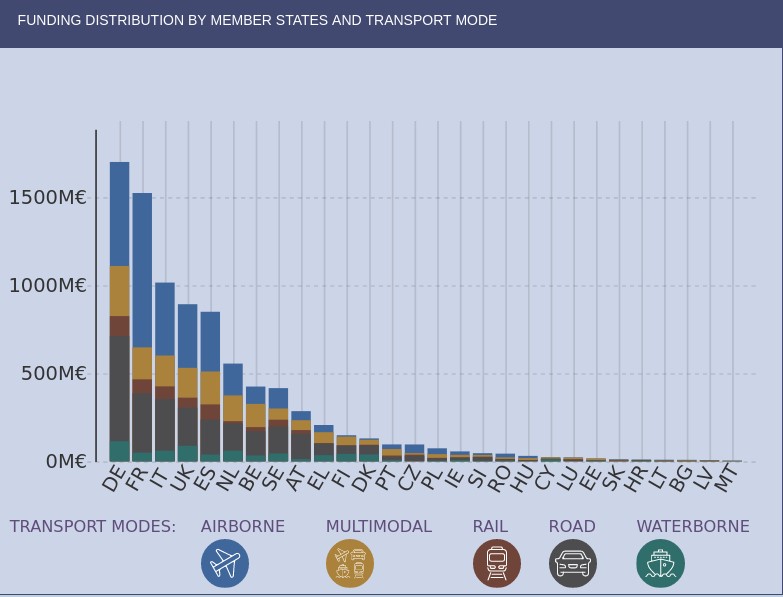
However, we find that in the strategic area of Smart Mobility and Services (SMO), which are evaluated in terms of their contribution to the overall sustainability of the energy and transport system, Spain is leading the research effort at the same level as Germany. It should also be noted that the effort being made in Spain in terms of multimodal transport is higher than in other countries.
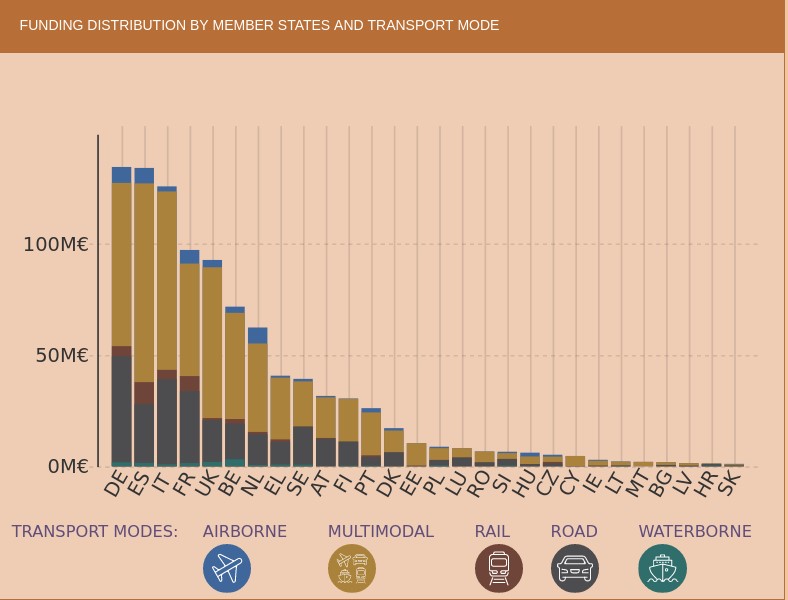
As an example of the research effort being carried out in Spain, we have the pilot dataset to implement semantic capabilities on traffic incident information related to safety on the Spanish state road network, except for the Basque Country and Catalonia, which is published by the General Directorate of Traffic and which uses an ontology to represent traffic incidents developed by the University of Valencia.
The area of intelligent mobility systems and services aims to contribute to the decarbonisation of the European transport sector and its main priorities include the development of systems that connect urban and rural mobility services and promote modal shift, sustainable land use, travel demand sufficiency and active and light travel modes; the development of mobility data management solutions and public digital infrastructure with fair access or the implementation of intermodality, interoperability and sectoral coupling.
The 100 mobility questions initiative
The 100 Questions Initiative, launched by The Govlab in collaboration with Schmidt Futures, aims to identify the world's 100 most important questions in a number of domains critical to the future of humanity, such as gender, migration or air quality.
One of these domains is dedicated precisely to transport and urban mobility and aims to identify questions where data and data science have great potential to provide answers that will help drive major advances in knowledge and innovation on the most important public dilemmas and the most serious problems that need to be solved.
In accordance with the methodology used, the initiative completed the fourth stage on 28 July, in which the general public voted to decide on the final 10 questions to be addressed. The initial 48 questions were proposed by a group of mobility experts and data scientists and are designed to be data-driven and planned to have a transformative impact on urban mobility policies if they can be solved.
In the next stage, the GovLab working group will identify which datasets could provide answers to the selected questions, some as complex as "where do commuters want to go but really can't and what are the reasons why they can't reach their destination easily?" or "how can we incentivise people to make trips by sustainable modes, such as walking, cycling and/or public transport, rather than personal motor vehicles?"
Other questions relate to the difficulties encountered by reusers and have been frequently highlighted in research articles such as "Open Transport Data for maximising reuse in multimodal route": "How can transport/mobility data collected with devices such as smartphones be shared and made available to researchers, urban planners and policy makers?"
In some cases it is foreseeable that the datasets needed to answer the questions may not be available or may belong to private companies, so an attempt will also be made to define what new datasets should be generated to help fill the gaps identified. The ultimate goal is to provide a clear definition of the data requirements to answer the questions and to facilitate the formation of data collaborations that will contribute to progress towards these answers.
Ultimately, changes in the way we use transport and lifestyles, such as the use of smartphones, mobile web applications and social media, together with the trend towards renting rather than owning a particular mode of transport, have opened up new avenues towards sustainable mobility and enormous possibilities in the analysis and research of the data captured by these applications.
Global initiatives to coordinate research efforts are therefore essential as cities need solid knowledge bases to draw on for effective policy decisions on urban development, clean transport, equal access to economic opportunities and quality of life in urban centres. We must not forget that all this knowledge is also key to proper prioritisation so that we can make the best use of the scarce public resources that are usually available to meet the challenges.
Content written by Jose Luis Marín, Senior Consultant in Data, Strategy, Innovation & Digitalization.
The contents and views reflected in this publication are the sole responsibility of the author.
Documentación
This report published by the European Data Portal explores the so-called Citizen Generated Data (CGD). This category of data refers to those generated by citizens. There is a lack of this type of data within European open data portals, mainly due to the lack of publication and management of CGDs by public administrations.
The document analyzes various open data portals, whose main objective is to provide a vision of the CGDs that can be part of these portals and how to include them by public administrations. It should be noted that during the analysis, a framework is established for the description, reference, and characterization of the CGDs.
Finally, based on the conclusions of the previous analysis, the document offers a series of recommendations and guidelines for data publishers. The objective is to increase and improve the presence of CGDs in the publication of open data, involving citizens in the design of policy, processes and governance.
This report is available at the following link: "Data.europa.eu and citizen-generated data"
Noticia
The Data Spaces Business Alliance (DSBA) was born in September 2021, a collaboration of four major organisations with much to contribute to the data economy: the Big Data Value Association (BDVA), FIWARE, Gaia-X and the International Data Spaces Association (IDSA). Its goal: to drive the adoption of data spaces across Europe by leveraging synergies.
How does the DSBA work?
The DSBA brings together diverse actors to realise a data-driven future, where public and private organisations can share data and thus unlock its full value, ensuring sovereignty, interoperability, security and reliability. To achieve this goal, DSBA offers support to organisations, as well as tools, resources and expertise. For example, it is working on the development of a common framework of technology agnostic blocks that are reusable across different domains to ensure the interoperability of different data spaces.
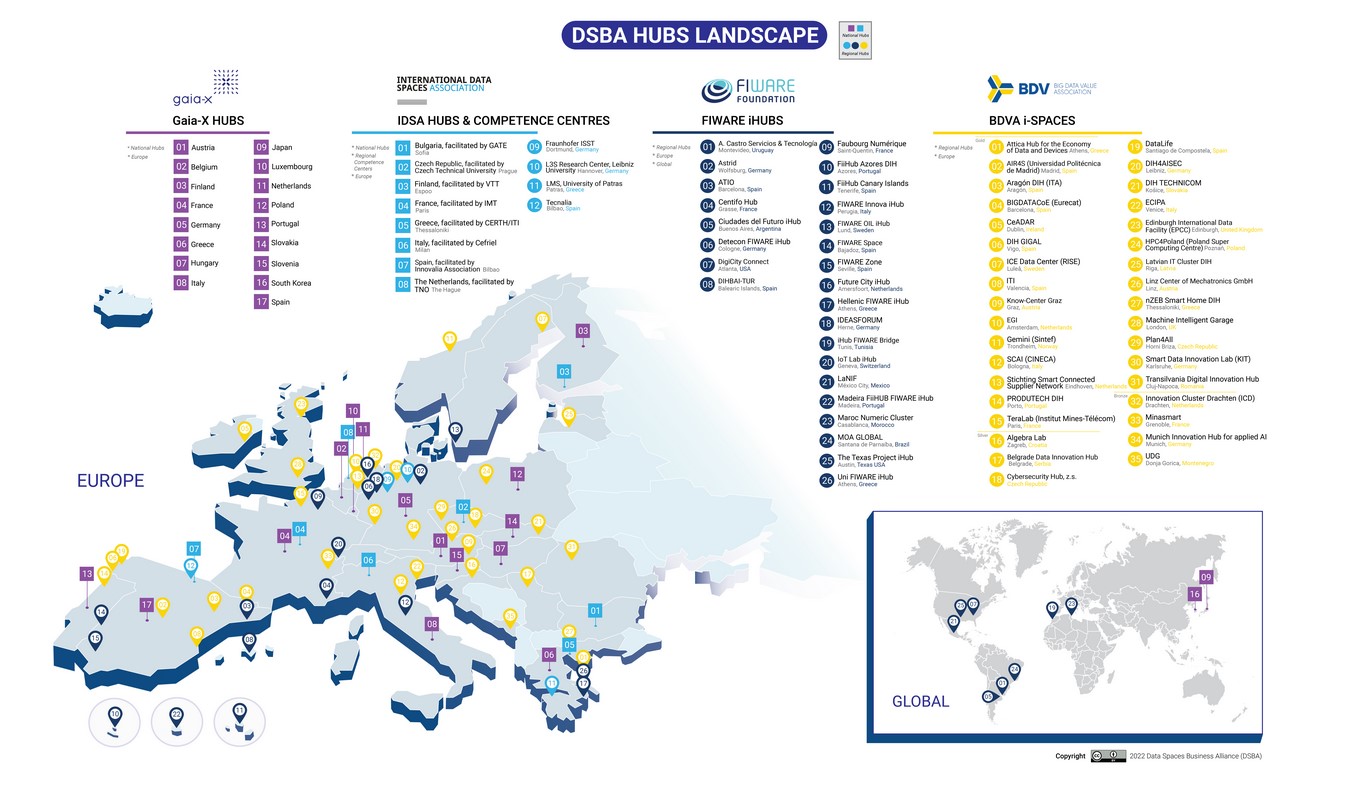
The four founding organisations, BDVA, FIWARE, Gaia-X and IDSA, have a number of international networks of national or regional hubs, with more than 90 initiatives in 34 countries. These initiatives, although very heterogeneous in focus, legal form, level of maturity, etc., have commonalities and great potential to collaborate, complement each other and create impact. Moreover, by operating at local, regional and/or national level, these initiatives provide regular feedback to European associations on the different regional policies, cultures and entrepreneurial ecosystems within the EU.
In addition, DSBA's application has been successful in the European Commission's call for the creation of a Support Centre, which will promote and coordinate actions related to sectoral data spaces. This centre will make available technologies, processes, standards and tools to support the deployment of common data spaces, thus enabling the re-use of data across sectors.
The DSBA hubs
The DSBA hubs refer to the global network combining the existing BDVA, FIWARE, Gaia-X and IDSA initiatives, as shown in the figure below.
The main characteristics of each of these groups are as follows:
BDVA i-Spaces
BDVA i-Spaces are cross-sector and cross-organisational data incubators and innovation hubs, aimed at accelerating data-driven innovation and artificial intelligence in the public and private sectors. They provide secure experimentation environments, bringing together all the technical and non-technical aspects necessary for organisations, especially SMEs, to rapidly test, pilot and exploit their services, products and applications.
i-Spaces offer access to data sources, data management tools and artificial intelligence technologies, among others. They host closed and open data from corporate and public sources, such as language resources, geospatial data, health data, economic statistics, transport data, weather data, etc. The i-spaces have their own Big Data infrastructure with ad hoc processing power, online storage and state-of-the-art accelerators, all within European borders.
To become an i-Space, organisations must go through an assessment process, using a system of 5 categories, which are ranked according to gold, silver and bronze levels. These hubs must renew their labels every two years, and these certifications allow them to join a pan-European federation to foster cross-border data innovation, through the EUHubs4Data project.
FIWARE iHubs
FIWARE is an open software community promoted by the ICT industry, which - with the support of the European Commission - provides tools and an innovation ecosystem for entrepreneurs to create new Smart applications and services. FIWARE iHubs are innovation hubs focused on creating communities and collaborative environments that drive the advancement of digital businesses in this area. These centres provide private companies, public administrations, academic institutions and developers with access to knowledge and a worldwide network of suppliers and integrators of this technology, which has also been endorsed by international standardisation bodies.
There are 5 types of iHubs:
- iHub School: An environment focused on learning FIWARE, from a business and technical perspective, taking advantage of practical use cases.
- iHub Lab: Laboratory where you can run tests and pilots, as well as obtain FIWARE certifications.
- iHub Business Mentor: Space to learn how to build a viable business model.
- iHub Community Creator: Physical meeting point for the local community to bring together all stakeholders, acting as a gateway to the local and global FIWARE ecosystem.
Gaia-X Hubs
The Gaia-X Hubs are the national contact points for the Gaia-X initiative. It should be noted that they are not as such part of Gaia-X AISBL (the European non-profit association), but act as independent think tanks, which cooperate with the association in project deployment, communication tasks, and generation of business requirements for the definition of the architecture of the initiative (as the hubs are close to the industrial projects in each country).
Through them, specific data spaces are developed based on national needs, as well as the identification of funding opportunities to implement Gaia-X services and technology. They also seek to interact with other regions to build transnational data spaces, facilitating the exchange of information and the scaling up of national use cases internationally. To this end, the AISBL provides access to a collaborative platform, as well as support to the respective hubs in the distribution and communication of the use cases.
IDSA Hubs
The IDSA Hubs enable the exchange of knowledge around the reference architecture (known as the IDS-RAM) at country level. By bringing together research organisations, innovation promotion organisations, non-profit organisations, and companies that use IDS concepts and standards in the region, they seek to foster their adoption, and thus promote a sovereign data economy with greater capillarity.
These centres are driven in each country by a university, research organisation, or non-profit entity, working with IDSA to raise awareness of data sovereignty, transfer knowledge, recruit new members, and disseminate IDS-RAM-based use cases. To this end, they develop activities ranging from training sessions to meetings with decision-makers from different public administrations. They also promote and coordinate research and development projects with international organisations and companies, as well as with governments and other public entities.
Conclusion
As we said at the beginning, there is a great potential for synergies between these groups, which should be explored, discussed and articulated in concrete actions and projects. We are facing a promising opportunity to join forces and make further progress in the development and expansion of data spaces, in order to generate a significant impact on the Data Economy.
To stimulate the initial debate, the Data Spaces Business Alliance has prepared the document "Data Spaces Business Alliance Hubs: potential for synergies and impact", which explores the situation described above.
Noticia
The European Directive 2019/1024 on open data and re-use of public sector information emphasises, among many other aspects, the importance of publishing data in real time. In fact, the document talks about dynamic data, which it defines as "documents in digital format, subject to frequent or real-time updates due to their volatility or rapid obsolescence". According to the Directive, public bodies must make this data available for re-use by citizens immediately after collection, through appropriate APIs and, where possible, as a bulk download.
To explore this further, the European Data Portal, Data.europa.eu, has published the report “Real-time data 2022: Approaches to integrating real-time data sources in data.europa.eu” which analyses the potential of real-time data. It draws on the results of a webinar held by data.europa.eu on 5 April 2022, a recording of which is available on its website.
In addition to detailing the conclusions of the event, the report provides a brief summary of the information and technologies presented at the event, which are useful for real-time data sharing.
The importance of real-time data
The report begins by explaining what real-time data are: data that are frequently updated and delivered immediately after collection, as mentioned above. These data can be of a very heterogeneous nature. The following table gives some examples:
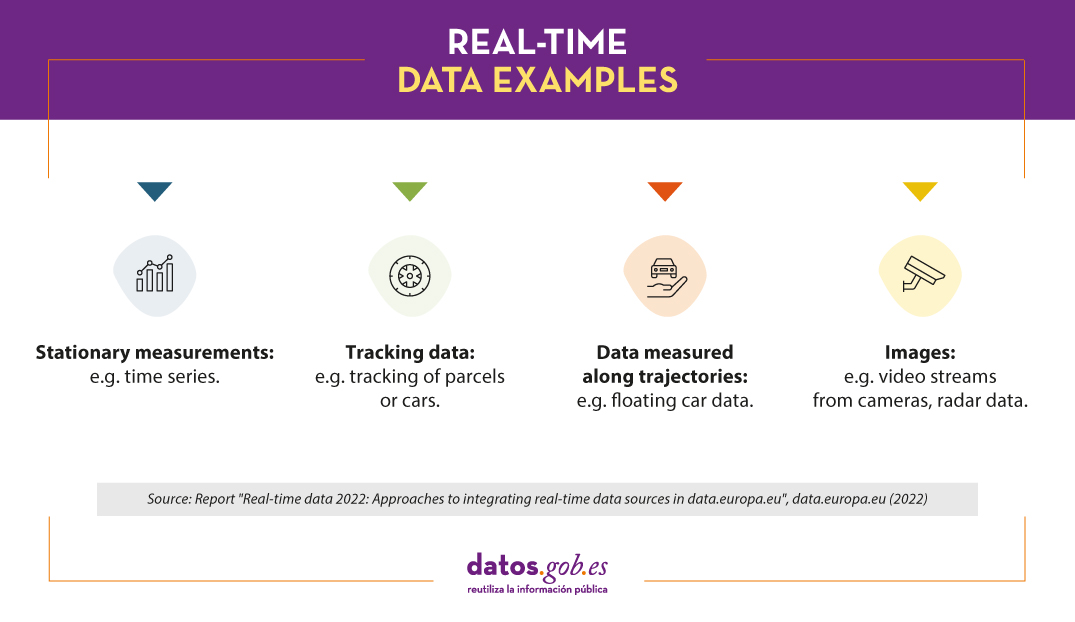
This type of data is widely used to shape applications that report traffic, energy prices, weather forecasts or flows of people in certain spaces. You can find out more about the value of real-time data in this other article.
Real-time data sharing standards
La interoperabilidad es uno de los factores más importantes a tener en cuenta a la hora de seleccionar la tecnología más adecuada para el intercambio de datos en tiempo real. Se precisa un lenguaje común, es decir, formatos de datos comunes e interfaces de acceso a datos que permitan el flujo de datos en tiempo real. Dos estándares que ya son muy utilizados en el ámbito del Internet de las cosas (IoT en sus siglas en inglés) y que pueden ayudar en este sentido son:
SensorThings API (STA)
SensorThings API, from the Open Geospatial Consortium, emerged in 2016 and has been considered a best practice for data sharing in compliance with the INSPIRE Directive.
This standard provides an open and unified framework for encoding and providing access to sensor-generated data streams. It is based on REST and JSON specifications and follows the principles of the OData (OASIS Open Data Protocol) standard.
STA provides common functionalities for creating, reading, updating and deleting sensor resources. It enables the formulation of complex queries tailored to the underlying data model, allowing more direct access to the specific data the user needs. Query options include filtering by time period, observed parameters or resource properties to reduce the volume of data downloaded. It also allows sorting the content of a result by user-specified criteria and provides direct integration with the MQTT standard, which is explained below.
Message Queuing Telemetry Transport (MQTT)
MQTT was invented by Dr. Andy Stanford-Clark of IBM and Arlen Nipper of Arcom (now Eurotech) in 1999. Like STA, it is also an OASIS standard.
The MQTT protocol allows the exchange of messages according to the publish/subscribe principle. The central element of MQTT is the use of brokers, which take incoming messages from publishers and distribute them to all users who have a subscription for that type of data. In this type of environment, data is organised by topics, which are freely defined and allow messages to be grouped into thematic channels to which users subscribe.
The advantages of this system include reduced latency, simplicity and agility, which facilitates its implementation and use in constrained environments (e.g. with limited bandwidth or connectivity).
In the case of the European portal, users can already find real-time datasets based on MQTT. However, there is not yet a common approach to providing metadata on brokers and the topics they offer, and work is still ongoing.
Other conclusions of the report
As mentioned at the beginning, the webinar on 5 April also served to gather participants' views on the use of real-time data, current challenges in data availability and needs for future improvements. These views are also reflected in this report.
Among the most valued categories of real-time data, users highlighted traffic information and weather data. Data on air pollution, allergens, flood monitoring and stock market information were also mentioned. In this respect, more and more detailed data were requested, especially in the field of mobility and energy in order to be able to compare commodity prices. Users also highlighted some drawbacks in locating real-time data on the European portal, including the heterogeneity of the information, which requires the use of common standards and formats across countries.
Finally, the report provides a set of recommendations on how to improve the ability to locate real-time data sources through data.europa.eu. To this end, a series of short and medium-term actions have been established, including the collection of use cases, support for data providers and the development of best practices to unify metadata.
You can read the full report here.
Blog
Nowadays we can find a great deal of legislative information on the web. Countries, regions and municipalities make their regulatory and legal texts public through various spaces and official bulletins. The use of this information can be of great use in driving improvements in the sector: from facilitating the location of legal information to the development of chatbots capable of resolving citizens' legal queries.
However, locating, accessing and reusing these documents is often complex, due to differences in legal systems, languages and the different technical systems used to store and manage the data.
To address this challenge, the European Union has a standard for identifying and describing legislation called the European Legislation Identifier (ELI).
What is the European Legislation Identifier?
The ELI emerged in 2012 through Council Conclusions (2012/C 325/02) in which the European Union invited Member States to adopt a standard for the identification and description of legal documents. This initiative has been further developed and enriched by new conclusions published in 2017 (2017/C 441/05) and 2019 (2019/C 360/01).
The ELI, which is based on a voluntary agreement between EU countries, aims to facilitate access, sharing and interconnection of legal information published in national, European and global systems. This facilitates their availability as open datasets, fostering their re-use.
Specifically, the ELI allows:
- Identify legislative documents, such as regulations or legal resources, uniquely by means of a unique identifier (URI), understandable by both humans and machines.
- Define the characteristics of each document through automatically processable metadata. To this end, it uses vocabularies defined by means of ontologies agreed and recommended for each field.
Thanks to this, a series of advantages are achieved:
- It provides higher quality and reliability.
- It increases efficiency in information flows, reducing time and saving costs.
- It optimises and speeds up access to legislation from different legal systems by providing information in a uniform manner.
- It improves the interoperability of legal systems, facilitating cooperation between countries.
- Facilitates the re-use of legal data as a basis for new value-added services and products that improve the efficiency of the sector.
- It boosts transparency and accountability of Member States.
Implementation of the ELI in Spain
The ELI is a flexible system that must be adapted to the peculiarities of each territory. In the case of the Spanish legal system, there are various legal and technical aspects that condition its implementation.
One of the main conditioning factors is the plurality of issuers, with regulations at national, regional and local level, each of which has its own means of official publication. In addition, each body publishes documents in the formats it considers appropriate (pdf, html, xml, etc.) and with different metadata. To this must be added linguistic plurality, whereby each bulletin is published in the official languages concerned.
It was therefore agreed that the implementation of the ELI would be carried out in a coordinated manner by all administrations, within the framework of the Sectoral Commission for e-Government (CSAE), in two phases:
- Due to the complexity of local regulations, in the first phase, it was decided to address only the technical specification applicable to the State and the Autonomous Communities, by agreement of the CSAE of 13 March 2018.
- In February 2022, a new version was drafted to include local regulations in its application.
With this new specification, the common guidelines for the implementation of the ELI in the Spanish context are established, but respecting the particularities of each body. In other words, it only includes the minimum elements necessary to guarantee the interoperability of the legal information published at all levels of administration, but each body is still allowed to maintain its own official journals, databases, internal processes, etc.
With regard to the temporal scope, bodies have to apply these specifications in the following way:
- State regulations: apply to those published from 29/12/1978, as well as those published before if they have a consolidated version.
- Autonomous Community legislation: applies to legislation published on or after 29/12/1978.
- Local regulations: each entity may apply its own criteria.
How to implement the ELI?
The website https://www.elidata.es/ offers technical resources for the application of the identifier. It explains the contextual model and provides different templates to facilitate its implementation:
It also offers the list of common minimum metadata, among other resources.
In addition, to facilitate national coordination and the sharing of experiences, information on the implementation carried out by the different administrations can also be found on the website.
The ELI is already applied, for example, in the Official State Gazette (BOE). From its website it is possible to access all the regulations in the BOE identified with ELI, distinguishing between state and autonomous community regulations. If we take as a reference a regulation such as Royal Decree-Law 24/2021, which transposed several European directives (including the one on open data and reuse of public sector information), we can see that it includes an ELI permalink.
In short, we are faced with a very useful common mechanism to facilitate the interoperability of legal information, which can promote its reuse not only at a national level, but also at a European level, favouring the creation of the European Union's area of freedom, security and justice.
Content prepared by the datos.gob.es team.
Noticia
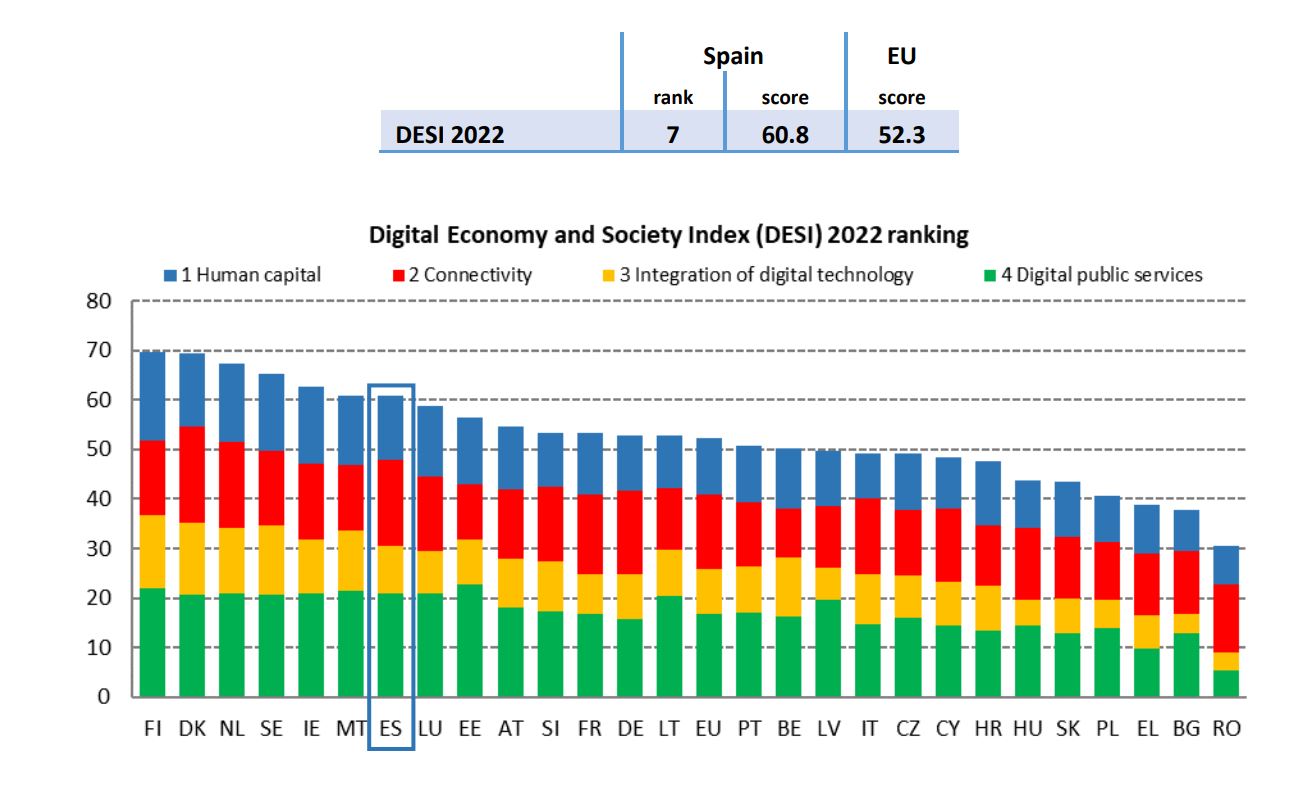
Since 2014, the European Commission has been monitoring Member States' digital progress through the annual DESI Digital Economy and Society Index. To do so, it analyses four digital performance indicators: human capital, connectivity, digital technology integration and digital public services.
In this year's edition, Spain is in seventh position, improving two places compared to 2021. It has gone from a score of 57.4% to 60.8%, which represents a growth of almost 6% (the EU average has grown by 3% in the same period). This puts Spain ahead of countries such as Germany, France and Italy. At the head of the EU-27 we find Finland, Denmark and the Netherlands.
It should be noted that the DESI 2022 index is based mainly on data from 2021. Overall, during the COVID-19 pandemic, Member States have made progress in their digitisation efforts, thanks in part to the opportunity provided by the resources allocated by Europe through the NextGenerationEU recovery plan. However, there are still general challenges, related to digital skills gaps, the digital transformation of SMEs and the deployment of advanced 5G networks.
Digital progress in Spain
Spain is above the EU average in all four categories analysed:
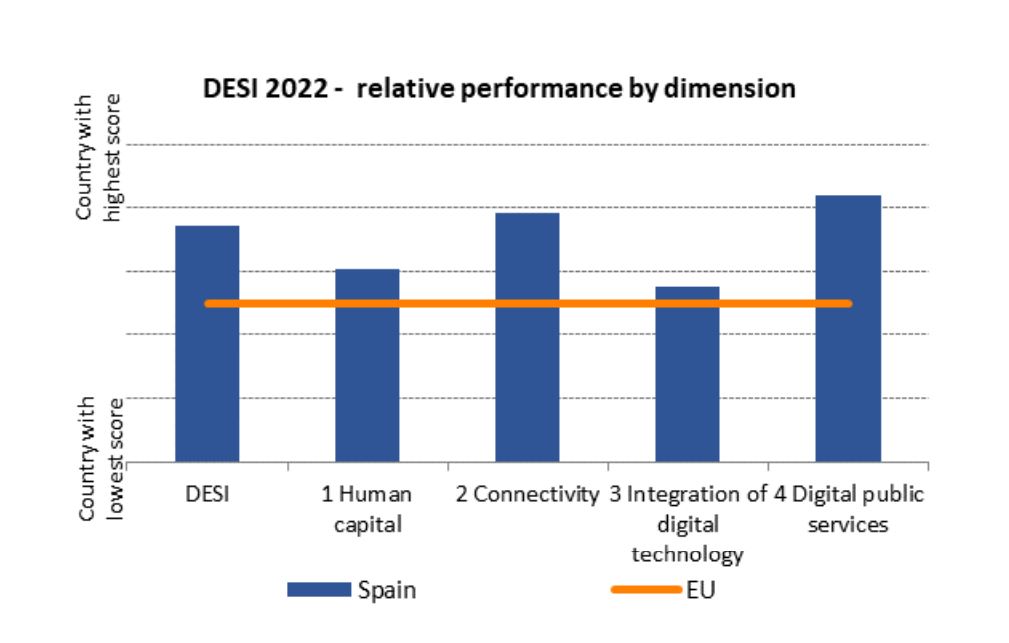
- Human capital. Spain improves two positions with respect to 2021 and ranks tenth. It stands out mainly in basic digital skills, while it is only below the EU average in the proportion of information and communication technology (ICT) specialists and graduates. The report highlights that several of the measures outlined in the National Recovery and Resilience Plan aim to boost the acquisition of digital skills, especially for SME employees.
-
Connectivity. Spain is one of the EU leaders in terms of connectivity, where it ranks third for the second year in a row. Our country performs particularly well in very high capacity fixed network coverage (94% compared to 70% of the European average), although it still has room for improvement in 5G coverage. In this regard, strategic reforms and investments are being carried out under the National Recovery and Resilience Plan in order to achieve the Digital Decade connectivity targets and reduce the digital divide between urban and rural areas.
-
Digital technology integration. This is the area where most progress has been made, with an improvement of five positions. Spain is currently in eleventh place. It stands out especially in the percentage of SMEs with a basic level of digital intensity and which use social networks, online sales media and electronic information exchange systems. In the use of artificial intelligence, we are at the European average. On the other hand, technologies such as cloud and Big Data analysis are still not widespread. To improve these capabilities, professionals with digital skills are needed, something that will help to boost the SME Digitalisation Plan 2021-2025.
-
Digital public services. Spain, which has traditionally been a pioneer in this field, is in fifth place, two places above 2021. One of the areas where it performs best is in open data, where it is in third place, well above the European average (95% vs. 81%). In addition, the report highlights how our country is proactively developing new services to respond to the needs of citizens in areas such as health, digital identification, cybersecurity, mobile applications and the integration of AI in the sector. Some examples of projects in which Spain is participating are Genome of Europe and European Self Sovereign identity (ESSIF).
If you would like to go deeper into the analysis of the results of Spain and the other European countries in the DESI index, you can download the reports by country on this website. In addition, the Spanish e-Government portal provides users with various useful materials, divided by year.
Women in Digital (WiD) Scoreboard
Together with the DESI index, the EU has also published the 2022 edition of the "Women in Digital (WiD) Scoreboard", a report that assesses the digital development of women and their inclusion in areas such as employment and digital entrepreneurship.
In this ranking, Spain is in eighth position, also exceeding the European Union average (64.2% compared to 54.9%). Spanish women stand out especially in terms of Internet use skills, where they are in fourth position compared to European women.
All these data show how Spain continues to make progress in digital matters. Although there are still areas for improvement, investment from Spain's Recovery and Resilience Plan is expected to continue to drive progress, mainly in areas such as the digitisation of businesses, strengthening the digital skills of the population, improving digital connectivity and the digitisation of public administrations. All of this without neglecting support for digital-related research and development (R&D).