


Noticia
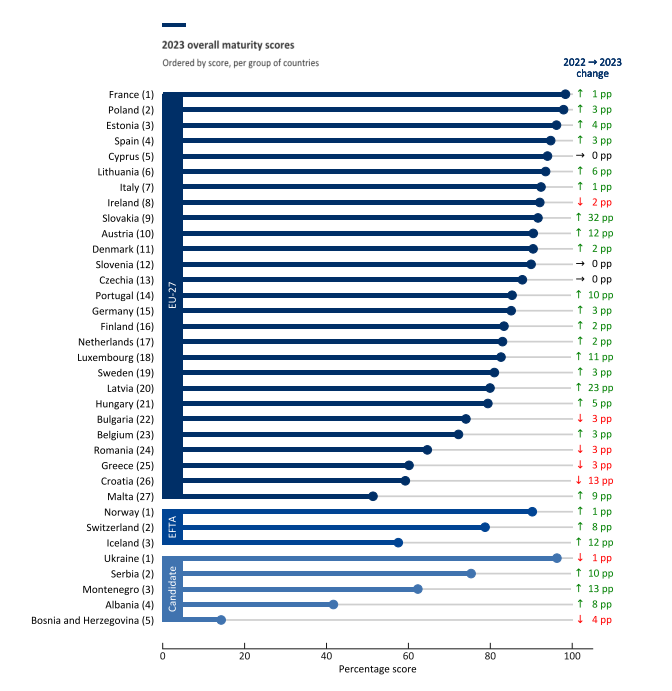
The European Data Portal, data.europa.eu, has just published its Data Maturity Index, an index that assesses the level of maturity of European countries in terms of open data. For its elaboration, an evaluation survey has been carried out and has been completed by 35 countries, including the 27 Member States of the European Union, three countries of the European Free Trade Association (Iceland, Norway and Switzerland) and five candidate countries (Bosnia and Herzegovina, Montenegro, Albania, Serbia and Serbia and Ukraine).
In this year's edition, Spain obtained a score of 95% out of 100%. This places it in fifth place overall and in fourth place if only European Union (EU27) member countries are taken into account. This figure represents an improvement of three percentage points over last year's score and places Spain 12 points above the EU27 average (83%).
The top positions in the ranking are occupied by France, Poland, Ukraine and Estonia.
Above the EU27 average in all dimensions analyzed
The index is accompanied by a report containing the analysis carried out and an overview of the good practices applied in Europe. In the case of Spain, it is above the EU-27 average in the four indicators analyzed:
-
Policy, focused on the open data policies of the different countries. It analyzes the existence of national governance models for open data management and the measures that have been applied to implement existing strategies. This is the indicator in which Spain obtains a higher score, with 99% compared to 89% in the EU27. The report highlights how the country's national open data strategy helps promote the openness of public information through innovative and structured actions in collaboration with public and private partners. Among other issues, the strategy includes the objective of identifying business models and business success stories to share successful practices. The report also highlights the existence of various digital strategies that complement specific policies on open data, such as the national artificial intelligence strategy, which includes provisions related to the availability of open data for the operation and training of artificial intelligence systems.
-
Impact, which analyzes the activities undertaken to monitor and measure both the reuse of open data and the impact created by such reuse. Traditionally, this has been the least mature dimension across Europe. Nevertheless, Spain scores 96% compared to 77% in the EU27. The best results are achieved in measuring the impact of open data use cases in the environmental, economic and political sectors.
-
Portal, focused on evaluating the functionalities of the national platform that allow users to access open data and help drive interaction within the community. With 96% compared to 85% in the EU27, Spain stands out in the use of analytical tools to understand user behavior, and in the implementation of strategies to ensure the sustainability of the portal and increase its visibility, including presence in social networks. It also highlights the existence of a private area that allows editors to act according to the feedback received.
-
Quality, which examines the mechanisms for ensuring the quality of (meta)data. Here Spain scores 88% compared to 82% in the EU27. Spain's score is driven by compliance with the DCAT-AP standard (providing educational materials for publishers), the existence of a systematic approach to ensure that metadata is up to date, and the wide range of data offered, both historical and current.

The report also measures how EU27 countries are progressing in the implementation of the implementing regulation on high-value datasets. In this section, Spain ranks ninth, with 68% implementation. In general, Member States are making more progress on geospatial and statistical datasets. Progress is also being made on the underlying technical and legal requirements.
Overall recommendations
The report includes a number of recommendations for Spain, among other countries, including encouraging the development of initiatives at the local and regional level, fostering better coordination between teams, and activating the network of open data officers to implement monitoring activities within their organizations. Emphasis is also placed on the need to promote existing open data courses and promote new training materials, paying special attention to developing strategic awareness of the reuse and impact of open data.
Overall, the report shows good progress in open data across Europe. Although there are areas for improvement, the European open data landscape is consolidating, with Spain at the top of the table.
In 2024, new waves of implementation of the European data strategy will present national teams with new challenges. On the one hand, they will have to redouble their efforts to inform citizens of the new data sources arising from initiatives such as the Data Governance Act and the data spaces. In this sense, coordination will be necessary between the new figures arising from these legislative developments and the traditional world of open data, enhancing the obvious synergies between the two to boost the data economy and collectivize the value generated.

Noticia
The European Commission has published the first Report of the state of the Digital Decade. It takes stock of the progress of the European Union on its way to the success of the digital transformation, as set out in the Digital Decade Policy Agenda 2030. The document builds on the agreements and recommendations adopted at European level on digitization towards 2030, including the Council Recommendation (EU) 2021/2122 of 26 November 2021 on a Pact for Research and Innovation in Europe.
Various studies and statistical sources, such as the Eurobarometer on the Digital Decade, the Strategic Foresight Report for 2021 and 2022, as well as different statistical sets from Eurostat on the state of technology, have been taken into account in compiling the report. It also includes the monitoring of the European Declaration on Digital Rights and Principles for the Digital Decade, which translates the EU's vision on digital transformation into principles and commitments.
According to the report, the success of the Digital Decade will be crucial for the future prosperity of the EU. Achieving the agenda could unlock more than €2.8 trillion in economic value, equivalent to 21% of the EU's current economy. To achieve this end, the text highlights the need to incentivize policies and investments in digital technologies, skills and infrastructure.
On this basis, the report includes concrete recommendations to Member States prior to the adoption of their national strategic roadmaps and for their future adjustments.
Spain, a major player
The Commission has prepared a report for each member country in which it exhaustively analyzes its strengths and future duties. About Spain it points out that the country is "in an ambitious digital transformation of the economy" and high rates in connectivity: Spain is, according to the report, one of the EU states with the best results in digital infrastructure.
The three key aspects analyzed in the report are:
-
Connectivity and Public Administration
In this regard, the report points out that Spain is "well above the EU average" in terms of very high capacity fixed networks, with 93% availability compared to 73% of the EU average. In fiber coverage "far exceeds" the EU average, with 91% connectivity compared to 56% of the EU average.
In terms of other technologies such as 5G, Spain is at the European average, with 82% improved broadband access. In addition, the document reveals that 98% of all pioneering 5G bands have already been allocated in the country and that "appropriate measures are being implemented to achieve the objectives of the Digital Decade" such as the Telecommunications Law of 2022.
The report also points out that Spain "is at the forefront of e-Government and digital public services in the EU". It also highlights the effort to update services and infrastructures to adapt them to the "rapid technological evolution" and the needs of companies. In fact, Spain is "well above the EU average" in indicators that measure the number of Internet users who use electronic administration services, with 84% compared to 74% in the EU or in digital public services for citizens, with 86% access, and companies, with 91%. In this sense, it highlights the work that has been done in the interoperability of digital public services at national, regional and local level.
The report includes some recommendations on healthcare digitization and notes that the country should continue to implement its public service digitization policies to "connect more types of healthcare providers to medical records" and implement measures "to ensure regionally comparable quality of service and completeness of healthcare data."
-
Economic development and companies
In terms of economic and technological development, the report praises the country's progress with PERTE Chip, whose objective is the development of semiconductors and cutting-edge technologies to strengthen their design and production in Spanish industry in order to "promote national and EU strategic sovereignty". In this field, it also highlights Spain's participation in the Important Project of Common European Interest (IPCEI) on Microelectronics and Communication Technologies with 11 direct participants active in various fields (material, open source design, equipment, packaging, connectivity, photonics) and that "could help to achieve the first European computer with quantum acceleration by 2025".
As for SMEs, the level of digital development is at the EU level (68%) and highlights the efforts "to improve the digitization of companies" that can be seen in figures: 12.3% of Spanish companies already use Artificial Intelligence and 14.3% use Big Data for analysis and internal use. In addition, it joins the Kit Digital initiative for the digital acceleration of SMEs and the Agents of Change program to hire experts in digital transformation in the field of small and medium-sized enterprises, a type of company with a high number of companies in the country and a "significant participation in the Spanish economy", which makes them a target for reforms and investments that "will have an indirect multiplier impact". The report encourages the country to continue "implementing these policies" in the area of business digitalization, particularly in the case of SMEs.
-
Citizen digitization
In addition, at the citizen level, the report analyzes the digitalization of the Spanish population. In this sense, the document points out that Spain obtains good results in terms of digital skills with 64% and 38% of the population benefiting from these skills respectively. In both cases, the Spanish average is above the EU.
Within the efforts being made when it comes to boosting ICT profiles both in the educational area and in the labor market, the report highlights measures to increase the number of ICT specialists, in particular a law to modernize the vocational education and training (VET) system, approved in March 2022, and a new VET specialization course on AI and big data that allows training in the new digital environment.
The report, which analyzes the state of play in 2022, notes the importance of that year, which stands out as having been the period "of a further acceleration of key trends affecting the digital transformation of the EU digital EU" with increasingly rapid technological advances, such as AI, climate change and associated social and economic concerns, a growing demand for high-speed connectivity or the multipolarization of the global scene in the face of an ever-increasing technological race.
The report concludes that the potential impact of technological change is significant and will require the EU to be agile and swift in its transformation.
Documentación
The digitalization in the public sector in Spain has also reached the judicial field. The first regulation to establish a legal framework in this regard was the reform that took place through Law 18/2011, of July 5th (LUTICAJ). Since then, there have been advances in the technological modernization of the Administration of Justice. Last year, the Council of Ministers approved a new legislative package to definitively address the digital transformation of the public justice service, the Digital Efficiency Bill.
This project incorporates various measures specifically aimed at promoting data-driven management, in line with the overall approach formulated through the so-called Data Manifesto promoted by the Data Office.
Once the decision to embrace data-driven management has been made, it must be approached taking into account the requirements and implications of Open Government, so that not only the possibilities for improvement in the internal management of judicial activity are strengthened, but also the possibilities for reuse of the information generated as a result of the development of said public service (RISP).
Open data: a premise for the digital transformation of justice
To address the challenge of the digital transformation of justice, data openness is a fundamental requirement. In this regard, open data requires conditions that allow their automated integration in the judicial field. First, an improvement in the accessibility conditions of the data sets must be carried out, which should be in interoperable and reusable formats. In fact, there is a need to promote an institutional model based on interoperability and the establishment of homogeneous conditions that, through standardization adapted to the singularities of the judicial field, facilitate their automated integration.
In order to deepen the synergy between open data and justice, the report prepared by expert Julián Valero identifies the keys to digital transformation in the judicial field, as well as a series of valuable open data sources in the sector.
If you want to learn more about the content of this report, you can watch the interview with its author.
Below, you can download the full report, the executive summary, and a summary presentation.
Noticia
The Asociación Multisectorial de la Información (ASEDIE) has published the eleventh edition of its Report on the Infomediary Sector, in which it reviews the health of companies that generate applications, products and/or services based on information from the public sector, taking into account that it is the holder of the most valuable data.
Many of the datasets that enable the infomediary sector to develop solutions are included in the lists of High Value Datasets (HVDS) recently published by the European Union. An initiative that recognises the potential of public information and adds to the aim of boosting the data economy in line with the European Parliament's proposed Data Law.
ASEDIE brings together companies from different sectors that promote the data economy, which are mainly nourished by the data provided by the public sector. Among its objectives is to promote the sector and contribute to raising society's awareness of its benefits and impact. It is estimated that the data economy will generate €270 billion of additional GDP for EU Member States by 2028.
The presentation of this edition of the report, entitled 'The Data Economy in the infomediary field', took place on 22 March in Red.es's Enredadera room. In this year's edition of the report, 710 active companies have been identified, with a turnover of more than 2,278 million euros. It should be noted that the first report in 2013 counted 444 companies. Therefore, the sector has grown by 60% in a decade.
Main conclusions of the report
- The infomediary sector has grown by 12.1%, a figure above the national GDP growth of 7.6%. These data are drawn from the analysis of the 472 companies (66% of the sample) that submitted their accounts for the previous years.
- The number of employees is 22,663. Workers are highly concentrated in a few companies: 62% of them have less than 10 workers. The subsector with the highest number of professionals is Geographic information, with 30% of the total. Together with the sub-sectors Financial economics, Technical consultancy and Market research, they account for 75% of the employees.
- Employment in the companies of the Infomediary Sector grew by 1.7%, compared to a fall of 1.1% in the previous year. All sub-sectors have grown, except for Tourism and Culture, which have remained the same, and Technical Consultancy and Market Research, which have decreased.
- The average turnover per employee exceeded 100,000 euros, an increase of 6.6% compared to the previous year. On the other hand, the average expenditure per employee was 45,000 euros.
- The aggregate turnover was 2,279,613,288 euros. The Geographical Information and Economic and Financial subsectors account for 46% of sales.
- The aggregate subscribed capital is 250,115,989 euros. The three most capitalised subsectors are Market Research, Economic and Financial and Geographic Information, which account for 66% of capitalisation.
- The net result exceeds 180 million euros, 70 million more than last year. The Economic and Financial subsector accounted for 66% of total profits.
- The sub-sectors of Geographical Information, Market Research, Financial Economics and Computer Infomediaries account for 76% of the infomediary companies, with a total of 540 companies out of the 710 active companies.
- The Community of Madrid is home to the largest number of companies in the sector, with 39%, followed by Catalonia (13%), Andalusia (11%) and the Community of Valencia (9%).
As the report shows, the arrival of new companies is driving the development of a sector that already has a turnover of around 2,300 million euros per year, and which is growing at a higher rate than other macroeconomic indicators in the country. These data show not only that the Infomediary Sector is in good health, but also its resilience and growth potential.
Progress of the Study on the impact of open data in Spain
The report also includes the results of a survey of the different actors that make up the data ecosystem, in collaboration with the Faculty of Information Sciences of the Complutense University of Madrid. This survey is presented as the first exercise of a more ambitious study that aims to know the impact of open data in Spain and to identify the main barriers to its access and availability. To this end, a questionnaire has been sent to members of the public, private and academic sectors. Among the main conclusions of this first survey, we can highlight the following:
- As main barriers to publishing information, 65% of respondents from the public sector mentioned lack of human resources, 39% lack of political leadership and 38% poor data quality.
- The biggest obstacle in accessing public data for re-use is for public sector respondents that the information provided in the data is not homogeneous (41.9%). Respondents from the academic sector point to the lack of quality of the data (43%) and from the private sector it is believed that the main barrier is the lack of updating (49%).
- In terms of the frequency of use of public data, 63% of respondents say that they use the data every day or at least once a week.
- 61% of respondents use the data published on the datos.gob.es portal.
- Respondents overwhelmingly believe that the impact of data openness on the private sector is positive. Thus, 77% of private sector respondents indicate that accessing public data is economically viable and 89% of them say that public data enables them to develop useful solutions.
- 95% of respondents call for a compendium of regulations affecting the access, publication and re-use of public sector data.
- 27% of public sector respondents say they are not aware of the six categories of high-value data set out in Commission Implementing Regulation (EU) 20137138 .
This shows that most respondents are aware of the potential of the sector and the impact of public sector data, although they indicate that some obstacles to re-use need to be overcome and believe that a compendium of the different existing regulations would facilitate their implementation and help the development of the sector.
Top 3 ASEDIE
As in previous editions, the report includes the status of the Top 3 ASEDIE, an initiative that aims for all Autonomous Communities to fully open three sets of data, following unified criteria that facilitate their reuse, and which is included in the IV Open Government Plan. In 2019, the opening of the Cooperatives, Associations and Foundations databases was proposed, and there are currently 16 Autonomous Communities in which they can be accessed in full. Moreover, in eight of them, it is possible to access the NIF with a unique identifier, which improves transparency and makes the information more accurate.
Taking into account the good results of the first proposal, in 2020 a new request for opening data was launched, the Second Top 3 ASEDIE, in this case of Energy Efficiency Certificates, SAT Registries (Agricultural Transformation Companies) and Industrial Estates, whose evolution has also been very positive. The following map shows the opening situation of these three new databases in 2023.
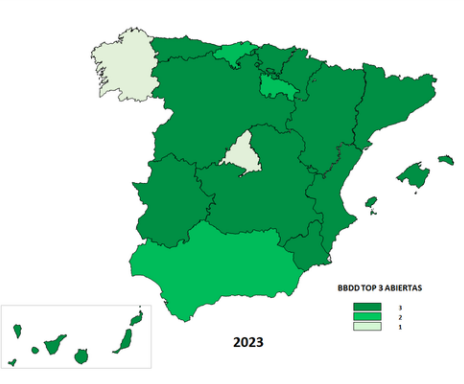
The Top 3 ASEDIE initiative has been a success and has become a reference in the sector, promoting the opening of databases in a joint manner and demonstrating that it is possible to harmonise public data sources to put them at the service of society.
The next steps in this sense will be to monitor the databases already open and to disseminate them at all levels, including the identification of good practices of the Administration and the selection of examples to encourage public-private collaboration in open data. In addition, a new top 3 will be identified to advance in the opening of new databases, and a new initiative will be launched to reach the bodies of the General State Administration, with the identification of a new Top 3 AGE.
Success stories
The report also includes a series of success stories of products and services developed with public sector data, such as Iberinform's API Market, which facilitates access to and integration of 52 sets of company and self-employed data in company management systems. Another successful case is Geocode, a solution focused on standardisation, validation, correction, codification and geolocation processes for postal addresses in Spain and Portugal.
Geomarketing makes it possible to increase the speed of calculating geospatial data and Infoempresa.com has improved its activity reports on Spanish companies, making them more visual, complete and intuitive. Finally, Pyramid Data makes it possible to access the Energy Efficiency Certificates (EEC) of a given property portfolio.
As examples of good practices in the public sector, the ASEDIE report highlights the open statistical data as a driver of the Data Economy of the Canary Islands Statistics Institute (ISTAC) and the technology for the opening of data of the Open Data Portal of the Andalusian Regional Government (Junta de Andalucía).
As a novelty, the category of examples of good practices in the academic sector has been incorporated, which recognises the work carried out by the Geospatial Code and the Report on the state of open data in Spain III, by the Rey Juan Carlos University and FIWARE Foundation.
The 11th ASEDIE Report on the Data Economy in the infomediary field can be downloaded from the ASEDIE website in Spanish. The presentations of the economic indicators and the Top 3 and the Data Ecosystem are also available.
In summary, the report shows the good health of the industry that confirms its recovery after the pandemic, its resilience and growth potential and, in addition, the good results of public-private collaboration and its impact on the data economy are observed.
Noticia
Measuring the impact of open data is one of the challenges facing open data initiatives. Ther are a variety of methods, most of which combine quantitative and qualitative analysis in order to understand the value of specific datasets.
In this context, data.europa.eu, the European Open Data Portal, has launched a Use Case Observatory. This is a research project on the economic, governmental, social and environmental impact of open data.
What is the Use Case Observatory?
For three years, from 2022 to 2025, the European Data Portal will monitor 30 cases of re-use of open data. The aim is to:
- Assess how the impact of open data is created.
- Share the challenges and achievements of the analysed re-use cases
- Contribute to the debate on the methodology to be used to measure such impact.
The analysed use cases refer to four areas of impact:
- Economic impact: includes reuse cases related to business creation and (re)training of workers, among others. For example, solutions that help identify public tenders or apply for jobs are included.
- Governmental impact: This refers to reuse cases that drive e-government, transparency and accountability.
- Social impact: includes cases of re-use in the fields of healthcare, welfare and tackling inequality.
- Environmental impact: This is limited to cases of re-use that promote sustainability and energy reduction, including solutions related to air quality control or forest preservation.
To select the use cases, an inventory was made based on three sources: the examples collected in the maturity studies carried out each year by the European portal, the solutions participating in the EU Datathon and the examples of reuse available in the repository of use cases on data.europa.eu. Only projects developed in Europe were taken into account, trying to maintain a balance between the different countries. In addition, projects that had won an award or were aligned with the European Commission's priorities for 2019 to 2024 were highlighted. To finalise the selection process, data.europa.eu conducted interviews with representatives of the use cases that met the requirements and were interested in participating in the project.
Three Spanish projects among the use cases analysed
The selected use cases are shown in the following image:
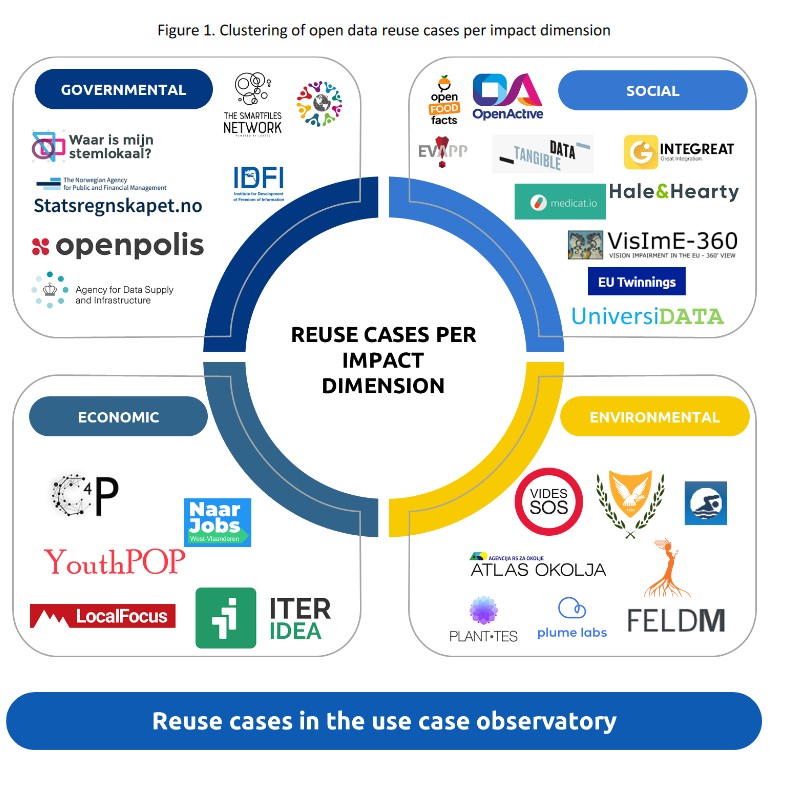
Among them, there are three Spaniards:
- In the Social Impact category is UniversiDATA-Lab, a public portal for the advanced and automatic analysis of datasets published by universities. This project, which won the first prize in the III Desafío Aporta, was conceived by the team that created UniversiData, a collaborative initiative oriented and driven by public universities with the aim of promoting open data in the higher education sector in Spain in a harmonised way. You can learn more about these projects in this interview.
- In the same category we also find Tangible data, a project focused on the creation of sculptures based on data, to bring them closer to non-technical people. Among other data sources, it uses datasets from NASA or Our World in Data.
- In the environment category is Planttes. This is a citizen science project designed to report on the presence of allergenic plants in our environment and the level of allergy risk depending on their condition. This project is promoted by the Aerobiological Information Point (PIA) of the Institute of Environmental Science and Technology (ICTA-UAB) and the Department of Animal Biology, Plant Biology and Ecology (BABVE), in collaboration with the Computer Vision Centre (CVC) and the Library Living Lab, all of them at the Autonomous University of Barcelona (UAB).
First report now available
As a result of the analysis carried out, three reports will be developed. The first report, which has just been published, presents the methodology and the 30 selected cases of re-use. It includes information on the services they offer, the (open) data they use and their impact at the time of writing. The report ends with a summary of the general conclusions and lessons learned from this first part of the research project, giving an overview of the next steps of the observatory.
The second and third reports, to be released in 2024 and 2025, will assess the progress of the same use cases and expand on the findings of this first volume. The reports will focus on identifying achievements and challenges over a three-year period, allowing concrete ideas to be extrapolated to improve methodologies for assessing the impact of open data.
The project was presented in a webinar on 7 October, a recording of which is available, together with the presentation used. Representatives from 4 of the use cases were invited to participate in the webinar: Openpolis, Integreat, ANP, and OpenFoodFacts.
Documentación
When publishing open data, it is essential to ensure its quality. If data is well documented and of the required quality, it will be easier to reuse, as there will be less additional work for cleaning and processing. In addition, poor data quality can be costly for publishers, who may spend more money on fixing errors than on avoiding potential problems in advance.
To help in this task, the Aporta Initiative has developed the "Practical guide for improving the quality of open data", which provides a compendium of guidelines for acting on each of the characteristics that define quality, driving its improvement. The document takes as a reference the data.europe.eu data quality guide, published in 2021 by the Publications Office of the European Union.
Who is the guide aimed at?
The guide is aimed at open data publishers, providing them with clear guidelines on how to improve the quality of their data.
However, this collection can also provide guidance to data re-users on how to address the quality weaknesses that may be present in the datasets they work with.
What does the guide include?
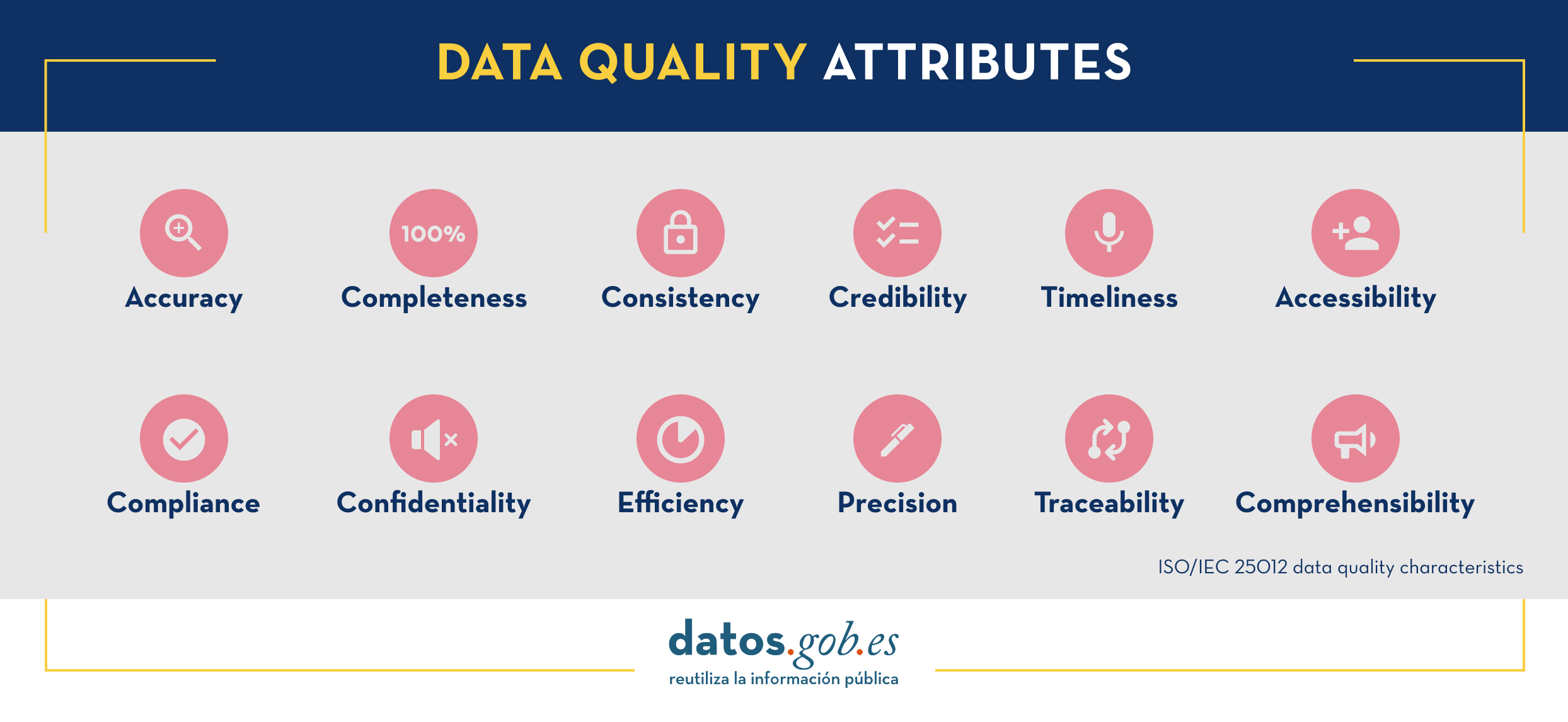
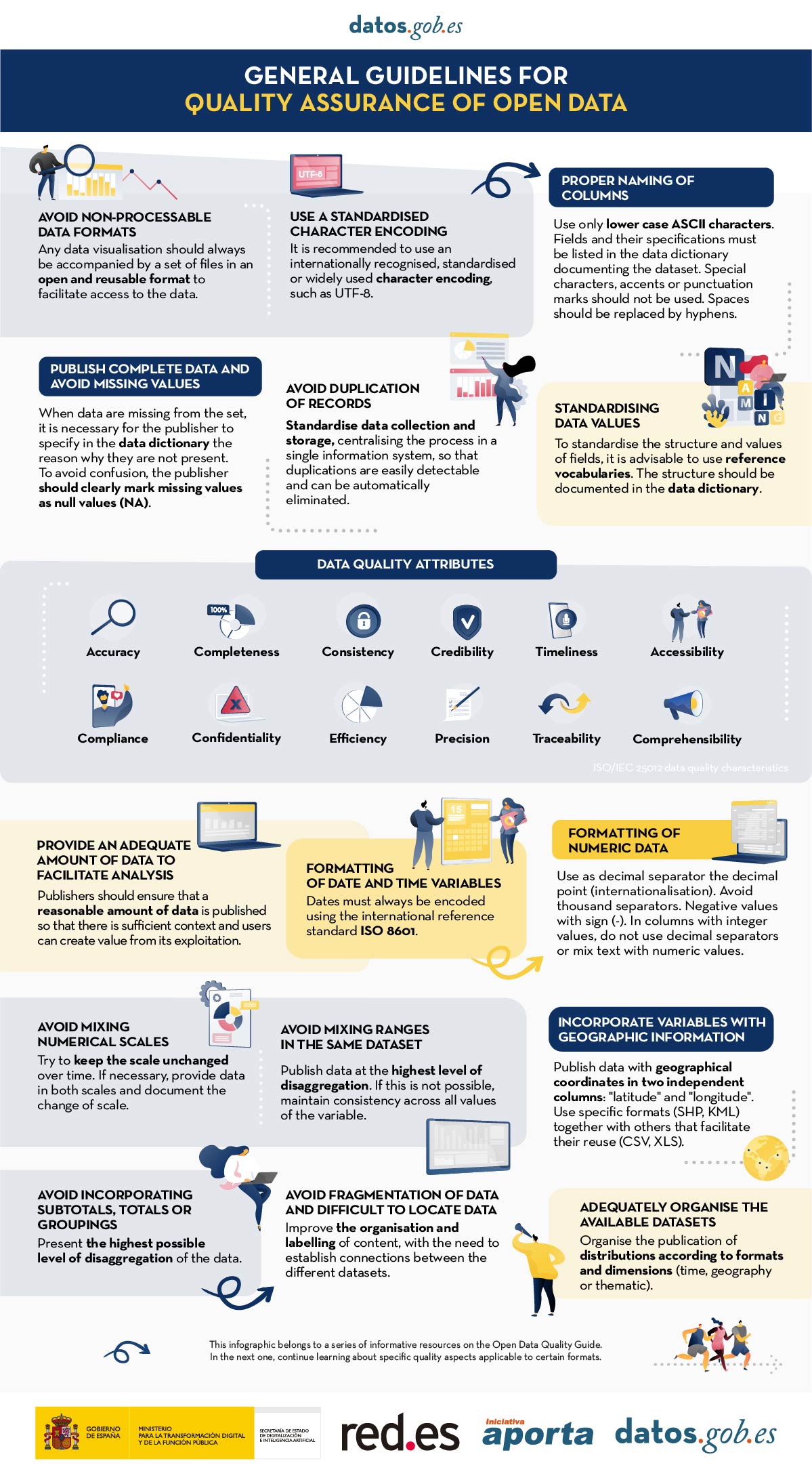
The document begins by defining the characteristics, according to ISO/IEC 25012, that data must meet in order to be considered quality data, which are shown in the following image
Next, the bulk of the guide focuses on the description of recommendations and good practices to avoid the most common problems that usually arise when publishing open data, structured as follows:
- A first part where a series of general guidelines are detailed to guarantee the quality of open data, such as, for example, using a standardised character encoding, avoiding duplicity of records or incorporating variables with geographic information. For each guideline, a detailed description of the problem, the quality characteristics affected and recommendations for their resolution are provided, together with practical examples to facilitate understanding.
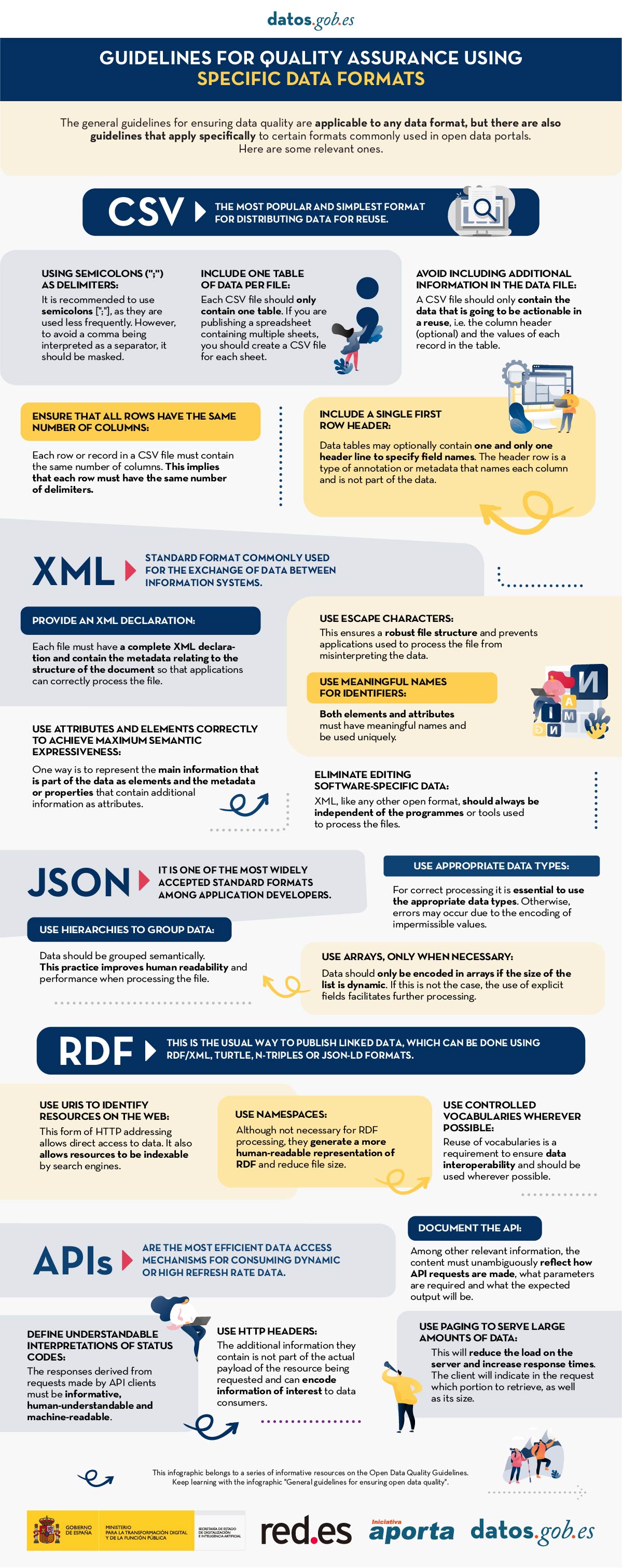
- A second part with specific guidelines for ensuring the quality of open data according to the data format used. Specific guidelines are included for CSV, XML, JSON, RDF and APIs.
- Finally, the guide also includes recommendations for data standardisation and enrichment, as well as for data documentation, and a list of useful tools for working on data quality.
You can download the guide here or at the bottom of the page (only available in Spanish).
Additional materials
The guide is accompanied by a series of infographics that compile the above guidelines:
- Infographic "General guidelines for quality assurance of open data".
- Infographic "Guidelines for quality assurance using specific data formats”.
Blog
There is a recurring question that has been around since the beginning of the open data movement, and as efforts and investments in data collection and publication have increased, it has resonated more and more strongly: What is the value of a dataset?
This is an extremely difficult question to answer given not only the inherent complexity of the data itself, which grows exponentially as we begin to combine it, but also the different points of view from which the question of value can be approached.
- If we know that the value will not be immediate, how can we foresee and quantify the potential benefits at some point in the future?
- Could the value of data become negative in some cases, if we can also cause some kind of 'harm' with it?
- Can the value of data degrade over time?
In this space we have recurrently analysed the value of open data for the administration from different approaches: high-value data and its identification, the perspective of suppliers, the keys to the value of data, how to generate value through data or what is the value of data in real time. However, analysis and research work in this area continues to grow unstoppably. In this regard, we would like to highlight a recently published paper from the University of Cambridge. It is a study in which some of the most common methods for data valuation are described.
Based on their previous analysis of the characteristics of the data and its associated value, a review of the methods that currently exist has been carried out. They concluded that these methods can be divided into several categories, the characteristics of which are detailed below.
Methods based on cost análisis
This approach is based on the traditional statistical principle of "sum of costs". It takes into account the costs of generating, collecting, storing and replacing datasets, as well as the costs to the organisation in case the data results in some kind of loss. These methods have the advantage that they are relatively easy to calculate, but on the other hand, they have the difficulty of having to differentiate between costs directly attributable to the data and other indirect costs related to, for example, the variety of professional work involved or the different software elements used.
An example of the application of this method is the case of Statistics Canada with its analysis of the valuation of the costs associated with investment in data, databases and data science in Canada.
Methods based on revenue análisis
In this case, revenue stream expectations are used, taking as a reference the existing potential market for the exploitation of the data. This may take into account, for example, usage fees, trademarks or patents. The main limitations of these methods are generally that they require the application of somewhat more subjective criteria and the complexity of estimating the value when the data are not exploited directly but indirectly, e.g. through analytics.
These methods are used in the OECD study on the prospects for the value of data. It calculates the reported revenues related to the collection and sale of data through the US enterprise survey.
Methods based on market análisis
Generally, these are the preferred methods to use when all the elements necessary to make the calculations are available. However, today there is still a large amount of data in organisations for internal use only, which makes it difficult to use these methods, as their behaviour is not visible to the market. Furthermore, these methods cannot fully incorporate the social value of the data.
An example of this method is the analysis made in the study carried out by the Economic Commission for Latin America and the Caribbean (ECLAC) on the data marts launched by the European Union and the Government of Colombia, respectively.
Experiments and surveys
This approach to the value of data consists of assessing market sentiment in relation to the data by directly asking about the willingness to pay for certain data or to do without it. It is generally used when the public market value is not known or in cases where social value is important, for example in the environmental area. A limitation of these methods is that, when respondents are not specialists, it can be quite difficult for them to assess the possible uses of the data and thus its full value.
The study carried out by the UK Office for National Statistics is a clear example of such valuation methods.
Impact-based methods
In this case the assessment is carried out through experiments or case studies that analyse the causal effect on certain outcomes attributable to the data. This option is particularly useful for evidence-led policy makers, as it allows a cause-effect relationship to be established, making it easier to understand the benefits and to develop a narrative in favour of the use of the data. However, if the experiments are not well designed or are not well adjusted to the specific context we want to analyse, we run the risk of obtaining an excessively subjective assessment.
The decision-based evaluation framework proposed by the Internet of Water Coalition is a good example of how to apply impact-focused methods to a particular case.
Actor-chain methods
The aim of these methods is to use a more comprehensive view to assess the data from different points of view. This means that evaluations can also be more complex by involving different definitions of what constitutes the value of the data. However, it also makes it the most appropriate method when one wants to assess a data ecosystem as a whole. Moreover, it is a growing method for organisations considering socially responsible investment.
An example of how these methods can be applied in practice is the case study carried out with Highways England.
Methods based on real options analysis
The main advantage of these methods is that they can be applied even when not all possible use cases for the data are yet defined. Their aim is to get an estimate of the value of the data in certain possible future scenarios - usually through computer simulation - so that if such a scenario is reached, exploitation of the data could be justified. Thus, certain data-related decisions and investments could be postponed until the ideal scenario that maximises the value of the data is reached, thereby minimising the associated costs and risks until that point.
The UK case study on the transport sector provides an example of how these methods could be applied using financial models.
And what is the method I should use in my particular case?
Unfortunately, there is no golden rule for selecting a particular method. However, there are a number of questions that the authors of the study suggest we ask ourselves in order to find the most appropriate method for each case:
- What exactly we are assessing: Data goes through several stages in its life cycle - from raw data to processed data, analysis or generated knowledge. Depending on which phase we want to focus our analysis on, some methods may be more appropriate than others.
- From which point of view the valuation is carried out: value can have different definitions depending on the point of view of who is carrying out or commissioning a valuation. In some cases, for example, cost containment due to budgetary constraints may be the priority, while in others one might choose to try to maximise social value.
- When the assessment process takes place: basically it should be considered whether the assessment will be carried out in a predictive way before all the elements assessed are available or whether it will be carried out a posteriori, once all the variables are already known.
- What is the purpose of the assessment: several of the available methods omit or minimise certain aspects of the data by focusing on other features of the assessment process. Therefore, it will be necessary to be clear about the priorities of our evaluation when selecting the most appropriate method: are we interested in social impact, improving productivity or maximising the cost-effectiveness of data?
We should therefore first analyse our needs and our own definition of value, asking ourselves what exactly we want to evaluate and how best to carry out that evaluation, and then develop our own valuation framework using the most appropriate methods from the wide variety available.
Content prepared by Carlos Iglesias, Open data Researcher and consultant, World Wide Web Foundation.
The contents and views expressed in this publication are the sole responsibility of the author.
Noticia
There are only a few days left until the end of summer and, as with every change of season, it is time to review what the last three months have brought in the Spanish open data ecosystem.
In July we learned of the latest edition of the European Commission's DESI (Digital Economy and Society Index) report, which places Spain ahead of the EU average in digital matters. Our country is in seventh position, improving two places compared to 2021. One of the areas where it performs best is in open data, where it ranks third. These good data are the result of the fact that an increasing number of organisations are committed to opening up the information they hold and more reusers are taking advantage of this data to create valuable products and services, as we will see below.
Advances in strategy and agreements to promote open data
Open data is gaining ground in political strategies at national, regional and local level.
In this regard, in July the Council of Ministers approved the draft Act on the Digital Efficiency of the Public Justice Service, an initiative that seeks to build a more accessible Justice Administration, promoting the data orientation of its systems. Among other issues, this act incorporates the concept of "open data" in the Administration of Justice.
Another example, this time at the regional level, comes from the Generalitat de Valencia, which launched a new Open Data Strategy at the beginning of the summer with the aim of offering quality public information, by design and by default.
We have also witnessed the signing of collaboration agreements to boost the open data ecosystem, for example:
- The Ajuntament de L'Hospitalet and the Universitat Politècnica de Catalunya have signed an agreement to offer training to undergraduate and master's degree students in Big Data and Artificial Intelligence, based on open data work.
- The University of Castilla la Mancha has agreed with the regional government to launch the 'Open Government' chair in order to promote higher education and research in areas such as transparency, open data or access to public information.
- The National Centre for Geographic Information (CNIG) and Asedie have signed a new protocol to improve access to geographic information, in order to promote openness, access and reuse of public sector information.
Examples of data reuse
The summer of 2022 will be remembered for the heat waves and fires that have ravaged different corners of the country. A context in which open data has demonstrated its power to provide information on the state of the situation and help in extinguishing fires. Data from Copernicus or the State Meteorological Agency (AEMET) have been used to monitor the situation and make decisions. These data sources, together with others, are also being used to understand the consequences of low rainfall and high temperatures on European reservoirs. In addition, these data have been used by the media to provide the public with the latest information on the evolution of the fires.
Firefighting based on open data has also been developed at the regional level. For example, the Government of Navarre has launched Agronic, a tool that works with Spatial Data Infrastructures of Navarre to prevent fires caused by harvesters. For its part, the Barcelona Provincial Council's open data portal has published datasets with "essential information" for the prevention of forest fires. These include the network of water points, low combustibility strips and forest management actions, used by public bodies to draw up plans to deal with fire.
Other examples of the use of open data that we have seen during this period are:
- The Environmental Radiological Surveillance Network of the Generalitat de Catalunya has developed, from open data, a system to monitor the radiation present in the environment of the nuclear power plants (Vandellòs and Ascó) and the rest of the Catalan territory.
- Thanks to the open data shared by Aragón Open Data, a new scientific article on Covid-19 has been written with the aim of finding out and identifying spatio-temporal patterns in relation to the incidence of the virus and the organisation of health resources.
- The Barcelona Open Data initiative has launched #DataBretxaWomen, a project that seeks to raise public awareness of the existing inequality between men and women in different sectors.
- Maldito dato has used open data from the statistics developed by the National Statistics Institute (INE) based on mobile positioning data to show how the population density of different Spanish municipalities changes during July and August.
- Within its Data Analytics for Research and Innovation in Health Programme, Catalonia has prioritised 8 proposals for research based on data analysis. These include studies on migraines, psychosis and heart disease.
Developments in open data platforms
Summer has also been the time chosen by different organisations to launch or update their open data platforms. Examples include:
- The Statistical Institute of Navarre launched a new web portal, with more dynamic and attractive visualisations. In the process of creation, they have managed to automate statistical production and integrate all the data in a single environment.
- Zaragoza City Council has also just published a new open data portal that offers all municipal information in a clearer and more concise way. This new portal has been agreed with other city councils as part of the 'Open Cities' project.
- Another city that already has an open data portal is Cadiz. Its City Council has launched a platform that will allow the people of Cadiz to know, access, reuse and redistribute the open data present in the city.
- The Valencian Institute of Business Competitiveness (IVACE) presented an open data portal with all the records of energy certification of buildings in the Valencian Community since 2011. This will allow, among other actions, to carry out consumption analysis and establish rehabilitation strategies.
- Aragón Open Data has included a new functionality in its API that allows users to obtain geographic data in GeoJSON format.
- The National Geographic Institute announced a new version of the earthquake app, with new features, educational content and information.
- The Ministry for Ecological Transition and the Demographic Challenge presented SIDAMUN, a platform that facilitates access to territorial statistical information based on municipal data.
- The open data portal of the Government of the Canary Islands launched a new search engine that makes it possible to locate the pages of the portal using metadata, and which allows exporting in CVS, ODS or PDF.
Some organisations have taken advantage of the summer to announce new developments that will see the light of day in the coming months, such as the Xunta de Galicia, which is making progress in the development of a Public Health Observatory through an open data platform, Burgos City Council, which will launch an open data portal, and the Pontevedra Provincial Council, which will soon launch a real-time budget viewer.
Actions to promote open data
In June we met the finalists of the IV Aporta Challenge: "The value of data for the health and well-being of citizens", the final of which will be held in October. In addition, some competitions have been launched in recent months to promote the reuse of open data, for which the registration period is still open, such as the Castilla y León competition or the first UniversiData Datathon. The Euskadi open data competition was also launched and is currently in the evaluation phase.
With regard to events, the summer started with the celebration of the Open Government Week, which brought together various activities, some of them focused on data. If you missed it, some organisations have made materials available to citizens. For example, you can watch the video of the colloquium "Open data with a gender perspective: yes or yes" promoted by the Government of the Canary Islands or access the webinar presentations to learn about the Data Office and the Aporta Initiative.
Other events that have been held with the participation of the Data Office and whose videos are public are: the National Congress on Archives and Electronic Documents and the Data Spaces as ecosystems for entities to reach further.
Finally, in the field of training, some examples of courses that have been launched these months are:
- The National Geographic Institute has launched an Inter-administrative Training Plan, with the aim of generating a common culture among all the experts in Geographic Information of the public bodies.
- Andalucía Vuela has launched a series of free training courses aimed at citizens interested in data or artificial intelligence.
International News
The summer has also brought many new developments at the international level. Some examples are:
- The beginning of the meteorological summer saw the publication of the results of the first edition of the Global Data Barometer, which measures the state of data with respect to societal issues such as Covid19 or climate.
- The 12 finalists of the Eu Datathon 2022 were also announced.
- An interactive edition of Eurostat's regional yearbook 2021 was published.
- England has developed a strategy to harness the potential of data in health and healthcare in a secure, reliable and transparent way.
This is just a selection of news among all the developments in the open data ecosystem over the last three months. If you would like to make a contribution, feel free to leave us a message in the comments or write to dinamizacion@datos.gob.es.
Noticia
The European Directive 2019/1024 on open data and re-use of public sector information emphasises, among many other aspects, the importance of publishing data in real time. In fact, the document talks about dynamic data, which it defines as "documents in digital format, subject to frequent or real-time updates due to their volatility or rapid obsolescence". According to the Directive, public bodies must make this data available for re-use by citizens immediately after collection, through appropriate APIs and, where possible, as a bulk download.
To explore this further, the European Data Portal, Data.europa.eu, has published the report “Real-time data 2022: Approaches to integrating real-time data sources in data.europa.eu” which analyses the potential of real-time data. It draws on the results of a webinar held by data.europa.eu on 5 April 2022, a recording of which is available on its website.
In addition to detailing the conclusions of the event, the report provides a brief summary of the information and technologies presented at the event, which are useful for real-time data sharing.
The importance of real-time data
The report begins by explaining what real-time data are: data that are frequently updated and delivered immediately after collection, as mentioned above. These data can be of a very heterogeneous nature. The following table gives some examples:
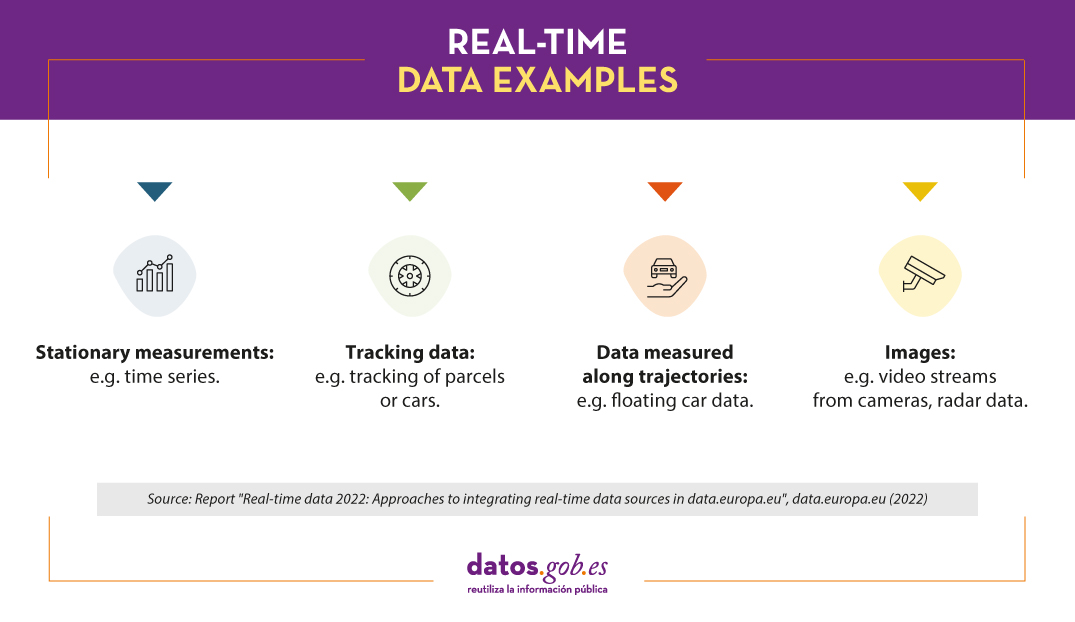
This type of data is widely used to shape applications that report traffic, energy prices, weather forecasts or flows of people in certain spaces. You can find out more about the value of real-time data in this other article.
Real-time data sharing standards
La interoperabilidad es uno de los factores más importantes a tener en cuenta a la hora de seleccionar la tecnología más adecuada para el intercambio de datos en tiempo real. Se precisa un lenguaje común, es decir, formatos de datos comunes e interfaces de acceso a datos que permitan el flujo de datos en tiempo real. Dos estándares que ya son muy utilizados en el ámbito del Internet de las cosas (IoT en sus siglas en inglés) y que pueden ayudar en este sentido son:
SensorThings API (STA)
SensorThings API, from the Open Geospatial Consortium, emerged in 2016 and has been considered a best practice for data sharing in compliance with the INSPIRE Directive.
This standard provides an open and unified framework for encoding and providing access to sensor-generated data streams. It is based on REST and JSON specifications and follows the principles of the OData (OASIS Open Data Protocol) standard.
STA provides common functionalities for creating, reading, updating and deleting sensor resources. It enables the formulation of complex queries tailored to the underlying data model, allowing more direct access to the specific data the user needs. Query options include filtering by time period, observed parameters or resource properties to reduce the volume of data downloaded. It also allows sorting the content of a result by user-specified criteria and provides direct integration with the MQTT standard, which is explained below.
Message Queuing Telemetry Transport (MQTT)
MQTT was invented by Dr. Andy Stanford-Clark of IBM and Arlen Nipper of Arcom (now Eurotech) in 1999. Like STA, it is also an OASIS standard.
The MQTT protocol allows the exchange of messages according to the publish/subscribe principle. The central element of MQTT is the use of brokers, which take incoming messages from publishers and distribute them to all users who have a subscription for that type of data. In this type of environment, data is organised by topics, which are freely defined and allow messages to be grouped into thematic channels to which users subscribe.
The advantages of this system include reduced latency, simplicity and agility, which facilitates its implementation and use in constrained environments (e.g. with limited bandwidth or connectivity).
In the case of the European portal, users can already find real-time datasets based on MQTT. However, there is not yet a common approach to providing metadata on brokers and the topics they offer, and work is still ongoing.
Other conclusions of the report
As mentioned at the beginning, the webinar on 5 April also served to gather participants' views on the use of real-time data, current challenges in data availability and needs for future improvements. These views are also reflected in this report.
Among the most valued categories of real-time data, users highlighted traffic information and weather data. Data on air pollution, allergens, flood monitoring and stock market information were also mentioned. In this respect, more and more detailed data were requested, especially in the field of mobility and energy in order to be able to compare commodity prices. Users also highlighted some drawbacks in locating real-time data on the European portal, including the heterogeneity of the information, which requires the use of common standards and formats across countries.
Finally, the report provides a set of recommendations on how to improve the ability to locate real-time data sources through data.europa.eu. To this end, a series of short and medium-term actions have been established, including the collection of use cases, support for data providers and the development of best practices to unify metadata.
You can read the full report here.
Noticia
Since 2014, the European Commission has been monitoring Member States' digital progress through the annual DESI Digital Economy and Society Index. To do so, it analyses four digital performance indicators: human capital, connectivity, digital technology integration and digital public services.
In this year's edition, Spain is in seventh position, improving two places compared to 2021. It has gone from a score of 57.4% to 60.8%, which represents a growth of almost 6% (the EU average has grown by 3% in the same period). This puts Spain ahead of countries such as Germany, France and Italy. At the head of the EU-27 we find Finland, Denmark and the Netherlands.
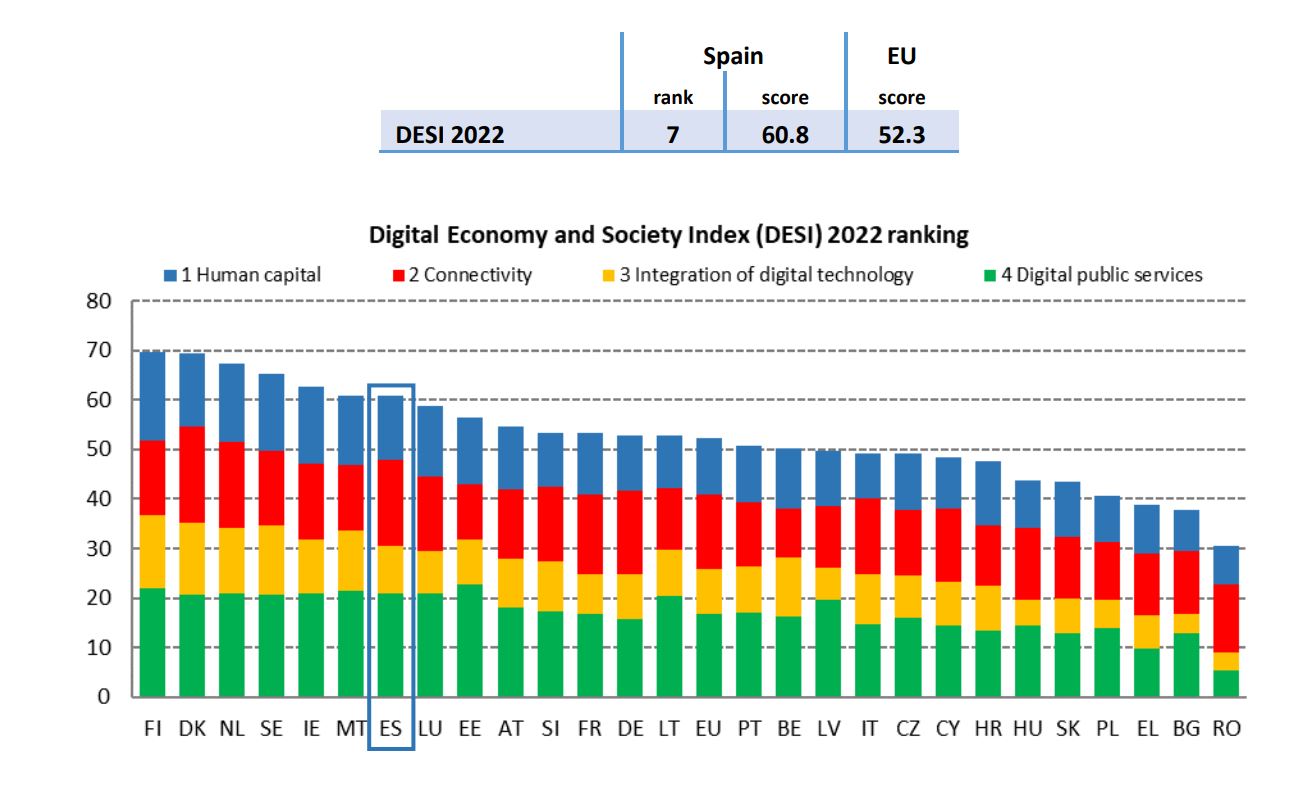
It should be noted that the DESI 2022 index is based mainly on data from 2021. Overall, during the COVID-19 pandemic, Member States have made progress in their digitisation efforts, thanks in part to the opportunity provided by the resources allocated by Europe through the NextGenerationEU recovery plan. However, there are still general challenges, related to digital skills gaps, the digital transformation of SMEs and the deployment of advanced 5G networks.
Digital progress in Spain
Spain is above the EU average in all four categories analysed:
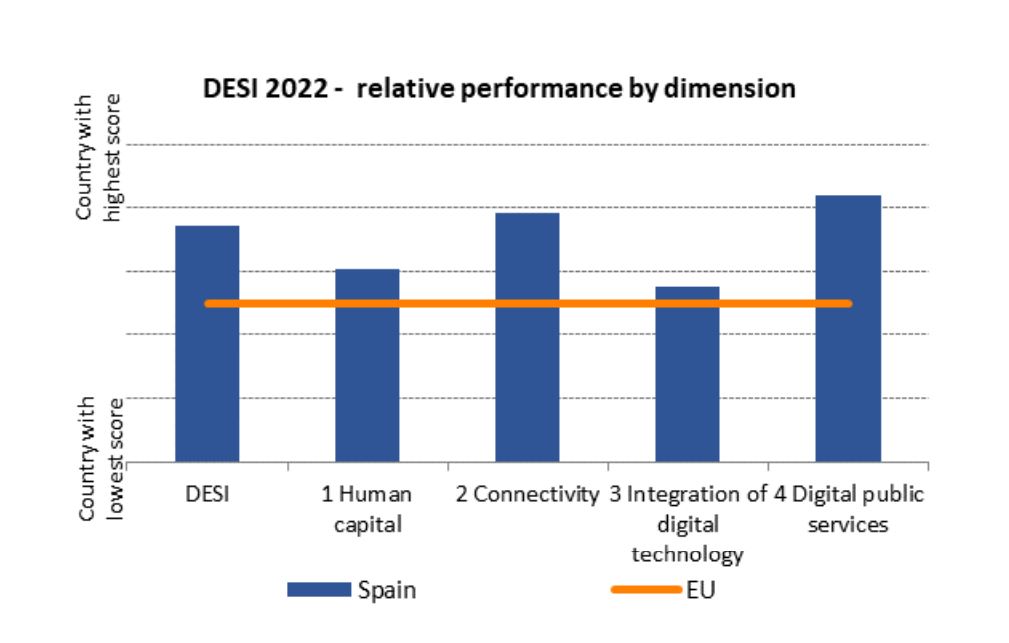
- Human capital. Spain improves two positions with respect to 2021 and ranks tenth. It stands out mainly in basic digital skills, while it is only below the EU average in the proportion of information and communication technology (ICT) specialists and graduates. The report highlights that several of the measures outlined in the National Recovery and Resilience Plan aim to boost the acquisition of digital skills, especially for SME employees.
-
Connectivity. Spain is one of the EU leaders in terms of connectivity, where it ranks third for the second year in a row. Our country performs particularly well in very high capacity fixed network coverage (94% compared to 70% of the European average), although it still has room for improvement in 5G coverage. In this regard, strategic reforms and investments are being carried out under the National Recovery and Resilience Plan in order to achieve the Digital Decade connectivity targets and reduce the digital divide between urban and rural areas.
-
Digital technology integration. This is the area where most progress has been made, with an improvement of five positions. Spain is currently in eleventh place. It stands out especially in the percentage of SMEs with a basic level of digital intensity and which use social networks, online sales media and electronic information exchange systems. In the use of artificial intelligence, we are at the European average. On the other hand, technologies such as cloud and Big Data analysis are still not widespread. To improve these capabilities, professionals with digital skills are needed, something that will help to boost the SME Digitalisation Plan 2021-2025.
-
Digital public services. Spain, which has traditionally been a pioneer in this field, is in fifth place, two places above 2021. One of the areas where it performs best is in open data, where it is in third place, well above the European average (95% vs. 81%). In addition, the report highlights how our country is proactively developing new services to respond to the needs of citizens in areas such as health, digital identification, cybersecurity, mobile applications and the integration of AI in the sector. Some examples of projects in which Spain is participating are Genome of Europe and European Self Sovereign identity (ESSIF).
If you would like to go deeper into the analysis of the results of Spain and the other European countries in the DESI index, you can download the reports by country on this website. In addition, the Spanish e-Government portal provides users with various useful materials, divided by year.
Women in Digital (WiD) Scoreboard
Together with the DESI index, the EU has also published the 2022 edition of the "Women in Digital (WiD) Scoreboard", a report that assesses the digital development of women and their inclusion in areas such as employment and digital entrepreneurship.
In this ranking, Spain is in eighth position, also exceeding the European Union average (64.2% compared to 54.9%). Spanish women stand out especially in terms of Internet use skills, where they are in fourth position compared to European women.
All these data show how Spain continues to make progress in digital matters. Although there are still areas for improvement, investment from Spain's Recovery and Resilience Plan is expected to continue to drive progress, mainly in areas such as the digitisation of businesses, strengthening the digital skills of the population, improving digital connectivity and the digitisation of public administrations. All of this without neglecting support for digital-related research and development (R&D).