


Blog
In the policies promoted by the European Union, an intimate connection between artificial intelligence and open data has been considered. In this regard, as we highlighted, open data is essential for the proper functioning of artificial intelligence, since the algorithms must be fed by data whose quality and availability is essential for its continuous improvement, as well as to audit its correct operation.
Artificial intelligence entails an increase in the sophistication of data processing, since it requires greater precision, updating and quality, which, on the other hand, must be obtained from very diverse sources to increase the quality of the algorithms results. Likewise, an added difficulty is the fact that processing is carried out in an automated way and must offer precise answers immediately to face changing circumstances. Therefore, a dynamic perspective that justifies the need for data -not only to be offered in open and machine-readable format, but also with the highest levels of precision and disaggregation- is needed.
This requirement acquires a special importance as regards the accessibility of the data generated by the public sector, undoubtedly one of the main sources for algorithms due to both the large number of available data sets and the special interest of the subjects, especially public services. In this regard, apart from the need to overcome the inadequacies of the current legal framework regarding the limited scope of the obligations imposed on public entities, it is convenient to assess what extent the legal conditions in which data are offered serve to streamline the development of applications based on artificial intelligence.
Thus, in the first place, article 5.3 of the Law states categorically that "public sector administrations and organizations may not be required to maintain the production and storage of a certain type of document focused on its reuse". Taking into account this legal forecast, the aforementioned entities can rely on the absence of an obligation to guarantee the supply of data indefinitely. Also in the limitation of liability contemplated by some provisions when stating that the use of the data will be carried out under the responsibility and risk of the users or reuser agents or, even, the exoneration for any error or omission that is determined by the incorrectness of the data itself. However, it is an interpretation whose effective scope in each specific case has to be contrasted with the demanding European regulation related to the scope of the obligations and the protection channels, in particular after the reform that took place in the year 2013.
Beyond an approach based on strict regulatory compliance from a restrictive interpretation, the truth is that the need to offer open data policies for the public sector to meet the unique demands of artificial intelligence requires a proactive approach. In this sense, the interaction between public and private subjects in contexts of systematic data measurements and collection, continuously updated from generalized connections - as is the case of smart city initiatives - places us in front of a technological scenario where active contractual management policies acquire a special importance in order to overcome the barriers and legal difficulties for its opening. In fact, municipal public services are often provided by private parties that are outside the reuse regulations and, in addition, data are not always obtained from services or objects managed by public entities; even in spite of the general interest underlying in areas such as electricity supply, the provision of telephony and electronic communications services, or even financial services.
For this reason, the initiative launched by the European Union in 2017 acquires a singular importance from the perspective of artificial intelligence, since it aims to overcome a large part of the legal restrictions currently in place for data opening. In the same sense, the Spanish Strategy of R & D in Artificial Intelligence, recently presented by the Ministry of Science, Innovation and Universities, considers as one of its priorities the development of a digital data ecosystem whose measures include the need to guarantee an optimal use of open data, as well as the creation of a National Data Institute in charge of the governance of the data coming from the different levels of the Public Administration. Likewise, in line with the European initiative previously referred, among other measures, there is a need to expand the sharing obligations of up to certain private entities and scientific data, which would undoubtedly have a relevant impact on the better functioning of the algorithms.
The technological singularity that Artificial Intelligence poses requires, without a doubt, an adequate ethical and legal framework that allows facing the challenges that it entails. The new Directive on open data and reuse of public sector information recently approved by the European Parliament will be a strong impulse for artificial intelligence, as this initiative will expand both the obligated parties and the type of data that will have to be available. Undoubtedly a certainly relevant measure, which will be followed by many others within the framework of the European Union's strategy on Artificial Intelligence, one of whose main premises is to ensure an adequate regulatory framework to facilitate technological innovation based on respect for fundamental rights and the ethical principles.
Content prepared by Julián Valero, professor at the University of Murcia and Coordinator of the Research Group "Innovation, Law and Technology" (iDerTec).
Contents and points of view expressed in this publication are the exclusive responsibility of its author.

Blog
Virtual assistants, purchase prediction algorithms or fraud detection systems. We all interact every day with Artificial Intelligence technologies.
Although there is still a lot of development ahead, the current Artificial Intelligence impact in our lives cannot be denied. When we talk about Artificial Intelligence (or AI) we don't mean humanoid-looking robots that think like us, but rather a succession of algorithms that help us extract value from large volumes of data in an agile and efficient way, facilitating automatic decision making. These algorithms need to be trained with quality data so that their behaviour adapts to our social context rules.
Currently, Artificial Intelligence has a high impact on the business value chain, and affects many of the decisions taken not only by companies but also by individuals. Therefore, it is essential that the data they use are not biased and respect human rights and democratic values.
The European Union and the governments of the different countries are promoting policies in this regard. To help them in this process, the OECD has developed a series of minimum principles that AI systems should comply with. These principles are a series of practical and flexible standards that can stand the test of time in a constantly evolving field. These standards are not legally binding, but they seek to influence international standards and function as the basis of the different laws.
The OECD principles on Artificial Intelligence are based on the recommendations developed by a working group composed of 50 expert AI members, including representatives of governments and business communities, as well as civil, academic and scientific society. These recommendations were adopted on May 22, 2019 by OECD member countries.
These recommendations identify five complementary values-based for the responsible stewardship of Artificial Intelligence:
- AI should benefit people and the planet by driving inclusive growth, sustainable development and well-being.
- AI systems should be designed in a way that respects the rule of law, human rights, democratic values and diversity, and they should include appropriate safeguards – for example, enabling human intervention where necessary – to ensure a fair and just society.
- There should be transparency and responsible disclosure around AI systems to ensure that people understand AI-based outcomes and can challenge them.
- AI systems must function in a robust, secure and safe way throughout their life cycles and potential risks should be continually assessed and managed.
- Organisations and individuals developing, deploying or operating AI systems should be held accountable for their proper functioning in line with the above principles.
Consistent with these principles, the OECD also provides five recommendations to governments:
- Facilitate public and private investment in research & development to spur innovation in trustworthy AI.
- Foster accessible AI ecosystems with digital infrastructure and technologies and mechanisms to share data and knowledge.
- Ensure a policy environment that will open the way to deployment of trustworthy AI systems.
- Empower people with the skills for AI and support workers for a fair transition.
- Co-operate across borders and sectors to progress on responsible stewardship of trustworthy AI.
These recommendations are a first step towards the achievement of responsible Artificial Intelligence. Among its next steps, the OECD contemplates the development of the AI Policy Observatory, which will be responsible for providing guidance on metrics, policies and good practices in order to help implement the principles indicated above, something fundamental if we want to move beyond the theoretical to practice scope.
Governments can take these recommendations as a basis and develop their own policies, which will facilitate the homogeneity of Artificial Intelligence systems and ensure that their behaviour respects the basic principles of coexistence.
Noticia
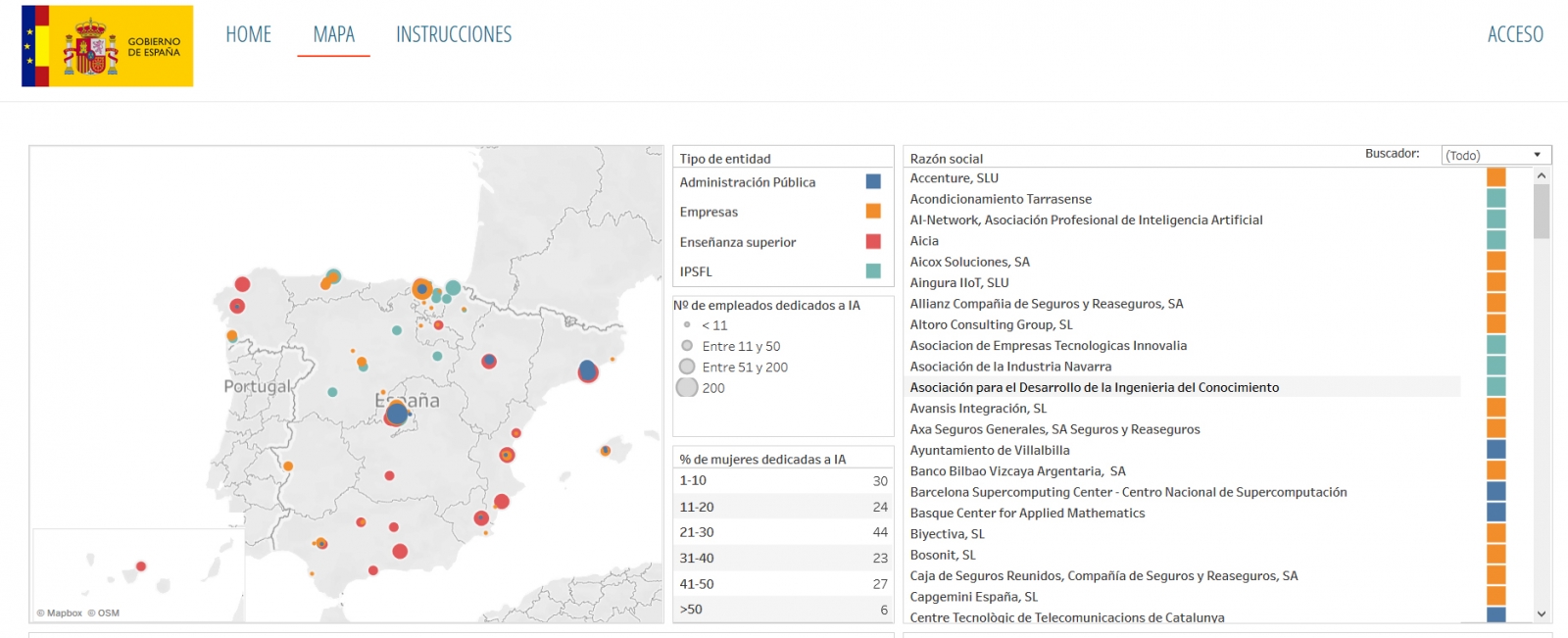
The Ministry of Science, Innovation and Universities has published a map that includes the current state of the Artificial Intelligence (AI) ecosystem in Spain. This action is included in the Spanish R + D + I AI Strategy and it is also one of the commitments reached by the Member States of the European Union in accordance with the Coordinated Plan on Artificial Intelligence.
The objective of the map is to promote synergies between Spanish entities and open a path of European and international collaboration, identifying and visualizing Spanish strengths in this area. For this, it collects information from public and private institutions that develop, investigate, use or provide services with AI technologies, both nationally and from autonomous communities and provinces.
Among the information that can be found on the map is the type of activities carried out by the entities (development of AI-based products or applications, creation of coordination networks, etc.), their experience in enabling technologies such as 5G or blockchain , the economic sector in which they carry out their activity or the autonomous community in which they are located. Data related to the percentage of women dedicated to these activities are also included, which helps to understand if there is a gender balance.
Open call for updating
A call has been opened for those companies or organizations that wish to incorporate their information to the maps, in order to ensure that the map has updated information. The call will be open from October 14 to 31. Those entities that want to participate have to follow the following steps:
- Registration. In order to incorporate information on the map, it is necessary to register with a corporate email account or the entity to register.
- Info Entidad. Once registered, the user will be able to access the “info entity” menu and complete the information of the organization.
- Complete form. After filling in the “entity info” section, a new option will appear in the menu, called “Formulario”. Different fields will appear in it, some mandatory and others optional. Data marked as mandatory will be displayed on the map individually, while non-mandatory data will be displayed in an aggregate way.
- Signature of the legal representative. It will be necessary to have the signature of the legal representative to be able to incorporate the information into the strategy map. It should be noted that once the document has been uploaded with the signature, the information provided cannot be edited.
As of today, the map has information on 154 entities. The idea is updating the map with future calls, forming a photo as realistic as possible about the current panorama of AI capabilities in our country
If you are interested in participating and need more information, you can send an email to mapaestrategiaia@ciencia.gob.es.
Empresa reutilizadora
A company dedicated to business and technology information for companies. Its main mission is to help companies around the world, with advanced analytics solutions and data integration tools, to identify business opportunities and potential risks of non-payment through business information, predictive models and propensity to buy; so that the areas of finance, risk, marketing, sales, purchasing and logistics can identify opportunities and potential risks of non-payment through business information, predictive models and propensity to buy; so that the areas of finance, risk, marketing, sales, purchasing and logistics can identify opportunities and potential risks of non-payment:
- Find new and good customers.
- Analyse the financial health of companies.
- Minimise the risk of non-payment of commercial transactions.
Iberinform is a subsidiary of Crédito y Caución, a global credit insurance operator with a presence in more than 50 countries.
Empresa reutilizadora
GIS4tech is a Spanish Spin-Off company founded in 2016, as a result of the research activity of the Cluster Territorial group and the Department of Urban Planning of the University of Granada. GIS4tech is dedicated to technical assistance, advice, training, research and development supported by Geographic Information Systems and related technologies. The team has more than 20 years of experience in territory studies, elaboration of cartographies and Geographic Information Systems.
Empresa reutilizadora
Solutions development, based on artificial intelligence techniques and data mining.
Empresa reutilizadora
Smartvel builds b2b content marketing solutions for airlines, hotel chains, travel agencies and tourism entities. They collect, monitor, classify, index, geolocate and translate segmented content from different sources. Then, they integrate this content, easily and quickly, into their client websites, driving user experience
In short, they provide a content solution that lets tourist know what to do in a specific place, mixing the destination's living agenda (events, culture, sports, etc.) with the points of interest (monuments, restaurants, etc.) and the own layers that their customers want to show.
Documentación
The amount of data we generate does not stop growing. 90% of the data created in the history of humanity were produced during the last year and a 40% annual growth is estimated for the next decade. These figures highlight the importance of data in today's economy and society. The data provide us with knowledge, which facilitate to make the right decisions at the right time.
To optimize the advantages that the use of data can bring to our day to day, an increasing number of organizations and companies are implementing new technologies that help to improve their management and obtain greater value. The report New trends and challenges in the data world analyzes some of these technological and social trends that are revolutionizing the world of data. These technologies are big data and artificial intelligence, decision algorithms, internet of things and blockchain.
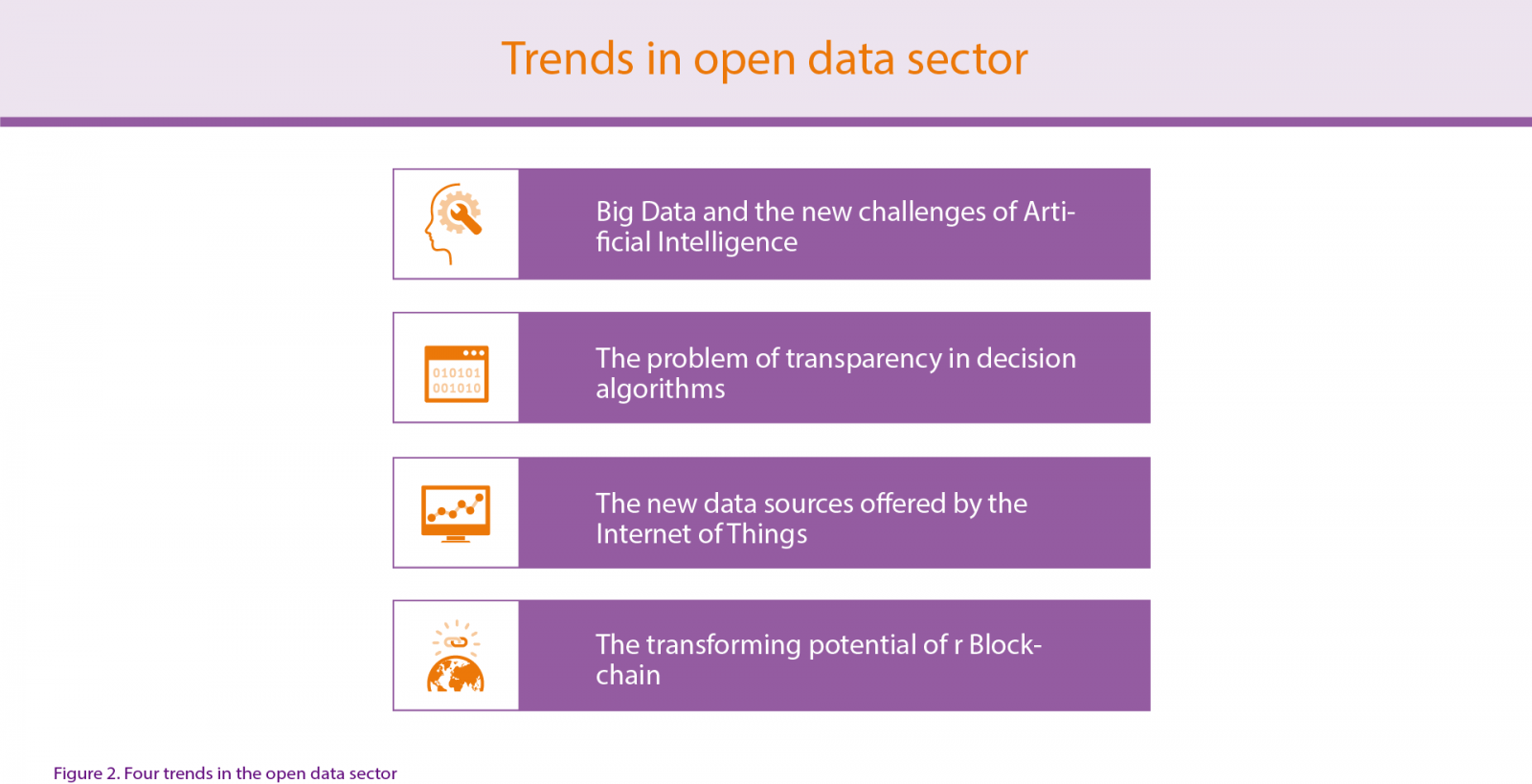
The following are some of the main conclusions of the report:
Big Data and Artificial Intelligence
- What is it? The analysis of large volumes of data, from different sources and with different formats, in real time, acquires a new dimension combined with artificial intelligence technologies, which apply reason guidelines to data.
- What are its advantages? Thanks to these technologies, companies and organizations can better understand the current and future functioning of their environment, and face the challenges at the right time. The combination of Artificial Intelligence and Big Data can boost economic growth, respond to citizens needs and optimize public services. In addition, it can contribute to the strengthening of democracy.
- What are its challenges? The lack of talent with the necessary skills, the limitation in current infrastructures and the privacy protection are the main challenges that organizations have to face when implementing a Big Data initiative.
The decision algorithms
- What is it? These are automated agents capable of extracting value from a large volume of data in an agile and efficient way, facilitating automatic decision making.
- What are its advantages? Decision algorithms allow more efficient, transparent and equitable decision making.
- What are its challenges? Among the challenges faced by people in charge of algorithms management is ensuring the quality and availability of data through controls and audits, as well as ensuring their integrity, ethics and independence.
Internet of Things
- What is it? When we talk about Internet of Things (IoT) we refer to a network of connected objects, by wireless or cable, capable of generating data without human intervention.
- What are its advantages? IoT facilitates processes automation and provides new and multiple forms of interaction that contribute to improving universality and accessibility to services.
- What are its challenges? The main inhibitors of IoT are security and privacy, interoperability and the need for new infrastructures. It is also important to bear in mind that IoT can contribute to increasing the existing gap between different social classes according to their possibilities of data and services access.
Blockchain
- What is it? Blockchain is a distributed database that controls the transfer of digital information. That is, a kind of account book where the records are encrypted and interleaved, so change in one of the blocks affects the others.
- What are its advantages? Its main advantage is the security and privacy of information, the integrity, the sustainability, the transparency and the (quasi) anonymity. This will allow us to transform our political system and enable profound social changes.
- What are its challenges?
- The lack of qualified talent, the regulatory changes, the electronic security of citizens and the limits on institutions ability to adapt the new enviroment are the main challenges highlighted in the report.
Thanks to Big Data and artificial intelligence, decision algorithms, Internet of Things or Blockchain, organizations and companies can extract the necessary value from the data, which will help them to improve services and products for citizens. Although these four technologies are still in a phase of incipient adoption, they are expected to grow rapidly over the next few years, once the above-mentioned challenges are overcome - if you want to delve into these challenges you can read the report New trends and challenges in the world of data.
.dge-detail__img{display:none;}
Noticia
On 20 September, the Debate Workshop on applications of Language Technologies will be held addressing the actions carried out within the Language Technologies Promotion Plan (LT Plan) with tools such as the public procurement of innovation services or participation in European programmes. The development of ICT information and communication technologies is generating an enormous volume of electronic textual information that is increasing in an unstoppable way. To take advantage of such electronic information, it must be done automatically. Language Technologies - and within them natural language processing (NLP) - allow the precise automatic understanding of human language, which entails great challenges. Computer systems process numerical data simply, but human language is much more complex because it is accompanied by nuances and meanings that depend on context and non-explicit information. This discipline can be applied to different areas and fields: from automatic machine translation to the retrieval and extraction of relevant information, and from digging for opinions to automatic generation of text summaries, making natural language processing technologies an emerging, innovative industry that has great opportunities for growth.
On Wednesday, 20 September, the activity will also aim to promote the transfer of knowledge and the sharing of opinions among the different professionals in the LT field of public administrations, research centres, universities and companies, as well as to increase knowledge about the language technology situation in other Spanish-speaking countries and to deepen the needs of users and the potential of language technologies in two sectors of particular relevance to the Spanish economy and society: health and tourism. Specifically, promoting the internationalisation of Spanish companies is one of the measures contemplated in the Plan.
In particular, four workshops will be held in the following areas with the participation of numerous experts:
- Coordination of Language Technologies Initiatives between Mexico and Spain
- Harnessing Synergies between Large and Small Companies
- Applications of LT in Tourism
- Health Improvements with the Use of LTs
Transforming electronic textual information into reusable formats and publishing it under open licenses can turn natural language processing (NLP) technologies into a driving force for the language technology industry. In the last 10 years, Google Translate has gone from supporting only a few languages to now supporting 103, translating more than 140 billion words every day, while technology continues advancing at an unstoppable pace from the hand of artificial intelligence towards the development of their own language.
The Debate was organised by SESIAD within the framework of the XXXIII International Conference of Spanish Natural Language Processing Society (SEPLN in Spanish) and will take place in the Auditorium of the Universidad de Murcia. The event will be recorded and will subsequently be made available online at red.es.