


Blog
In this post we have described step-by-step a data science exercise in which we try to train a deep learning model with a view to automatically classifying medical images of healthy and sick people.
Diagnostic imaging has been around for many years in the hospitals of developed countries; however, there has always been a strong dependence on highly specialised personnel. From the technician who operates the instruments to the radiologist who interprets the images. With our current analytical capabilities, we are able to extract numerical measures such as volume, dimension, shape and growth rate (inter alia) from image analysis. Throughout this post we will try to explain, through a simple example, the power of artificial intelligence models to expand human capabilities in the field of medicine.
This post explains the practical exercise (Action section) associated with the report “Emerging technologies and open data: introduction to data science applied to image analysis”. Said report introduces the fundamental concepts that allow us to understand how image analysis works, detailing the main application cases in various sectors and highlighting the role of open data in their implementation.
Previous projects
However, we could not have prepared this exercise without the prior work and effort of other data science lovers. Below we have provided you with a short note and the references to these previous works.
- This exercise is an adaptation of the original project by Michael Blum on the STOIC2021 - disease-19 AI challenge. Michael's original project was based on a set of images of patients with Covid-19 pathology, along with other healthy patients to serve as a comparison.
- In a second approach, Olivier Gimenez used a data set similar to that of the original project published in a competition of Kaggle. This new dataset (250 MB) was considerably more manageable than the original one (280GB). The new dataset contained just over 1,000 images of healthy and sick patients. Olivier's project code can be found at the following repository.
Datasets
In our case, inspired by these two amazing previous projects, we have built an educational exercise based on a series of tools that facilitate the execution of the code and the possibility of examining the results in a simple way. The original data set (chest x-ray) comprises 112,120 x-ray images (front view) from 30,805 unique patients. The images are accompanied by the associated labels of fourteen diseases (where each image can have multiple labels), extracted from associated radiological reports using natural language processing (NLP). From the original set of medical images we have extracted (using some scripts) a smaller, delimited sample (only healthy people compared with people with just one pathology) to facilitate this exercise. In particular, the chosen pathology is pneumothorax.
If you want further information about the field of natural language processing, you can consult the following report which we already published at the time. Also, in the post 10 public data repositories related to health and wellness the NIH is referred to as an example of a source of quality health data. In particular, our data set is publicly available here.
Tools
To carry out the prior processing of the data (work environment, programming and drafting thereof), R (version 4.1.2) and RStudio (2022-02-3) was used. The small scripts to help download and sort files have been written in Python 3.
Accompanying this post, we have created a Jupyter notebook with which to experiment interactively through the different code snippets that our example develops. The purpose of this exercise is to train an algorithm to be able to automatically classify a chest X-ray image into two categories (sick person vs. non-sick person). To facilitate the carrying out of the exercise by readers who so wish, we have prepared the Jupyter notebook in the Google Colab environment which contains all the necessary elements to reproduce the exercise step-by-step. Google Colab or Collaboratory is a free Google tool that allows you to programme and run code on python (and also in R) without the need to install any additional software. It is an online service and to use it you only need to have a Google account.
Logical flow of data analysis
Our Jupyter Notebook carries out the following differentiated activities which you can follow in the interactive document itself when you run it on Google Colab.
- Installing and loading dependencies.
- Setting up the work environment
- Downloading, uploading and pre-processing of the necessary data (medical images) in the work environment.
- Pre-visualisation of the loaded images.
- Data preparation for algorithm training.
- Model training and results.
- Conclusions of the exercise.
Then we carry out didactic review of the exercise, focusing our explanations on those activities that are most relevant to the data analysis exercise:
- Description of data analysis and model training
- Modelling: creating the set of training images and model training
- Analysis of the training result
- Conclusions
Description of data analysis and model training
The first steps that we will find going through the Jupyter notebook are the activities prior to the image analysis itself. As in all data analysis processes, it is necessary to prepare the work environment and load the necessary libraries (dependencies) to execute the different analysis functions. The most representative R package of this set of dependencies is Keras. In this article we have already commented on the use of Keras as a Deep Learning framework. Additionally, the following packages are also required: htr; tidyverse; reshape2; patchwork.
Then we have to download to our environment the set of images (data) we are going to work with. As we have previously commented, the images are in remote storage and we only download them to Colab at the time we analyse them. After executing the code sections that download and unzip the work files containing the medical images, we will find two folders (No-finding and Pneumothorax) that contain the work data.

Once we have the work data in Colab, we must load them into the memory of the execution environment. To this end, we have created a function that you will see in the notebook called process_pix(). This function will search for the images in the previous folders and load them into the memory, in addition to converting them to grayscale and normalising them all to a size of 100x100 pixels. In order not to exceed the resources that Google Colab provides us with for free, we limit the number of images that we load into memory to 1000 units. In other words, the algorithm will be trained with 1000 images, including those that it will use for training and those that it will use for subsequent validation.
Once we have the images perfectly classified, formatted and loaded into memory, we carry out a quick visualisation to verify that they are correct. We obtain the following results:

Self-evidently, in the eyes of a non-expert observer, there are no significant differences that allow us to draw any conclusions. In the steps below we will see how the artificial intelligence model actually has a better clinical eye than we do.
Modelling
Creating the training image set
As we mentioned in the previous steps, we have a set of 1000 starting images loaded in the work environment. Until now, we have had classified (by an x-ray specialist) those images of patients with signs of pneumothorax (on the path "./data/Pneumothorax") and those patients who are healthy (on the path "./data/No -Finding")
The aim of this exercise is precisely to demonstrate the capacity of an algorithm to assist the specialist in the classification (or detection of signs of disease in the x-ray image). With this in mind, we have to mix the images to achieve a homogeneous set that the algorithm will have to analyse and classify using only their characteristics. The following code snippet associates an identifier (1 for sick people and 0 for healthy people) so that, later, after the algorithm's classification process, it is possible to verify those that the model has classified correctly or incorrectly.
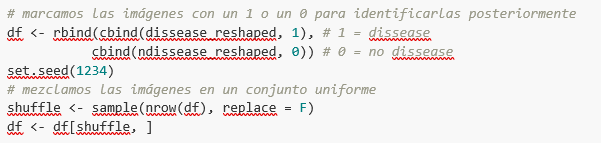
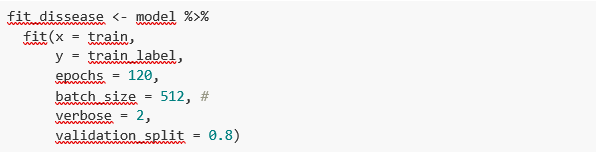
So, now we have a uniform “df” set of 1000 images mixed with healthy and sick patients. Next, we split this original set into two. We are going to use 80% of the original set to train the model. In other words, the algorithm will use the characteristics of the images to create a model that allows us to conclude whether an image matches the identifier 1 or 0. On the other hand, we are going to use the remaining 20% of the homogeneous mixture to check whether the model, once trained, is capable of taking any image and assigning it 1 or 0 (sick, not sick).

Model training
Right, now all we have left to do is to configure the model and train with the previous data set.
Before training, you will see some code snippets which are used to configure the model that we are going to train. The model we are going to train is of the binary classifier type. This means that it is a model that is capable of classifying the data (in our case, images) into two categories (in our case, healthy or sick). The model selected is called CNN or Convolutional Neural Network. Its very name already tells us that it is a neural networks model and thus falls under the Deep Learning discipline. These models are based on layers of data features that get deeper as the complexity of the model increases. We would remind you that the term deep refers precisely to the depth of the number of layers through which these models learn.
Note: the following code snippets are the most technical in the post. Introductory documentation can be found here, whilst all the technical documentation on the model's functions is accessible here.
Finally, after configuring the model, we are ready to train the model. As we mentioned, we train with 80% of the images and validate the result with the remaining 20%.
Training result
Well, now we have trained our model. So what's next? The graphs below provide us with a quick visualisation of how the model behaves on the images that we have reserved for validation. Basically, these figures actually represent (the one in the lower panel) the capability of the model to predict the presence (identifier 1) or absence (identifier 0) of disease (in our case pneumothorax). The conclusion is that when the model trained with the training images (those for which the result 1 or 0 is known) is applied to 20% of the images for which the result is not known, the model is correct approximately 85% (0.87309) of times.

Indeed, when we request the evaluation of the model to know how well it classifies diseases, the result indicates the capability of our newly trained model to correctly classify 0.87309 of the validation images.
Now let’s make some predictions about patient images. In other words, once the model has been trained and validated, we wonder how it is going to classify the images that we are going to give it now. As we know "the truth" (what is called the ground truth) about the images, we compare the result of the prediction with the truth. To check the results of the prediction (which will vary depending on the number of images used in the training) we use that which in data science is called the confusion matrix. The confusion matrix:
- Places in position (1,1) the cases that DID have disease and the model classifies as "with disease"
- Places in position (2,2), the cases that did NOT have disease and the model classifies as "without disease"
In other words, these are the positions in which the model "hits" its classification.
In the opposite positions, in other words, (1,2) and (2,1) are the positions in which the model is "wrong". So, position (1,2) are the results that the model classifies as WITH disease and the reality is that they were healthy patients. Position (2,1), the very opposite.
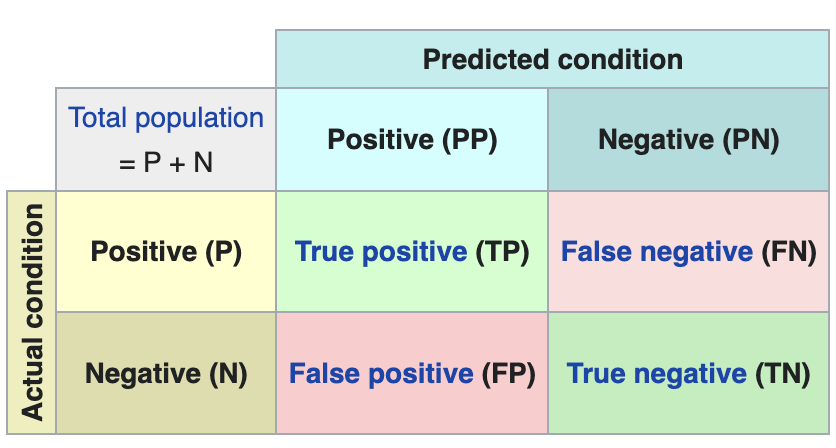
Explanatory example of how the confusion matrix works. Source: Wikipedia https://en.wikipedia.org/wiki/Confusion_matrix
In our exercise, the model gives us the following results:


In other words, 81 patients had this disease and the model classifies them correctly. Similarly, 91 patients were healthy and the model also classifies them correctly. However, the model classifies as sick 13 patients who were healthy. Conversely, the model classifies 12 patients who were actually sick as healthy. When we add the hits of the 81+91 model and divide it by the total validation sample, we obtain 87% accuracy of the model.
Conclusions
In this post we have guided you through a didactic exercise consisting of training an artificial intelligence model to carry out chest x-ray imaging classifications with the aim of determining automatically whether someone is sick or healthy. For the sake of simplicity, we have chosen healthy patients and patients with pneumothorax (only two categories) previously diagnosed by a doctor. The journey we have taken gives us an insight into the activities and technologies involved in automated image analysis using artificial intelligence. The result of the training affords us a reasonable classification system for automatic screening with 87% accuracy in its results. Algorithms and advanced image analysis technologies are, and will increasingly be, an indispensable complement in multiple fields and sectors, such as medicine. In the coming years, we will see the consolidation of systems which naturally combine the skills of humans and machines in expensive, complex or dangerous processes. Doctors and other workers will see their capabilities increased and strengthened thanks to artificial intelligence. The joining of forces between machines and humans will allow us to reach levels of precision and efficiency never seen before. We hope that through this exercise we have helped you to understand a little more about how these technologies work. Don't forget to complete your learning with the rest of the materials that accompany this post.
Content prepared by Alejandro Alija, an expert in Digital Transformation.The contents and points of view reflected in this publication are the sole responsibility of its author.

Documentación
We present a new report in the series 'Emerging Technologies and Open Data', by Alejandro Alija. The aim of these reports is to help the reader understand how various technologies work, what is the role of open data in them and what impact they will have on our society. This series includes monographs on data analysis techniques such as natural language analysis and predictive analytics. This new volume of the series analyzes the key aspects of data analysis applied to images and, through this exercise, Artificial Intelligence applied to the identification and classification of diseases by means of medical radio imaging, delves into the more practical side of the monograph.
Image analysis adopts different names and ways of referring to it. Some of the most common are visual analytics, computer vision or image processing. The importance of this type of analysis is of great relevance nowadays, since many of the most modern algorithmic techniques of artificial intelligence have been designed specifically for this purpose. Some of its applications can be seen in our daily lives, such as the identification of license plates to access a parking lot or the digitization of scanned text to be manipulated.
The report introduces the fundamental concepts that allow us to understand how image analysis works, detailing the main application cases in various sectors. After a brief introduction by the author, which will serve as a basis for contextualizing the subject matter, the full report is presented, following the traditional structure of the series:
- Awareness. The Awareness section explains the key concepts of image analysis techniques. Through this section, readers can find answers to questions such as: how are images manipulated as data, how are images classified, and discover some of the most prominent applications in image analysis.
- Inspire. The Inspire section takes a detailed look at some of the main use cases in sectors as diverse as agriculture, industry and real estate. It also includes examples of applications in the field of medicine, where the author shows some particularly important challenges in this area.
- Action: In this case, the Action section has been published in notebook format, separately from the theoretical report. It shows a practical example of Artificial Intelligence applied to the identification and classification of diseases using medical radio imaging. This post includes a step-by-step explanation of the exercise. The source code is available so that readers can learn and experiment by themselves the intelligent analysis of images.
Below, you can download the report - Awareness and Inspire sections - in pdf and word (reusable version).
Blog
The demand for professionals with skills related to data analytics continues to grow and it is already estimated that just the industry in Spain would need more than 90,000 data and artificial intelligence professionals to boost the economy. Training professionals who can fill this gap is a major challenge. Even large technology companies such as Google, Amazon or Microsoft are proposing specialised training programmes in parallel to those proposed by the formal education system. And in this context, open data plays a very relevant role in the practical training of these professionals, as open data is often the only possibility to carry out real exercises and not just simulated ones.
Moreover, although there is not yet a solid body of research on the subject, some studies already suggest positive effects derived from the use of open data as a tool in the teaching-learning process of any subject, not only those related to data analytics. Some European countries have already recognised this potential and have developed pilot projects to determine how best to introduce open data into the school curriculum.
In this sense, open data can be used as a tool for education and training in several ways. For example, open data can be used to develop new teaching and learning materials, to create real-world data-based projects for students or to support research on effective pedagogical approaches. In addition, open data can be used to create opportunities for collaboration between educators, students and researchers to share best practices and collaborate on solutions to common challenges.
Projects based on real-world data
A key contribution of open data is its authenticity, as it is a representation of the enormous complexity and even flaws of the real world as opposed to artificial constructs or textbook examples that are based on much simpler assumptions.
An interesting example in this regard is documented by Simon Fraser University in Canada in their Masters in Publishing where most of their students come from non-STEM university programmes and therefore had limited data handling skills. The project is available as an open educational resource on the OER Commons platform and aims to help students understand that metrics and measurement are important strategic tools for understanding the world around us.
By working with real-world data, students can develop story-building and research skills, and can apply analytical and collaborative skills in using data to solve real-world problems. The case study conducted with the first edition of this open data-based OER is documented in the book "Open Data as Open Educational Resources - Case studies of emerging practice". It shows that the opportunity to work with data pertaining to their field of study was essential to keep students engaged in the project. However, it was dealing with the messiness of 'real world' data that allowed them to gain valuable learning and new practical skills.
Development of new learning materials
Open datasets have a great potential to be used in the development of open educational resources (OER), which are free digital teaching, learning and research materials, as they are published under an open licence (Creative Commons) that allows their use, adaptation and redistribution for non-commercial uses according to UNESCO's definition.
In this context, although open data are not always OER, we can say that they become OER when are used in pedagogical contexts. Open data used as an educational resource facilitates students to learn and experiment by working with the same datasets used by researchers, governments and civil society. It is a key component for students to develop analytical, statistical, scientific and critical thinking skills.
It is difficult to estimate the current presence of open data as part of OER but it is not difficult to find interesting examples within the main open educational resource platforms. On the Procomún platform we can find interesting examples such as Learning Geography through the evolution of agrarian landscapes in Spain, which builds a Webmap for learning about agrarian landscapes in Spain on the ArcGIS Online platform of the Complutense University of Madrid. The educational resource uses specific examples from different autonomous communities using photographs or geolocated still images and its own data integrated with open data. In this way, students work on the concepts not through a mere text description but with interactive resources that also favour the improvement of their digital and spatial competences.
On the OER Commons platform, for example, we find the resource "From open data to civic engagement", which is aimed at audiences from secondary school upwards, with the objective of teaching them to interpret how public money is spent in a given regional, local area or neighbourhood. It is based on the well-known projects to analyse public budgets "Where do my taxes go?", available in many parts of the world as a result of the transparency policies of public authorities. This resource could be easily ported to Spain, as there are numerous "Where do my taxes go?" projects, such as the one maintained by Fundación Civio.
Data-related skills
When we refer to training and education in data-related skills, we are actually referring to a very broad area that is also very difficult to master in all its facets. In fact, it is common for data-related projects to be tackled in teams where each member has a specialised role in one of these areas. For example, it is common to distinguish at least data cleaning and preparation, data modelling and data visualisation as the main activities performed in a data science and artificial intelligence project.
In all cases, the use of open data is widely adopted as a central resource in the projects proposed for the acquisition of any of these skills. The well-known data science community Kaggle organises competitions based on open datasets contributed to the community and which are an essential resource for real project-based learning for those who want to acquire data-related skills. There are other subscription-based proposals such as Dataquest or ProjectPro but in all cases they use real datasets from multiple general open data repositories or knowledge area specific repositories.
Open data, as in other areas, has not yet developed its full potential as a tool for education and training. However, as can be seen in the programme of the latest edition of the OER Conference 2022, there are an increasing number of examples of open data playing a central role in teaching, new educational practices and the creation of new educational resources for all kinds of subjects, concepts and skills
Content written by Jose Luis Marín, Senior Consultant in Data, Strategy, Innovation & Digitalization.
The contents and views reflected in this publication are the sole responsibility of the author.
Blog
Perhaps one of the most everyday uses of artificial intelligence that we can experience in our day-to-day lives is through interaction with artificial vision and object identification systems. From unlocking our smartphone to searching for images on the Internet. All these functionalities are possible thanks to artificial intelligence models in the field of image detection and classification. In this post we compile some of the most important open image repositories, thanks to which we have been able to train current image recognition models.
Introduction
Let's go back for a moment to late 2017, early 2018. The possibility of unlocking our smartphones with some kind of fingerprint reader has become widespread. With more or less success, most manufacturers had managed to include the biometric reader in their terminals. The unlocking time, the ease of use and the extra security provided were exceptional compared to the classic systems of passwords, patterns, etc. As has been the case since 2008, the undisputed leader in digital innovation in mobile terminals - Apple - revolutionised the market once again by incorporating an innovative unlocking system in the iPhone X using an image of our face. The so-called FaceID system scans our face to unlock the terminal in tenths of a second without having to use our hands. The probability of identity theft with this system was 1 in 1,000,000; 20 times more secure than its predecessor TouchID
Let this little story about an everyday functionality be used to introduce an important topic in the field of artificial intelligence, and in particular in the field of computer image processing: AI model training image repositories. We have talked a lot in this space about this field of artificial intelligence. A few months after the launch of FaceID, we published a post on AI, in which we mentioned near-human-level image classification as one of the most important achievements of AI in recent years. This would not be possible without the availability of open banks of annotated images[1] to train image recognition and classification models. In this post we list some of the most important (freely available) image repositories for model training.
Of course, recognising the number plate of a vehicle at the entrance to a car park is not the same as identifying a lung disease in an X-ray image. The banks of annotated images are as varied as the potential AI applications they enable.
Probably the 2 best known image repositories are MNIST and ImageNET.
- MNIST, is a set of 70,000 black and white images of handwritten numbers normalised in size, ready to train number recognition algorithms. Professor LeCun's original paper is from 1998.
- ImageNET is a huge database of concepts (words or sets of words). Each concept with its own meaning is called a synset. Each synset is represented by hundreds or thousands of images. ImageNET's own website cites the project as an indispensable tool for the recent advancement of Deep Learning and computer vision.
The project has been instrumental in advancing computer vision and deep learning research. The data is available for free to researchers for non-commercial use
The most widely used subset of ImageNet is ImageNet Large Scale Visual Recognition Challenge ILSVRC, an image classification and localisation dataset. This image subset was used from 2010 to 2017 for the worldwide object detection and image classification competitions. This dataset covers 1000 object classes and contains more than one million training images, 50,000 validation images and 100,000 test images. This subset is available in Kaggle.
In addition to these two classic repositories that are already part of the history of image processing by artificial intelligence, we have some more current and varied thematic repositories. Here are some examples:
- The very annoying CAPTCHAs and reCAPTCHAs that we find on a multitude of websites to verify that we are human trying to access are a good example of artificial intelligence applied to the field of security. Of course, CAPTCHAs also need their own repository to check how effective they are in preventing unwanted access. We recommend reading this interesting article about the history of these web browsing companions.
- As we have seen several times in the past, one of the most promising applications of AI in the field of imaging is to assist physicians in diagnosing diseases from a medical imaging test (X-ray, CT scan, etc.). To make this a reality, there is no shortage of efforts to collect, annotate and make available to the research community repositories of quality, anonymised medical images to train models for detecting objects, shapes and patterns that may reveal a possible disease. Breast cancer are 30% of all cancers in women worldwide. Hence the importance of having image banks that facilitate the training of specific models.
- The diagnosis of blood-based diseases often involves the identification and characterisation of patient blood samples. Automated methods (using medical imaging) to detect and classify blood cell subtypes have important medical applications.
- Three years ago, Covid19 burst into our lives, turning developed societies upside down with this global pandemic with terrible consequences in terms of human and economic loss. The entire scientific community threw itself into finding a solution in record time to tackle the consequences of the new coronavirus. Many efforts were made to improve the diagnosis of the disease. Some techniques relied on AI-assisted image analysis. At the same time, health authorities incorporated a new element in our daily routine - face masks. Even today, in some situations the mask is still mandatory, and during these 3 years we have had to monitor its proper use in almost all kinds of places. So much so that in recent months there has been a proliferation of specific image banks to train AI and computer vision models to detect the use of masks autonomously.
- For more information on open repositories related to health and wellbeing, we leave you with this post we published a few months ago.
In addition to these curious examples cited in this post, we encourage you to explore Kaggle's section of datasets that include images as data. You only have 10,000 sets to browse through ;)
[1] Annotated image repositories contain, in addition to the image files (jpeg, tiff, etc.), descriptive files with metadata identifying each image. Typically, these files (csv, JSON or XML) include a unique identifier for each image as well as fields that provide information about the content of the image. For example, the name of the object that appears in the image.
Content prepared by Alejandro Alija, expert in Digital Transformation and Innovation.
The contents and views expressed in this publication are the sole responsibility of the author.
Blog
After several months of tests and different types of training, the first massive Artificial Intelligence system in the Spanish language is capable of generating its own texts and summarising existing ones. MarIA is a project that has been promoted by the Secretary of State for Digitalisation and Artificial Intelligence and developed by the National Supercomputing Centre, based on the web archives of the National Library of Spain (BNE).
This is a very important step forward in this field, as it is the first artificial intelligence system expert in understanding and writing in Spanish. As part of the Language Technology Plan, this tool aims to contribute to the development of a digital economy in Spanish, thanks to the potential that developers can find in it.
The challenge of creating the language assistants of the future
MarIA-style language models are the cornerstone of the development of the natural language processing, machine translation and conversational systems that are so necessary to understand and automatically replicate language. MarIA is an artificial intelligence system made up of deep neural networks that have been trained to acquire an understanding of the language, its lexicon and its mechanisms for expressing meaning and writing at an expert level.
Thanks to this groundwork, developers can create language-related tools capable of classifying documents, making corrections or developing translation tools.
The first version of MarIA was developed with RoBERTa, a technology that creates language models of the "encoder" type, capable of generating an interpretation that can be used to categorise documents, find semantic similarities in different texts or detect the sentiments expressed in them.
Thus, the latest version of MarIA has been developed with GPT-2, a more advanced technology that creates generative decoder models and adds features to the system. Thanks to these decoder models, the latest version of MarIA is able to generate new text from a previous example, which is very useful for summarising, simplifying large amounts of information, generating questions and answers and even holding a dialogue.
Advances such as the above make MarIA a tool that, with training adapted to specific tasks, can be of great use to developers, companies and public administrations. Along these lines, similar models that have been developed in English are used to generate text suggestions in writing applications, summarise contracts or search for specific information in large text databases in order to subsequently relate it to other relevant information.
In other words, in addition to writing texts from headlines or words, MarIA can understand not only abstract concepts, but also their context.
More than 135 billion words at the service of artificial intelligence
To be precise, MarIA has been trained with 135,733,450,668 words from millions of web pages collected by the National Library, which occupy a total of 570 Gigabytes of information. The MareNostrum supercomputer at the National Supercomputing Centre in Barcelona was used for the training, and a computing power of 9.7 trillion operations (969 exaflops) was required.
Bearing in mind that one of the first steps in designing a language model is to build a corpus of words and phrases that serves as a database to train the system itself, in the case of MarIA, it was necessary to carry out a screening to eliminate all the fragments of text that were not "well-formed language" (numerical elements, graphics, sentences that do not end, erroneous encodings, etc.) and thus train the AI correctly.
Due to the volume of information it handles, MarIA is already the third largest artificial intelligence system for understanding and writing with the largest number of massive open-access models. Only the language models developed for English and Mandarin are ahead of it. This has been possible mainly for two reasons. On the one hand, due to the high level of digitisation of the National Library's heritage and, on the other hand, thanks to the existence of a National Supercomputing Centre with supercomputers such as the MareNostrum 4.
The role of BNE datasets
Since it launched its own open data portal (datos.bne.es) in 2014, the BNE has been committed to bringing the data available to it and in its custody closer: data on the works it preserves, but also on authors, controlled vocabularies of subjects and geographical terms, among others.
In recent years, the educational platform BNEscolar has also been developed, which seeks to offer digital content from the Hispánica Digital Library's documentary collection that may be of interest to the educational community.
Likewise, and in order to comply with international standards of description and interoperability, the BNE data are identified by means of URIs and linked conceptual models, through semantic technologies and offered in open and reusable formats. In addition, they have a high level of standardisation.
Next steps
Thus, and with the aim of perfecting and expanding the possibilities of use of MarIA, it is intended that the current version will give way to others specialised in more specific areas of knowledge. Given that it is an artificial intelligence system dedicated to understanding and generating text, it is essential for it to be able to cope with lexicons and specialised sets of information.
To this end, the PlanTL will continue to expand MarIA to adapt to new technological developments in natural language processing (more complex models than the GPT-2 now implemented, trained with larger amounts of data) and will seek ways to create workspaces to facilitate the use of MarIA by companies and research groups.
Content prepared by the datos.gob.es team.
Evento
Data has become one of the pillars of society's digital transformation process, which also challenges sectors such as justice and law enforcement. Thanks to them, access to information and statistics has been improved, allowing decision-making to be based on objective figures to which new techniques such as automation and artificial intelligence can be applied.
Thus, and with the aim of continuing to delve into the advantages derived from the data ecosystem, on 17 and 18 October, the University of Salamanca is organising, in collaboration with the Ministry of Justice, a symposium on Justice and Data.
What will be the themes to be addressed?
During the two days of the event and through the various presentations, the aim will be to discuss "the role of data for the proper functioning of public services". In other words, how open data can help to improve the efficiency and effectiveness with regard to citizens and the services offered to them.
In line with this idea, the questions that will form part of the symposium will revolve around the following themes:
- Personalised assistants
- Data Analytics
- Designing Data Visualisations
- Governance, Transparency and Open Data
- AI - NLP
- AI - Other
- Robotisation
- Data Sharing Spaces
- Data, AI, RPA Training
Thus, while the first day will be made up of conferences by relevant people from the Justice, Law and academic sectors, the second day will showcase the different initiatives of the international technology sector and the legal-tech sector related to data.
Likewise, in simultaneous rooms, public and private projects in which technology is applied to the services of Justice and Law will be analysed.
In conclusion, it is an event that seeks to become a meeting point for innovation in the field of justice. So that, through the exchange of experiences and success stories, between the administration, institutions and private companies in any field, it will be possible to guide the use of data to provide and give solutions to specific problems.
How can I attend?
Attendance at the conference will be free of charge and will take place at the Hospederia Arzobispo Fonseca in Salamanca. In order to attend, it will be necessary to fill in the following registration form. As with other similar events, this one will also be broadcast live online.
Blog
According to the latest analysis conducted by Gartner in September 2021, on Artificial Intelligence trends, Chatbots are one of the technologies that are closest to deliver effective productivity in less than 2 years. Figure 1, extracted from this report, shows that there are 4 technologies that are well past the peak of inflated expectations and are already starting to move out of the valley of disillusionment, towards states of greater maturity and stability, including chatbots, semantic search, machine vision and autonomous vehicles.
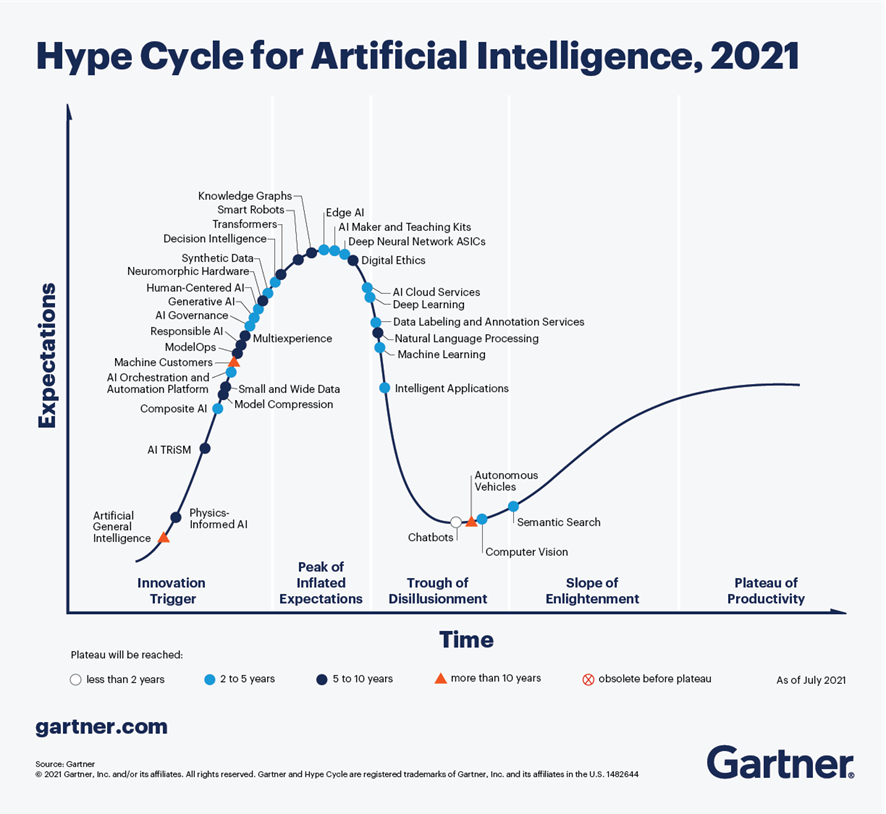
Figure 1-Trends in AI for the coming years.
In the specific case of chatbots, there are great expectations for productivity in the coming years thanks to the maturity of the different platforms available, both in Cloud Computing options and in open source projects, especially RASA or Xatkit. Currently it is relatively easy to develop a chatbot or virtual assistant without AI knowledge, using these platforms.
How does a chatbot work?
As an example, Figure 2 shows a diagram of the different components that a chatbot usually includes, in this case focused on the architecture of the RASA project.
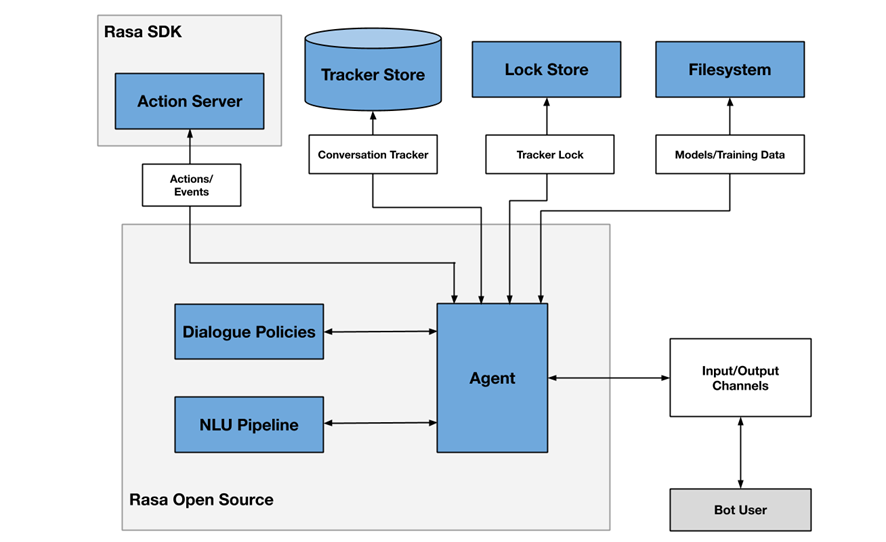
Figure 2- RASA project architecture
One of the main components is the agent module, which acts as a controller of the data flow and is normally the system interface with the different input/output channels offered to users, such as chat applications, social networks, web or mobile applications, etc.
The NLU (Natural Languge Understanding) module is responsible for identifying the user's intention (what he/she wants to consult or do), entity extraction (what he/she is talking about) and response generation. It is considered a pipeline because several processes of different complexity are involved, in many cases even through the use of pre-trained Artificial Intelligence models.
Finally, the dialogue policies module defines the next step in a conversation, based on context and message history. This module is integrated with other subsystems such as the conversation store (tracker store) or the server that processes the actions necessary to respond to the user (action server).
Chatbots in open data portals as a mechanism to locate data and access information
There are more and more initiatives to empower citizens to consult open data through the use of chatbots, using natural language interfaces, thus increasing the net value offered by such data. The use of chatbots makes it possible to automate data collection based on interaction with the user and to respond in a simple, natural and fluid way, allowing the democratization of the value of open data.
At SOM Research Lab (Universitat Oberta de Catalunya) they were pioneers in the application of chatbots to improve citizens' access to open data through the Open Data for All and BODI (Bots to interact with open data - Conversational interfaces to facilitate access to public data) projects. You can find more information about the latter project in this article.
It is also worth mentioning the Aragón Open Data chatbot, from the open data portal of the Government of Aragón, which aims to bring the large amount of data available to citizens, so that they can take advantage of its information and value, avoiding any technical or knowledge barrier between the query made and the existing open data. The domains on which it offers information are:
- General information about Aragon and its territory
- Tourism and travel in Aragon
- Transportation and agriculture
- Technical assistance or frequently asked questions about the information society.
Conclusions
These are just a few examples of the practical use of chatbots in the valorization of open data and their potential in the short term. In the coming years we will see more and more examples of virtual assistants in different scenarios, both in the field of public administrations and in private services, especially focused on improving user service in e-commerce applications and services arising from digital transformation initiatives.
Content prepared by José Barranquero, expert in Data Science and Quantum Computing.
The contents and points of view reflected in this publication are the sole responsibility of the author.
Evento
The pandemic situation we have experienced in recent years has led to a large number of events being held online. This was the case of the Iberian Conference on Spatial Data Infrastructures (JIIDE), whose 2020 and 2021 editions had a virtual format. However, the situation has changed and in 2022 we will be able to meet again to discuss the latest trends in geographic information.
Seville will host JIIDE 2022
Seville has been the city chosen to bring together all those professionals from the public administration, private sector and academia interested in geographic information and who use Spatial Data Infrastructures (SDI) in the exercise of their activities.
Specifically, the event will take place from 25 to 27 October at the University of Seville. You can find more information here.
Focus on user experience
This year's slogan is "Experience and technological evolution: bringing the SDI closer to citizens". The aim is to emphasise new technological trends and their use to provide citizens with solutions that solve specific problems, through the publication and processing of geographic information in a standardised, interoperable and open way.
Over three days, attendees will be able to share experiences and use cases on how to use Big Data, Artificial Intelligence and Cloud Computing techniques to improve the analysis capacity, storage and web publication of large volumes of data from various sources, including real-time sensors.
New specifications and standards that have emerged will also be discussed, as well as the ongoing evaluation of the INSPIRE Directive.
Agenda now available
Although some participations are still to be confirmed, the programme is already available on the conference website. There will be around 80 communications where experiences related to real projects will be presented, 7 technical workshops where specific knowledge will be shared and a round table to promote debate.
Among the presentations there are some focused on open data. This is the case of Valencia City Council, which will talk about how they use open data to obtain environmental equity in the city's neighbourhoods, or the session dedicated to the "Digital aerial photo library of Andalusia: a project for the convergence of SDIs and Open-Data".
How can I attend?
The event is free of charge, but to attend you need to register using this form. You must indicate the day you wish to attend.
For the moment, registration is open to attend in person, but in September, the website of the conference will offer the possibility of participating in the JIIDE virtually.
Organisers
The Jornadas Ibéricas de Infraestructuras de Datos Espaciales (JIIDE) were born from the collaboration of the Directorate General of Territory of Portugal, the National Geographic Institute of Spain and the Government of Andorra. On this occasion, the Institute of Statistics and Cartography of Andalusia and the University of Seville join as organisers.
Noticia
Artificial intelligence (AI) has been pervasive in our lives for several years now. While there is no exact definition of AI, one description could be "the ability of a machine to display human-like capabilities such as reasoning, learning, planning and creativity". This process is done through the creation and application of algorithms. In other words, AI refers to the ability of computers, software and other machines to think and act as humans would.
Artificial intelligence allows the development of different use cases that facilitate decision-making or provide solutions to complex problems. As a result, artificial intelligence has been able to revolutionise not only the business world but also the social sphere, with applications ranging from the rapid detection of cancer to the fight against deforestation in the Amazon, to name but a few examples.
Given all these advantages, it is not surprising that in recent years the demand for professional profiles related to this field has grown. Therefore, here are some examples of interesting courses and training that could help you to broaden your knowledge of artificial intelligence.
Online courses
Elements of AI
- Taught by: University of Helsinki and Reaktor
- Duration: 50 hours
- Language: English
- Price: Free
This massive open educational project (MOOC), which has already enrolled more than 750,000 students, offers you the opportunity to learn what artificial intelligence is, as well as showing how it can affect your work and personal life and how it will evolve in the coming years.
This course, which offers all citizens the possibility of training and first-hand knowledge of how AI works and the opportunities it offers, has been promoted in our country by the Secretary of State for Digitalisation and Artificial Intelligence together with the UNED.
Building AI
- Taught by: University of Helsinki and Reaktor
- Duration: 50 hours
- Language: English
- Price: Free
The authors of the previous course launched this new course some time later with the aim of closing the gap between courses for beginners such as 'Elements of AI' and the vast majority of training courses in this field, which usually present a more advanced level.
This course, which starts where the previous one ends, will help you to delve deeper into elements such as machine learning, neural networks or some practical applications of AI. It also offers you the option of setting up your first artificial intelligence project and getting started in programming if you wish.
Specialised programme: Introduction to artificial intelligence
- Taught by: Coursera (UNAM)
- Duration: 8 meses
- Language: Spanish
- Price: Free
This course is aimed at people who are interested in learning more about the different developments that have been generated over the last few years in the field of artificial intelligence.
If you opt for this training you will learn how to implement AI technology for a specific purpose, how to compare the solution you have developed with other existing ones or how to report the results obtained in a structured test.
Machine Learning Crash Course
- Taught by: Google
- Duration: 15 hours
- Idioma: English
- Price: Free
Through this course you will learn some key concepts such as the detailed study of machine learning and you will take your first steps with the TensorFlow API, among others.
To attend this course, it is recommended: some programming experience (preferably in Python), basic knowledge of machine learning, statistics, linear algebra and calculus.
Machine Learning
- Taught by: Coursera (Stanford)
- Duration:: 60 hours
- Language: English (English subtitles)
- Price: Free (47€ if you wish to apply for a certificate)
This is a MOOC on machine learning created by Andrew Ng, founder of the Google Brainproject in 2011 and the online course platform Coursera.
Through this course you will cover topics such as supervised and unsupervised learning, statistical pattern recognition or the application of 'best practices' in this field. In addition, you will also learn how to apply learning algorithms to the construction of intelligent robots, among many other aspects.
Masters
The current training offer on artificial intelligence does not only come in the form of courses. An increasing number of universities and study centres are offering their students specialised programmes and university master's degrees related to the field of AI. Here are just a few examples:
- Official Master's Degree in Computer Security and AI, Rovira i Virgili University (60 ECTS credits, one academic year): its programme covers research topics related to information protection, application security, machine learning, modelling and problem solving, among others.
- University Master's Degree in Artificial Intelligence, University of Santiago de Compostela (USC) (90 ECTS credits, 18 months): it offers students the possibility of broadening their knowledge in areas such as natural language processing, robotics, AI fundamentals or data engineering.
- Master's Degree in Intelligent Systems and Numerical Applications in Engineering, University of Las Palmas de Gran Canaria (ULPGC) (60 ECTS credits, 1 academic year): it introduces students to the bases and fundamentals of some leading areas such as computational modelling and numerical simulation of engineering problems, the use and development of intelligent and autonomous systems, or methods of data analysis and interpretation.
- Master in Artificial Intelligence, Universitat Politécnica de Catalunya (90 ECTS credits, 18 months): it offers a solid foundation and advanced knowledge in artificial intelligence. In this master's degree you will learn key concepts in computational intelligence, computer vision and multi-agent systems.
- Master's Degree in Applied Artificial Intelligence, Universidad Carlos III Madrid (60 ECTS credits, 1 academic year): it allows students to understand the most relevant AI methods and techniques and apply them to develop appropriate solutions to different types of problems.
- Master's Degree in Artificial Intelligence, UNIR (60 ECTS credits, 1 academic year): in this master's degree you will learn techniques of computational perception and artificial vision, automatic reasoning and planning, machine learning and deep learning, Natural Language Processing, as well as the technologies needed to implement them.
- Master's Degree in AI Research, Spanish Association for Artificial Intelligence (AEPIA) (60 ECTS credits, one academic year): it has three specialisations: Learning and Data Science, Web Intelligence and Reasoning and Planning.
- Master in Artificial Intelligence, Universidad Europea (30 ECTS credits, 8 months): aimed at providing students with an integrated vision of Artificial Intelligence and the mastery of advanced Machine Learning and Computational Optimisation techniques.
This has been just a small compilation of training courses related to the field of artificial intelligence that we hope will be of interest to you. If you know of any other course or master's degree that you would like to recommend, do not hesitate to leave us a comment or send us an email to dinamizacion@datos.gob.es.
Entrevista
The AMETIC association represents companies of all sizes linked to the Spanish digital technology industry, a key sector for the national GDP. Among other issues, AMETIC seeks to promote a favorable environment for the growth of companies in the sector, promoting digital talent and the creation and consolidation of new companies.
At datos.gob.es we spoke with Antonio Cimorra, Director of Digital Transformation and Enabling Technologies at AMETIC, to reflect on the role of open data in innovation and as the basis for new products, services and even business models.
Full interview:
1. How does open data help drive digital transformation? What disruptive technologies are the most benefited by the opening of data?
Open data is one of the pillars of the data economy , which is called to be the basis of our present and future development and the digital transformation of our society. All industries, public administrations and citizens themselves have only just begun to discover and use the enormous potential and usefulness that the use of data brings to improving the competitiveness of companies, to the efficiency and improvement of services. of Public Administrations and to social relations and people's quality of life.
2. One of the areas in which they work from AMETIC is Artificial Intelligence and Big Data, among whose objectives is to promote the creation of public platforms for sharing open data. Could you explain to us what actions you are carrying out or have carried out for this?
At AMETIC we have an Artificial Intelligence and Big Data Commission in which the main companies that provide this technology participate . From this area, we work on the definition of initiatives and proposals that contribute to disseminating their knowledge among potential users, with the consequent advantages that their incorporation in the public and private sectors entails. Outstanding examples of actions in this area are the recent presentation of the AMETIC Artificial Intelligence Observatory, as well as the AMETIC Artificial Intelligence Summit. which in 2022 will celebrate its fifth edition that will focus on showing how Artificial Intelligence can contribute to meeting the Sustainable Development Goals and the Transformation Plans to be executed with European Funds
3. Open data can serve as a basis for developing services and solutions that give rise to new companies . Could you tell us an example of a use case carried out by your partners?
Open data, and very particularly the reuse of public sector information, are the basis for the development of countless applications and entrepreneurial initiatives both in consolidated companies in our technology sector and in many other cases of small companies or startups found in this source of information the motor of development of new businesses and approach to the market.
4. What types of data are most in demand by the companies you represent?
At present, all industrial and social activity data are in great demand by companies , due to their great value in the development of projects and solutions that have been demonstrating their interest and extension in all areas and types of organizations and users. usually.
5. It is also essential to have data sharing initiatives such as GAIA-X , built on the values of digital sovereignty and data availability. How have companies received the creation of a national hub ?
The technology sector has received the creation of the GAIA-X national hub very positively, understanding that our contribution from Spain to this European project will be of enormous value to our companies from very different fields of activity. Data sharing spaces in sectors such as tourism, health, mobility, industry, to give a few examples, have Spanish companies and experiences that are an example and a reference at European and global level .
6. Right now there is a great demand for professionals related to data collection, analysis and visualization. However, the supply of professionals, although it is growing, continues to be limited . What should be done to boost training in skills related to data and digitization?
The supply of technology professionals is one of the biggest problems for the development of our local industry and for the digital transformation of society. It is a difficulty that we can describe as historical, and that far from going less, every day there is a greater number of positions and profiles to cover. It is a worldwide problem that shows that there is no single or simple formula to solve it, but we can mention the importance of all social and professional agents developing joint and collaborative actions that allow the digital training of our population from an early age. and cycles and specialized training and degree programs that are characterized by their proximity to what will be the professional careers for which it is necessary to have the participation of the business sector
7. During the last years, you have been part of the jury of the different editions of the Aporta Challenge. How do you think these types of actions contribute to boosting data-driven businesses?
The Aporta Challenge has been an example of support and encouragement for the definition of many projects around open data and for the development of its own industry that in recent years has been growing very significantly with the availability of data of very different groups, in many cases by the Public Administrations, and their subsequent reuse and incorporation into applications and solutions of interest to very different users.
Open data constitutes one of the pillars of the data economy, which is called to be the basis of our present and future development and of the digital transformation of our society.
8. What are the next actions that are going to be carried out in AMETIC linked to the data economy?
Among the most outstanding actions of AMETIC in relation to the data economy, it is worth mentioning our recent incorporation into the national hub of GAIA-X for which we have been elected members of its board of directors, and where we will represent and incorporate the vision and contributions of the digital technology industry in all the data spaces that are constituted , serving as a channel for the participation of the technology companies that carry out their activity in our country and that have to form the basis of the projects and use cases that integrate into the European network GAIA-X in collaboration with other national hubs.