


Blog
The favorable regime of access to environmental information
Environmental legislation has traditionally been characterized by establishing a more beneficial legal regime than that which has inspired the general rules on access to information held by the public sector. Indeed, the Aarhus Convention, adopted in 1998, was an important milestone in recognizing the right of access to environmental information under very advanced legal conditions, imposing relevant obligations on public authorities. Specifically, the Convention starts from an inescapable premise: in order for society to enjoy the right to a healthy environment and fulfill its duty to respect and protect it, it must have relevant access to environmental information. To this end, on the one hand, the right to obtain information held by public authorities was recognized and, on the other, an obligation was established for the latter to make certain information public without prior request.
In execution of said international treaty and, specifically, of the obligations assumed by the European Union through Directive 2003/4/EC of the European Parliament and of the Council, of January 28, 2003, on public access to environmental information, Law 27/2006, of July 18, regulating the rights of access to information, public participation and access to justice in environmental matters, was approved. Unlike the general regime contemplated in Law 19/2013, of December 9, on transparency, access to public information and good governance, Law 27/2006 does not contain any reference to open and reusable formats. However, it does include the following developments:
- establishes the obligation to provide the information even when, without having generated it directly in the exercise of its functions, it is in the possession of the entity from which it is requested;
- requires that the grounds for refusal of the request for access be interpreted in a restrictive manner, so that in case of doubt when interpreting the exceptions provided by law, access to information must be favored;
- for those cases in which the request is not resolved and notified within the established period, the rule of positive silence is applied and, therefore, access will be understood to be granted.
The impact of regulations on open data and reuse of public sector information
As in the previous regulation, Directive (EU) 1024/2019 excludes its application in those cases in which the corresponding regulation of the Member States limits access. This would not be, therefore, the case of the environment sector, since, apart from the cases in which access is not applicable, in general the availability of the information is especially assured. Consequently, except for the legal exceptions to the obligation to provide environmental information, there are no specific restrictions that would be an obstacle to facilitating its reuse.
On the other hand, one of the main novelties of European legislation is a measure that ultimately obliges the Member States to adapt their regulations regarding access to environmental information. Indeed, Chapter V of the Directive establishes a unique regime for the so-called high-value datasets, which, in general, will be available free of charge, machine-readable, provided through APIs and, where appropriate, provided in the form of bulk download. Precisely, this very favorable legal regime is envisaged, among others, for the field of Earth Observation and Environment, although the specific datasets to which it will apply are still pending a decision by the European Commission after the elaboration of an extensive impact analysis whose final result is yet to be finalized.
On the other hand, following the European regulatory model, among the novelties that Royal Decree-Law 24/2021, of November 2, has incorporated into Spanish legislation on the reuse of public sector information, one that stands out is one referring to high-value data. Specifically, Article 3.ter of Law 37/2007 contemplates the possibility that, in addition to the datasets established by the European Commission, others may be added at the national level by the Ministry of Economic Affairs and Digital Transformation, taking into account the selection made by the Data Office Division, so that those specifically referring to the environment could be extended, where appropriate.
The potential for high-value environmental data
As the European regulation itself points out, the reuse of high-value datasets is seen as a tool to facilitate, among other objectives, the creation and dynamization of value-added digital applications and services that have the potential to generate considerable benefits for society, the environment and the economy. Thus, in this area, open data can play an important role in tackling technological innovation to address challenges of enormous relevance such as climate change, deforestation and, in general, the challenges posed by environmental conservation.
On the other hand, the development of digital applications and services can serve to revitalize rural areas and promote tourism models that value the knowledge and protection of natural resources, especially taking into account the rich and varied natural heritage existing in Spain, for which it is essential to have specific datasets, particularly with regard to natural areas.
Ultimately, from the perspective and demands of Open Government, the accessibility of environmental information, according to the standards of high-value data in accordance with the provisions of the regulations on the reuse of public sector information, could have a significant reinforcement by facilitating social control regarding the decisions of public entities and citizen participation. However, for this it is essential to overcome the model on which the regulatory framework on access to environmental information has traditionally been based, since, although at the time it represented a significant advance, the fact is that the 2006 regulation does not include any reference to the possibilities of technological innovation based on open data.
In short, it seems that the time has come to raise a debate about an eventual update of the sectorial regulation on access to environmental information in order to comply with the requirements of the legal regime contemplated in Directive (EU) 1024/2019.
Content prepared by Julián Valero, Professor at the University of Murcia and Coordinator of the Research Group "Innovation, Law and Technology" (iDerTec).
The contents and points of view reflected in this publication are the sole responsibility of its author.

Blog
Why a Royal Decree-Law?
In the plenary session of the Congress of Deputies held on December 2, 2021, Royal Decree-Law 24/2021, of November 2, on the transposition of several European Union directives, including Directive (EU) 2019/1024 of the European Parliament and of the Council, of June 20, 2019, on open data and the reuse of public sector information, was validated. With this new regulation, the provisions of Law 37/2007, of November 16, on the reuse of public sector information have been modified.
What are the main novelties of this regulation?
The content of the new legal regulation is substantially focused on the incorporation of the provisions of the 2019 Directive to the text of the Spanish Law of 2017, although it is necessary to take into account that those precepts that could be directly applied were already in force since the end of the deadline for its transposition in July 2021. However, apart from updating some already outdated legal references -specifically on personal data protection, public sector legal regime and administrative procedure-, on the occasion of the transposition, some relevant novelties have been added that go beyond the mere adaptation of the European regulation. Thus:
- From the point of view of its subjective scope, the legislation will be applicable to all entities to which, according to the terms provided in their regulatory regulations, the regulations governing the common administrative procedure are applicable. This would be the case, for example, of private law entities linked to or dependent on Public Administrations when they exercise administrative powers.
- The reuse of documents to which access is excluded or limited for reasons of protection of sensitive information on critical infrastructures is expressly excluded from the legal regulation.
- As regards high-value data, alongside those established by the European Commission (i.e. geospatial, Earth observation and environment, meteorology, statistics, companies, as well as mobility), additional datasets may also be specified by the Ministry of Economic Affairs and Digital Transformation, specifically through the selection and updating carried out by the Data Office Division with the collaboration of the stakeholders, both public and private. In this regard it is important to recall that, as a general rule, these data will be freely available, machine-readable, provided through APIs and, where appropriate, provided in the form of bulk download.
- When making high-value data available free of charge could have a substantial impact on the budget of bodies and entities governed by public law that must obtain income to finance their public service activity, the Public Administration to which they are linked, or on which they depend, will be competent to exempt them from this obligation. Consequently, such bodies and entities would not be able to take this decision on their own.
- The scope of the reusable public information catalog is projected -at least potentially- beyond the scope of the General State Administration and its public bodies, so that other entities that decide to create their own catalogs that are interoperable with the national one are required to do so. This is an instrument whose practical relevance is reinforced by the fact that, through it, information will be provided on the rights legally provided for reuse, help systems will be offered and datasets will be made available in accessible, easy to locate and reusable formats.
- En cuanto al sometimiento a las normas legales sobre procedimiento de tramitación de solicitudes de reutilización, las sociedades mercantiles, centros de enseñanza, organismos de investigación o entidades que realicen actividades de investigación quedarán exentos.
- Regarding the submission to the legal rules on the procedure for processing requests for reuse, corporations, educational institutions, research organizations or entities that carry out research activities will be exempted.
- From the organizational point of view, each entity is required to designate a unit responsible for ensuring the availability of its information. Among the functions that will correspond to these units are those related to the coordination of reuse activities with existing policies on publications, administrative information and electronic administration; providing information on which bodies are competent in each area; promoting the updating and making information available in appropriate formats; as well as promoting awareness and training activities.
In any case, in the aforementioned parliamentary session, it was unanimously decided to proceed with the processing of the initiative as a bill through the urgency procedure, one of the possibilities provided for in Article 86 of the Constitution when it comes to validating decree-laws. Consequently, a legislative initiative will have to be processed following the regulatory channels established for this type of cases, which will allow the various parliamentary groups to propose amendments that, if approved, would be incorporated into the final text of the legislation on the reuse of public sector information and open data.
Content prepared by Julián Valero, Professor at the University of Murcia and Coordinator of the Research Group "Innovation, Law and Technology" (iDerTec).
The contents and points of view reflected in this publication are the sole responsibility of its author.
Blog
Last September, an international congress was held at the University of Alicante, which addressed some of the main challenges posed by open data and the reuse of public sector information from a legal perspective.
The inaugural conference was given by Kiko Llaneras, who made, from his own journalistic experience, a suggestive presentation on the role played by data in the communication processes during the management of the pandemic. Specifically, he explained that almost 20% of the most read news items during the pandemic were stories based on data. In his opinion, this is a trend that goes beyond circumstantial reasons and is due to a greater interest in this type of methodology, particularly in making the understanding of complex subjects more accessible. The speaker concluded by emphasizing the need to make data available in better conditions in terms of their accessibility, the formats in which they are available, their updating and their integration when they come from different sources.
The first round table of the congress was dedicated monographically to the field of tourism. Despite the efforts and progress that have been made in this essential area of the Spanish economy, the speakers highlighted two challenges still to be addressed with regard to the promotion of open data. On the one hand, the information made available by public entities is fragmented and heterogeneous, not only because of the plurality of the datasets published but, above all, because of the difficulties of integrating their automated processing; difficulties that are increased with regard to data with tourist relevance offered by private sector entities - search engines, social networks, information society service providers which, as is evident, are not subject to legislation on open data and reuse of public sector information. On the other hand, the difficulties encountered by many of the municipalities, largely due to their limited material and human resources, were highlighted when it comes to committing to advanced tourism management based on data management, which requires the support and assistance of the State and the Autonomous Communities in particular if the aim is to encourage the opening of data in this sector.
The second round table addressed the challenges posed by open data and the reuse of information in the field of public sector procurement, with a special focus on the proposal to incorporate this area into the categories of high-value data. Even though the establishment of an unavoidable legal obligation to use open and reusable formats was an important step forward in terms of contractor profiles and procurement platforms, the need to advance in the implementation of this important measure was highlighted during the debate. On the other hand, the limited scope of the legal regulation was noted, since it does not cover the entire contracting process, since it does not reach the phase related to the execution of the contract, which undoubtedly represents a major obstacle when it comes to facilitating not only accountability but also the dynamization of the market in this important economic sector. Finally, among other pending issues, emphasis was placed on the suitability of an eventual establishment of common criteria for document management by the numerous and diverse bodies and entities subject to the Public Sector Contracts Law, so as to pave the way towards a specific standardization in this sector, a necessary condition for the full integration of data when it is intended to reuse them to provide value-added services at the state or European level.
The third round table was devoted to reviewing the singularities in the field of the environment, urban planning and land use planning. In this respect, the environmental sector was highlighted, given its traditional legal regime, especially reinforced in terms of the possibilities of access to information, a regulation that undoubtedly explains why open data has a relevant potential when facing the most complicated challenges, as demonstrated by the existence of interesting specific applications. In general terms, and from a legal point of view, it was emphasized that these are sectors characterized by a significant technical component, so that open data have an undeniable value, particularly in terms of strengthening the possibilities of control by citizens and also in terms of their effective participation in these matters.
Finally, the congress closed with an international round table, which analysed the regulation of open data in several European Union States, showing that the process of transposition of Directive 2019/1024 is being irregular and, in fact, most of the European Union States have not yet approved their own regulations. Furthermore, one of the main new features of the Directive, the identification of high-value data, which is undoubtedly a tool that will play an essential role, has yet to be implemented by the European Commission.
In short, the speeches and debates that took place during the Congress showed the need to make a firm commitment to a public management model in which data and, in particular, its openness and the consequent possibility of its reuse, take on a greater role. All of this is consistent with the possibilities of digital transformation enabled by the technology available to meet the major challenges that lie ahead in the immediate future.
Content prepared by Julián Valero, Professor at the University of Murcia and Coordinator of the Research Group "Innovation, Law and Technology" (iDerTec).
The contents and views expressed in this publication are the sole responsibility of the author.
Blog
The year 2021 is undoubtedly a crucial period for the definitive progress in a regulatory and institutional framework that will enable the promotion of data strategies at both national and European level. As regards the latter, as has been advanced through various media, the main initiative refers to the foreseeable approval of a new data governance framework already announced with the draft Regulation made public in November 2020. As can be seen in this outline, this regulation is set to become one of the cornerstones of European policy on open data.
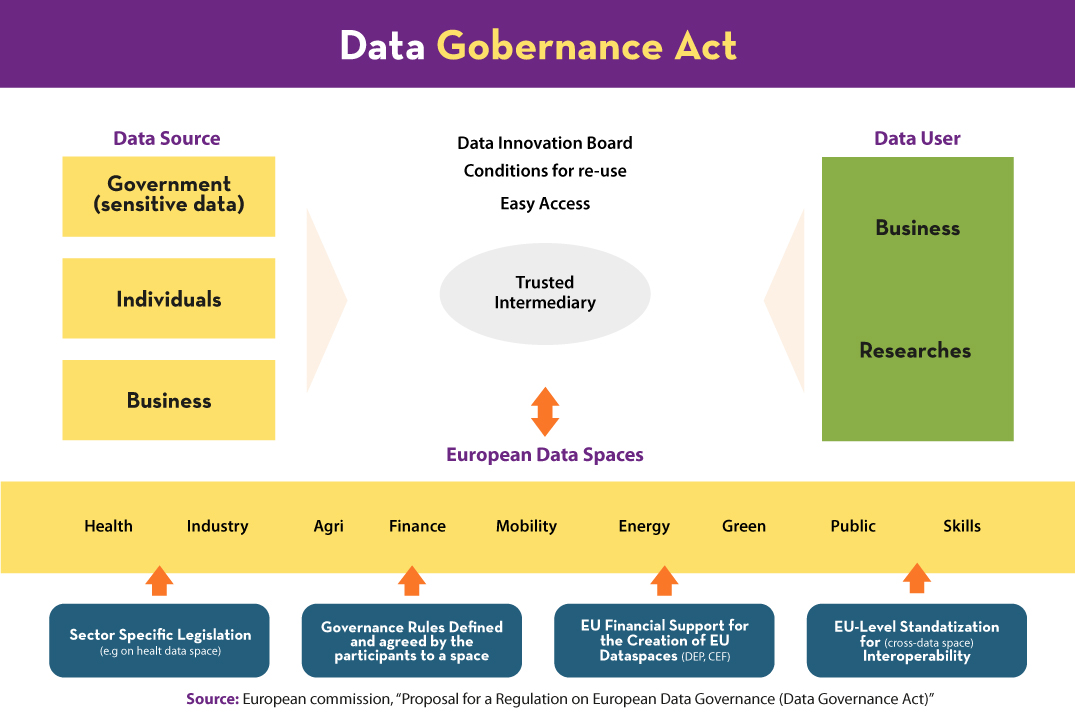
As a basis for the proposal for a Regulation on data governance, an impact assessment has been carried out beforehand, which has considered various analytical criteria, in addition to assessing the cost-benefit ratio of each of the measures envisaged. Specifically, the impact assessment identified several regulatory options of varying intensity in relation to the four main challenges identified:
- Identifying mechanisms to improve the re-use of public sector data
- Promoting trust in intermediaries
- Facilitating the transfer of data for altruistic purposes
- Fostering horizontal aspects of governance.
The evaluation found that there are barriers related to difficulties in accessing data, mostly related to technical aspects and data quality, but other barriers are also highlighted, such as those related to denial of access or the setting of unfair or prohibitive conditions, both financial and otherwise.
Throughout the process of preparing the impact assessment, evidence has been gathered through different and complementary methodologies, such as case studies and workshops on the possible existence of third-party rights hindering re-use and on governance structures; market studies on the role of intermediaries; and legal analysis, in particular on altruism in the release of data.
The different regulatory options considered ranged from no general measures at all (although they could be considered in relation to specific sectoral areas or, where appropriate, by Member States), to high/low intensity regulatory measures, without ruling out simple coordination based on guidelines and recommendations.
What were the different regulatory options envisaged in each of the above areas and why have some been prioritised over others?
Mechanisms to improve the re-use of public sector data
As a low-intensity measure - finally chosen - it was envisaged that Member States should establish a one-stop shop that would allow re-users to contact public sector bodies and even offer them advice, in particular to facilitate the re-use of publicly owned data subject to third party rights under certain conditions. The more demanding option, which was discarded in the final proposal, was instead to oblige them to set up a single body with decision-making powers, although this would entail significant legal and institutional challenges and more rigidity.
Promoting trust in intermediaries
In this respect, the approach is to seek to strengthen the role of intermediaries in fostering reliable data exchange systems both in business-to-business (B2B) and consumer-to-business (C2B) scenarios. In particular, while the less intensive alternative focused on an EU-wide voluntary labelling/certification scheme for such intermediaries, the more demanding option would have been to make such schemes mandatory. The major difficulties relating to the lack of an appropriate industry forum for the development of such a model and the difficulties in setting neutrality criteria, as well as the risk of fragmentation, led the draft Regulation to incorporate the first of the alternatives.
Facilitating the transfer of data for altruistic purposes
In relation to this objective, the aim was to ensure the availability of more data for the common good by increasing trust in systems inspired by altruism in the provision of data. Thus, a choice was made between requiring States to establish voluntary certification schemes for the implementation of data altruism mechanisms and/or for the entities that offer them or, on the contrary, opting for a model based on the need to have an authorisation to carry out such activities. This authorisation, granted by a public authority in advance and valid in the rest of the Member States, would aim at verifying whether the requirements laid down by law are actually met. The latter alternative was finally chosen in order to strengthen confidence in such entities and arrangements.
Fostering horizontal aspects of governance
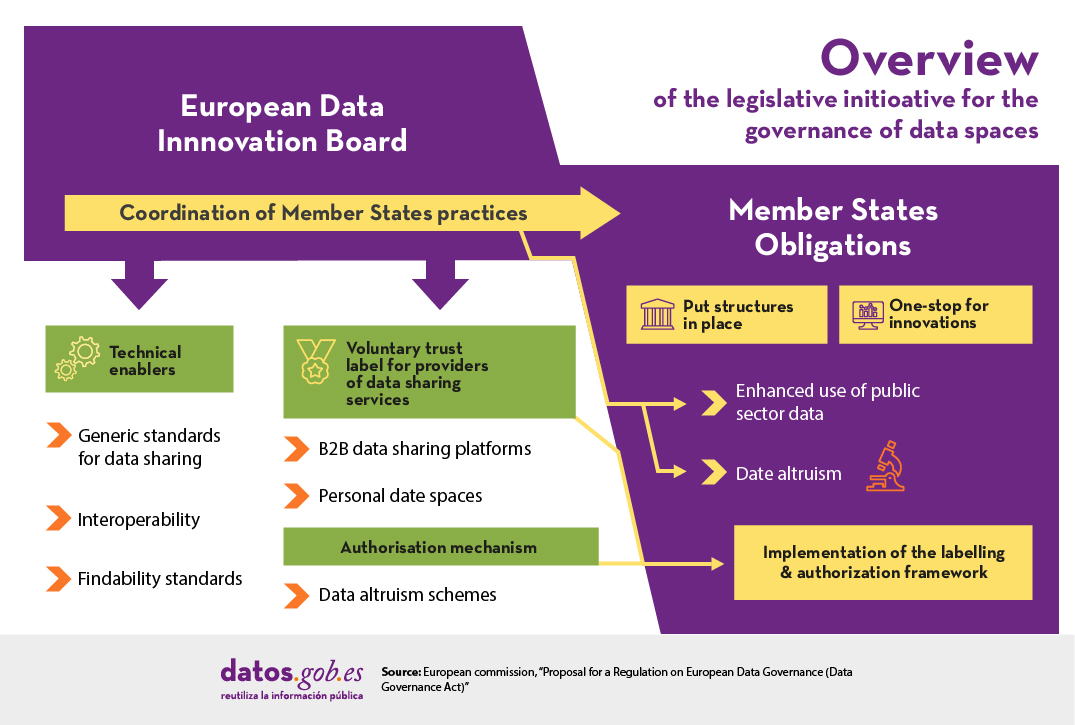
The draft Regulation proposes the creation of a formal group of experts - the so-called European Data Innovation Board - in charge of promoting the exchange of national practices and policies based on the information provided by the States themselves, as well as exercising advisory functions, facilitating standardisation and the improvement of interoperability, providing coherence to the proposed governance model as explained in the following image:
However, the creation of a body with its own legal personality was envisaged which, in addition to the above-mentioned functions, would assume the task of supervising the process of granting labels and certifications, as well as the authorisations granted by the Member States. This last alternative was rejected, among other reasons, due to the results of the cost/benefit analysis carried out from the point of view of economic efficiency.
Finally, the document itself envisages a mid-term review mechanism through which to check whether, four years after the entry into force of the Regulation's provisions -three in the case of the objective of strengthening confidence in data sharing- the measures adopted really meet the expected results in terms of a series of specific indicators for each of the objectives and solutions finally proposed. In short, this is an approach that takes on a singular relevance if we consider the dynamism that characterises the data economy, since the regulation proposed with the draft Regulation is destined to be one of the main tools in meeting the objectives formulated in the European Data Strategy.
Content prepared by Julián Valero, professor at the University of Murcia and Coordinator of the Research Group "Innovation, Law and Technology" (iDerTec).
Contents and points of view expressed in this publication are the exclusive responsibility of its author.
Empresa reutilizadora
Papelea solves the doubts and legal and administrative questions of the users. To do this, it collects and improves tens of thousands of pages of public information from administrations in Spain and Mexico. In addition, it connects users with professionals in each legal field, so that they can answer their questions and offer them their services. It receives around one million visits per year from users looking for a solution to their needs.
Blog
Updated 02/02/2024
In 2020, the proposal for a Regulation of the European Parliament and of the Council on European data governance (Data Governance Act) was made public. This is an initiative that was already announced in the Communication from the Commission to the European Parliament, the Council, the European Economic and Social Committee and the Committee of the Regions entitled "A European strategy for data", one of whose main objectives is to promote a single market for data that favours its rapid handling and, at the same time, is based on the principles and values of the EU.
The text of this proposal was preceded by a public consultation process with wide participation, especially with regard to the data governance model (section 2.1) whit almost eight hundred contributions. Furthermore, as highlighted in the preamble of the proposal itself, the regulatory options finally adopted considered the previous analysis in which the different possible alternatives for achieving the objectives sought were analysed.
Although this new initiative was initially assessed positively, the truth is that it could raise doubts about its necessity, given that Directive (EU) 2019/1024, of 20 June 2019, on open data and the re-use of public sector information, was approved a little over a year ago.
Why then a new regulation now?
Firstly, the new proposal takes the form of a Regulation - not a new Directive - to establish a mandatory, directly applicable regime throughout the Union to harmonise the EU internal market, given the risk that unilateral regulation by States will end up fragmenting it if there is no minimum harmonisation to help boost cross-border digital services. However, the competence of the Member States with regard to the organisational measures to be taken is respected, as is their ability to legislate on access to public sector information, so that the Regulation will not affect existing state rules in this area.
Secondly, it should be noted that the regulation is complementary to the 2019 directive, given that the achievement of the objectives set out above requires an approach which goes beyond the limitations to which that party is subject. Specifically, it is a question of establishing new regulations for those sets of data on which third parties have rights that make their re-use difficult, as is the case in particular with the protection of personal data, intellectual property or, among other legal assets, statistical or commercial confidentiality. Indeed, the existence of these legal barriers may seriously hinder - and even prevent - the re-use of data of enormous value when it comes to implementing projects of great impact in the current social and technological context, such as those relating to research and those based on the innovation required by the digital transformation. The measures incorporated in the proposal for a Regulation are intended to offer solutions specifically aimed at addressing these obstacles, incorporating mechanisms that provide greater legal certainty and therefore strengthen the confidence of the holders of these rights and interests.
It is also intended to establish a number of identical mechanisms throughout the Union to encourage reuse, as is the case with:
- The establishment of a reporting regime for data sharing providers, which will be neutral, i.e. they will not be able to use the data for purposes other than making it available to re-users. The services they provide must also be transparent and non-discriminatory.
- The promotion of altruism in order to facilitate the use of data for the common good on a voluntary basis, including the implementation of a form at European level to facilitate the provision of consent for the transfer of data.
- The obligation for States to establish a single point of information which, in addition, must have a register in which to submit requests for re-use so that, once received, they are sent to the corresponding bodies and entities for resolution within a maximum period of two months.
- The creation at European level of a committee of experts with the aim of facilitating re-use, which will also have an advisory role for the Commission.
What are the main legal guarantees of the Regulation?
With these objectives in mind, the initiative aims to lay the foundations for building a model of European data governance based on transparency and neutrality as a counterweight to trends in other areas. Specifically, the aim is to establish a regulatory framework that reinforces the confidence of citizens, businesses and other organisations that their data will be reused in accordance with minimum legal standards, thus facilitating control over the uses made by third parties. Thus, among the main novelties of the proposal:
- Public bodies that allow the re-use of this type of data affected by the rights and interests of third parties are obliged to adopt the technical, organisational and legal measures that guarantee their protection.
- The possibility is established for public bodies to impose an obligation that data may be re-used only if it has been subject to "pre-processing", which consists in making it anonymous, pseudonymous or, where appropriate, deleting confidential information.
- It is foreseen that re-use is only allowed in environments directly controlled by the public body if there is no other alternative that can meet the needs of the re-user.
- Public bodies are recognised as having the power to prohibit the use of the results of data processing that contains information that endangers the rights and interests of third parties.
- The collaboration of public bodies in the collection of consent from the data subjects is facilitated without the re-users having direct contact with them.
- Effective conditions and guarantees are established for cases in which the processing of the data is to take place outside the European Union, including express acceptance of submission to the jurisdiction of the State in which the public sector body that facilitated the re-use is located.
As the European Commission emphasised in a recent Communication on the occasion of the review carried out after two years of application of the General Data Protection Regulation, its provisions " helps to foster trust-worthy innovation, notably through its risk-based approach and principles such as privacy by design and by default ". This is precisely the approach of the new proposal: to establish the bases of a regulatory model based on the protection of the rights and interests affected, thus facilitating the optimal legal conditions that will allow the re-use of public sector information to be promoted with the appropriate guarantees.
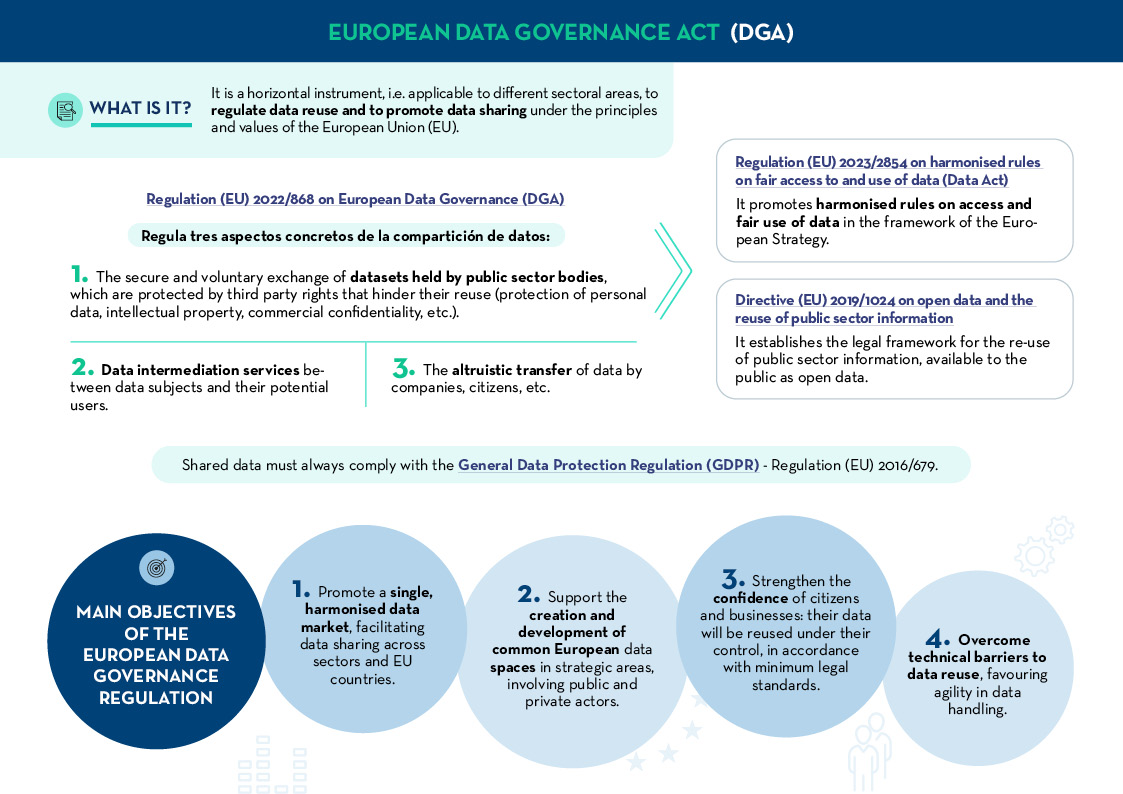
The following infographic provides a summary of the main aspects of the DGA. Click on the images to go to the different versions:
Two-page version One-page version

Content prepared by Julián Valero, professor at the University of Murcia and Coordinator of the Research Group "Innovation, Law and Technology" (iDerTec).
Contents and points of view expressed in this publication are the exclusive responsibility of its author.
Noticia
The European General Data Protection Regulation (GDPR) full entry into force only one year and a half ago. It has been a worldwide revulsion in terms of how to deal with data management and privacy. However, almost three out of four people ask their governments to further increase regulation on big technology companies to protect their personal data. And it is not only the users of those companies that ask for greater regulation, but even the CEOs of big data platforms such as Mark Zuckerberg (Facebook) join the appeal. In this context, a new generation of regulations regarding personal data is already being developed, whose objective will be, on the one hand, to complement the existing European regulations and, on the other, to fill the current legal in the United States.
The situation in Europe
While in Europe we are still trying to assimilate the potential impact of the GDPR and ensure a greater degree of implementation, the president of the European Commission - Ursula von der Leyen - has requested the Internal Market Commissioner - Thierry Breton - to establish a new European data strategy, committed to innovation through data while protecting the digital identity of people. For the moment, and while this strategy is not completed, we are still waiting for the new digital privacy regulation (ePrivacy) regarding the processing of personal data and the protection of privacy in the electronic communications sector, currently in progress. It is called to complement the GDPR, replacing the current directive - whose latest version has been in force for more than 10 years (since 2009), a whole world in the field in which we move.
This highly anticipated new regulation, which will be directly applicable to all member countries, continues to develop after almost a dozen drafts submitted and two years of negotiations between the different parties contributing to its development. This regulation, also known as the law of cookies for being responsible for the warning messages that appear on the websites we visit, is of vital importance precisely because it affects one of the most used (and sometimes also abused) mechanisms to access to online user data. Although it is still uncertain what the final result will be, during the negotiations we have seen how it shift from a more protectionist initial text, in which the importance of explicit consent was reinforced, including the possibility of configuring our browsers to automatically oppose any treatment of unauthorized data (the famous "do not track" mode), to the current draft that is practically committed to maintaining the status quo with only a few minor changes.
The situation in the United States
If we cross the puddle and take a look at what is happening in the United States - the current reference market for the development of the online platforms that manage our data -, we have started the year with the entry into force of the Consumers Privacy Act (CCPA) in the state of California, and several states also have their own legislative initiatives in the field. A very relevant milestone because it is not only the first complete law of this kind in the country, but also start in the state in which the Silicon Valley is located, which saw the birth of a large part of these big platforms.
While it is true that the CCPA has received some criticism for being behind the GDPR in some aspects, and that the federal legal framework does not finish arriving while the voices that claim it continue, at least a great start number of federal legislative initiatives in the country have started, and they could considerably set the bar in terms of demand - even going beyond the requirements established by the current European legislation. These initiatives include, for example:
- The Consumer Online Privacy Rights Act (COPRA Act), whose objective is to increase control over personal data, prohibiting harmful uses and establishing specific and strict rules for the collection, use and sharing of consumers´ personal data.
- The bill for Augmenting Compatibility and Competition by enabling Service Switching (ACCESS Act), whose main objective is to enable data portability between different platforms, thus fostering competition and innovation in services offered by big companies.
- The bill for Designing Accounting Safeguards To Help Broaden Oversight and Regulations on Data (DASHBOARD Act), whose purpose is to increase transparency regarding the use of personal data by big companies, including an objective economic estimate of the value obtained through said data.
- The program for the end of unauthorized tracking (Do Not Track Act), whose objective is to considerably limit the online tracking of personal data of those who request it, similar to how it is already done with the telephone advertising exclusion records (such as the Robinson List in our country)
- The law to take responsibility for own business (MYOBA Act) aims to end radically with the potential abuses of privacy and personal data by making company CEOs directly and legally responsible for serious breaches of existing regulations.
It is also important to note that, with the aim that all this set of laws in the United States does not mean an obstacle to innovation, in general its scope has been reduced to the big consolidated companies, with a high number of users and large volumes of billing, although specific margins vary from one law to another.
In any case, the great challenge now - both in Europe and in the United States - is on the one hand to clarify the terms and limits of application established in all these laws and see how they are finally consolidated and, on the other hand, to determinate how to achieve convergence between all these initiatives to avoid a legislative mosaic that supposes a headache for globalized companies and also a possible discrimination between the rights of some people and others depending on what legislation applies to them.
Blog
The digital transformation is, without a doubt, one of the main challenges facing any public or private organization that intends to carry out its functions effectively in the current technological context. For public entities this requirement becomes an obligation from the legal perspective, to the extent that the constitutional mandate of effectiveness constitutes a manifestation of the principle of good administration.
In the case of the Administration of Justice, we face a real collective challenge since its proper functioning is an elementary condition for the existence of a true rule of law. However, unlike what happens in other areas of the public sector - perhaps, for example, the tax - there is a social perception that adaptation to technological challenges is not taking place as quickly as social evolution demands.
The complete robotization of the judicial decision does not seem very feasible in the short and medium term, despite some emerging initiatives in relation to the use of artificial intelligence in this field whose effectiveness is not always demonstrated and, on occasion, has been the subject of relevant responses in particular as regards the evaluation of the risks and the ethical challenges involved. However, in the context of legaltech services, commercial initiatives related to the use of technology to facilitate the predictability of judicial decisions are increasing in the legal field. These are projects that, ultimately, are based on the reuse of documents and, in particular, judicial decisions.

In this regard, in France there has been an important controversy at the social and political level that has culminated in a reform of the Criminal Code that prohibits the evaluation, analysis, comparison or prediction when the treatment allows the holder of the judicial body to be identified. In Spain, the measures related to anonymization have currently only been considered for the parties to the process, and there is a consolidated practice of eliminating their real identity before publishing them. However, as can be seen in the official search engine of the Judicial Documentation Center (CENDOJ), judicial decisions are nevertheless accessible with full identification of the natural persons holding the jurisdictional body.
However, beyond the difficulties related to the protection of the personal data of the parties to the process, there are other restrictions that hinder an appropriate treatment of judicial decisions in order to carry out advanced analyses that could be taking as an starting point for consistent predictive functionalities:
- First, the official documentary fund is not exhaustive, since only the complete series of Supreme Court decisions are incorporated and, likewise, a selection - more or less exhaustive- of cases of other judicial bodies, mainly the Spanish National Court, the Superior Courts of Justice and the Provincial Courts.
- Second, according to the legal notice that appears when accessing the search engine, the use of the resolutions is limited to mere knowledge and consultation of the decision criteria of the Courts, in compliance with the provisions of the Organic Law of the Judiciary. However, “The reuse of this information for the elaboration of databases or for commercial purposes must follow the procedure and conditions established by the CGPJ through its Judicial Documentation Centre”.
- Thirdly, access for reuse purposes is subject to economic conditions designed to facilitate downloading and access for commercial purposes by legal publishers. However, such conditions hinder mere treatment consisting of a massive analysis of judicial decisions and, therefore, become a major obstacle to carrying out the procedures required by artificial intelligence.
Beyond such conditions, the reuse of judgments and other judicial resolutions in Spain was the subject of an important legal discussion that still remains to be closed. Indeed, the Regulation approved at the time by the General Council of the Judiciary was annulled by the Supreme Court through a judgment that did not go into substantive aspects. It was limited to consider the appeal for a mere competence issue in understanding that the Council of Ministers should be the body responsible for its approval. However, to date, no other regulatory initiative has been known to address the regulation of the singularities of the reuse of judicial decisions.
It is important to highlight that judicial bodies are subject exclusively to the rule of Law according to the Constitutional Text and, therefore, there is a reinforced public interest in facilitating mechanisms for monitoring their additional decisions to the institutional system of resources that, as is known, is subject to important legal limitations -not all decisions can be appealed- and economic imitations-the expenses to hire professionals and the imposition of costs are two obvious examples-. In this regard, on the one hand, transparency and access to information are legally recognized as tools that serve as an indirect control mechanism for certain actions, procedures and documents, although their scope is limited to certain moments - public visits - and the concurrence of certain requirements –be part of the process-. And, on the other hand, the greater opening of judicial decisions from the perspective of their reuse could facilitate their predictability and, in this way, strengthen legal certainty apart from any other commercial purpose.
Perhaps the future transposition of Directive 2019/1024 is a propitious opportunity to face this unfinished debate and, thus, lay the legal foundations that provide security to a sector in need of clear regulatory rules. In this regard, these rules should not only aim to facilitate reuse in the editorial field, but also to boost the social mechanisms of informal control based on Open Government and, in particular, the co-creation of digital public services by society.
Content prepared by Julián Valero, professor at the University of Murcia and Coordinator of the Research Group "Innovation, Law and Technology" (iDerTec).
Contents and points of view expressed in this publication are the exclusive responsibility of its author.
Documentación
Spain is the second country with the highest life expectancy in the world, only behind Japan. Spaniards live 83 years on average. This positive data is stained by a negative one: the low birth rate, which is leading us towards a population aging. This situation means that we need a more efficient health system to continue providing quality health services to citizens.
As in other sectors, the improvement of efficiency goes through the necessary digital transformation, in which data in general - and open data in particular - have a leading role. Open data can help us better understand the situation of patients and, together with technologies such as big data or artificial intelligence systems, facilitate early detection of diseases. In short, they can help improve both the management and the provision of services.
But in an area where patient privacy is essential, we have a series of doubts: What types of data can be opened? What does the legislation say about it?
The report "Open data and health: technological context, stakeholders and legal framework", prepared by Julián Valero, tries to shed some light on this situation. For this, the following objectives are set:
- Knowing the conditions, limitations and restrictions imposed by current legal regulations.
- Posing how the guarantees offered by the Law should be adapted to a new reality based on technological innovation.
The report begins by showing the current situation of the Spanish health system, gathering the challenges to be faced, but also the opportunities that come hand in hand with new technological trends, such as Internet of Things or the aforementioned Artificial Intelligence.
Once the context has been explained, the report focuses on the different stakeholders involved in the provision of health services, both public and private, and the main laws and regulations that affect each group. The novelties of the General Data Protection Regulation (GDPR) and its impact on the opening of health data are also addressed.

The report ends with a series of conclusions and recommendations to promote public policies in the field of health that drive improvements in the provision of health services.
You can download the full report below.
Entrevista
María Jesús González-Espejo is, with Laura Fauqueur, co-founder of the Institute of Legal Innovation (Instituto de Innovación Legal), a company specialized in supporting professionals, law firms and organizations in innovation and digital transformation projects. For this, they are based on 4 pillars: consulting, training, events and information.
Datos.gob.es has spoken with her to tell us the role of open data to get a more transparent judicial system.
What is the impact of data and new technologies in the legal sector? Why is it important to transform this sector?
Technology and data can and will transform the sector in many ways. On the one hand, technology and data impact on the legal framework. In effect, new technologies are demanding new regulations and also generating new business sources for lawyers who specialize and are able to advise on these topics.
On the other hand, technology allows jurists to better manage their work and their organizations. And nowadays, although later than other sectors, jurists know that they can be much more efficient if they use technology for certain tasks, especially those where data and its management are relevant: issues management; Customer Management; People Management; knowledge management; financial management and legal prediction. The impact of these technologies on legal professionals and their organizations is enormous.
Finally, there are legal services that can be offered through technology, improving its provision. For example, chatbots allow providing advice in a more efficient manner, and contract automation tools allow generate contract easily and without the need for professional support. These types of technologies will clearly impact the employment market.
The Institute of Legal Innovation seeks to help in the digital transformation of the sector through different projects. What is the role of open data in this transformation process?
I believe that the Institute of Legal Innovation has been one of the first private operators that has claimed the need for more open data. In the legal sector there is a series of data that are key to the development of more and better Legal Tech: judgments, resolutions and other information that result from legal procedures and that must be public. Many of the agencies that keep this information (CGPJ, CENDOJ, Registrars, Notaries, Ministry of Justice, Bar Associations, etc.) provide us with great reports and statistics, but not the data. In our opinion, that is the next step that must be taken to produce the real "Legal Tech Revolution", as I claimed during my speech in the Senate.
What is Legal Design Thinking? What advantages can it bring?
Legal Design Thinking is a methodology, based on Design Thinking. The origin of Design Thinking is located in the 50s in Stanford University in the US, but it is really in the 90s, hand in hand with David Kelley, when Design Thinking begins to be conceived as we know it today. In the 90s, also professors of this university began to investigate the applications of this methodology to the legal field. Parallel to this North American school, in Helsinki, several researchers of different specializations (legal, design, etc.) develop projects focused on the so-called Visual Design Thinking and its application to the legal sector.
This methodology helps to solve legal problems, understanding as such, those that refer to the functioning of the legal system or legal service providers, Legal Design Thinking (LDC). The word "problem" must be understood not in the traditional sense, as something negative, but in a broader one, as a challenge or situation that can be improved through creativity. This activity is the core idea on which Design Thinking is articulated. The other main point of the Design Thinking discipline is the client, the user, the recipient of the service, the contract, the rule, the sentence. In summary, Legal Design Thinking is a discipline that fits into the heuristic and whose main objective is the search for solutions to problems through creativity, always putting people at the center of the activity.
This discipline is very useful for many of the needs that law firms and other organizations in the legal sector have nowadays, such as the revision of their business models; the identification and development of new products or services; the understanding of customer journey to better meet customer needs or the operation of equipment.
One of the challenges to address the digital transformation of the legal sector is the lack of personnel with technological skills and knowledge, something that also happens in other sectors. What are the necessary capabilities and how can they be acquired?
Acquiring technological knowledge is not easy, but it is possible. There are already some complete works that analyse the Legal Tech in depth. In addition, there are numerous conferences, congresses, etc. where you can learn about the subject.
However, it is more complex to acquire the necessary skills such as project management; leadership; change management; time management; etc. The reasons are that, on the one hand, our sector has its own idiosyncrasy and requires customized training; but at the same time jurists are usually short on time and, consequently, many courses do not achieve sufficient capacity. So it is not always easy to find suitable training offer.
You also organize hackathons, such as #HackTheJustice (2017) and JustiApps (2014). Among other issues, the aim is to develop applications that help improve the efficiency and transparency of the sector. How has the reception of these events been? What are the challenges to access and reuse legal public data?
The reception of these events has been very good. In fact, they have received support from many relevant institutions such as the Ministry of Justice, the General Council of Notaries and companies such as Amazon, Banco Santander, Ilunión, Everis, Thomson Reuters, WKE, etc. In both editions we counted on a sufficient number of participants who also had very different profiles: lawyers, judges, students, etc. For all of them, working for a weekend with designers and developers of apps has been a unique experience that has changed their lives. Several of our participants have decided to turn, in part, their professional lives around after participating in our hackathons.
When we organize the first hackathon, we realized that there were almost no legal datasets and we made a round of calls to try to get them. The answers were not very positive. Since our first hackathon, there have not been major changes. So there is still room for work to continue asking the institutions to open the data they own.
What measures do you consider necessary to encourage the opening and reuse of legal open data?
The most important measure seems simple at first sight: all administrations that are responsible for data susceptible to becoming datasets should open them. Beginning with the Ministry of Justice and continuing through the CENDOJ or Registrars. All datasets should be inventoried, so that whoever wants to locate them does not have to spend days on their location.
To encourage reuse, perhaps a Legal Datathon could be organized once a year. Of course, hackathons and such activities also help and it would be great if some public institution wanted to organize them. In addition, the creation of Legal Tech incubators in professional colleges would support entrepreneurs who reuse this data. Finally, training in data, big data, transparency, etc. to law students and even professionals is perhaps the most necessary and practical measure that could be implemented.
The Legal Innovation Institute is also an incubator of Legal Tech projects. Based on your experience, how is the situation in Spain regarding innovation in the legal sector? Could you tell us about some of the projects you have in hand?
The situation is better in some aspects and worse in others. Spain has a clear advantage: the potential of the Spanish-speaking market. And several disadvantages: lack of enterprising spirit in technology among jurists; lack of institutional support; lack of training in the necessary skills and knowledge; etc. However, I am optimistic and I think that, in Spain,we are becoming aware that we are facing a sector with great potential. In the coming years, I think that we can become the cradle of many Legal Tech that will transform professionals, legal organizations and how many legal services are provided today.
One of the most relevant projects that we have in hand is the launch of the first Legal Tech comparator. It will be a very useful tool for any firm or professional who wants to know what technology is available in the market.