


Documentación
In the Action Plan of the International Open Data Conference, capacity development has become a priority within the international open data movement. After all, the need for training tools is essential for leaders responsible for PSI policies, data producers and reusers, public and private sector, and even citizens. For this reason, providing training tools that allow the different agents to advance in the openness and re-use of public data is a priority task.
To this end, eight training units have been developed within the dissemination, awareness raising and training line of Iniciativa Aporta, aimed at all types of public: from citizens who read for the first time about open data to public employees, responsible for open information initiatives who want to expand their knowledge in the field.
The training units are designed to understand the basic concepts of the open data movement, to know best practices in the implementation of open data policies and their re-use, methodological guidelines for open data, technical regulations such as DCAT-AP and NTI-RISP, in addition to the use of data processing tools, among other aspects.
In the development of resources, two types of learning have been taken into account. Learning by discovery, oriented to extend the knowledge to solve the doubts and reflections raised, and significant learning based on prior knowledge, through the use of practical examples to contextualize and apply the concepts treated.
In addition, the training modules contain complementary materials through links to external pages and documents to be downloaded without connection. In this way, the student is given the opportunity to enhance his knowledge and familiarize himself with relevant sources to obtain reliable and up-to-date information about the open data sector.
All units are distributed under the Creative Commons Share-Alike Attribution Licence (CC-BY-SA) which allows copying, distributing the material in any medium or format and adapting it to create new resources from it.

The training material developed by Iniciativa Aporta consists of eight didactic units that address the following contents of the open data sector:
- Basic concepts, benefits and barriers of open data
- Legal framework
- Trends and best practices on the implementation of open data practices
- The re-use of public data on its transformative role
- Methodological guidelines for open data
- DCAT-AP and NTI-RISP
- Use of basic tools for data treatment
- Best practices in the design of APIs and Linked Data

Each unit is designed in a way the student expands his knowledge on the open data sector. In order to facilitate their understanding, all of them have a similar structure that includes objectives, contents, evaluation activities, practical examples, complementary information and conclusions.
All the training units can be done online, directly from the datos.gob.es or, in its absence, it is also possible to download them on the user's device and even load it on an LMS platform.

Each unit is independent; enabling the student to acquire the necessary knowledge in a specific subject according to their training needs. However, those students who wish to have a more complete view of the PSI sector have the opportunity to perform the complete series of eight training units in order to know in depth the most relevant aspects of open data initiatives.

The training units are available in the "Documentation" section under the category "Training materials" to be carried out through the online portal or to be downloaded.
Training materials of the Aporta Initiative

The Aporta Challenge moves on to the 2nd phase after selecting the 10 best ideas of the 45 presented
Blog
The first phase of the Aporta Challenge 2017: The value of data for the Administration has come to an end. The competition "How to reuse open data to improve efficiency in public administration", promoted by the State Secretariat for the Information Society and Digital Agenda, the Public Body Red.es and the General Secretariat for Digital Administration, received a total of 45 ideas from working groups in the academic and business sectors as well as individuals. Ten of these have been selected and move on to the second stage. The jury, which evaluated the ideas presented taking into account their relevance, quality and usefulness, stressed the high quality of all the proposals received.
The ten proposals selected as finalists in this first phase are the following:
- QME -Aporta: NL guidance in datos.gob.es consultations
Search engine based on natural language guidance that seeks to facilitate the discovery of the data provided by the public administrations and reuse thereof between them. - Licitalio: Your tool for comparison of public contracts
A web tool which, using datamining and clustering techniques, aims to improve access to public sector contracts in order to facilitate selection or and reuse of the best bids according to the needs of the administration concerned. - Informal analysis of licenses
Mechanism to characterize licenses, using natural language processing techniques, aiming to detect swiftly what administration resources are duly licensed for reuse and which of them have conditions of use needing to be readjusted. - Anfitrión (Host)
Client server system intended to act as an interpreter for the transformation of sets of data in different formats to JSON, easily reusable by businesses and other administrations. - Light
Mobile application that, by introducing gamification mechanisms, proposes to encourage people to contribute together with the administrations to enable a more sustainable environment, by rewarding habits and actions such as using the public transport service. - PLAN Platform
Project aimed at publication of announcements prior to the launch of national tenders to which all economic agents could subscribe, encouraging competition and transparency. - Analysis of content for public communication
Initiative to streamline the response of administrations to the general public by means of analysis of the channels of communication citizens-city council, and identification or the interest prior to the request for information. - Open News
System designed to recommend open public datasets related to content generated by digital means, in order to encourage active citizen participation and transparency in public administrations. - Funding Analytics For Innovation Projects
Proposed development of an analytical web tool based on open data R&D+i projects aimed at analyzing and visualizing subsidies granted and detecting trends in research that help public administrations to evaluate and create new business lines for companies. - My turn
Mobile application that, while showing the number of people waiting their turn at the offices associated with a service offered by the administration, would analyze and manage waiting times for the public and therefore improve the administration’s efficiency.
Now the second phase of the Aporta Challenge is beginning, in which those responsible for the winning ideas have a period of two and half months to develop their prototypes, which they will present to the jurors next October 23.
Prizes of 3,000, 2,000 and 1,000 euros will be presented to the top three prototypes, which will be announced during the Aporta 2017 Meeting on 24 October.
We encourage the open data community to attend this meeting (attendance free) which this year reaches its seventh edition.
Blog
On 12 September, the deadline ends for companies and entities that have developed projects with public data to submit their projects in the first Aporta Awards in 2017. These awards are focused on divulging and recognising professionals who have opted for reusing open data and innovation as a driving force for digital transformation and who are promoted by the Secretariat of State for the Information Society and the Digital Agenda, the Public Business Entity Red.es and the General Secretariat of Digital Administration.
With this initiative, the aim is to promote and make visible the value of the data generated by the Spanish public administrations, as well as to reuse them. Projects that may qualify for these awards must have been developed in the last two years, reusing public data and contributing to generate social value, new business and/or improvements for society.
Applications will be evaluated during the month of September by representatives from the Aporta Initiative. The originality, utility and impact of the initiative will be considered in terms of beneficiaries. The two best initiatives will receive recognition at the Aporta Conference which will take place at the end of October 2017.
We invite and encourage industry professionals and innovative companies to apply for the Aporta Awards, through the form available on the Red.es website. The deadline is 12 September. Come participate!
All the information is available at dagos.gob.es and in the Terms and Conditions of the 2017 Aporta Awards.
Blog
When planning our vacations, we all look for the perfect destination that meets our expectations: beach, mountain, city... But once we have decided where to go, we still have to make many decisions: how am I going to organize my trip so that everything goes perfect? Luckily, we have hundreds of applications that make our lives much easier.
Nowadays you can use some apps to calculate the most suitable route to reach your destination or to decide where to fill up the car during the journey without damaging your pocket. You can also look for accommodation or restaurants with a good value for money, using your mobile. Or consult the cultural activities of the area, looking for activities aimed at the youngest members of the family. And, if you want to go to the beach, you can easily check the state of the sea, the wind or the temperature of the water without leaving the hotel.
All these applications, in addition to helping us organize our vacations in a simple way, have something in common: their functioning is based on open data from public administrations.
The fact that an increasing number of local administrations are opening their tourism data allows us to generate services that help to manage our trips in a more efficient way, integrating information that is sometimes difficult to find. As an example, Asturias or Aragón are promoting catalogues of specific datasets focused on this area.
Many of these applications have been designed by individuals and companies, reusing available open data, but others have been promoted by the public administrations. This is because tourism open data not only help visitors, but also have great advantages for municipalities.
Tourism is a fundamental economic activity for our country. During the first 5 months of 2018, Spain exceeded 28.6 million international tourists, representing an increase of 2% over the same period of the previous year. These tourists are a great source of economic income: just in May, the average expenditure per tourist was 1,009 euros, 1.8% more than in 2017. It is not surprising, therefore, that all city councils wants to promote their services and attract visitors.
Tourism applications based on open data can favor interaction between visitors and the local community, promoting local services and fostering economic growth. In addition, some applications even allow to collect information from users under their consent. The analysis of this anonymized information, combined with other data sets such as the total expenditure on trips of international tourists who participate in cultural activities or tourists housed by municipalities, allows knowing tourists behavior patterns and designing specific policies with the focus on innovation and intelligent management of tourist destinations.
Traditionally, the tourism sector has a great weight in Spain, but like all sectors, it has to keep renewing itself so as not to be left behind, integrating new elements that help improve the visitor's experience. Open data linked to the use of new technologies such as Big Data analysis and artificial intelligence are a good option - for example to make recommendations and customizations based on user behavior-. The ultimate goal is to provide a high quality global service that allows us to continue being leaders and receiving millions of visitors year after year.
Blog
In the policies promoted by the European Union, an intimate connection between artificial intelligence and open data has been considered. In this regard, as we highlighted, open data is essential for the proper functioning of artificial intelligence, since the algorithms must be fed by data whose quality and availability is essential for its continuous improvement, as well as to audit its correct operation.
Artificial intelligence entails an increase in the sophistication of data processing, since it requires greater precision, updating and quality, which, on the other hand, must be obtained from very diverse sources to increase the quality of the algorithms results. Likewise, an added difficulty is the fact that processing is carried out in an automated way and must offer precise answers immediately to face changing circumstances. Therefore, a dynamic perspective that justifies the need for data -not only to be offered in open and machine-readable format, but also with the highest levels of precision and disaggregation- is needed.
This requirement acquires a special importance as regards the accessibility of the data generated by the public sector, undoubtedly one of the main sources for algorithms due to both the large number of available data sets and the special interest of the subjects, especially public services. In this regard, apart from the need to overcome the inadequacies of the current legal framework regarding the limited scope of the obligations imposed on public entities, it is convenient to assess what extent the legal conditions in which data are offered serve to streamline the development of applications based on artificial intelligence.
Thus, in the first place, article 5.3 of the Law states categorically that "public sector administrations and organizations may not be required to maintain the production and storage of a certain type of document focused on its reuse". Taking into account this legal forecast, the aforementioned entities can rely on the absence of an obligation to guarantee the supply of data indefinitely. Also in the limitation of liability contemplated by some provisions when stating that the use of the data will be carried out under the responsibility and risk of the users or reuser agents or, even, the exoneration for any error or omission that is determined by the incorrectness of the data itself. However, it is an interpretation whose effective scope in each specific case has to be contrasted with the demanding European regulation related to the scope of the obligations and the protection channels, in particular after the reform that took place in the year 2013.
Beyond an approach based on strict regulatory compliance from a restrictive interpretation, the truth is that the need to offer open data policies for the public sector to meet the unique demands of artificial intelligence requires a proactive approach. In this sense, the interaction between public and private subjects in contexts of systematic data measurements and collection, continuously updated from generalized connections - as is the case of smart city initiatives - places us in front of a technological scenario where active contractual management policies acquire a special importance in order to overcome the barriers and legal difficulties for its opening. In fact, municipal public services are often provided by private parties that are outside the reuse regulations and, in addition, data are not always obtained from services or objects managed by public entities; even in spite of the general interest underlying in areas such as electricity supply, the provision of telephony and electronic communications services, or even financial services.
For this reason, the initiative launched by the European Union in 2017 acquires a singular importance from the perspective of artificial intelligence, since it aims to overcome a large part of the legal restrictions currently in place for data opening. In the same sense, the Spanish Strategy of R & D in Artificial Intelligence, recently presented by the Ministry of Science, Innovation and Universities, considers as one of its priorities the development of a digital data ecosystem whose measures include the need to guarantee an optimal use of open data, as well as the creation of a National Data Institute in charge of the governance of the data coming from the different levels of the Public Administration. Likewise, in line with the European initiative previously referred, among other measures, there is a need to expand the sharing obligations of up to certain private entities and scientific data, which would undoubtedly have a relevant impact on the better functioning of the algorithms.
The technological singularity that Artificial Intelligence poses requires, without a doubt, an adequate ethical and legal framework that allows facing the challenges that it entails. The new Directive on open data and reuse of public sector information recently approved by the European Parliament will be a strong impulse for artificial intelligence, as this initiative will expand both the obligated parties and the type of data that will have to be available. Undoubtedly a certainly relevant measure, which will be followed by many others within the framework of the European Union's strategy on Artificial Intelligence, one of whose main premises is to ensure an adequate regulatory framework to facilitate technological innovation based on respect for fundamental rights and the ethical principles.
Content prepared by Julián Valero, professor at the University of Murcia and Coordinator of the Research Group "Innovation, Law and Technology" (iDerTec).
Contents and points of view expressed in this publication are the exclusive responsibility of its author.
Blog
A few months ago, the Open Data Climático, carried out by the Spanish Meteorology Agency, starred a large number of news, with headlines such as "70% of Spaniards affected by climate change", "Summers are five weeks longer than they were in the eighties" or "The semi-arid climate advances towards Galicia".
Our planet faces big challenges in the coming years: deforestation, high levels of contamination, melting of the poles, desertification ... All these element endanger the life of the different species that live on the Earth, leading some even to extinction. In addition, it could damage the economic development: if the effects of climate change are not mitigated, the global market could suffer a recession of up to 20% of global GDP, as said by Carmen Parra, Director of the Chair of Solidarity Economy of the Abat Oliba CEU University, based on the Stern Report on the impact of climate change on the economy.
Human beings have the responsibility to try to reverse this situation, and the technology and open data can help us. Providing detailed and up-to-date information helps to raise environment awareness, as well as to seek solutions to climate change and the other environmental challenges that affect us.
Taking advantage of World Environment Day, in datos.gob.es we have wanted to compile some examples of applications that reuse open data generated by public bodies and whose objective is to promote sustainability and environment improvements.
Fight against pollution
Nine out of ten people around the world are exposed to levels of pollution that surpass the security quotas indicated by the World Health Organization (WHO). An increasing number of cities, regions and countries put in place mechanisms to try to limit the amount of pollutant particles and gases emitted. In this sense, we can also find more applications to inform about air or rivers situation in real time.
- airACT. This application, developed by the Polytechnic University of Catalonia together with Ecologistas en Acción and the CSIC, among others, seeks to inform the population about the air quality in real time. Through an alerts system, based on WHO recommendations, users can know main air pollutants levels, as well as the risk they are exposed to.
- Riu Net. In addition to the air we breathe, it is also important to raise awareness about water quality. Riu Net is an interactive educational tool that allows evaluating the ecological status of the rivers and, at the same time, it provide scientific data that can be consulted both by experts and environmental managers and the general public.
Improve waste management
8 million tons of plastics arrive every year to our oceans. To end this situation, it is necessary to promote the reuse and recycling of materials. The applications that show the waste collection points help raise awareness and educate public about the recycling, classification and disposal of waste. Some examples of these applications are:
- Garbage containers in Cáceres. This application help to visualize the location of all containers in the city of Cáceres. The user can filter by types of container (organic, plastics, paper, etc.) to improve the search and locate the closest container.
- CleanSpotApp - Your nearest clean point !. Some waste needs specialized containers (recycling centres). Thanks to applications like CleanSpotApp we can know the closest household waste recycling centre to deposit batteries, electrical appliances, light bulbs, used oil, clothes and shoes, toys, books and school supplies, coffee capsules, etc.
Promote sustainable means of transport
Automobiles account for 83% of transport CO2 emissions. Some applications based on open data seek to avoid or reduce the individual use of private cars and encourage the use of more sustainable means of transport (public transport, bicycles, electric scooters).
- dBizi++. dBizi Users can know, with a frequency of 5-6 minutes, the availability of bicycles in the 16 stations of the city of San Sebastián. In addition, the application informs the user about the feasibility of their journey, using historical and real-time data.
- Puedo circular. This application provides personalized information on the contamination protocols in the city of Madrid. The user only has to enter the license plate of his vehicle in the web / application and will obtain information on the environmental mark that corresponds to the vehicle, the current scenario activated according to the pollution protocol of the city and the effects of this scenario: whether or not you can travel around the city, where you can park or what speed you should keep to reduce the environmental impact.
Fight against noise pollution
We usually forget acoustic pollution when we talk about environment, but its effects can be very harmful to health: it can generate from stress and sleep disorders to loss of attention or cardiovascular diseases. In Spain, at least 9 million people support average levels of 65 decibels, the limit accepted by WHO.
- ComfortUP!:This is a mobile application for citizen collaboration, through which people who are using public spaces can assess the comfort of these places from an acoustic and thermal point of view, based on their own experience. The application also allows observations and measurements of environmental conditions in a selection of city parks.
- Noise Capture: This application support citizen science project whose objective is to register the noise levels listened by the users. In addition to discovering the noise pollution suffered by citizens, it allows us to share this information and contribute to the creation of collaborative noise maps on a voluntary and anonymous basis.
The protection and improvement of the environment is a fundamental issue that affects welfare and social and economic development. Therefore, it must be one of the priorities not only of governments, but also of citizens. Thanks to the open data, and the services created based on them, citizens can be more aware of their environment and act accordingly to reduce their environmental footprint.
Empresa reutilizadora
Group of professionals specialized in data management and use at different levels.
A reference team in the development, extraction and processing of information, turning it into strategy and value for their clients.
Documentación
Why are open data important? What is their relationship with open government? How can I start an initiative of this kind? Who can I take as a reference? These are some of the questions that the Open Data Guide: Publication and reuse of Open Data as an initiative of Open Government in the Administration tries to answer
Prepared by the Ministry of Development and Environment of the Junta de Castilla y León, this guide is part of the Rural Digital Community (CRD), a collaboration project between Public Administrations of Portugal and Spain. The objective of the project is to improve the technological innovation of rural institutions, promoting cooperation and competitiveness.
The guide is divided into 5 sections: introduction to open data, current status of open government and open data, open data implementation , innovative solutions and success stories, and conclusions.
In the first introductory section, perfect for those unfamiliar with the open data world, some basic concepts are reviewed. The report focuses on open government as a sociopolitical mode of interaction based on 4 pillars - transparency, accountability, participation and collaboration - which can be promoted and improved thanks to open data. All this is explained in this section, which also describes the principles that data must meet to be considered open.
Next, the report address the current situation of open government and open data in Spain, Portugal and Europe, including existing regulations. In the case of Spain, the report highlights the existence of almost 300 initiatives, included in the initiatives map of datos.gob.es, as well as more than 660 companies that reuse information, with a business volume higher than 1,700 million euros per year. These data, together with the good position of Spain in the European Open Data Maturity Landscaping 2018 report, show the good momentum of open data in our country.
The third section of the report focuses on the implementation of open data in an organization. To facilitate this process, the authors of the guide have drawn up a plan with a series of stages that are detailed in the report:
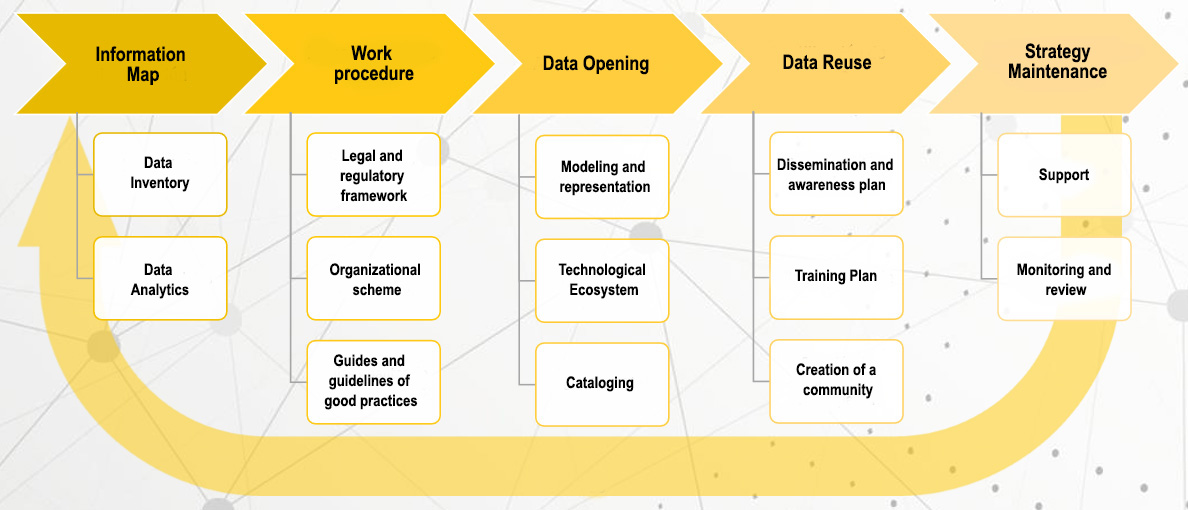
Finally, the report shows several examples of innovative solutions and success stories, based on 2 criteria:
- Examples of open data portals, which stand out for their functionality, such as Aragon Open Data or the download center of the National Geographic Institute (IGN), among others.
- Examples of good practices regarding reuse, due to their innovative nature and the economic or social value they generate. Examples of different sectors are included, such as real estate (TerceroB), meteorological (Meteogrid), public procurement (EuroAlert) or data journalism and public transparency (Civio).
The report concludes with a series of conclusions, such as the need to improve the training of both public employees who are immersed in data opening and companies and individuals to promote the use and analysis of data.
Below you can download the full report and delve into all of these sections.
Evento
8th Edition of Aporta Meeting will take place on November 28. In this occasion, the event will focus on the power of public data to promote innovation and entrepreneurship. Under the motto "Innovation with public data", consolidated companies, start-ups and public bodies will share their experience about taking advantage of improvement and business opportunities linked to open data and new technological paradigms, such as Big Data or Artificial intelligence.
Thanks to these testimonies, attendees can learn first-hand about the challenges of an innovative project with open data, and discover possible solutions. The objective is to create an inclusive and dynamic event, where attendees can also share their concerns and own experiences through collaborative round tables.
The Meeting will begin at 9:30 in the Assembly Hall of the Secretariat of State for Digital Progress (Ministry of Economy and Enterprise).
- Round table 1: The value of open data reuse for Public Administrations
The first round table will be focused on public administrations and how the reuse of their data allows optimizing the services offered to citizens.
There are many examples of local, regional or state entities that have implemented services and applications based on public data to improve their agility and efficiency. These services allow a more direct communication, promoting transparency and accountability, as well as a greater participation of citizens in their locality or region political life. In addition, through the data analysis, these organizations can also identify behavior patterns that drive better resource planning and greater services personalization.
In order to address this issue, representatives from the following entities will participate in the round table: City of Madrid - who will moderate the debate-, Ministry of Agriculture, Fisheries and Food, Junta of Castilla y León, Autonomous Community of Murcia, Renfe and Provincial Council of Bizkaia.
- Round table II: Public sector information and entrepreneurship
According to the latest data from the National Observatory of Telecommunications and the Information Society (ONTSI), currently, there are more than 530 small and medium-sized companies with the objective of creating ideas and new products based on public information and data. These companies generated a turnover of 1,500 - 1,750 million euros and more than 5,000 direct jobs in 2016.
Innovation based on public data is especially noticeable when we talk about entrepreneurs and start-ups. The availability of free public data or public data with a marginal cost reduce the risk of starting a new business.
Therefore, the second round table will be integrated by entrepreneurs and startups from different sectors that are developing new products and services based on public data reuse and analysis. This is the case of VisualNACert, a software developer that improves the management of agricultural farms, Piperlab, which uses Big Data technologies and data sciences to develop algorithms that improve decision making, or Naru Intelligence, which applies data analytics to biomedicine sector. This round table will be moderated by Barcelona Open Data Initiative.
- Round table III: Public data and business development
But open data is not only useful for entrepreneurs. An increasing number of private entities use public data to face business challenges and improve their competitiveness. For these companies, public data has become an additional business resource that contributes to maintaining leadership in their industry sector, reducing corporate costs, adapting to and evolving with agility in their environments and collaborating with clients - and even competitors- to face industry challenges.
Therefore, the third round table will be integrated by four international companies that will explain how public data use help improve their products or services, adapt to new markets and expand their radius of influence in the industry. These companies are Informa, Syngenta, GMV and Esri, who will share their experience under the moderation of the Secretariat of State for Digital Progress.
The complete agenda is available in this link. Although the event is free, places are limited. Therefore, those interested in attending must register in this link.
Evento
For the tenth consecutive year, Asedie organizes a new edition of the "International Conference on the Reuse of Public Sector Information". The appointment will take place on October 23 at the headquarters of the Spanish Agency for Data Protection in Madrid.
As the previous years, the main objective is to serve as a platform to share knowledge and experiences, coming together all those involved in the Information and Data Community, as well as to promote public-private collaboration for public interest.
Under the motto, "Information, an essential resource for economic development", experts will address the importance of Infomediary sector and the evolution of information access and reuse.
Agenda
The event will begin at 9:45, with a few words from the Asedie President, D. Dionisio Torre. Then, Mr. Carlos Romero, Counsellor of Industry, Telecommunications and Audiovisual, Mr. Jesús Rubí, Deputy to the Director of the Spanish Data Protection Agency, and Barbara Ulbaldi, Head of OECD Digital Government and Open Data Policies Team, will share their vision on the challenges and opportunities of the infomediary sector, paying special attention to sector regulations.
After the coffee break, a round table entitled "The implementation of Reuse and its evolution in the last 10 years" will take place. Mrs. Cristina Morales, General Deputy Director of Information Society Content from the Ministry of Economy and Business, Jorge Salazar, Coordinator of the Commercial Registry from the Registrar College, Mr. Pedro Vivas, Head of the IDE / SIG Support Area of the Ministry of Development, and Mr. Enrique Crespo, Chief of the Information Access Service of the city of Madrid.
The event will conclude with the presentation of the Asedie Award. Since 5 years, Asedie present this award with the aim of highlighting the work of those people, companies or institutions that have done the best work or the greatest contribution to innovation and development of the Infomediary Sector.
Inscription
Admission is free, but places are limited. Therefore, those interested in attending the conference must register before October 18 through this online form.