


Empresa reutilizadora
Group of professionals specialized in data management and use at different levels.
A reference team in the development, extraction and processing of information, turning it into strategy and value for their clients.

Documentación
Why are open data important? What is their relationship with open government? How can I start an initiative of this kind? Who can I take as a reference? These are some of the questions that the Open Data Guide: Publication and reuse of Open Data as an initiative of Open Government in the Administration tries to answer
Prepared by the Ministry of Development and Environment of the Junta de Castilla y León, this guide is part of the Rural Digital Community (CRD), a collaboration project between Public Administrations of Portugal and Spain. The objective of the project is to improve the technological innovation of rural institutions, promoting cooperation and competitiveness.
The guide is divided into 5 sections: introduction to open data, current status of open government and open data, open data implementation , innovative solutions and success stories, and conclusions.
In the first introductory section, perfect for those unfamiliar with the open data world, some basic concepts are reviewed. The report focuses on open government as a sociopolitical mode of interaction based on 4 pillars - transparency, accountability, participation and collaboration - which can be promoted and improved thanks to open data. All this is explained in this section, which also describes the principles that data must meet to be considered open.
Next, the report address the current situation of open government and open data in Spain, Portugal and Europe, including existing regulations. In the case of Spain, the report highlights the existence of almost 300 initiatives, included in the initiatives map of datos.gob.es, as well as more than 660 companies that reuse information, with a business volume higher than 1,700 million euros per year. These data, together with the good position of Spain in the European Open Data Maturity Landscaping 2018 report, show the good momentum of open data in our country.
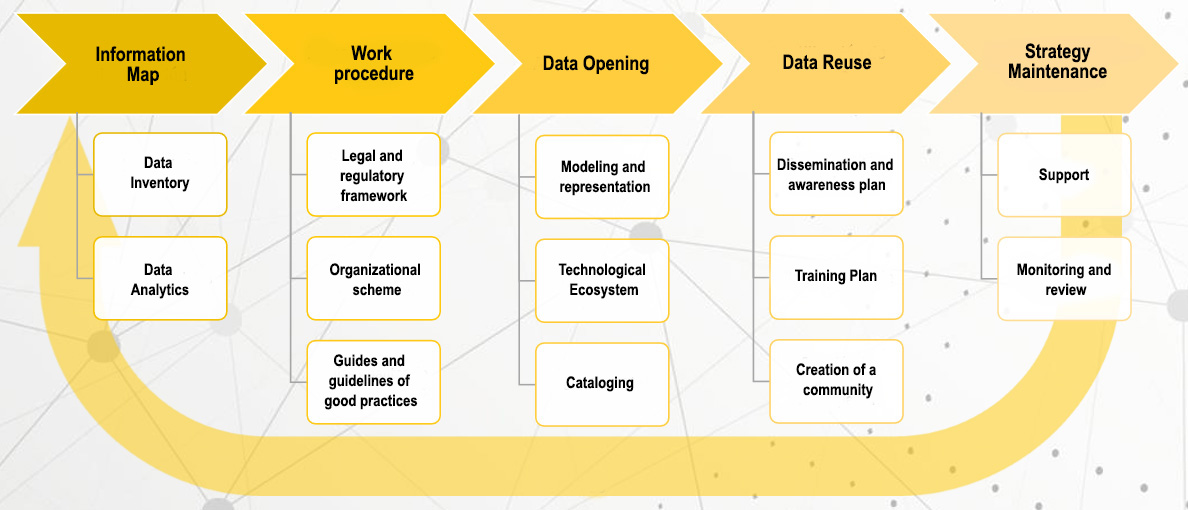
The third section of the report focuses on the implementation of open data in an organization. To facilitate this process, the authors of the guide have drawn up a plan with a series of stages that are detailed in the report:
Finally, the report shows several examples of innovative solutions and success stories, based on 2 criteria:
- Examples of open data portals, which stand out for their functionality, such as Aragon Open Data or the download center of the National Geographic Institute (IGN), among others.
- Examples of good practices regarding reuse, due to their innovative nature and the economic or social value they generate. Examples of different sectors are included, such as real estate (TerceroB), meteorological (Meteogrid), public procurement (EuroAlert) or data journalism and public transparency (Civio).
The report concludes with a series of conclusions, such as the need to improve the training of both public employees who are immersed in data opening and companies and individuals to promote the use and analysis of data.
Below you can download the full report and delve into all of these sections.
Evento
8th Edition of Aporta Meeting will take place on November 28. In this occasion, the event will focus on the power of public data to promote innovation and entrepreneurship. Under the motto "Innovation with public data", consolidated companies, start-ups and public bodies will share their experience about taking advantage of improvement and business opportunities linked to open data and new technological paradigms, such as Big Data or Artificial intelligence.
Thanks to these testimonies, attendees can learn first-hand about the challenges of an innovative project with open data, and discover possible solutions. The objective is to create an inclusive and dynamic event, where attendees can also share their concerns and own experiences through collaborative round tables.
The Meeting will begin at 9:30 in the Assembly Hall of the Secretariat of State for Digital Progress (Ministry of Economy and Enterprise).
- Round table 1: The value of open data reuse for Public Administrations
The first round table will be focused on public administrations and how the reuse of their data allows optimizing the services offered to citizens.
There are many examples of local, regional or state entities that have implemented services and applications based on public data to improve their agility and efficiency. These services allow a more direct communication, promoting transparency and accountability, as well as a greater participation of citizens in their locality or region political life. In addition, through the data analysis, these organizations can also identify behavior patterns that drive better resource planning and greater services personalization.
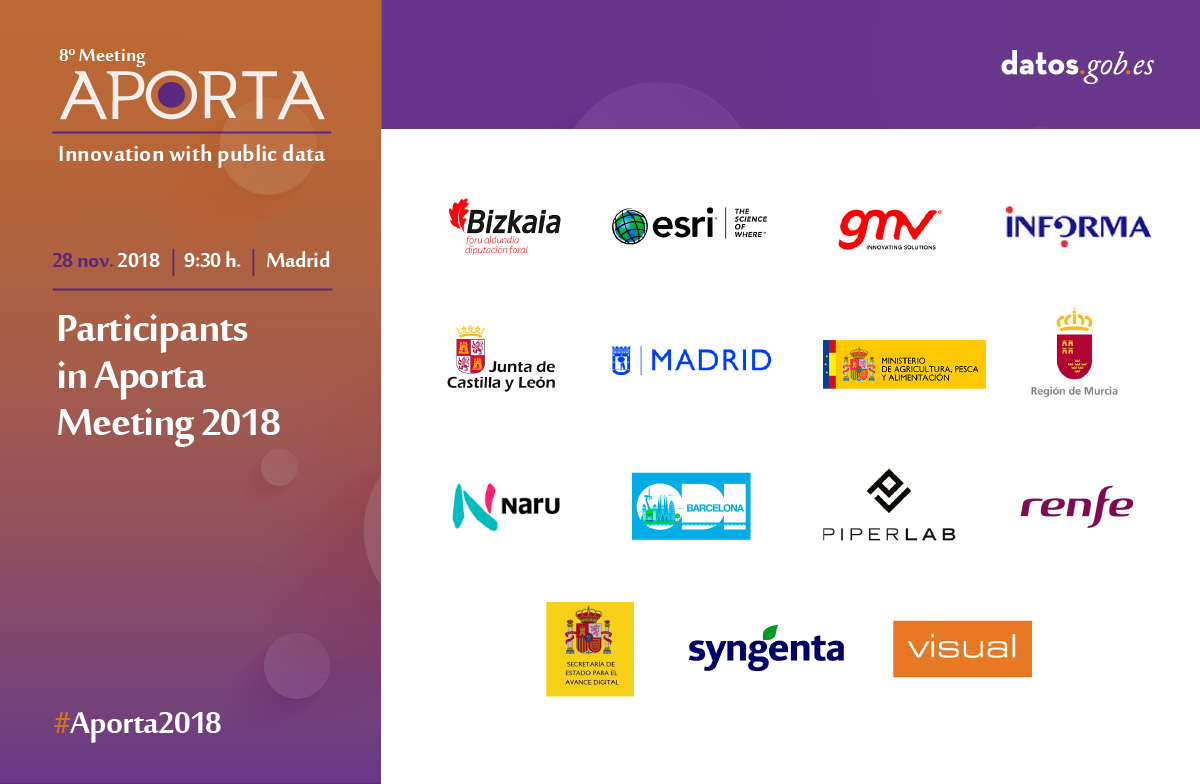
In order to address this issue, representatives from the following entities will participate in the round table: City of Madrid - who will moderate the debate-, Ministry of Agriculture, Fisheries and Food, Junta of Castilla y León, Autonomous Community of Murcia, Renfe and Provincial Council of Bizkaia.
- Round table II: Public sector information and entrepreneurship
According to the latest data from the National Observatory of Telecommunications and the Information Society (ONTSI), currently, there are more than 530 small and medium-sized companies with the objective of creating ideas and new products based on public information and data. These companies generated a turnover of 1,500 - 1,750 million euros and more than 5,000 direct jobs in 2016.
Innovation based on public data is especially noticeable when we talk about entrepreneurs and start-ups. The availability of free public data or public data with a marginal cost reduce the risk of starting a new business.
Therefore, the second round table will be integrated by entrepreneurs and startups from different sectors that are developing new products and services based on public data reuse and analysis. This is the case of VisualNACert, a software developer that improves the management of agricultural farms, Piperlab, which uses Big Data technologies and data sciences to develop algorithms that improve decision making, or Naru Intelligence, which applies data analytics to biomedicine sector. This round table will be moderated by Barcelona Open Data Initiative.
- Round table III: Public data and business development
But open data is not only useful for entrepreneurs. An increasing number of private entities use public data to face business challenges and improve their competitiveness. For these companies, public data has become an additional business resource that contributes to maintaining leadership in their industry sector, reducing corporate costs, adapting to and evolving with agility in their environments and collaborating with clients - and even competitors- to face industry challenges.
Therefore, the third round table will be integrated by four international companies that will explain how public data use help improve their products or services, adapt to new markets and expand their radius of influence in the industry. These companies are Informa, Syngenta, GMV and Esri, who will share their experience under the moderation of the Secretariat of State for Digital Progress.
The complete agenda is available in this link. Although the event is free, places are limited. Therefore, those interested in attending must register in this link.
Evento
For the tenth consecutive year, Asedie organizes a new edition of the "International Conference on the Reuse of Public Sector Information". The appointment will take place on October 23 at the headquarters of the Spanish Agency for Data Protection in Madrid.
As the previous years, the main objective is to serve as a platform to share knowledge and experiences, coming together all those involved in the Information and Data Community, as well as to promote public-private collaboration for public interest.
Under the motto, "Information, an essential resource for economic development", experts will address the importance of Infomediary sector and the evolution of information access and reuse.
Agenda
The event will begin at 9:45, with a few words from the Asedie President, D. Dionisio Torre. Then, Mr. Carlos Romero, Counsellor of Industry, Telecommunications and Audiovisual, Mr. Jesús Rubí, Deputy to the Director of the Spanish Data Protection Agency, and Barbara Ulbaldi, Head of OECD Digital Government and Open Data Policies Team, will share their vision on the challenges and opportunities of the infomediary sector, paying special attention to sector regulations.
After the coffee break, a round table entitled "The implementation of Reuse and its evolution in the last 10 years" will take place. Mrs. Cristina Morales, General Deputy Director of Information Society Content from the Ministry of Economy and Business, Jorge Salazar, Coordinator of the Commercial Registry from the Registrar College, Mr. Pedro Vivas, Head of the IDE / SIG Support Area of the Ministry of Development, and Mr. Enrique Crespo, Chief of the Information Access Service of the city of Madrid.
The event will conclude with the presentation of the Asedie Award. Since 5 years, Asedie present this award with the aim of highlighting the work of those people, companies or institutions that have done the best work or the greatest contribution to innovation and development of the Infomediary Sector.
Inscription
Admission is free, but places are limited. Therefore, those interested in attending the conference must register before October 18 through this online form.
Evento
Tus Datos, Mis Datos, Nuestros Datos meeting will be held next Wednesday, February 14, in the Auditorium of Medialab Prado, Madrid, from 9:30 am to 2:00 pm. Organized by Iniciativa Open Data, the event will cover the massive use of data in today's society, from different perspectives.
The event will begin with an open day session where attendees - prior registration - can visit three thematic spaces. In the first one, some national data catalog novelties (datos.gob.es) will be exposed, including information about which datasets are most used by citizens. Subsequently, Adolfo Antón, responsible for Datalab, will dedicate the second thematic space to address the key aspects for open data reuse. The third and last thematic space will be aimed at presenting the importance of data to move the city. This third space will be led by Ángeles Navarro of OpenDataSoft.
The second part of the meeting will be the Seminar Data, aimed at data managers of the Public Administration, open data professionals and digital rights and/or transparency experts. Given the target audience, access to this event will be invitation-only; although a score of places will be opened to the public the day before. The data seminar consists of a speech marathon where seven different profiles will present 7 miradas a los datos (7 looks at the data), a debate to discuss its importance, ownerhip, legal framework and opportunities for entrepreneurs and citizens, among others.
Then, there will be a round table discussion, focused on the socio-economic potential of open data, as well as the right to privacy and value generation at local level. This space will have the assistance of Juan Tomás García, from OpenSistemas, Borja Adsuara, digital strategy, public and regulatory affairs consultant, Helen Darbishire, from Access Info Europe and Elisa de la Nuez, from the Fundación ¿Hay derecho?, four experts to discuss open data as a wealth generator.
Finally, the day will end with a debate, with more than twenty renowned experts in data field. Participants will share their knowledge to develop a rights commandments based on institutional framework, in order to take advantage of data value in society.
This event´s aim is to promote open data knowledge, reuse and training among the citizens, while supporting entrepreneurial projects. An open space to reflect on governance, digital rights and data use in society to, in subsequent days, implement the conclusions to general public.
For more information, visit www.nuestrosdatos.es
Evento
On October 23, the day before the Aporta Meeting 2017, the report “The reuse of data for business generation” will be presented, which analyses published data and the portals where it is published, together with those responsible for its management and services generated from it.
During the session, which will take place - from 4.30pm to 6.00pm - at the headquarters of the Foundation for Innovation COTEC, the data in the report will be presented and a debate will be opened on the key aspects related to the publication of data to generate new services, as well as on the opportunity for a European association of data publishers.
The organisation of this day, will be published on social media with the hashtag #DatosAbiertosCotec, the Barcelona Open Data Initiative and the King Juan Carlos University will participate and it will be led by the open data expert Alberto Abella.
The conclusions of the event will be presented on October 24 during the afternoon of the Aporta Meeting 2017.
Evento
The seventh edition of the Aporta Meeting will be held next October 24, and this year has as its motto "The value of data in the global ecosystem", in which experts in open data, both national and international, will describe their views regarding the publication of public sector data and its reuse.
The meeting, open to all, will be organized in morning and afternoon sessions with round tables, talks and presentations. In the afternoon, as the final act of the conference, the Aporta awards will be given (aimed at recognizing the best experiences already completed in reuse of public data), as well as the awards to the winners of the Aporta Challenge (ideas, applications , solutions and/or services that use and reuse public data contributing to an improvement of efficiency in public administrations in Spain).
The event, which will also have various pre-events of a sectoral nature on the previous days, is organized by Red.es in collaboration with the Ministries of Energy, Tourism and Digital Agenda, and Finance and Public Function.
Entrevista
In reference to the Open Government Data Working Group of the World Bank, could you explain how the entity contributes to the opening and re-use of public information?
The World Bank has been providing technical assistance, capacity building and funding for developing countries’ Open Data programs since 2012. Its activities can be summarized under four domains: (a) tools, (b) technical assistance, (c) capacity building and (d) networks and inter-institutional collaboration.
On tools for open data, the Bank publishes and continually updates an Open Data Toolkit Open Data Toolkit that provide a set of curated resources for initiating or deepening an open data program. The tools include basic explanation of what is open data; advice on open data licensing and technology options, training opportunities, research, examples of apps and other uses of open data by sector and many other similar tools. Some of these tools have been developed by the World Bank, but the large majority have been developed by other institutions.
On technical assistance and funding, most developed countries are already harvesting the economic and social benefits that Open Government Data brings about, thus, one of the objectives of the World Bank is to take that knowledge and similar Open Data programs to developing countries. Currently, the World Bank has around 26 Open Data-related lending projects at different completion stages that are being, totally or partially financed, by one of the two lending windows of the World Bank: IBRD or IDA. Some of these projects also have a significant trust fund component.
“One of the objectives of the World Bank is to take that knowledge and similar Open Data programs to developing countries.”
The Bank has primarily focused on two approaches for capacity development on use and engagement with open data. The first approach has been to collaborate with civic hacker communities around opened data, through an array of generally low-cost hackathons (including on ‘hackable’ questions in key development areas, such as domestic violence, water quality and access, and sanitation). The second approach is more time and resource-intensive – it focuses on short term ‘open data bootcamps’ or long-term ‘deep dive’ open data training and efforts to institutionalize a ‘culture’ of open data among government and non-government groups. This approach prioritizes the strengthening of sustainable, endemic (self-reinforcing) capacity and use of open data up and down value chains without subsequent external support. Additional examples include efforts to integrate teaching curricula on open data into university environments and to integrate open data into private sector business models.
The World Bank has been a main sponsor of the last 3 International Open Data Conferences (Washington 2012, Ottawa 2015 and Madrid 16) and has committed to sponsor the next one (Argentina 2018). The Bank is a funder and founding member of the Open Data for Development (OD4D) program, along with the Canadian Government, the International Development Research Center and DFID. Both directly and through OD4D the Bank also sponsors regional conferences, such as ConDatos (official conference) and AbreLatam (unconference) in Latin America, Africa Open Data conferences and similar ones in other regions that host developing countries. Lastly, the Bank is also a member, but not always a leader, of other global groups that work on Open Data for Development, such as the Open Data Working Group of the OGP, the Open Contracting Data Partnership, the Global Partnership for Sustainable Development Data, The Open Data Charter and others.
Among the functions of the working group, what would you highlight and what are their lines of action? In what projects is the group currently immersed?
One of the most important tools in the Toolkit is the Open Data Readiness Assessment (ODRA), a quick diagnostic and action plan builder, tailored to each country’s legislation, institutions and demand/supply of data. The ODRA includes analysis and recommendations in 8 areas: leadership, policy/legal framework, institutions & capacities, data supply, data demand, civic engagement and capability, funding, and national IT infrastructure. ODRA assessments and the resulting reports are joint products of a small Government team and a Bank team. The methodology can be applied at the national, sub-national, city or agency level. Sectoral adaptations of the methodology have been done for energy and transport. The next section has more information on the countries where ODRAs have been done.
As explained above, there are currently 26 active projects financed by a combination of Bank’s own budget, trust funds, IBRD or IDA, or a combination of these. Since 2012 we have supported around 45 open data initiatives in developing countries.
When IBRD or IDA projects count with full government support, ODRA implementation and other related Open Data initiatives can be deepened and expanded, since IDA/IBRD projects assign larger amounts and take several years of implementation. Also, once the Open Data initiative or ODRA implementation is concluded, there is a great possibility to use Open Data applications to shed light on some individual sectors of the economy that need more technical support or financial assistance from IBRD or IDA.
“Since 2012 we have supported around 45 open data initiatives in developing countries.”
How do you think that opening up public information and citizen participation in government processes can boost development in emerging economies? Could you illustrate this with some real cases?
When data are made widely available and easy to use, the benefits can be significant. Broadly speaking, the benefits of Open Data include:
- Transparency. Open Data supports public oversight of governments and helps reduce corruption by enabling greater transparency. For instance, Open Data makes it easier to monitor government activities, such as tracking public budget expenditures and impacts. It also encourages greater citizen participation in government affairs and supports democratic societies by providing information about voting procedures, locations and ballot issues.
- Public Service Improvement. Open Data gives citizens the raw materials they need to engage their governments and contribute to the improvement of public services. For instance, citizens can use Open Data to contribute to public planning, or provide feedback to government ministries on service quality.
- Innovation and Economic Value. Public data, and their re-use, are key resources for social innovation and economic growth. Open Data provides new opportunities for governments to collaborate with citizens and evaluate public services by giving citizens access to data about those services. Businesses and entrepreneurs are using Open Data to better understand potential markets and build new data-driven products.
- Efficiency. Open Data makes it easier and less costly for government ministries to discover and access their own data or data from other ministries, which reduces acquisition costs, redundancy and overhead. Open Data can also empower citizens with the ability to alert governments to gaps in public datasets and to provide more accurate information.
Several concrete examples of the use of Open Data in specific countries and sectors can be found here.
It will take time to fully understand the complexity and broad potential of Open Data, as the benefits of Open Data impact on broader populations and additional useful options are continuously discovered.
The World Bank has its own open data portal. You could mention some outstanding project - visualization, service, app ... - that has reused the information of the platform and that has had a positive social impact in its environment.
The World Bank provides several tools to enable use of its own data. These include the Bank’s Open Data website and Databank, which allow users to search, visualize and download development data quickly and easily. The Bank also provides data via application programming interfaces (APIs), which has enabled the development of many third-party apps and greatly expanded the ways in which Bank data can be put to use.
Here are some examples:
- Google incorporates development data from the World Bank into its search engine. Searches for common, country-level development indicators such as GDP of Ethiopia typically produce a visualization of relevant data, sourced from the World Bank’s open data API.
- StatPlanet allows users to select and visualize over 3,000 development indicators for nearly every dimension of economic, social and human development. StatPlanet was the winner of the World Bank’s Apps for Development competition, and its technology has been incorporated into the Bank’s EdStats education data portal.
- Save the Rain is an app that uses World Bank open data to estimate the agricultural impacts of small-scale water conservation on a local scale. Save the Rain was one of the finalists in the World Bank’s Apps for Climate competition.
- WB Panorama is another Apps for Climate finalist that uses World Bank open data to show the impact of climate change on crop yields and local living conditions.
In addition, open data best practices enable other governments and organizations to redistribute World Bank data with virtually no transaction costs. For example, when Edo State, Nigeria launched its open data portal in 2014, it copied open data for that region from the World Bank as a way to augment its own data offerings. Open data allowed Edo State to provide its citizens with a broader set of useful data in a single repository than would have been possible otherwise.
Following your participation in the last edition of the International Open Data Conference held in Madrid. How would you rate the current state of the open data sector on a global scale? What immediate needs do you detect and what do you consider to be the next steps necessary to move forward in openness?
While open data is showing signs of increasing maturity in developed countries and some developing countries, the state of progress is heterogeneous and its impact is hard to measure. Why is open data succeeding in some contexts and failing to achieve traction in others? Open data is more useful and actionable when it is a strategic element of a larger development initiative and not pushed forward as a standalone issue. There is evidence that open data is progressing where it is aligned with other important agendas such as the climate change or national development plans, as well as with regional and sector-specific discussions, for example standards and best practices in contracting, statistics, transport, open cities’ data and more. There is also noticeable interest in business models for open data. The future of open data is largely linked to the extent to which the agendas and activities of the organizations and individuals within the open data community align around concrete, shared priorities.
Realizing the potential of open data for decision-making requires making open data and its applications work for everyone, creating tools for a broad audience and identifying data to be opened based on larger efforts to improve the lives of all people, including the poor, the marginalized, and the chronically underserved.
“The future of open data is largely linked to the extent to which the agendas and activities of the organizations and individuals within the open data community align around concrete, shared priorities.”
In contrast to previous years, the Madrid Conference showed that National Statistical Offices (‘NSOs’) are emerging as a potentially important stakeholder group. This is a qualitative leap for open data in developing countries, where NSOs are often the primary (if not the only) source of high-quality, official data.
Advocates for grassroots open data initiatives in many developing countries need financial, material, and human support. The international community is increasingly interested in data for development. However, it is unclear whether open data has the same level of priority in their agenda. Also, models for implementation that work in the developed world may need to be reconsidered, and merged with other approaches that recognize different circumstances in developing countries. With this in mind, the business case for open data still needs to be showcased wherever possible (e.g. public services’ efficiencies resulting from open data, contributions to economic growth, job creation, etc.)
Another challenge in developing country contexts is the availability of quality data, on a predictable and frequent schedule and with enough metadata to make it useful for reuse. Use of common taxonomies is essential to extract maximum value from data already opened, and I think we are just starting on this.