


Blog
Within this technological maelstrom in which we are constantly immersed, every day that passes, humanity is creating a great amount of information that, in many cases, we are unable to deal with.
Public administrations also generate large volumes of information, which they make available to citizens so that we can reuse it from open data portals, but how can we take advantage of this data?
On many occasions, we think that only experts can analyse these large amounts of information, but this is not the case. In this article we are going to see what opportunities open data presents for users without technical knowledge or experience in data analysis and visualisation.
Generating knowledge in 4 simple steps with a use case
Within the Spanish Government's open data platform, we can find a multitude of data at our disposal. These data are grouped by category, subject, administration that publishes the data, format or with other tags that label us its content.
We can load this data into informational analysis applications, such as PowerBI, Qlik, Tableau, Tipco, Excel, etc., which will help us to create our own graphs and tables with hardly any computer knowledge. The use of these tools will allow us to develop our own informational analysis product, with which we can create filters or unplanned queries. All this without having other computer elements such as databases or ETL tools (Abbreviation of data Extraction, Transformation and Load).
Next we will see how we can build a first dashboard in a very simple way.
1.- Data selection
Before we start collecting meaningless data, the first thing we must decide is for what purpose we will use the data. The datos.gob.es catalogue is very extensive and it is very easy to get lost in this sea of data, so we must focus on the subject matter we are looking for and the administration that publishes it, if we know it. With this simple action we will greatly reduce the scope of our search.
Once we know what to look for, we must focus on the format of the data:
- If we want to collect the information directly to write our doctoral thesis, write an article for a media outlet with statistical data, or simply acquire new knowledge for our own interest, we will focus on taking information that is already prepared and worked on. We should then use data formats such as pdf, html, jpg, docx, etc. These formats will allow us to gather that knowledge without the need for additional technological tools, since the information is served in visual formats, the so-called unstructured formats.
- If we want to work on the information applying different calculation metrics and cross them with other data in our possession, in that case we must use structured information, that is, XLS, CSV, JSON, XML formats.
As an example, let's imagine that we want to analyse the population of each of the districts of the city of Madrid. In this case the dataset we need is the census of the Madrid City Council.
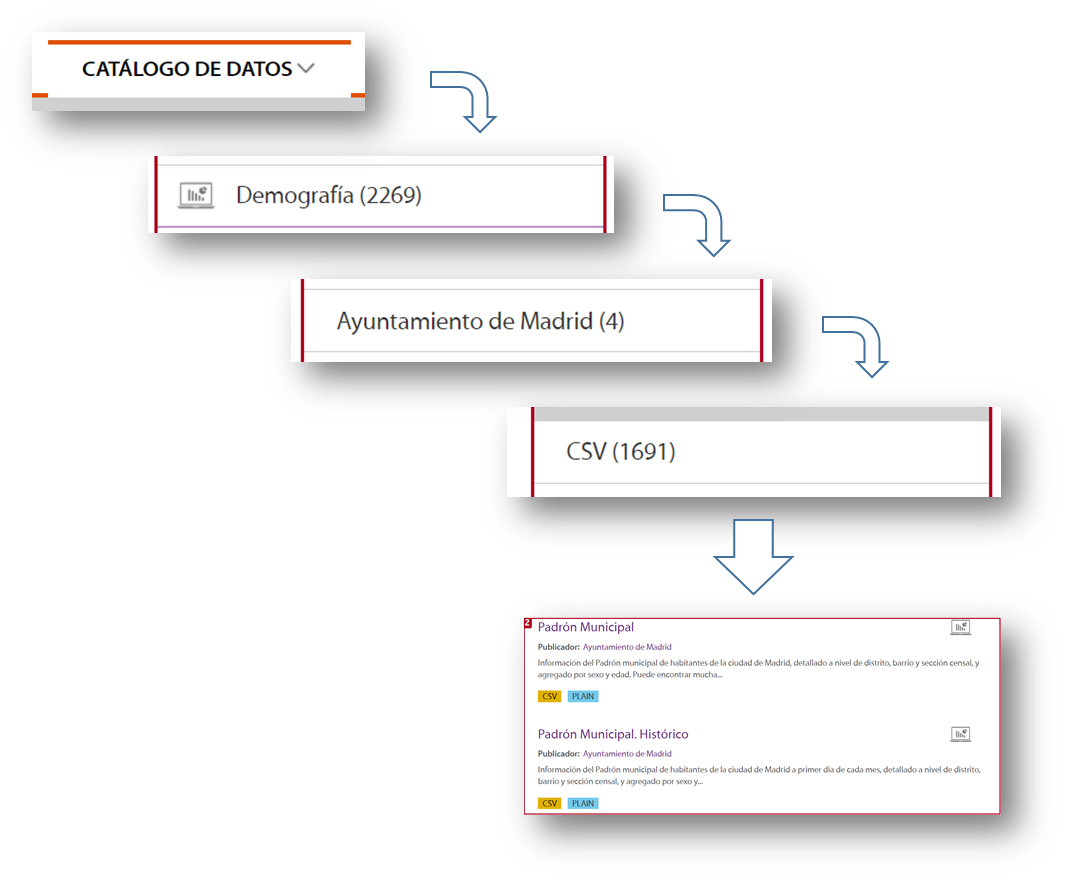
To locate this set of data, we selected Data Catalogue, Demography category, the City Council of Madrid as publisher, the CSV format and I already have the information I need on the right side of the screen. Another simple and complementary way to locate the information is to use the search engine included in the platform and type in "Padrón "+"Madrid".
With this search, the platform offers, among others, two sets of data: the historical census and the census of the last month published. For this example we will take the document corresponding to the August 2020 update.
2.- Loading the information into an information display tool
Many of the information visualisation tools usually have built-in wizards to collect data that can be downloaded from an open data portal. The images in this article are from the Business version of QlikSense (which has a free 30-day trial), but any of the tools mentioned above work in a similar way. With a simple "drag and drop", you will already have the information inside the tool, to start creating indicators and thus generate knowledge.

Most of these tools directly interpret the content of the fields and propose a use for these values, differentiating them by data that can be used as filters, geographical data and data to formulate.
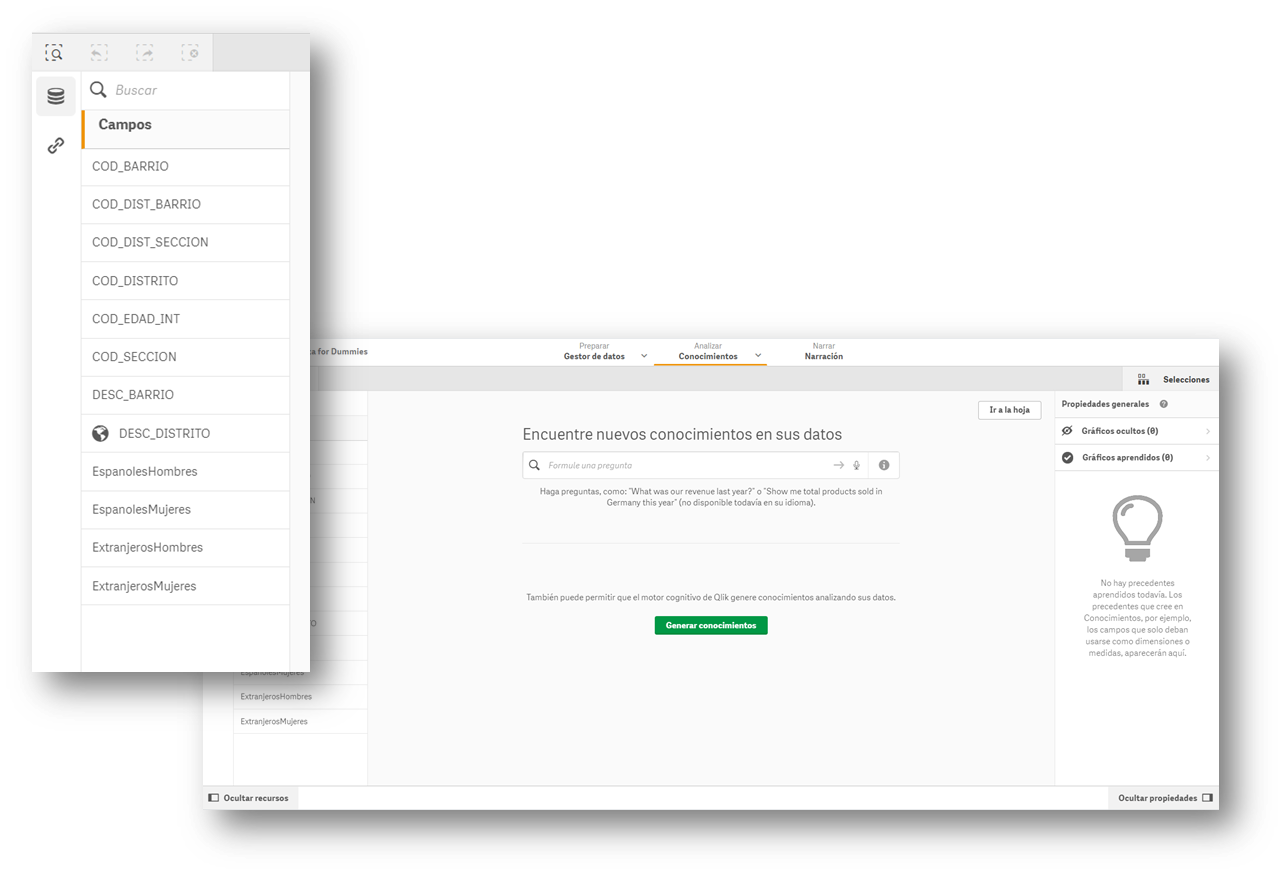
3.- Creation of the first graph or indicator
Now all that remains is to drag the fields on which we want to generate knowledge and create the first indicator on our dashboard. We will drag the field DESC_DISTRITO, which contains the description of the district, to see what happens.
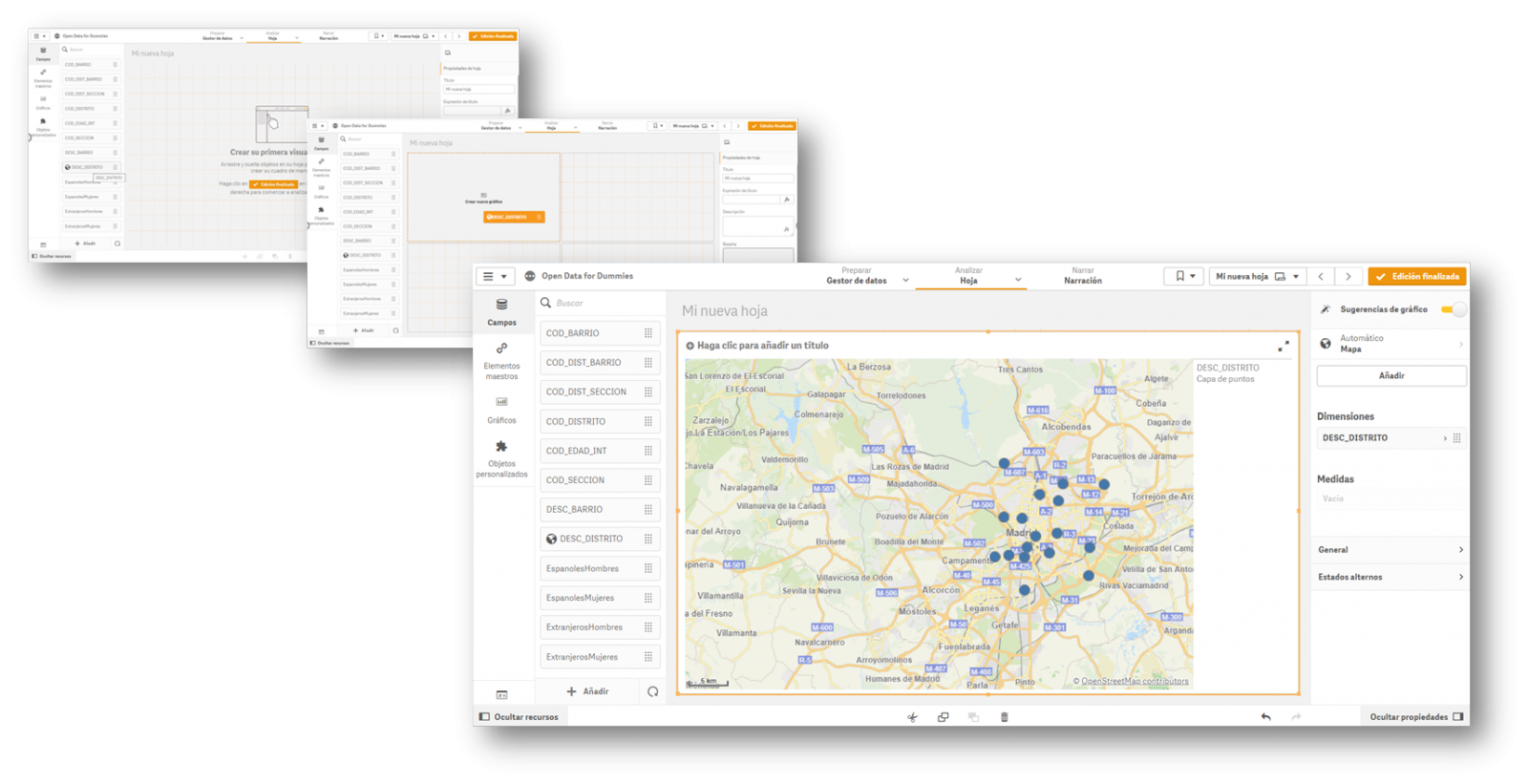
Once the action has been carried out, we see that it has geo-positioned all the districts of Madrid on a map, although at first we do not have any information to analyse. In this first automatic visualization it shows us a point in the centre of the district, but it does not provide us with any other type of additional information.
4.- Creating value in our indicator
Once we have the points on the map, we need to know what we want to see within those points. We will continue with the "Drag and Drop" to count the men and women of Spanish nationality. Let's see what happens...
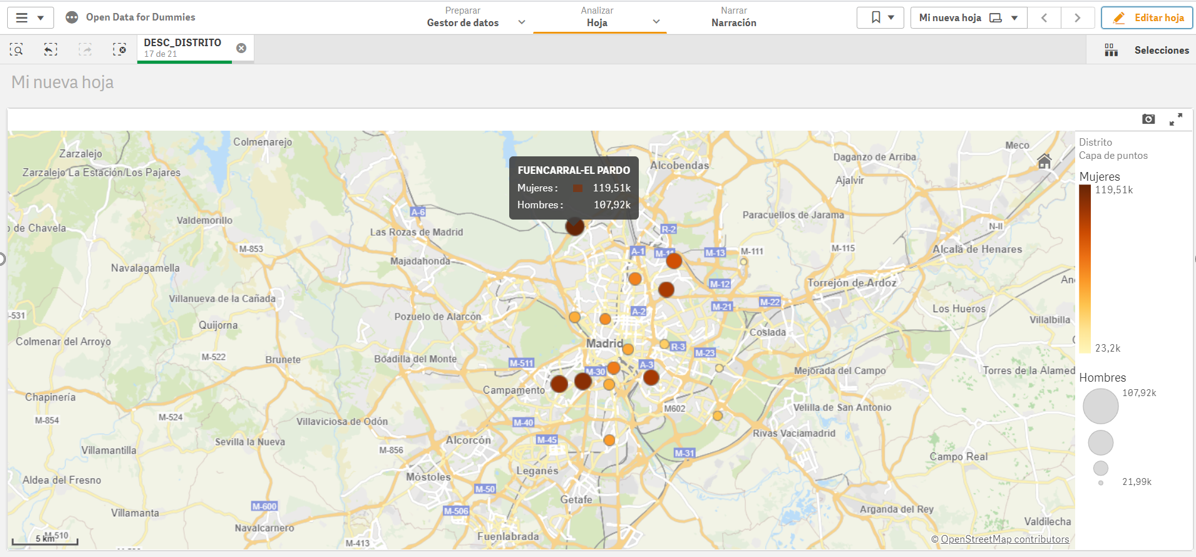
We see that, for each of the points, the tool has added the citizens by sex in each of the districts where they are registered.
In short, with four simple steps in which we have only selected the set of data and we have dragged and dropped the file into a visualisation tool, we have created the first indicator on our dashboard, where we can continue to generate knowledge.
If we continue to go deeper into the use of these tools, we will be able to create new graphics, such as dynamic tables, pie charts or interactive visualisations.
The interesting thing about this type of analysis is that it allows us to incorporate new sets of open data, such as the number of pharmacies in a district or the number and type of accidents in a particular area. By crossing the different data, we will be able to acquire more knowledge about the city and make informed decisions, such as which is the best area to set up a new pharmacy according to the population or to install a new traffic light.
Content elaborated by David Puig, Graduate in Information and Documentation and responsible for the Master Data and Reference Group at DAMA ESPAÑA
Contents and points of view expressed in this publication are the exclusive responsibility of its author.

Blog
Copernicus is one of the geospatial data programmes that is most in demand and the focus of attention of various organisations, private companies and citizens. The programme is run jointly by the European Space Agency (ESA) and the European Union through the European Environment Agency, and has two clear objectives: to observe the environment in order to support strategies for mitigating and adapting to climate change, to manage emergencies efficiently and to improve the security of each citizen; and to provide accurate and up-to-date information that is easily accessible to everyone.
The Copernicus programme provides data and information services without restrictions and free of charge on many areas of application thanks to the different technologies used, ranging from satellites in space - including Sentinel satellites - to sensor systems on land, at sea and in the air. Copernicus transforms the data obtained from the satellite into valuable information, thanks to the processing and analysis of the information, its integration with other sources, and the validation of the results.
Through these data, both private and public organisations can create products and services of great economic and social value. The Copernicus programme itself highlights three of these on its website that are linked to our country:
Carbon mapping of forest trees
Agresta S.Coop in collaboration with several Universities of Almeria (Spain) and Delaware (USA), has developed a new methodological approach to improve the national aerial carbon map. The ecosystems of the Iberian Mediterranean area are highly sensitive to climate change and it is therefore essential to monitor and manage organic carbon in these areas. Traditionally, LIDAR technology has been used to measure the carbon density of vegetation, but the data obtained by this means have longer repetition cycles than those provided continuously by satellites. For this reason, programmes such as Copernicus are essential to develop better management of the study area. In this case, thanks to Copernicus Global Land Service it has been possible to integrate the necessary data with high resolution vegetation images, thereby improving the viability and study of the area.
More information in this fact sheet.

Forest Fire Risk through vegetation stress
At present, forest fires are a constant threat to the ecosystem in Spain, which continues to grow due to the drought that the land suffers as a result of climate change and a decreasing forest control. Monitoring, studying and controlling the state of vegetation and wooded areas through geospatial programmes such as Copernicus is essential to curb fires. Thanks to them, it is possible to know the dryness of the land and the load of inflammable elements in the area. The Castilla-La Mancha Forest Fire Service is working in this direction, using this data for management and decision-making in the forest environment, not only in operational phases but also in emergency situations.
More information in this fact sheet.

Customs: arrest of drug traffickers
The maritime accesses to Spain and Portugal are strategic entry points for drug smuggling. A large deployment of customs authorities fights every day side by side to stop drug trafficking by investigating the different transit routes already known. Geolocation systems such as Copernicus help in this difficult task. Thanks to the combination of different technologies and available SAR satellites, the search for suspicious vessels at sea becomes less complicated. A real example of use is this joint operation of the National Police and the Tax Agency, which has involved the collaboration of the Portuguese police, the American DEA and the British NCA, where nearly two and a half tonnes of cocaine were intercepted.
More information in this fact sheet.

Other use cases of Copernicus
In addition to these 3 examples highlighted on Copernicus' own website, there are many more Copernicus' use cases.
One way to find out more about Copernicus' use cases is to visit Aplicop's website. Aplicop is a project funded by the European Commission, responsible for "disseminating the Copernicus programme, facilitating the use of the programme's products in Spain, and connecting users and providers of the Copernicus ecosystem in Spain". Among other actions, its website collects examples of use cases, through the following form. These examples are shown on a knowledge map, together with other components of the Copernicus ecosystem.
On ApliCop's website we also find information about upcoming events that promote the construction of services and applications based on Copernicus information services, such as the next Copernicus Hackathon Malaga to be held from 18 September to 3 October in the Andalusian city.
Copernicus continues to drive the reuse of the data it provides
As we have seen, the opportunities for geospatial data to generate benefits for society, the economy and the environment are numerous. The Copernicus programme itself aims to continue promoting the creation of valuable services based on geospatial information, which it provides through different acceleration and incubation programmes. A great opportunity for entrepreneurs and start-ups who want to be part of this interesting ecosystem.
More information about Copernicus
If you want to know more about the project, you can visit the following links:
- In this article you can find out more about Copernicus' information services and Spain's role in the European Observation Programme.
- In this interview, Nuria Valcárcel, Deputy Director (Territory Observation) of the Subdirectorate General of Geodesy and Cartography, in the D.G. National Geographic Institute (IGN) of the Ministry of Development, the body that represents Spain in the Copernicus Users' Forum, for the monitoring and evolution of the programme, together with the Ministry for Ecological Transition (MITECO), looks in depth at the Copernicus services and highlights other examples of use such as this application for the environmental control of ports developed by NOLOGIN.
Content elaborated by datos.gob.es team.
Noticia
The open data ecosystem does not rest in summer. During the summer months we have seen both the opening of new content and the creation of interesting reuse projects. In Spain, we find pioneering initiatives related to areas such as sustainability and smart cities, humanities and culture or geographic data.
Below are some examples of the proposals that have been launched this summer related to open data.
Launch of new portals, repositories and tools to promote access to open data
Reusers have more and more content at their fingertips. An increasing number of initiatives are encouraged to make their data available to users, as well as organizations that go one step further and launch thematic repositories:
- Terrassa City Council launched a new open data portal in July. The portal includes a data catalogue with 133 datasets on demography, transport, urbanism and infrastructure, etc. It also includes an applications section, with examples of reuse.
- The Generalitat Valenciana has also launched a new open data portal, which allows users to consult and download various types of data: education, health, infrastructure... and it includes a space with information for reusers.
- The San Sebastian City Council has opened the GeoDonostia portal, in which it releases all the geographic data and 300 graphics -which will be extended- so that citizens and professionals can consult them.
- In the economic field, the Institute of Economic Studies of the Province of Alicante, INECA, has launched, thanks to the open data, the largest economic database in the province.
- As far as initiatives in the food sector are concerned, the groups AGR127 and RNM322 from the University of Cordoba, which form part of the 'Cereal Water' Task Force, are investigating new techniques and technologies to achieve a more sustainable cereal crop. All the data generated will soon be shared through their platform.
- Regarding art and humanities, the Guggenheim Museum of Bilbao opened its doors online through exhibitions and digital tours that allowed access to their works.
Where more advances are being experienced is in the field of sustainability and the search for smart and efficient cities. A good example is the city of Onda, whose project turned out to be the winner of the XII Aslan Awards. The project promotes the collection of real time data on public transport and incorporates a virtual assistant that solves the neighborhood's doubts.
The reuse of data in public administrations
But public bodies are not only opening up their information, they are also creating services to encourage its reuse:
- The City Council of Murcia has presented MUDATAlab, a laboratory that promotes the production and dissemination of humanistic related to the heritage of Murcia, based on the use of open data.
- Summer has been the time chosen by several data initiatives to launch competitions aimed at promoting the creation of solutions based on data reuse. The Junta de Castilla y León has opened the period to participate in the fourth edition of its data contest, which this year includes as a novelty a prize for data journalism. The Government of the Basque Country has approved a new call for its awards, which will be opened in September, as well as the new edition of the Barcelona Dades Obertes Challenge.
Public administrations not only publish data, but are also reusers of information services, as we have seen in this recent report. Some examples, developed during the last months, are
- Andalusia has released an application through which geolocalized information on free Internet access points can be consulted.
- In order to improve habitability in the city, the Santiago de Compostela City Council has announced that it will introduce a traffic system that will signal the availability of parking spaces in the parking lots using open data from its open data portal.
- The Cartographic and Geological Institute of Catalonia, ICGCat, has published a viewer of routes in the province with data extracted from the open data portal of the Catalan Government. In the same community, the Ministry of Agriculture has published a map of farms in Catalonia.
International proposals that promote the use of open data
Initiatives based on the use of open data are not only limited to Spain. There are also interesting proposals in the international arena that can serve as inspiration:
- Uruguay has created an open data system of trade and business intelligence that provides useful information to small and medium businesses.
- The Digital Agency for Public Innovation of Mexico City has presented a digital tool based on open data through which it will be possible to explore, consult and download information from the territorial cadastre.
- The Massachuetts Institute of Technology has collaborated with Toyota to launch open data to accelerate research in the field of autonomous driving.
- Argentina has launched an educational platform that includes virtual classrooms, a repository of educational content and a monitoring and research module, developed from open data.
These are some of the most striking examples to be found in the world of open data, but there are many more. If you know of any other interesting news, you can mention it in the comments or by sending an email to the Dynamization department: dinamizacion@datos.gob.es.
Noticia
In order to continue with the dissemination of geographical knowledge in society and to encourage the study of Spanish geography and the interaction of young people, the National Geographic Institute (IGN) has created a series of educational materials aimed at secondary and high school students. To create these contents, the IGN has used their own geographic data, that are shared openly in its Download Center, and maps from its viewers, such as the Interactive National Atlas of Spain.
With these training materials, the IGN aims to provide interesting and attractive information on Spanish geography in an interactive way for young people to become familiar with cartographic systems, maps, coordinates, etc.
Until now, these materials were available in Spanish, but now they can also be found in English, to continue strengthening materials in bilingual education and, at the same time, contributing to their dissemination beyond our borders.
Specifically, these 4 contents have been translated:
1. Territorial inequalities
The activity on territorial inequalities is focused on students between 16 and 18 years old (Bachillerato). The objective is to show in a synthesized way and from different perspectives how human occupation, communication infrastructures or the physical environment (north/south, inland/coast, lowlands/mountains, mainland/islands...) generate a series of differences that characterize the current Spanish society and that are manifested at different scales.
This interactive and educational resource will analyse the territorial inequalities of Spain as a historical process in which economic, political, social and geographical factors come together. For this purpose, data and maps are used not only from the IGN, but also from different entities such as the INE.
2. Economy and urban features
This new activity aimed at high school students is especially focused on knowing the economic characteristics that define 5 Spanish towns (Villablino, Benidorm, El Ejido, Avilés and Zaragoza). In order to study each of them and know their main economic activity, the student must answer several questions by researching through different resources such as: maps, photographs, orthoimages, graphics...
The aim of this exercise is for young people to obtain all the information through the Internet and the different platforms, such as the Geoportal of the National Atlas of Spain, in addition to the topographic resources offered by the National Geographic Institute. What is the ultimate goal? To show students, in the most interactive way, the endless documentation and public information available to citizens and through which they can recognize the characteristics of Spanish populations and learn to distinguish them according to their predominant function.
3. Physical environment and settlement
The third activity is a new exercise in which students between 12 and 16 years old (Secondary) must look for information in several maps to solve the issues raised in the activity.
They must answer questions about why the city has a certain organization, how it is oriented, the layout of its streets and what the reasons are that justify its urban morphology. To answer the questions, they have a series of IGN geolocation services to make the search. These are: CartoCiudad to search for postal codes, streets or house numbers, and the Basic Geographic Nomenclature of Spain for population entities, municipalities and all the toponyms of the country.
4. Spain, 8,000 kilometres of coastline
The following activity delves into the study of the Spanish coastal landscape through definitions, photographs, geographic displays and the use of maps using the National Geographic Information System of Spain (SignA) of the IGN. The exercise, aimed mainly at high school students, tries to show students the different geographical features that are characteristic of the Spanish coast (estuaries, deltas ...), through the management of coordinates in the application SignA.
Documentación
Natural language processing is making machines (computers) understand human language: spoken or in the form of text. More formally, natural language processing is a hybrid field between computer science and linguistics, which uses different techniques, some of them based on artificial intelligence, to interpret human language.
In this report, prepared by the digital transformation expert Alejandro Alija, we will see how natural language processing is much closer to our day-to-day life than we may initially think. Applications such as automatic translation of texts; sentiment analysis in social networks; the searches we carry out on the internet; the generation of meteorological summaries or the simple requests that we make to our smart speaker, have a strong technological component of natural language processing.
The specific weight that natural language processing has (and will have) in industry and the economy is increasing, since most of the data that is produced in the world (mainly through the Internet) is data in the form of texts and voice (unstructured data). Open data plays a crucial role for this technology. The artificial intelligence algorithms that are used to analyze and understand natural language require a huge amount of quality data to be trained. Many of these data come from the open data repositories of both public and private institutions.
Throughout this report, the history of natural language processing is reviewed, from its inception to the present day. Additionally, the Inspire section describes some of the most representative use cases that harness the potential of natural language processing. The prediction of text when writing a new email, the classification of texts in categories or the generation of false news, are just some of the cases that are reviewed in this report.
Finally, for those more enthusiastic readers, in the Action section, a complete use case (using programming tools) is developed on sentiment analysis in conversations about citizen public debates.
The report ends with a list of resources and readings for those users who wish to continue expanding their knowledge of Artificial Intelligence.
You can download the full report and other additional materials at the following links:
Note: The published code is intended to be a guide for the reader, but may require external dependencies or specific configurations for each user who wants to run it.
Documentación
The data economy in the European Union exceeded € 375,000 M in 2018, with a growth close to 12% compared to 2017, and it is expected to continue growing to € 555,000 M in 2025. Then, it will reach 4% of the GDP of the EU27.
Given this situation, it is not surprising that an increasing number of companies are emerging in the field of data-based businesses. Starting a new business is not always easy. We need resources, knowledge of the business environment, contacts, a suitable team ... For that reason, it is important to know a series of public and private programs and initiatives that seek to help those braves who want to start their business.
The “Guide to accelerate data-based businesses”, carried out by the Digital Transformation expert Jose Luis Marín, collects a set of useful recommendations aimed at entrepreneurs and start-ups who want to access existing resources to boost and finance the development and launch of products and services that create value from the reuse of public or private data.
The guide is structured in 3 parts:
- In the first part, an introduction is developed that offers context about the growing market of products and services based on the use and reuse of public or private data. This explains growth forecasts and areas of greatest interest, such as artificial intelligence or smart city solutions.
- The second part provides a series of recommendations to help select the most appropriate resources to start up a business. For this, the different current mechanisms are explained: accelerators, incubators, public subsidies and private investments. The factors to be considered when filling out an application to access these resources are also explained.
- Finally, the third part collects some examples of concrete, public and private resources that entrepreneurs and start-ups can use to boost their projects.
You can access the report and other materials through the following links:
Documentación
We release a new series of reports in datos.gob.es, which under the methodology “Awareness, Inspire, Action” tries to explain how different emerging technologies work and their relationship with open data. The objective is to introduce the reader to the subject through the use of practical, simple and recognizable use cases.
The first report of the series is dedicated to Artificial Intelligence. We can define Artificial Intelligence (AI) as the ability of a machine to mimic human intelligence. This technology will have a great impact on our lives, in two ways: the automation of daily, routine and dangerous tasks and the increase of human capacities, helping to strengthen the work force of the future.
The report has been prepared by Alejandro Alija, expert in Digital Transformation and Innovation, and addresses the following contents:
- The report begins with the Awareness section where the concept of AI is explained in a simple way, briefly outlining two of its sub-fields: Machine Learning and Deep Learning. This section also includes a brief historical review, where the evolution of AI is reviewed, and the factors that make it possible are compiled and explained.
- Next, in the Inspire section, we deep on the AI use cases. For this, the author has taken as reference his two areas of impact: AI as an amplifier of human language, with tasks such as reports translation or conversion of written to spoken language (and vice versa), and AI as an extension of human vision, illustrated through examples of the use of image recognition and classification.
- Finally, in the Action section one of the use case mentioned in the Inspire section is developed: the recognition and classification of images. For them, a set of images has been selected available in the data catalogue of data.gob.es (the photographic archive of the Basque Government: images about Euskadi and the Government activity). Using AI tools, the images have been classified and their description noted. This example can be replicated by the reader since the code necessary for its development has been made available.
The report ends with a list of resources and readings for those users who wish to continue expanding their knowledge about Artificial Intelligence.
You can also download the full report and other additional materials in the following links:
Note: The published code is intended to be a guide for the reader, but may require external dependencies or specific configurations for each user who wants to run it.
Blog
One of the economic sectors that is experiencing a high growth in our country is the real estate market. Deciding on a property involves a lot of small decisions: Rent or purchase? In what zone? What services do I need nearby? What is the market price?
As we saw a few months ago, open data can help us make this decision in the most informed way, based on evidence and proven information. In Spain, this trend is also spreading, and more and more public bodies and companies are creating products and services based on public information to facilitate the search for housing.
A business with future potential
In the era of technology and information, real estate agencies are having to incorporate tools that allow them to know the market situation, something that is giving rise to new business models: companies that combine open data with analytics and Big Data to show in a simple way (through visualizations, dashboards, etc.) the market behaviour. Let's see some examples of Spanish companies that are emerging in this sector:
- Urban Data Analytics (uDA) is one of the companies that has emerged in recent years dedicated to segregating and geolocated knowledge of the real estate sector. Through Big Data and Business Intelligence tools, it provides a service of 190 indicators through APIs and an application. These indicators allow instant knowledge of both market and portfolio of a company´s real estate, and are very helpful to real estate agents who seek to make their investments profitable.
- Clicpiso, for his part, is a Spanish startup specializing in homes sale, with a peculiarity that differentiates it from its competitors: Clicpiso carries out the transaction in less than 7 days. For this, it use a valuation algorithm based on Big Data, which also automatically learns from itself to ensure that the processes and valuations of each property are optimized with each new registry.
- Another example is Strabi, who offers dashboards to keep track of home sales in Spain, both free and protected. Thanks to its web quevalemicasa.es citizens will be able to know quickly if their home was well valued at the time of purchase and in what situation it is now (above or below its reference price). This application relies on the use of open data and Business Intelligence tools, based on Open Source technology, for model development, data loading and analytical exploitation.
The involvement of public bodies
But, despite the positive growth data of the sector, we must also take into account the difficulties of a large part of the population in accessing housing, a concern that affects young people above all. The society is demanding measures from public agencies and these measures go through knowing how supply and demand are being managed. The Government of Aragon and the Madrid City Council, among others, have launched tools in recent years that allow integrating all this information:
- Inmuebles de alquiler, Aragón is the application created by the Government of Aragon in 2017 to know the prices of house and premises renting throughout the Autonomous Community. Thanks to it, citizens can search by street name or geolocation, as well as make comparisons through historical data. The objective: that the citizen knows if the price they offer adapts to the reality of the market.
- The Puerta de Alcalá Urban Planning Platform was created by the Madrid City Council in 2018 to collect all the information related to the different areas of the city and manage its urban cycle, from planning to construction. In this way, citizens, companies or administrations have more accessible, transparent, reliable and up-to-date information on municipal action in urban planning.
It is clear that we are facing a complex market, whose future is to boost economic growth while respecting the basic rights of access to housing. The knowledge of the sector, analyzing historical data and preparing future predictions, will allow to better adapt the offer to the demand, promoting a housing stock that responds to the needs of all citizens.
Blog
Close your eyes and try to get on without seeing what is around you. Seat you in a wheelchair and determine if it is easy to access public transport and visit your favourite restaurant.
Perhaps you have not tried to live these experiences, but you could imagine the result. Public administrations are making an effort to make our environment more accessible, but it is true that there is still work to be done and people with disabilities face barriers that limit their movements.
To try to make these daily situations easier, simple applications have emerged in recent years that provide useful information about the environment using open data. The objective: to make the daily life of people with disabilities easier.
Here are some examples:
- Lazzus is an assistant created by Neosentec that accompanies blind and visually impaired people in their daily journeys, creating an auditory field of vision. The application provides relevant information about the environment, such as the situation of crosswalks, crossroads, stairs, nearby establishments, etc. Simply point a direction with the mobile to inform you about the elements around. It also allows you to customize searches, activating filters or saving frequent points as favourites.
- Mapcesible is an initiative of Fundación Telefónica, COCEMFE and ILUNION. It is a collaborative platform that allows mapping the accessibility of different places so that people with reduced mobility can plan their daily trips. Information is obtained in two ways. The application incorporates 14 datasets from official bodies such as the Ministry of Agriculture and Environment or different municipalities. In addition, any citizen, with or without reduced mobility, can assess the accessibility of the places they visit. They just have to register with an email and answer a series of simple questions that allow to quickly define how accessible a place is. Some examples of questions are “Is it close to public transport?” or “Has it an adapted toilet?”. There are currently more than 22,000 mapped spaces.
- Disable park is a web platform and mobile application created by 3dids, which offers all available information on the exact location of parking spaces for people with reduced mobility. Its objective is not only to improve the day-to-day life of people with reduced mobility and their companions, but also seeks to raise awareness among companies and individuals through the “sponsorship of places”: users who wish can pay an amount per year to put their name, or a friend´s name, to a parking space. The application also allows to report when a place is occupied by a vehicle without accreditation or add new parking spaces that were not previously mapped in the application.
- Sin barreras is a web application consisting of a search engine for accessible spaces, adapted parking lots and architectural barriers. The user only has to enter a location or short description to see the results or add new elements not previously included in the application. Sinbarrera.es received a grant in the form of a Project Construction Grant from the Youth Initiative Cabinet of the Junta de Extremadura, and was also awarded with the Otaex Universal Accessibility Award 2012.
These 4 examples of applications demonstrate what can be done from the open data. An opportunities increase if we also enrich the public data available with the information collected by anonymous citizens through citizen science initiatives. All this information not only help people with disabilities to move in an easier way, but it can also help to determine the gaps and take the necessary measures to get cities without barriers.
Do you know more examples of applications that can improve the lives of people with disabilities? Tell us in the comments.
Blog
By 2020, the amount of data stored in IT systems will be doubled compared to 2018. Given this scenario, it seems logical that the demand for professionals with analytical and data management capabilities is growing, something we have already spoken about on numerous occasions.
One way to boost the learning of these skills is through open data and its use in the classroom as another educational resource. The development of collaborative projects where students have to search and filter information, analyse data or generate visualizations have a place in almost all subjects. With this type of project, students can acquire a great diversity of capacities: from the use of technological tools and the capacity for analysis and argumentation, to the improvement of so-called soft skills such as teamwork - also fundamental for professional development -.
The first step: train teachers
One of the fundamental pillars for open data to be integrated into classrooms is the previous training of teachers. In this sense, programs such as Use (Open Research) Data in Teaching project (UDIT) try to help higher education professors to be able to use open research data in their classes. Among other activities, the website offers courses that show good practices and examples of learning activities based on the reuse of open data.
Along the same lines, the National Library of Spain and Red.es have created the BNEscolar educational platform with digital content prepared from the documentary collection of the Hispanic Digital Library. The website includes a search engine to facilitate the location of the desired resources, as well as workshops, videos, educational sequences and interactive challenges (such as an escape game). The contents of BNEscolar are aimed at pre-university students, with special focus on the latest levels of Primary and Secondary Education.
Contests and activities to boost the use of data in classrooms
In addition to these platforms, concrete activities, contests and challenges that seek to promote the use of open data among the youngest citizens are also increasingly common. Examples are the Reto BCN Dades Obertes or the Open Data Contest of Castilla y León, which included a special prize for students in each of the main categories, as well as a specific category for the creation of teaching resources that could be used in the classrooms. Another example is Escuelas Comciencia initiative, created by the Observatory of Scientific Communication and the Cyberimaginary research group, where students learn to carry out a research project using open data.
But we can also find such initiatives internationally. The programs developed by Technovation stand out here, aimed at identifying problems in student communities and solving them using disruptive technologies. An example is Technovation Girls, aimed at girls around the world. This program seeks to teach girls how to identify a problem and brainstorm ideas to solve it, and create an application to launch a business. Also noteworthy is the AI Family challenge contest, which brings learning to the family environment, another of the fundamental foundations of children's education. The AI Family Challenge invites families to learn about Artificial Intelligence (AI) technology and solve a problem using data tools and AI systems. The original approach of the contest, in which parents and children combine their abilities and learn together in a fun way, has driven the success: 7,500 people from 13 countries participated in the first edition. The deadline for submitting to the second edition will be open until February 2020.
The importance of government involvement
The results obtained in all the previously highlighted activities have been very positive, clearly showing the benefits of incorporating open data in classrooms: the improvement of technological and analytical capabilities, but also of critical thinking.
But if you want to go one step further, it would be advisable to incorporate open data directly into educational plans. This is what Switzerland has done through the Lehrplan21 plan, adopted to standardize education in the 21 German-speaking and multilingual cantons. The plan includes the learning of basic concepts related to data in the educational itinerary: structures, formats, management and analysis of databases, etc.
These types of measures are essential if we want to promote more active learning, where open data helps students to better understand their environment, in a reasoned way, to become the professionals that our future needs.