14 documents found

Technical Guide: Implementing SHACL
The adoption of the new DCAT-AP-ES profile aligns Spain with the application profile in Europe (DCAT-AP), facilitating automatic federation between data catalogs defined in RDF (Resource Description Framework).
In this RDF graph environment where flexibility is the norm, the absence of traditional…

- Guides

New Trends and Challenges in the World of Data
The digital ecosystem around data has evolved rapidly in recent years. While the debate once focused mainly on volume and speed, today we face a far more complex landscape in which generative artificial intelligence, governance, ethics, and interoperability have become central priorities.
This…
- Guides

Public sector data reuser´s decalogue
The "Public Sector Data Re-User´s Decalogue" (2025 edition), offers an updated guide to facilitate the access, reuse and enhancement of public sector information in the current context marked by the data economy, artificial intelligence and new European regulatory frameworks. It maintains its…
- Guides

Technical guide: Data version control
Data possesses a fluid and complex nature: it changes, grows, and evolves constantly, displaying a volatility that profoundly differentiates it from source code. To respond to the challenge of reliably managing this evolution, we have developed the new 'Technical Guide: Data Version Control'.
This…
- Guides
Data Scientist's Decalogue
Data science has become a pillar of evidence-based decision-making in the public and private sectors. In this context, there is a need for a practical and universal guide that transcends technological fads and provides solid and applicable principles. This guide offers a decalogue of good practices…
- Guides

Data Visualisation Guide for Local Authorities
The FEMP's Network of Local Entities for Transparency and Citizen Participation has just presented a guide focused on data visualisation. The document, which takes as a reference the Guide to data visualisation developed by the City Council of L'Hospitalet, has been prepared based on the search for…
- Guides
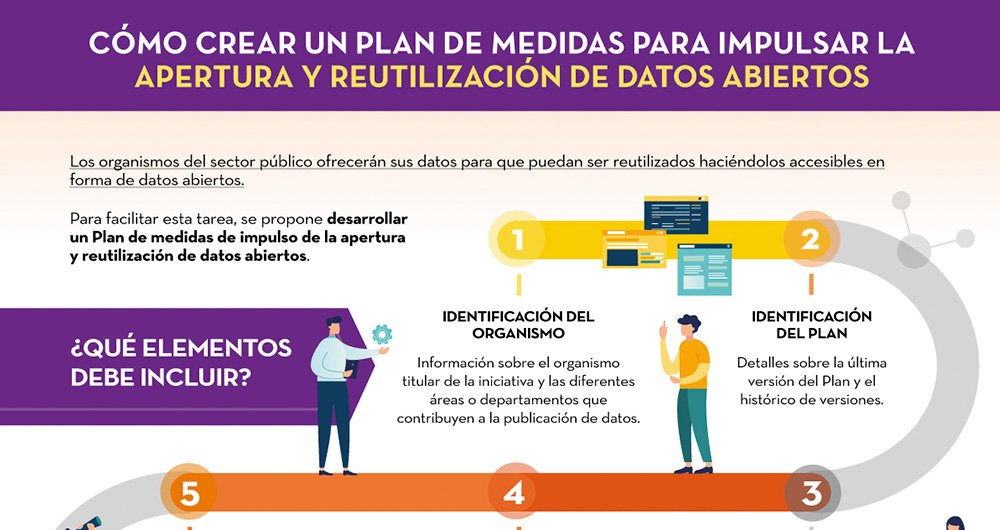
How to develop a plan of measures to promote openness and reuse of open data
Public sector bodies must make their data available for re-use, making it accessible in the form of open data, as referred to in Spain's legislative framework. The first step for this is that each entity, at local, regional and state level, as well as bodies, entities and trading companies…
- Guides
Introduction to data anonymisation: Techniques and case studies
Data anonymization defines the methodology and set of best practices and techniques that reduce the risk of identifying individuals, the irreversibility of the anonymization process, and the auditing of the exploitation of anonymized data by monitoring who, when, and for what purpose they are used…
- Guides
Practical guide for improving the quality of open data
When publishing open data, it is essential to ensure its quality. If data is well documented and of the required quality, it will be easier to reuse, as there will be less additional work for cleaning and processing. In addition, poor data quality can be costly for publishers, who may spend more…
- Guides

Features for the creation of data spaces
A data space is an ecosystem where, on a voluntary basis, the data of its participants (public sector, large and small technology or business companies, individuals, research organizations, etc.) are pooled. Thus, under a context of sovereignty, trust and security, products or services can be…
- Guides